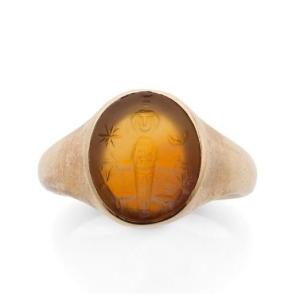
Scarab with naturalistic forms, the upper part engraved, and on the reverse an eight-pointed star, also represented by incision. The entire object is finely carved and polished, with particular attent[...]
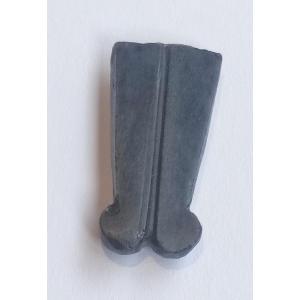
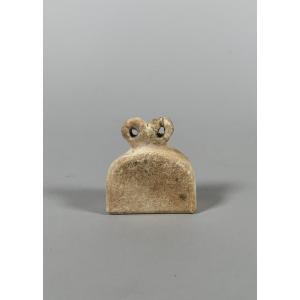
Miniature amulet representing a traditional Egyptian headrest, finely carved in black stone. The object faithfully reproduces the classic structure: rectangular base, slightly narrowed vertical shaft,[...]
Tellem Neckrest – Mali, XI-XVI CenturyUsed in funerary rites, this wooden neckrest comes from the Tellem culture, which inhabited the cliffs of Bandiagara between the 11th and 16th centuries, before t[...]
Circular amulet with radiant decoration, evoking a stylized flower or a solar disk, with relief motifs arranged in twelve regular segments around a slightly hollowed center. Both sides have an identic[...]
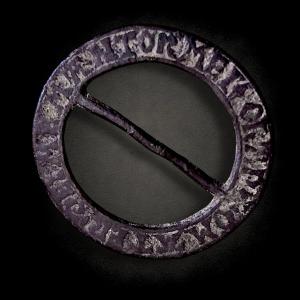
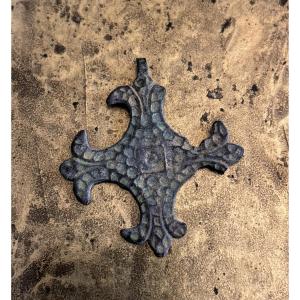
Beautiful medieval sign : shield decorated with a potenced cross. Cloisonné work with remnants of red and white enamel. 13th century 39x40 mm 13.87 g Small loss at the tip of the shield. These signs w[...]
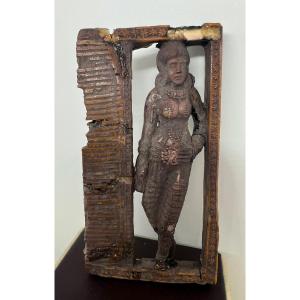
Sculpture of a court lady China Ming Dynasty (1368-1644) terracotta sculpture with green and brown glaze Represents a court lady in a green and brown dress with a bun on her head Dimensions: 20 x 5 x [...]
Polychrome terracotta vase HU dynasty HAN earlier 2nd-1st century BC. Polychrome painted terracotta with archaic motifs, yellow and ochre highlighted with white. Intertwined scroll decorations with ar[...]
Sculpture of a Court Lady in terracotta, HAN dynasty 206 BC-220 ACPolychrome painted terracottaRepresents a lady in imperial court dress, polychrome red, white and brown slipDimensions 42 x 20 x 15 cm[...]
Sculpture of a Court Lady in terracotta, HAN dynasty 206 BC-220 ACPolychrome painted terracottaThe sculpture is made with a removable headRepresents a seated lady in imperial court dress, polychrome r[...]
Sculpture of a horseman in terracotta HAN dynasty 206 BC-220 AC Mingqi in polychrome painted terracotta Represents a lady in court dress perched on a horse Excellent condition, no restoration has been[...]
Janiform funerary idol known as the "master of animals" - Luristan (Louristan), 1100-700 BCAndré Godard proposed an interpretation as being the representation of Gilgamesh or Enkidu. Mounted on a tubu[...]
Funerary idol representing two ibexes (ibex) - Luristan (louristan), 1100-700 BC Representing a pair of ibexes facing each other, their paws clasping two rings and mounted on a tubular base with a bel[...]
Bronze anklet - Luristan (Archaic Persia), end of the 2nd beginning of the 1st millennium BC. Missing the two joining pins. A restoration at one end of the upper element. Bibliography: - Bronzes of Lu[...]
Iron sword known as "with masks" - Luristan (Louristan), 1100-700 BCRare but well-known type of sword from Luristan (in Archaic Persia, present-day Iran), among the very first iron swords of humanity.[...]
Talismanic vial with a pyramidal body ending in a point, topped with a neck constricted at the base, animated by a circular outgrowth. The opening ends with hemmed lips, tightened towards the inside. [...]
Female Statuette Holding a Duck, Rare terracotta figurine representing a young woman standing, holding a duck in her hands. She is adorned with a rich multi-strand necklace, tambas in her ears and a l[...]
Prehistoric mastodon or pachyderm tooth in remarkable condition. Species and period to be defined. Comes from the same collection formed at the end of the 19th century, which includes the archaeologic[...]
Archaeological lot: 2 axe heads and 2 grinding wheels - Western Sahara, Neolithic period Large axe head: 15cm 602gr Small axe head: 7cm 150gr Spherical grinding wheel: approximately 11cm x 8.5cm 880gr[...]
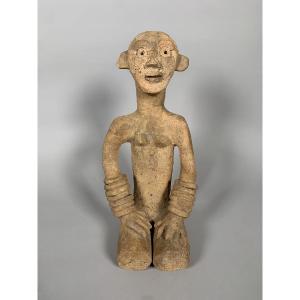
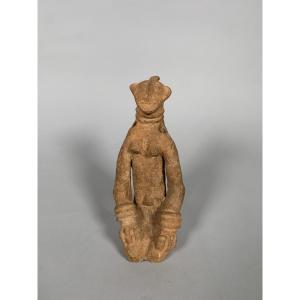
Archaeological object, probably with a funerary function. The first sculptures of the Bankoni style were studied in the 1940s (by Théodore Monod among others) in Bankoni south of Bamako. From 1974, th[...]
"Giant fossilized clam "tridacna gigas" Oceania"Exceptional material, the fossil clam gave birth to unique objects reserved for Melanesian men of power. They greatly appreciate these prestigious objec[...]
An exceptional material, the fossil clam gave rise to unique objects reserved for Melanesian men of power. They greatly appreciate these prestigious objects, much more durable than objects carved in w[...]
Stone head fragment depicting a crowned bodhisattva, identifiable by his elaborate headdress adorned with pearls and flowers. The softly modeled face retains a serene expression, although partially er[...]
Large carved Celtic limestone votive head representing a high dignitary, probably a male warrior chief. He is depicted wearing a typical mustache, curled locks of hair and his mouth open as if in full[...]
China, Han Dynasty (-206 + 220 CE), rare and superb set of three gilt bronze weights. The first is circular in shape, decorated with two tiger heads. The second is oval in shape, decorated with a chim[...]
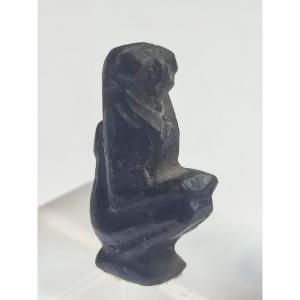
Egyptian Shu Amulet In green faience openwork on the sides to be worn as a pendantPersonification of air, Shu is almost always represented anthropomorphic, like all the cosmic gods. In relation to Ra,[...]
ROMAN ARCHAEOLOGY Very nice display and curiosity archaeologic itemSmall carved bone knife handle depicting a feline holding prey in its mouth IMPERIAL ROMAN PERIOD (-27 BC; +476 AD) Please check a[...]
Archaeology Terracotta dragon or harpy head: fantastic animal derived from a dragon, its mouth open as if it were screaming. Small black marble cubic base Palmyra (present-day Syria, Persia) 2nd / 3r[...]
Lot of archaeological artifacts from prehistory - France, Paleolithic and Neolithic I acquired these objects in Paris at auction, they come from the same old collection that was formed at the end of t[...]
Fossilized mammoth tooth - Origin Holland, Pleistocene Tooth of good dimensions on its presentation base. Collection label: MAMMOTH ELEPHAS PRIMIGENIUS PLEISTOCENE Origin: HOLLAND Slight damage to the[...]
ARCHAEOLOGY Superb and LARGE TERRACOTTA VASE FROM THE HAN DYNASTY (-206 BC; + 220 AD) The piece is originally only partially glazed creating surprise in the reading of this dark and shinier covering[...]
Polychrome Ceramic Whistling Vase from Vicus Culture, Peru, Pre-Columbian period, circa 4th century AD. The Thermoluminescence Certificate of 22-12-1990 from the Ralf Kotalla Laboratory indicates a da[...]
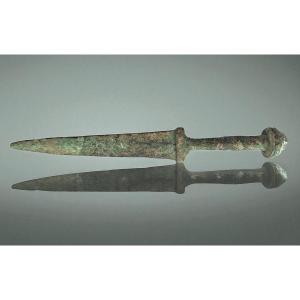
Short acinaceous sword with ball pommel - Archaic Persia, Luristan (Louristan), early 1st millennium BC Bronze sword with double-edged blade and median ridge. Cylindrical handle and ball pommel. The h[...]
Bronze Age Archaeological Lot - Levantine Countries 3rd-2nd Millennium BC A bow stretcher with two rings and a ram's head. 2 circular pendants. A couple of man and woman embracing. 8 types of star nut[...]
Roman silver ring set with glass paste.Roman Art, 3d century.28x26 mm. 7.71 g Finger size : 7 (US) - O (UK) - 54 (EU)This ring model is referenced under the number “3a” in the typology of Hélène Guir[...]
Dating: 1st – 3rd century AD (cf. Bussière) Origin: Western Mediterranean, probably North African or Italian workshops Provenance: Private collection, South of France An intimate gesture captured in t[...]
HAUTE EPOQUECabinet of CuriositiesLARGE AND CURIOUS TERRACOTTA SEAL with RELIEFS OF GOTHIC INSCRIPTION (unreadable) and a WADING BIRD, standing with its head curved towards the ground (on the right w[...]
Long bronze sword with a pommel called "with ears" - Archaic Persia, Luristan (Louristan), 1st Iron Age, circa 1200-1000 BC This sword comes from an old Belgian collection formed in the 1970s. Slight [...]
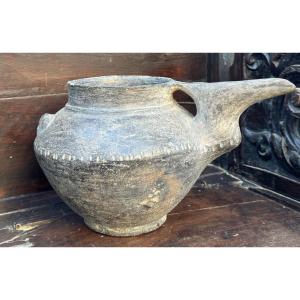
A beautifully crafted water jug with a dark glaze and a stylized owl. Such jars were used to store water in the ancient Khmer period, around 1200-1300. A fine piece of archaeology in perfect condition[...]
Schist sculpture depicting the cult of the three jewels (triratna) - Greco-Buddhist culture of Gandhara, 1st-3rd century AD The sculpture depicts 4 disciples worshipping the triratna (the three jewels[...]
Iron sword known as "with masks" - Luristan (Luristan), 1100-700 BC Rare but well-known type of sword from Luristan (in Archaic Persia, present-day Iran), among the very first iron swords of humanity.[...]
It's a tiny bronze statuette depicting a male figure. It's of pre-Hispanic origin, dating from the 5th to the 3rd century BC. Perhaps a votive or protective amulet? A fine collection can be seen at th[...]
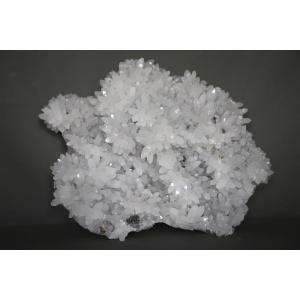
Gogotte is a natural stone that is formed during early Oligocene Period 30 millions years ago. It is composed of quartz crystal and to some extent limestone (calcium carbonate). Gogottes are uniquely [...]
Roman silver denarius, struck around 145 BC, from the Antestia family, and mounted in the 19th century as a tie pin. It represents on the obverse a helmeted head, symbol of Rome and on the left the na[...]
Large Hydria with black varnish. Magna Graecia, Italy , 4th century BC. Orange terracotta with black varnish. Height: 32 cm. Condition: old restorations, reglued, repainted. Can be the subject of a re[...]
Superb and rare double wooden comb. Egyptian work from the Late Period (-664 to -332). Good condition. Wear from use. One row is composed of fine teeth, the other has thicker and spaced teeth. 7.1 cm [...]
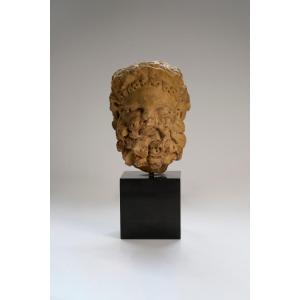
Bronze applique in the shape of a medallion: head of Silenus.Roman art - 2nd century. 44 mm. in diameter. 20.35 g. Very beautiful small bronze. The face is treated with great finesse. Very good condit[...]
Pair of Ancient Greek gold lion protome earrings. Hellenistic period. Eastern Mediterranean. Late 4th century - early 3rd century BC. Approximately 15 x 15 mm and 17 x 14 mm. Total weight: 4.02 g. Eac[...]
Roman bronze with dark green patina : theater mask.Roman art.2nd century.32 x 24 mm34.70 gRoman theater actor's mask, inspired by older Greek masks, with Dionysian features and a floral crown around t[...]
Anepigraphic scarab amulet - Late Period
An anepigraphic scarab-shaped amulet from the Egyptian Late Period (664 to 332 BC). Made of siliceous faience, a material frequently used for amulets and vo[...]
Proantic uses a cookie to analyze traffic and improve its service by using Google Analytics. Data sent to Google Analytics (frequency of visits to the site and pages visited) are anonymous. No other cookie tracks your activity, your personal data is not collected. Thank you for helping us to have better understanding how Proantic is used.