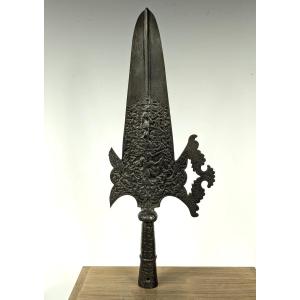
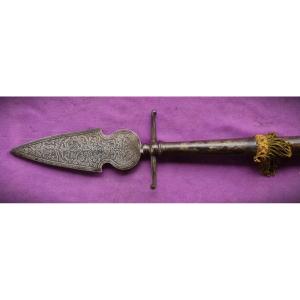
Halberd with abundant decoration, warriors, mascarons, and scrolling foliage. Cast iron. A decorative object popular during the second half of the 19th century. There is probably a missing piece: see [...]
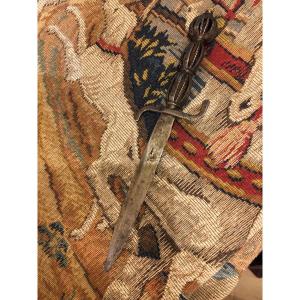
This rondel dagger is from Germanic origin and can be dated to the 16th century. In fact, the engravings on the blade leave no doubt: the style of the decoration is clearly later than the 15th century[...]
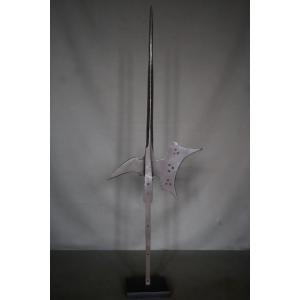
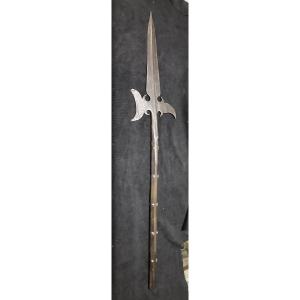
Halberd Head - Europe, 16th Century. Forged steel with a four-sided spike on the first half, then rounded to the point. One of the braces is cut/missing. Weight 1013g. Length 81cm. Width 29.5cm. Spike[...]
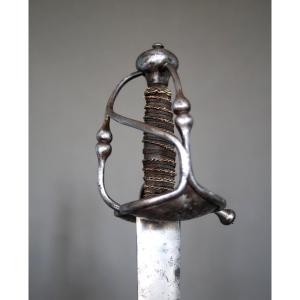
A Walloon-type cavalry saber - Probably Germanic, 17th century. Curved blade with a single edge and a false edge on the last third. The wolf of Passau is engraved on one side. Walloon-style hilt. Miss[...]
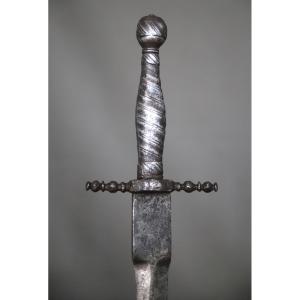
Renaissance dagger - Western Europe, late 16th/early 17th century. Blade with a strong, flat ricasso, later becoming four-sided and double-edged. Maker's marks (very faded but discernible) are present[...]
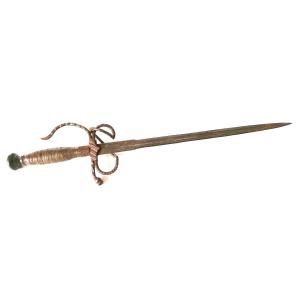
Dagger with a twisted bronze hilt, in two sections separated by a central ring. Short, straight guard, also twisted, with symmetrical quillons in rosettes. Lobed discoid pommel. Narrow, double-edged b[...]
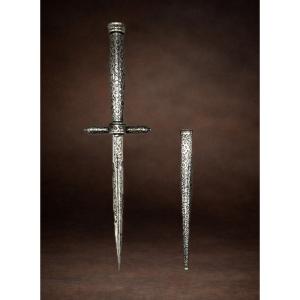
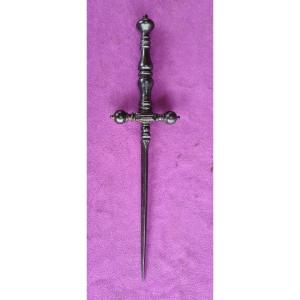
Civil ceremonial stylus (stiletto da cintura) in fully engraved and chiseled steel, Northern Italy (Lombardy - Veneto), around 1620–1650.Remarkable example of the Italian art of steel decoration in th[...]
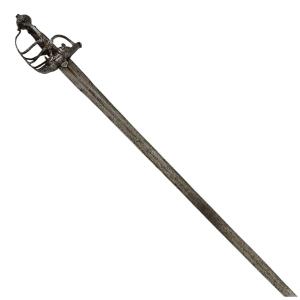
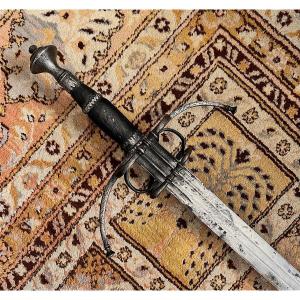
A superb English Civil War period “Mortuary” sword. Broad double-edged blade that shows the maker’s mark ‘Andrea Ferrara’ running along the central fuller, as well as armory stamp to either side of th[...]
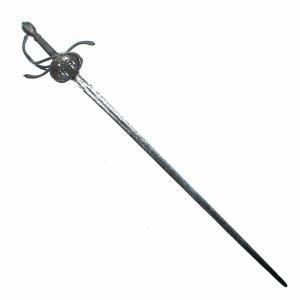
German made Rapier sword with double edged tapered blade showing fuller running approximately one third of the blade. The blade is marked with “Me Fecit Solignen” and shows traces of other engraved de[...]
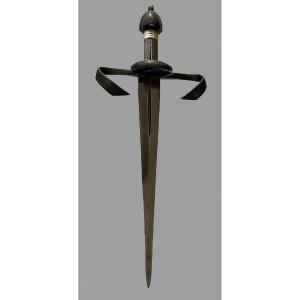
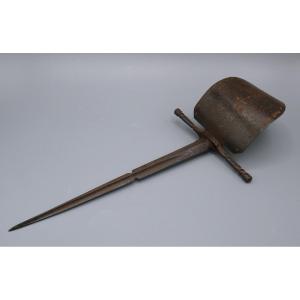
This left-handed dagger with a ring guard has a morphology distributed across a fairly wide geographical area; typically, it can be attributed to Northern Italy or Southern Germany, but examples of th[...]
This war axe is made entirely of metal, in the style of the 16th century, but manufactured in the 19th century. The head and handle of the axe are richly decorated: AXE HEAD: On one side, within a med[...]
Spanish rapier (sword) with a tang - Spain, late 17th-first half of the 18th century. The hilt has a tang, two large quillons, and a guard branch. The grip is made of beautiful fluted horn. This type [...]
Sword signed Enrique CoelSpain17th centurySteel, leatherTotal length: 98 cm; Blade length: 84.3 cmStraight double-edged blade with a flat edge, with a fuller in the first third, engraved with ‘por la [...]
A rapier with a very refined cut, dating from the first half of the 17th century, around 1630-1640. The openwork hilt is richly decorated with floral and vegetal motifs, punctuated by cartouches depic[...]
This stiletto is a fairly large model designed for fighting. The style of the handle might initially suggest Italian craftsmanship, but the blade, with its cross-shaped globus, its shape, and its deco[...]
This stiletto likely originated in Northern Italy, although a Southern German origin is also possible. Its large size makes it a model designed for combat. It dates from the 17th century. Stilettos fi[...]
EXTREMELY RARE DAGGER KNOWN AS "CINQUEDEA" Italy, late 15th/early 16th century. Triangular, double-edged iron blade, grooved in the middle, the central section double-fullered, an oval hallmark on a g[...]
Collector's item and curiosity: Small 19th-century virtue dagger: a dagger that women carried in their handbags or under their petticoats for defense against overly amorous men. It is also known collo[...]
Mercy dagger bearing the arms of Savoy and monogrammed for Emmanuel Philibert, 16th century. This dagger is said to have been given by Duke Emmanuel Philibert of Savoy to Marshal Blaise de Montluc of [...]
17th-century halberd. Asymmetrical iron head with an axe and hook, 44 cm long, including an 8 cm long socket; 9.5 cm long brace with two nails. Rebuilt wooden shaft. Overall length 98.5 cm. Good condi[...]
This dagger is somewhat difficult to classify; it could be defined either as a variant of a "mercy dagger" or as a rather atypical stiletto. The blade, with its robust ricasso, would suggest a mercy d[...]
A swordsman's rapier with a thick blade, Hispano-Portuguese, 17th century. The thick blade has a lenticular cross-section and a small faceted iron pommel with a rivet button, securing the guard branch[...]
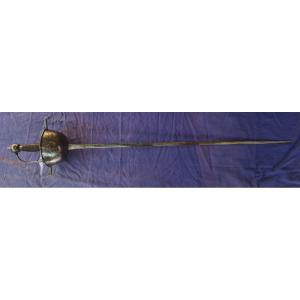
This rapier is Spanish. Its origin from the Iberian Peninsula is beyond doubt, as this type of hilt is found almost exclusively on Spanish or Portuguese rapiers. The hilt can be dated to the mid-17th [...]
A straight, rigid thrusting dagger with a chain-piercing point and longitudinal fullers pierced with trefoil and cruciform motifs on the first half. The cylindrical guard terminates in small spherical[...]
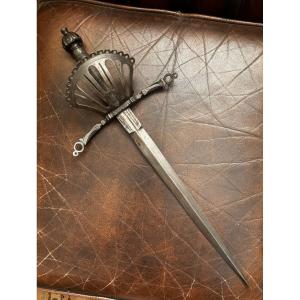
Left hand dagger with S guard, openwork ring and silver handle"Northern Italy or Germany, around 1560-1600.Superb and rare Renaissance dagger, used as an auxiliary weapon in the rapier duel, perfectly[...]
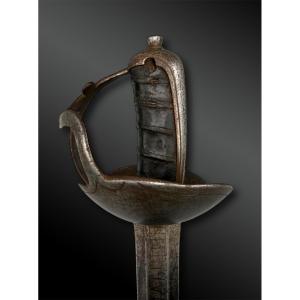
This is a beautiful and long rapier called "a la taza" in Italian style that can be dated to the mid-17th century. The very deep bowl of the Taza corresponds to Italian taste. The very large arms "fin[...]
This rapier called "taza rapier" (rapier with bowl guard) dates from the first half of the 17th century. It comes from the region of South Germany with an Italian influence. If the very deep bowl corr[...]
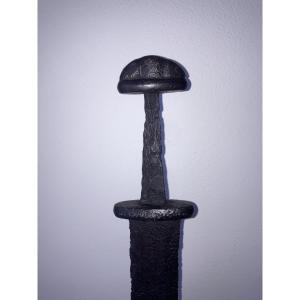
A rare and fine Viking sword in good condition , typical pommel with rest of gold metal decoration , straight guard of the typical form . 98 cm length . The sword is guarantee authentic lifetime and c[...]
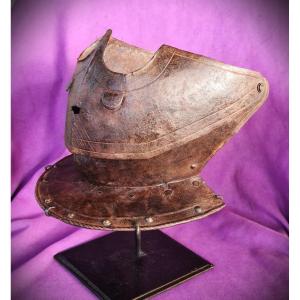
This is the entire front part of a 16th-century Savoyard armet, consisting of the gorget and the movable mesail. This is by far the most delicate part to manufacture, and it requires a certain mastery[...]
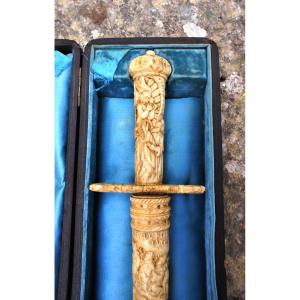
Rare Ceremonial German Bone Dagger 16th CenturyThe hilt is comprised of a set of straight quillons and are completely made of deer bone.The bone fittings are richly and masterfully engraved, the guar[...]
Skeleton dagger from the 16th century, marking called left hand, engraved with the name "BD-MONTLUC" Marshal of France in 1574 Lieutenant of Guyenne, LASSERAN de MASSENCOMME de MONTLUC family. Born in[...]
Large left-hand daggerVery beautiful compound dagger, probably from the time of Viollet-Le-Duc in the 19th century. The blade appears older, probably dating from the 18th or 19th century. The dagger i[...]
16th Century Italian Hand and a Half (Bologna / Venice)This magnificent Italian hand and a half, originally from Venice or Bologna, is recognizable by the smith's marks on the blade. These swords are [...]
Halberd head Viollet Le Duc period XIXth. XVIth style engraved on both sides. Beautiful spearhead in iron and not cast iron. Good condition. Length 38 cm, width 21 cm.- This item is for immediate purc[...]
This rapier dates from the very early years of the 18th century. It is of Spanish origin and of a distinctly archaic style. The blade bears the apocryphal signature "EN ALAMANIA / ENRIQUE COEL 1711". [...]
This rapier is a typical Spanish model. The blade dates from the 17th century, it is the work of the famous and prestigious Enrique Coel / Coll, or Heinrich Coel /Kohl (several spellings exist) who wa[...]
Miniature knife used for sharpening quills. Spanish work from the 17th or 18th century. A miniature version of the classic Spanish knife, made in Albacete. Bronze and bone handle. Dimensions: 7.5 cm.
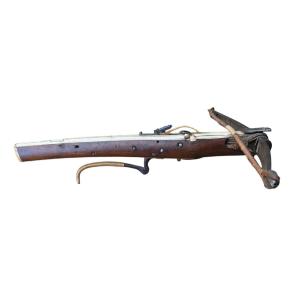
Exquisite Bone-Inlaid Stock | Functional Iron Sight | Superb Historical Craftsmanship
A beautifully preserved and exceptionally crafted 17th-century hunting crossbow, originating from Switzerland or [...]
Beautiful and unique Renaissance bronze coin with the addition of an iron ring with hook in a later period and thus transformed into a counterweight for Roman scales (hand scales). Height: 6 cm
Left Hand Dagger called "A Voile". Spanish style 17th, 19th century. Flat back blade with marking to identify, partially erased. Steel guard, large hand protection decorated with a Cross, iron fuse co[...]
HAUTE EPOQUE, CUTLERY COLLECTIONImportant italien hunting dagger, richly engraved steel, and ebony (?) handle decorated with engraved iron platesThe knife has retained its original embossed leather sc[...]
Very rare Saxon left-hand dagger from the personal guards of the Elector of Saxony. Handle in perfect condition with black lacquer and shagreen-covered wood. Blade cleaned and some oxidation spots. Se[...]
This stiletto is a large Spanish model intended for combat. It dates from the very beginning of the stiletto era, therefore from the first half of the 16th century. Indeed, it was in Spain at the begi[...]
17th Century, large stiletto (40 cm) called "misericorde" in wrought iron and steel. The fully forged fuse has slightly domed sides, olive pommel, guard with two curved quillons, ending in a heart wit[...]
Renaissance dagger (knife dagger) - Excavated piece, 17th centuryThe steel has suffered from time and is corroded. The corrosion has stabilized and the whole remains solid. The filigree on the wooden [...]
Ring dagger, called left hand, LOUIS XIII° - LOUIS XIV° - XVII° period, origin ITALY or SPAIN. Iron mount with fluted olive pommel and rivet button. Filigree steel wire fuse. Guard with curved quillon[...]
This left hand ring dagger can be dated to the first half of
the 17th century, or the last quarter of the 16th century. it is probably
from South Italia, altough a spanish origin is also possible. [...]
Venetian sword of the Doge's Guard of Venice, mid-15th century. Very beautiful sword with its fossilized wood hilt. Schiavonesca model pommel with an opening in its center that likely contains relics.[...]
This stiletto is typically Italian, and can be dated to the 17th century. This type of weapon was used to inflict narrow and deep wounds, very difficult to treat at the time. The section of this blade[...]
Spain, Toledo, 17th century taza rapier. Iron mount with filigree reverse chevron fuse and thin band with baguettes. Faceted olive pommel and prominent rivet button. Symmetrical straight quillon endin[...]
This espontoon is in the 16th century style, but its manufacture dates from the 19th century. Unlike many 19th century productions, it is not made of cast iron but of forged steel, with a thin socket [...]
Proantic uses a cookie to analyze traffic and improve its service by using Google Analytics. Data sent to Google Analytics (frequency of visits to the site and pages visited) are anonymous. No other cookie tracks your activity, your personal data is not collected. Thank you for helping us to have better understanding how Proantic is used.























 Le Magazine de PROANTIC
 TRÉSORS Magazine
 Rivista Artiquariato