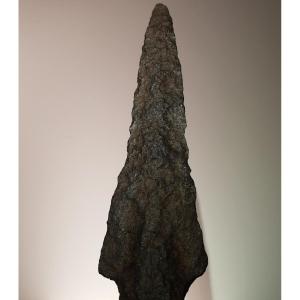
Indoor Rapier, Spain, Early 18th Century
Artist: Signée Enrique Coel En Alamania
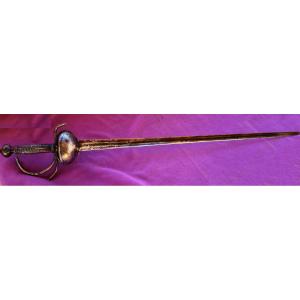
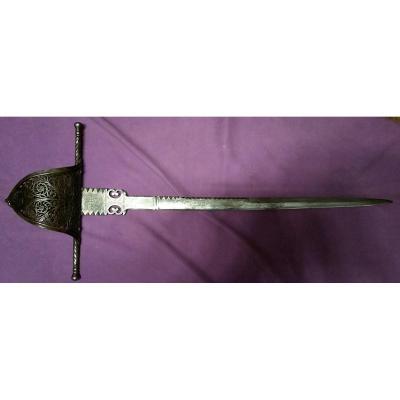
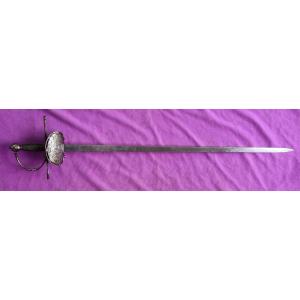
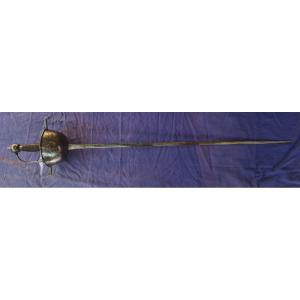
This rapier dates from the very early years of the 18th century. It is of Spanish origin and of a distinctly archaic style. The blade bears the apocryphal signature "EN ALAMANIA / ENRIQUE COEL 1711". This date clearly cannot correspond to the work of the very illustrious Enrique/Heinrich Coll/ Coel/ Kohl (several spellings exist), an excellent swordsmith from Solingen, who also supplied the Spanish court in the years 1620-1640 and who was "espadero del Rey".
This type of short rapier was called "indoor rapier", or "city rapier". The powerful blade confirms that it is indeed a real rapier and not a court sword as the 18th century would later produce.
The style of the mount is typical of the second half of the 16th century. This should be seen as a return to archaic tastes at the beginning of the reign of Philip V "the Brave", who brought back into fashion a certain virility recalling the warrior virtues of the past to make people forget the reign of his predecessor, the puny and deformed Charles II "the bewitched", the last sovereign of the Habsburg line.
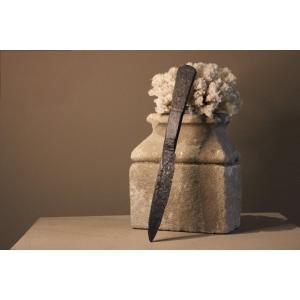
BLADE: It begins with a long rectangular section on its first half, hollowed out with a central groove. Then the section becomes lenticular. This very solid first half is intended to be able to parry the blow of an opposing blade, and to reinforce the rigidity of the weapon which is intended exclusively for advanced fencing.
On the external face, we can read in the throat: - :- E – N – A – L -A – M – A – N - I- A - :-
On the internal face: - :- E – N - R – I – Q- V – E – C – O – E – L - :- 1711
Length of the blade = 78.2 cm, width near the guard = 1 cm, thickness near the guard = 6 mm balance point at 11 cm from the guard, but the weapon being light, it is wellbalanced and does not weigh in the hand.
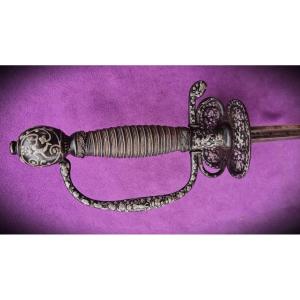
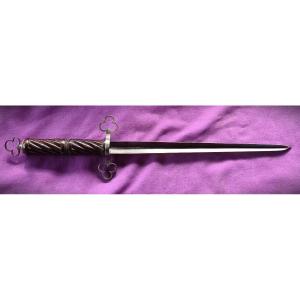
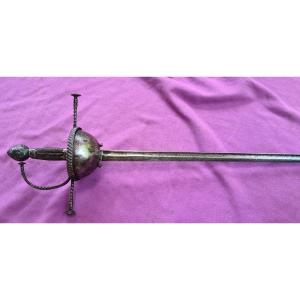
GUARD : It is a 16th century style iron guard, which has two large twisted straight quillons, and two concentric protection rings on the external face.
POMMEL : It is a fluted iron pommel, in the shape of an elongated bulb, surmounted by a small button on which the tang of the blade is riveted.
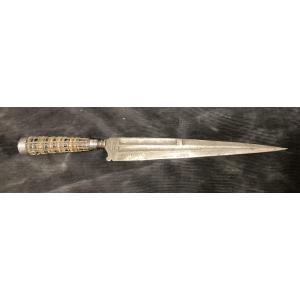
GRIP : It is covered with a copper binding with alternating smooth parts and twisted parts in chevrons. The ferrules in twisted binding crowns called "Turk's heads" are present and in good condition.
In conclusion, it is an unusual, elegant weapon, in a beautiful state of preservation.
Shipping costs: France €30, Europe €40
Ref E-25/2-10
This type of short rapier was called "indoor rapier", or "city rapier". The powerful blade confirms that it is indeed a real rapier and not a court sword as the 18th century would later produce.
The style of the mount is typical of the second half of the 16th century. This should be seen as a return to archaic tastes at the beginning of the reign of Philip V "the Brave", who brought back into fashion a certain virility recalling the warrior virtues of the past to make people forget the reign of his predecessor, the puny and deformed Charles II "the bewitched", the last sovereign of the Habsburg line.
BLADE: It begins with a long rectangular section on its first half, hollowed out with a central groove. Then the section becomes lenticular. This very solid first half is intended to be able to parry the blow of an opposing blade, and to reinforce the rigidity of the weapon which is intended exclusively for advanced fencing.
On the external face, we can read in the throat: - :- E – N – A – L -A – M – A – N - I- A - :-
On the internal face: - :- E – N - R – I – Q- V – E – C – O – E – L - :- 1711
Length of the blade = 78.2 cm, width near the guard = 1 cm, thickness near the guard = 6 mm balance point at 11 cm from the guard, but the weapon being light, it is wellbalanced and does not weigh in the hand.
GUARD : It is a 16th century style iron guard, which has two large twisted straight quillons, and two concentric protection rings on the external face.
POMMEL : It is a fluted iron pommel, in the shape of an elongated bulb, surmounted by a small button on which the tang of the blade is riveted.
GRIP : It is covered with a copper binding with alternating smooth parts and twisted parts in chevrons. The ferrules in twisted binding crowns called "Turk's heads" are present and in good condition.
In conclusion, it is an unusual, elegant weapon, in a beautiful state of preservation.
Shipping costs: France €30, Europe €40
Ref E-25/2-10
1 400 €
Period: 18th century
Style: Renaissance, Louis 13th
Condition: Excellent condition
Material: Other
Length: 92.5 cm
Width: aux quillons 22 cm
Reference (ID): 1591355
Availability: In stock
Print