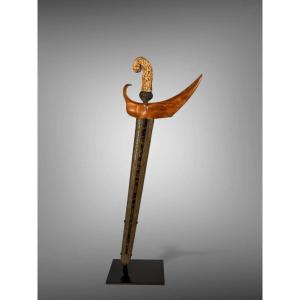
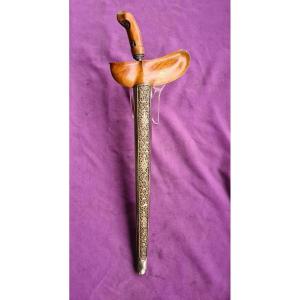
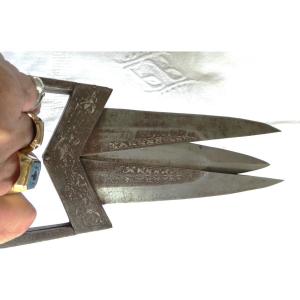
Nepalese Khukuri knife of the GURKHAS fighter regiment. Blade engraved with a dragon and the other side a stylized leopard, traditional notch for the flow of blood. Horn and bone handle, horn scabbard[...]
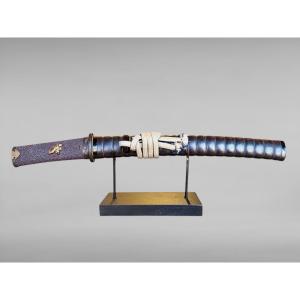
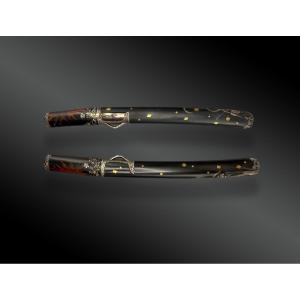
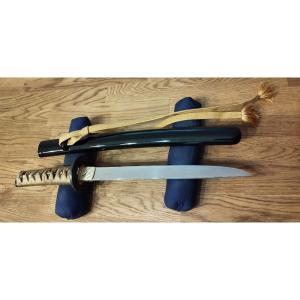
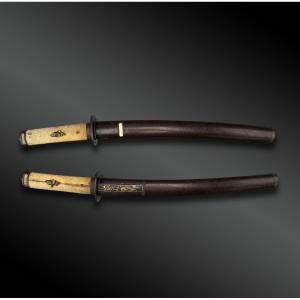
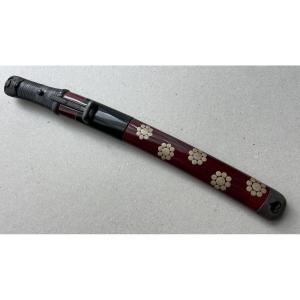
JAPAN - Late Edo period (1603-1868). Samurai tanto. FUSHI - KASHIRA in textured gilt copper inlaid with silver. TSUKA in wood covered with ray skin. MENUKIS in chiseled and gilt copper depicting shish[...]
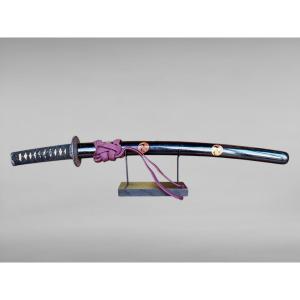
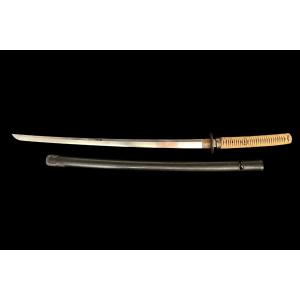
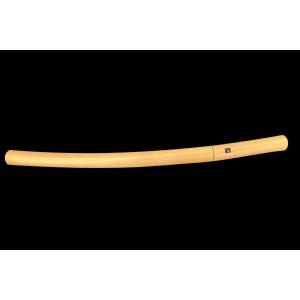
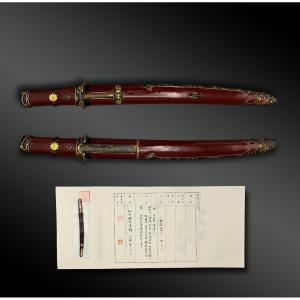
JAPAN - 9th year of the Kanbun era (1669). Samurai katana in shirasaya. FUSHI - KASHIRA in patinated, silvered and gilded copper suite decorated with cherry blossoms (associated with spring) on a nana[...]
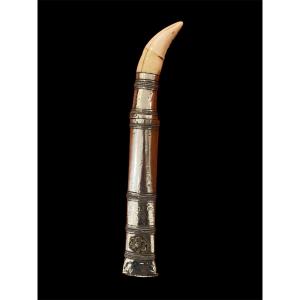
Short Himalayan saber - Bhutan or Tibet, circa 1900 Very rustic wooden handle and iron ferrules. Silver-plated metal scabbard worked in repoussé. Strong single-edged blade. Length 52cmLength without s[...]
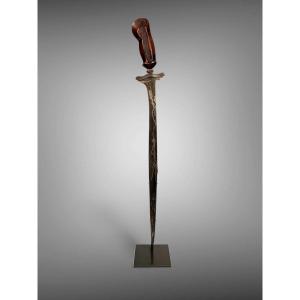
Philippine knife called gunong - Philippines, late 19th early 20th century Handle with stock in noble wood and ferrule in chiseled silver alloy. Double-edged blade. Wooden scabbard with chape and chis[...]
Philippine knife called gunong - Philippines, late 19th early 20th century Ivory butt handle and copper ferrule and chiseled silver metal. Double-edged blade with heavily effecé engravings. Wooden sca[...]
Small Tibetan utility knife - Tibet, 1st half of the 20th century Handle made of a horn plate and another of bone. Single-edged blade. Scabbard in wood and openworked and chiseled steel. Length 17.5cm[...]
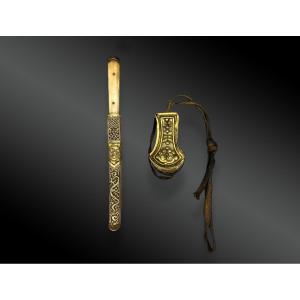
Travel kit including knife and chopsticks - China or Mongolia, late 19th early 20th century The scabbard has kept its silver attachment loop set with red coral and malachite. Wooden scabbard covered w[...]
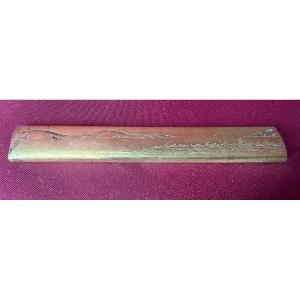
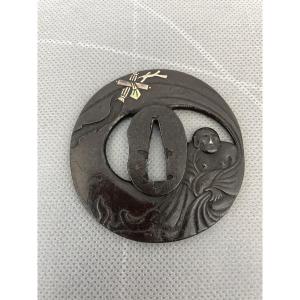
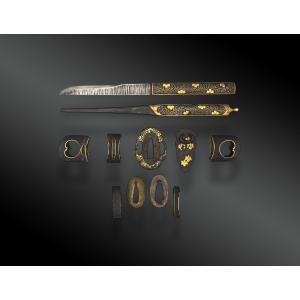
MOUNTING composed of a KOZUKA, a pair of MENUKI and a TSUBAJapanEdo period (1603-1868)Iron, silver, copper, gold, brassIron Kozuka decorated with two silver cherry blossoms in bas-relief with brass le[...]
TSUBA Shin No Maru GataJapanEdo period (1603-1868)Iron, goldH. 7.9; L 7.5 cm; Thickness 3 mm H. Nakago Hitsu Ana: 2.6 cmIron tsuba engraved with a dragonfly flying over a river, two flowers on the rev[...]
KOTSUKAJapanEdo period (1603-1868)Copper, goldL. 9.6 ; W. 1.9 cmA copper Kozuka engraved in bas-relief with two men arm-wrestling, enhanced with gold.The back is textured with gold stippling.Reference[...]
JAPAN - Muromashi period. Samurai katana. FUSHI - KASHIRA and KOJIRI in iron suite decorated with gilded chrysanthemum motifs. TSUKA in wood covered with ray skin and black lacquered silk braid. MENUK[...]
Samurai Katana. FUSHI - KASHIRA in iron suite originally inlaid with copper interlacing, the fushi simulating basketwork (significant wear). TSUKA in wood covered with ray skin, braided with black lac[...]
SABER called Katana signed Hizen Kuni (No) Ju Mutsu (No) Kami TadayoshiJapan Edo period (1603-1868)17th centurySteel, wood, lacquer, silk, gold, copper, shakudoNagasa: 71 ; Nakago: 21 cmSori: 2.6 cm [...]
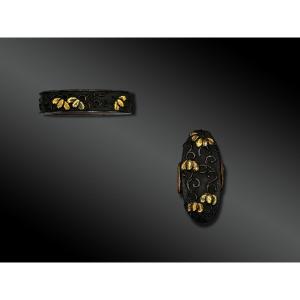
PAIR OF SHI SHI MENUKI WITH NENUPHAR BLOSSOMJapan, late 19th centuryGilt bronze4.5cmPair of menuki representing a Shi Shi with his head turned towards a water lily flower on foliage. The whole is in g[...]
Very finely crafted Omani silver Khanjar dagger with a richly decorated scabbard and hilt, the fittings show fine silver wire and filigree work including floral designs, geometric patterns and hammere[...]
Vietnamese high dignitary saber called guom - Vietnam, 2nd half of the 19th century. Handle made of fossilized mammoth molar. Chiseled and embossed silver pommel depicting a lion's head or foal dog. C[...]
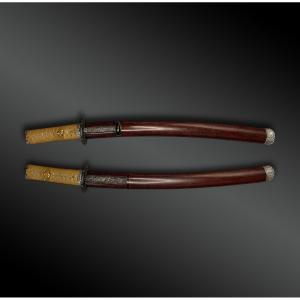
Wakizashi Japanese Bone Carved Sword Tanto small KatanaVery beautiful small bone sword finely carvedMissing the tipRichly decorated with characters and floral motifsWear and small chips to be notedJap[...]
Katana entirely carved in relief with characters in various scenes of Japanese daily life around 1900. Good general condition, some small accidents. Total length 88 cm Blade length 47 cm Careful, secu[...]
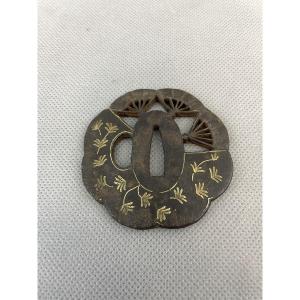
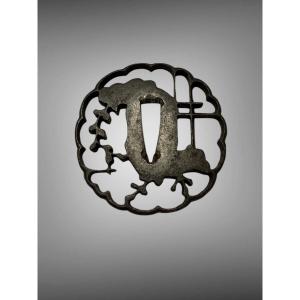
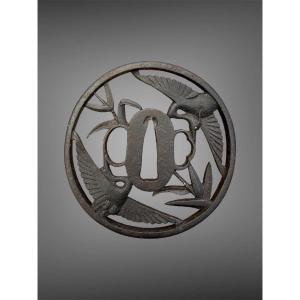
Beautiful, antique circular tsuba, probably 18th century, having been mounted on a katana, wrought iron, openwork of a sinuously geometric decoration including a single hitsu ana. (excuse my lack of [...]
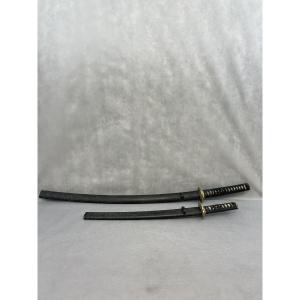
DAISHO consisting of a KATANA and a WAKISHASHI from the EDO period. Blades: - TORII ZORI shape, iori mune back and CHU KISSAKI tips. - NAGAKO (silks) without signature in furisode and kurijiri shape. [...]
TSUBA Otafuku MokkoJapanEdo period (1603-1868)Copper, shakudo, gold, silverH. 6.2; L 5.6 cm; Thickness 3 mm H. Nakago Hitsu Ana: 2.9 cmCopper tsuba covered with shakudo, chased with a silver moon in t[...]
Samurai sword tsuba or guard in iron inlaid with brass, representing a fishing net, Dewa province, Shonai school, Edo period, 17th century. The fishing net symbolizes happiness and victory. A similar [...]
Japanese Wakizashi, EDO Period, Signed by the Swordsmith Nagayoshi - SDC25WAK001High-quality sword, used by the Japanese male caste in the 16th century, or even by a samurai...The inscription engraved[...]
JAPAN - End of the Edo Period (19th century). Samurai Katana. FUSHI - KASHIRA in silver-plated copper with a butterfly decoration among plants (symbol of rebirth). TSUKA in wood covered with ray skin,[...]
JAPAN - Bunmei era (1469-1487). Samurai katana. FUSHI - KASHIRA en suite in silver-plated copper decorated with plover birds fluttering above the waves (symbol of good omen). Black lacquered ringed TS[...]
Forged from iron and shaped into the form of a "Hachi Mokko Gata" using the "sukashi" (openwork) technique, the negative space is an integral part of the design, as is the solid form representing a ch[...]
TSUBA in the shape of a MARU GATA divided into a pentagon. In wrought iron with inlays (SHAKUDO) representing branches and foliage, all encircled by a rope. This on both sides. Presence of SEKI GANE ([...]
NAGA MARU GATA shaped tsuba. In wrought iron with some SHAKUDO inlays representing a temple in the mountain. Beautiful original patina. No signature. Width 7.6cm Length 8.1cm
Small TSUBA in the shape of a NAGA MARU GATA for WHAKISHASHI or TANTO. Wrought iron with SHAKUDO inlays, decorated with a dragonfly on both sides as well as the symbolism of beehive cells also on both[...]
MOKKO GATA shaped TSUBA. Wrought iron with very fine SHAKUDO inlays in gilded copper and silver. Representing a dragon in the clouds facing a tiger in the jungle. Beautiful original patina. No signatu[...]
A fine Javanese presentation sword, primarily worn by high-ranking officers and dignitaries in the kraton palace, or presented to Dutch dignitaries. It displays many European influences, often stemmin[...]
TSUBA EDO period (1603-1868) Japanese tsuba made of openwork iron (sukashi) with shakudō inlays (a noble alloy of copper and gold, with a characteristic black patina). Maru gata (round) shape with jus[...]
Ainu culture - 19th century. The curved wooden handle surrounded by thin sheets of cut metal and engraved with geometric patterns (slight lacks). The scabbard formed by two wooden elements assembled b[...]
JAPAN - Edo period (1603-1868). Samurai Yari spear. Long wooden shaft, the last quarter decorated with a braided rope hoof, ringed brown lacquer and two gilded copper rings. Straight "Ho" spear blade [...]
JAPAN - Edo period (1603-1868). Samurai Wakizashi. FUSHI - KASHIRA and KOJIRI in suite with gadroon decoration dotted with silver droplets. TSUKA in wood covered with ray skin. MENUKIS of large size i[...]
Dha ceremonial dagger Southeast Asia most likely Burma late 19th century Solid silver mount on wooden core steel blade Rare ornate pear-shaped handle Good condition old patina oxidation of the blade 2[...]
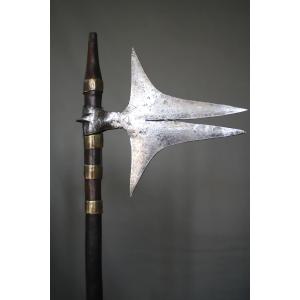
Bronze axe head - Archaic Persia, Luristan (Louristan), Circa 1000 BC Copper alloy axe head, with cylindrical socket, pointed blade and four spikes. Length 22.5cm Height 6.5cm Bibliography and auction[...]
A rare opportunity to
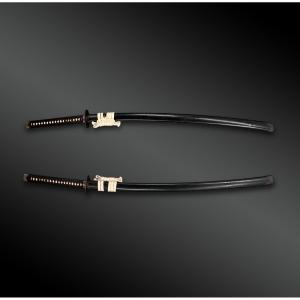
buy a pair of Ceremonial gươm truòng.During the Nguyen Dynasty, large ceremonial sabers were carried at official assemblies. Old photos suggest these are real swords, but surviv[...]
Splendid Japanese sword stand in the shape of a Tashi kake for vertical presentation, gold lacquered wood and decorated with a superb figure of a samurai helmet, etc., late 19th centurysword on pictur[...]
Hizen-style iron tsuba in the shape of a mokko-gata, decorated with a dragon rising among the clouds. Finely engraved work, typical of 19th-century Japanese aesthetics. The side openings (kozuka-hitsu[...]
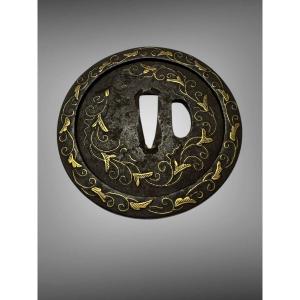
Gilt Copper Inlaid Iron Tsuba – Floral Motif – Marugata Shape – Edo Period Iron tsuba, marugata (round) shape, decorated with floral and foliage motifs inlaid with gilt copper. The work is fine and ba[...]
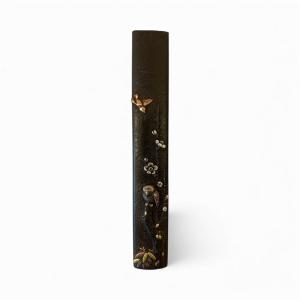
Kozuka of exceptional quality; on a hammered Shibuichi background with a light, discreet amati, the artist has chiseled a scene representing a Chinese child feeding a crane, the details are inlaid wit[...]
Iron tsuba of the mokko-gata form, dating from the Edo period and attributed to the Mito school. The front depicts a flute player seated beside rock formations, with finely executed floral details in [...]
Superb small tanto of Kwaiken type Usual for women of samurai to wear with the kimono popular as a small weapon of defense, among the noble women, who wore it in their Obi. Here with beautiful gener[...]
The mount is in iron chiseled with dragons among clouds, the details are in nunome zogan (damascus) it should be noted that the layer of gold used is very thick which is unusual. The whole is of good [...]
TSUBA Mokko GataJapanEdo period (1603-1868)Iron, copper, shakudoH. 7.1; L 6.9 cm; Thickness 6 mm H. Nakago Hitsu Ana: 2.9 cmIron tsuba decorated with three Noh theatre masks in copper and shakudo repr[...]
This Ottoman kard features a finely curved, patinated metal scabbard adorned with an elegant gilded plant frieze along its entire length. The cylindrical metal handle flares slightly toward the top. A[...]
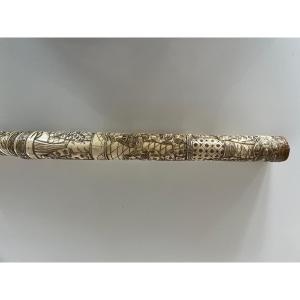
This Japanese tanto is typical of the Meiji period (1868-1912). Its entire mount is made of engraved bone. The blade is of low quality, as always on these weapons. The scabbard decoration takes up one[...]
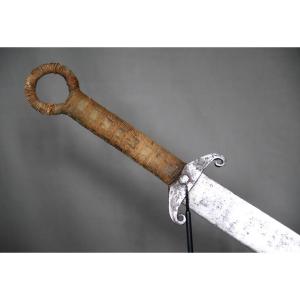
A sizeable piece, designed to be wielded with two hands. Asymmetrical "fork" shaped wooden handle, decorated with decorative carvings. Rattan-covered handle. Solid blade, gradually widening from the b[...]
An exceptional Japanese katana dating from the Edo period (1603-1868), signed on the tang Bizen Osafune Ju Sukesada, and bearing the additional inscription Oite Naniwatsu Saku Kore on the reverse side[...]
JAPAN - Late Edo (Shin-Shin-To period). Samurai Katana. FUSHI - KASHIRA in patinated copper decorated with parallel oblique striations. TSUKA in wood covered with ray skin, braided with blue silk. MEN[...]
With the French colonization of Vietnam in 1802, European influence began to shape the design of Vietnamese weapons. By the early 19th century, traditional Vietnamese fencing saw the gradual introduct[...]
Tsuba Kaku-Maru-Gata EDO period (1603-1868) Wrought iron inlaid with bronze and silver with a gourd motif surrounded by scrolls of roots and leaves Japan 19th century Very good condition (see photos) [...]
Tsuba Mokko-Gatta EDO period (1603-1868) Carved iron with basketwork and sunflower motifs Japan 18th century Very good condition (see photos) Dimensions 7 x 7.5 x 0.4 cm
Tsuba Maru-Gata EDO period (1603-1868) Wrought iron inlaid with copper, silver and gold Represents an old man sitting on the side of a cliff in front of a waterfall The other side represents the waves[...]
Proantic uses a cookie to analyze traffic and improve its service by using Google Analytics. Data sent to Google Analytics (frequency of visits to the site and pages visited) are anonymous. No other cookie tracks your activity, your personal data is not collected. Thank you for helping us to have better understanding how Proantic is used.