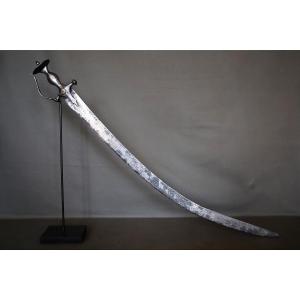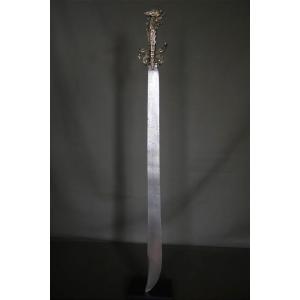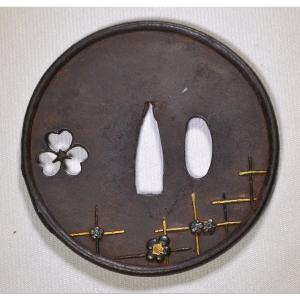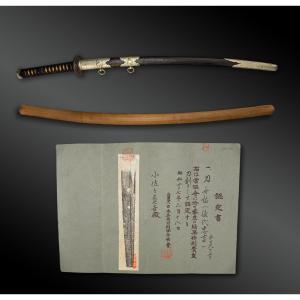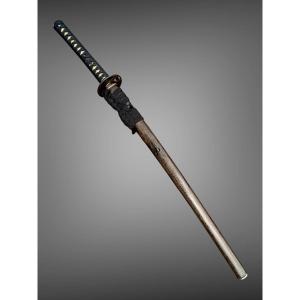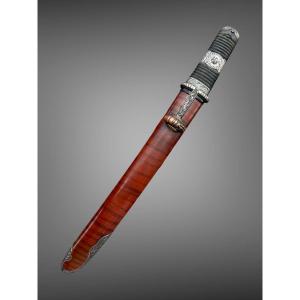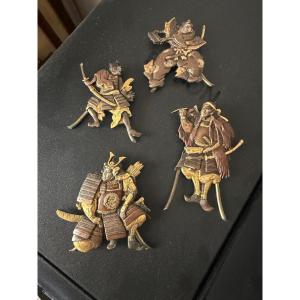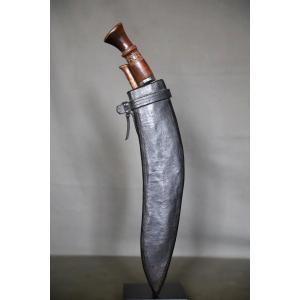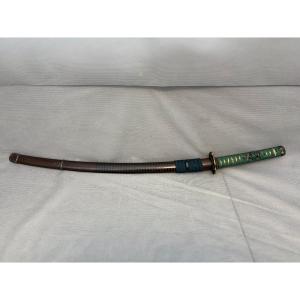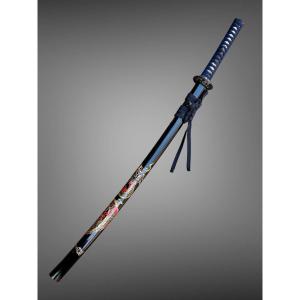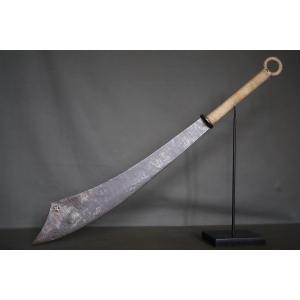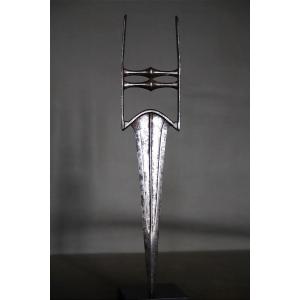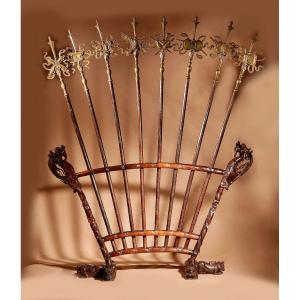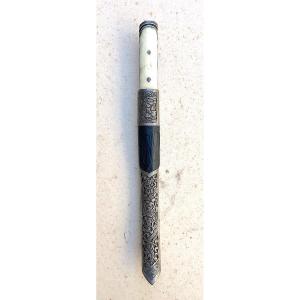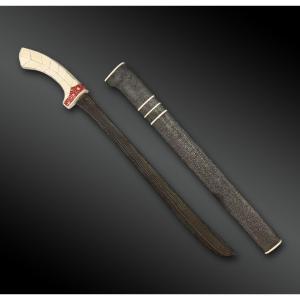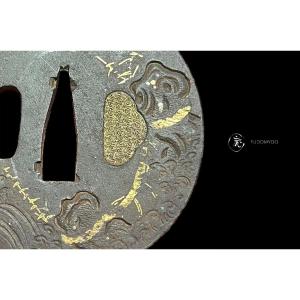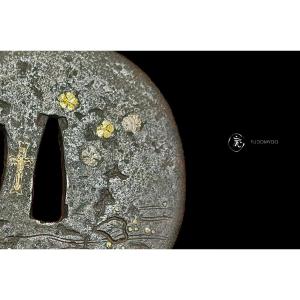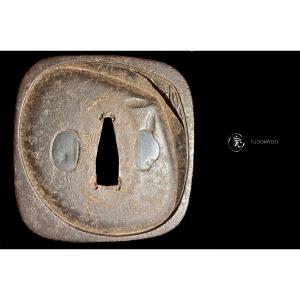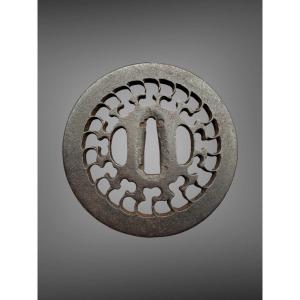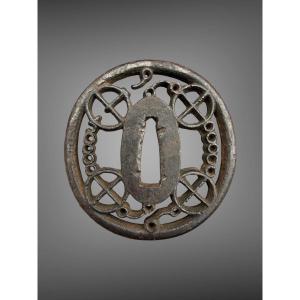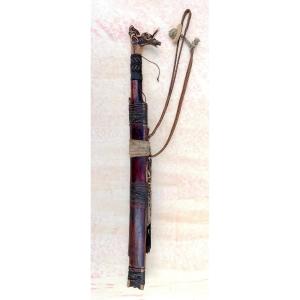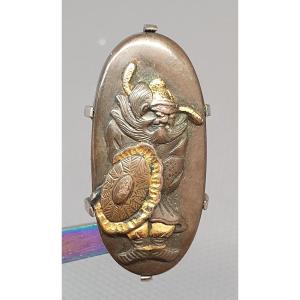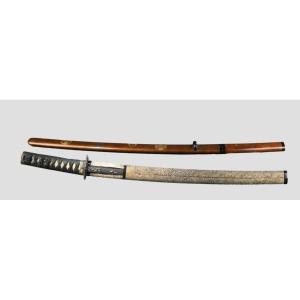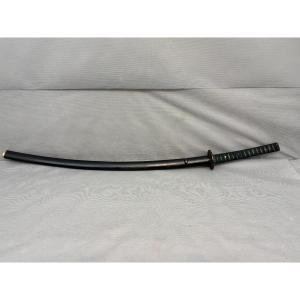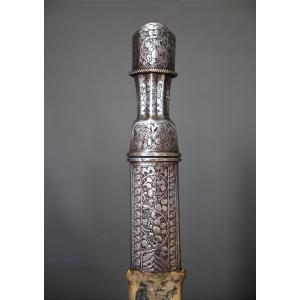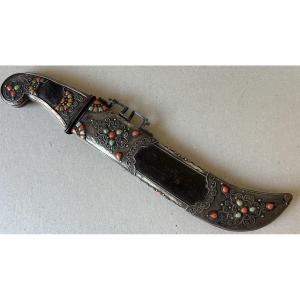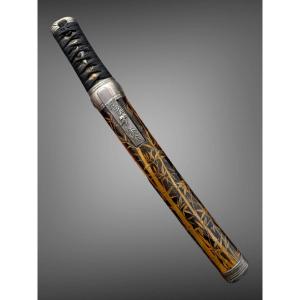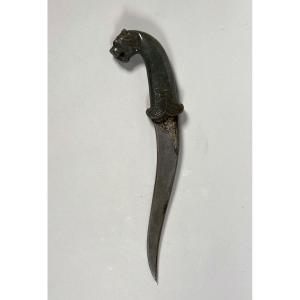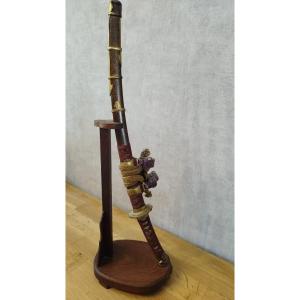
Katana from the late Edo to Meiji period. Blade: Otoshi-zukuri (V-shaped cross-section with two faces) blade, Iori-mune (two-sided) blade spine. O-kissaki (long) points. Shinoji (11 mm) (face 1). Jiga[...]
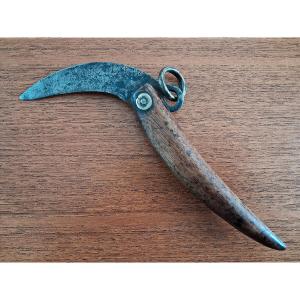
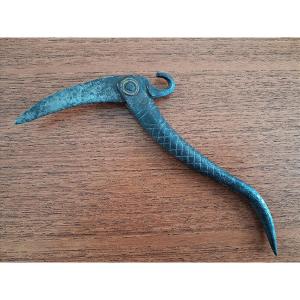
Ancient ritual keris – Indonesia (Java or Bali), pre-Islamic period
Fully forged from a single piece of iron, length: 17.5 cm
Rare ancient keris, entirely forged from one single piece of iron, inclu[...]
Nagamaru Gata (oval) shaped tsuba, signed. Made of openwork iron in the Maru Bori style and inlaid with gilded and silvered brass in the Hira Zogan style. Depicting two figures facing each other: on o[...]
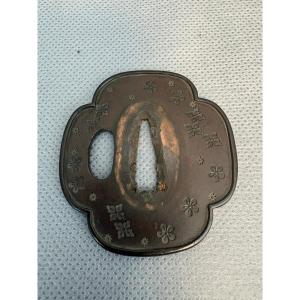
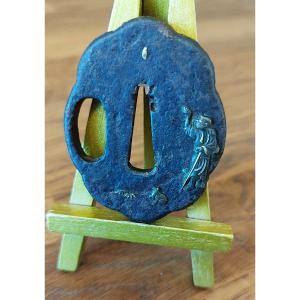
Mokko-gata (quadrilobed) tsuba, signed, in iron inlaid with gilt and silvered copper in Hira Zogan style, depicting a Gama Sennin figure with his toad. A signature difficult to identify. The presence [...]
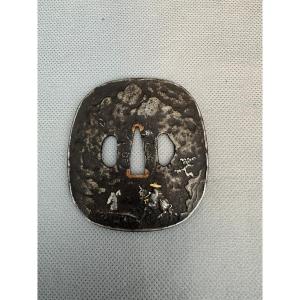
Very large Nagamarugata-shaped tsuba (handguard) in iron with Hira Zogan decoration in gilded copper and silver, depicting figures working in the fields with a water carrier. Dimensions: 77.6 mm x 82.[...]
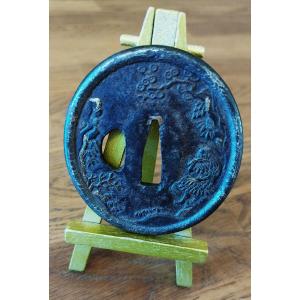
Ho Kei-style tsuba. Openwork iron in Maru Bori style, inlaid with gilt copper. Decorated with a coiled dragon with an open mouth. The presence of Seki Gane indicates reuse with new adjustments. Dimens[...]
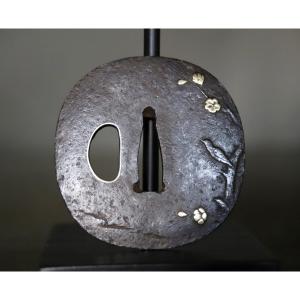
A very beautiful and large tsuba in the Nagamaru Gata style, made of finely chiseled and openwork iron in the Maru Bori style, inlaid with gilt copper. It depicts chrysanthemums in bloom amidst foliag[...]
Large Nagamaru Gata style tsuba. in openwork iron with marubori inlay, inlaid with shibuichi of gilded and silvered brass ,depicting a herdsman and a scholar in front of a thatched cottage and a cloud[...]
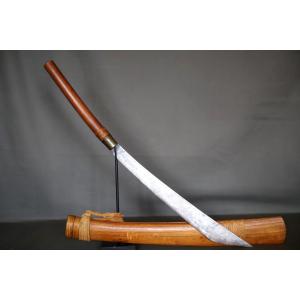
Ceremonial weapon. Rare straight, double-edged blade in black pamor (Damascus steel), attached to a wooden handle by a metal "mendak" ring, decorated with colored glass beads. Lombok Island, Indonesia[...]
JAPAN - Edo Period (1603-1868). Samurai Wakizashi. FUSHI and KASHIRA in a set, in chased, patinated, and gilded copper, decorated with five monkeys perched on a nanako background. TSUKA in wood covere[...]
JAPAN - Edo Period (1603-1868). Samurai Tanto. Patinated copper kashira, inlaid, gilded, and silvered, decorated with bamboo branches on a textured background. Wooden tsuka covered with purple-dyed st[...]
JAPAN - Edo Period (1603-1868). Samurai Wakizashi. KASHIRA and FUSHI in a set, made of engraved iron inlaid with gilt and silvered copper, decorated with a lobster and aquatic plants. Wooden TSUKA enc[...]
Samurai Wakizashi sword. Japan, Edo period (1603-1868). The sword itself dates from the early 1800s. Ray skin scabbard. Length: 75 cm. Weight: 810 grams. Good condition.
Small tsuba for a tento or wakizashi, in the shape of a Naga Maru Gata, made of openwork iron inlaid with Nunome Zogan in gilded copper. The design features symmetrical cabalistic motifs. The presence[...]
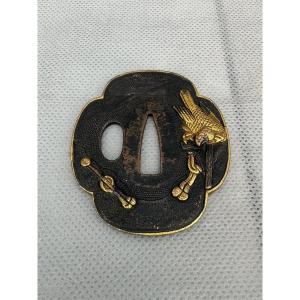
Large tsuba in the NARU MARA GATA style, made of openwork iron with HIRA BORI brass decoration symbolizing foliage and ropes. The presence of SEKI GANE indicates reuse. Dimensions: 81.3 mm x 80.1 mm
Ceremonial weapon. Straight, double-edged blade of pamor (Damascus steel), connected to the hilt by a metal "mendak" ring with filigree decoration. The marine ivory (sperm whale tooth) hilt is stylize[...]
Kikka-gata shaped iron tsuba. Openwork in the Maru Bori style with three fans.The rest of the tsuba is inlaid with Hira Boran foliage and branches. One side is slightly more oxidized. Dimensions: 72 m[...]
Edo period (1603-1868) Unsigned Blade: shinogi zukuri, iori mune Forging pattern: Masame Forging pattern Choji temper: O-suriage, kiri nakagojiri, un mekugi ana Mounting: Openwork iron tsube nagamaru [...]
EDO period (1603-1868) Unsigned Blade Shinogi zukuri, ioro nume Forging pattern Mokume Midare temper Suriage rocket, kiri nakagojiri, two mekugi ara Shirasaya scabbard
Unsigned Blade: shinogi zukuri, iori mune. Forging pattern: Masame Tempering: Hotsure suguha Rocket: suriage, kurinakagojiri, three mekugi ana, two of which are filled Mount (koshira-e): Iron tsuba [...]
66 cm wakizashi. Torii Zori shaped blade, Toran Ha temper line, Iori Mune shaped spine. O Kissaki shaped blade tip. Length 48 cm. This blade is damaged in places with the presence of Kizu (a type of s[...]
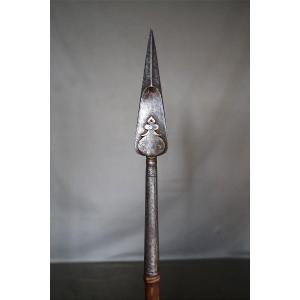
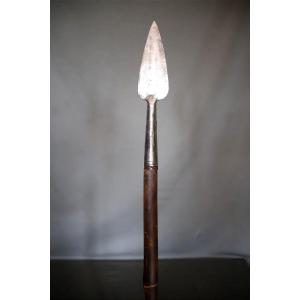
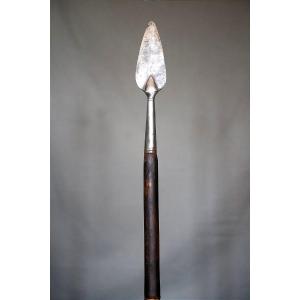
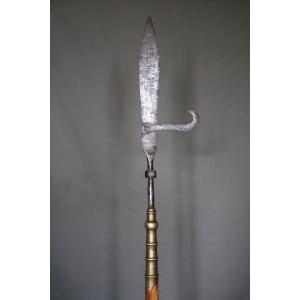
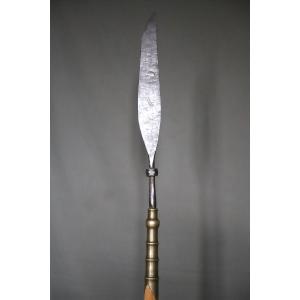
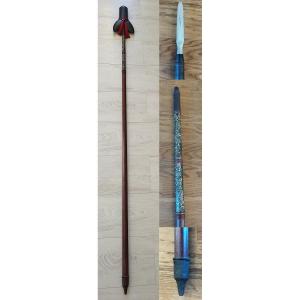
Yari in the shape of a spear, or more precisely, a straight-pointed spear. Shagreen, burgone inlays. At the bottom, the hirumaki protects the shaft from damage by contact with the ground, but it can a[...]
DaishoKatana signed Bizen no Kuni Osafune jū Sukesada saku and Wakizashi signed KuniyasuBizen Province, Osafune Village, JapanKatana – Kanpō period (1743)Wakizashi – Muromachi period (1336–1573)Steel,[...]
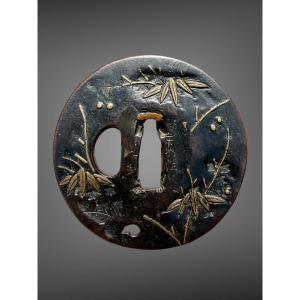
Antique tsuba from the late Edo period, made of shakudo (brass), 19th century. Shipping not included. Weight: 98 grams. Dimensions: 65.9 x 70.2 cm. Thickness: 4.86 mm. Type: Tate Ito Gata (cross-shape[...]
Beautiful antique dragon tsuba from the mid-Edo period, 18th century. Shipping not included . Weight: 104g. Dimensions: 75.8 x 76.2 cm. Thickness: 4.42mm. Type: Maru Gata (Round). Theme: Dragon. Mater[...]
Beautiful and antique tsuba from the late Edo period, made of shakudo (brass), 18th century. Shipping not included. Weight: 90g. Dimensions: 75.4 x 77.2 cm. Thickness: 3.6mm. Type: Tate Ito Gata (cros[...]
Very rare antique tsuba from the Late Edo period, in sukashi (openwork) style, mid-19th century. Shipping not included. Weight: 153g. Dimensions (H x W): 83.6 x 85.2 cm. Thickness: 4.25 mm. Type: Unco[...]
Magnificent antique tsuba from the mid-Edo period, made of shakudo (brass), 17th century. Shipping not included. Weight: 107 grams. Dimensions: Diameter 81 mm. Thickness: 3.1 mm. Type: Maru Gata (Roun[...]
SABER known as Katana signed Tango no Kami Fujiwara Shigetsune and Echizen Oite Toyohara with Tokubetsu Hozon certificateEchizen Province, JapanEdo period (1660-1680)Steel, wood, lacquer, copper, horn[...]
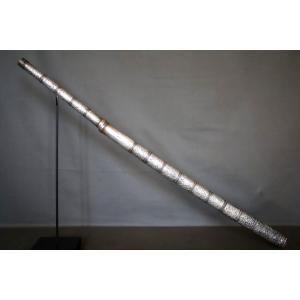
This is a beautifully crafted piece, likely Laotian or Thai, executed with great finesse, particularly in the decoration. Note some signs of wear from use, a few small rust spots, and minor dents on t[...]
JAPAN - Edo Period (1603-1868). Samurai Wakizashi. Simple patinated copper KASHIRA. Chiseled, patinated, silvered, and gilded copper FUSHI depicting a bird on a cherry blossom branch (minor wear). Woo[...]
Japanese sword, SHINTO WAKIZASHI with KOSHIRAEJapan, Edo period (1603-1868).Steel, silver, wood, gold, lacquerTotal length: 40 cm - Blade length (Nagasa): 30.2 cmNakago: 9.8 cm - Curvature (Sori): 0.1[...]
WOMEN'S KNIFE, WITH NEEDLE HOLDER Tibet, 19th century Steel, iron, brass, bone, leather Total length: 18.6 cm; Blade length: 8.6 cm Straight blade with one cutting edge, with a groove on each side. Ha[...]
JAPAN - Edo Period (1603-1868). Samurai Wakizashi. KASHIRA in stamped and chased copper with high relief decoration of plant motifs (wear). FUSHI in chased metal with plant motifs. TSUKA in wood cover[...]
TSUBA Naga Maru GataJapanEdo period (1603–1868)Iron, goldH: 6.5 cm; W: 6.2 cm; Thickness: 3 mm H. Nakago Hitsu Ana: 2.5 cmTsuba chiselled with a Ryū dragon with golden whiskers.SignedRef.: 5904Text an[...]
TSUBA Shin No Maru GataJapanEdo period (1603–1868)Iron, copperH: 8.7 cm; W: 8.4 cm; Thickness: 2 mm H. Nakago Hitsu Ana: 2.8 cmHammered tsuba with openwork stylised gourdsSeki Gane in copper.Signed.Re[...]
A very fine wakizashi with its original Shinto blade, "Heianjo Ju Masakuni" (平安城政国), featuring a magnificent koshirae and shirasaya, along with a Sayagaki.
Price includes shipping within the EU, [...]
JAPAN - Edo Period (1603-1868). Samurai Wakizashi. FUSHI - KASHIRA in a suite of chased, patinated, and gilded copper decorated with dragons in clouds against a nanako background. TSUKA in wood covere[...]
Tanto Uda Kunimune (宇多国宗) in Koshirae, with a very rare Shiji-Mei signature on the blade and Kinzogan (gold) inscriptions. (Shipping costs included for the EU, extra for international).This Tanto i[...]
Proantic uses a cookie to analyze traffic and improve its service by using Google Analytics. Data sent to Google Analytics (frequency of visits to the site and pages visited) are anonymous. No other cookie tracks your activity, your personal data is not collected. Thank you for helping us to have better understanding how Proantic is used.