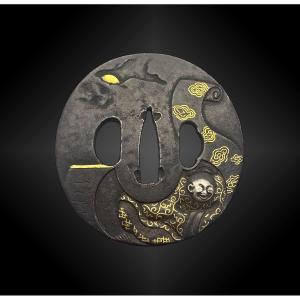
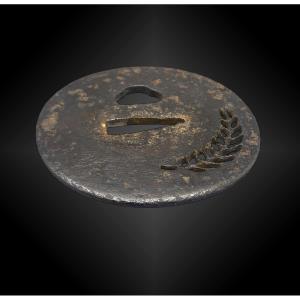
Tsuba Maru-Gata EDO period (1603-1868) Wrought iron inlaid with copper and gold with the motif of a Yōkai in the form of an eagle holding a gourd in its hand The other side represents a Torii The outl[...]
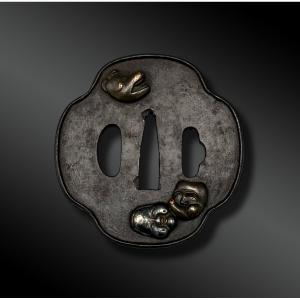
Tsuba Maru-Gata EDO period (1603-1868) Wrought iron inlaid with copper, silver and gold Represents in the middle of the reeds, a wise man sitting at the edge of a lake watching geese fly away. To the [...]
Tsuba Mokko-Gatta EDO period (1603-1868) Wrought iron inlaid with copper and gold with the motif of a woman wrapped in a dress Japan 18th century Very good condition (see photos) Dimensions 7 x 7.5 x [...]
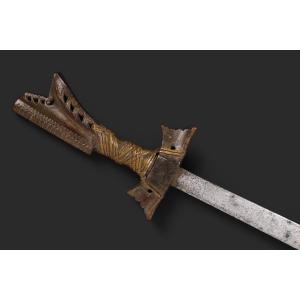
Indian dagger with wrap-around hilt called Vijayanagara katar - India, 16th-17th centuryThis type of katar with a characteristic wrap-around hilt appeared under the Vijayanagara empire in southern Ind[...]
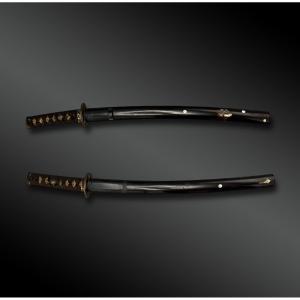
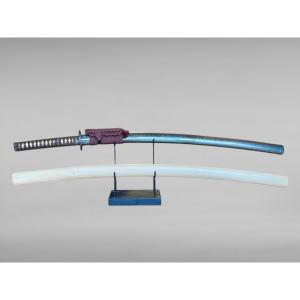
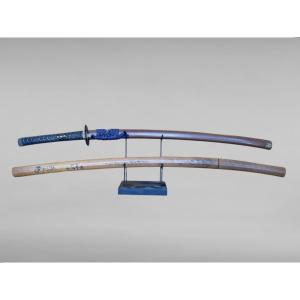
Daisho, late EDO early Meiji period mounting Katana 74 cm blade Tanto 33.5 cm No signature Tempering: sambon suji Iron tsuba on the katana, kogai on the tanto Brown and gold lacquered scabbards mounte[...]
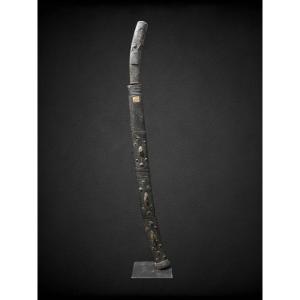
Dha type knife of the Lü and Shan ethnic groups - South East Asia, late 19th early 20th century (2)The Lü and Shan ethnic groups are widely distributed across the territories of North Vietnam, Laos, B[...]
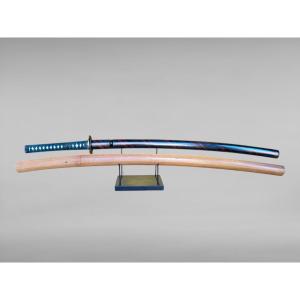
Katana Blade: Period: Late Edo period, signed Heian jo Ju Osumi No Kami Taira Hiromitsu. Shape: Shinogi katana, with an Iori Mune back and an O Kissaki point. Nagako (blade tang): Ha Agari Kuru Jiri, [...]
Tsuba Kaku-Maru-Gata EDO period (1603-1868) Wrought iron added to the motif of two dragons surrounded by intertwined scrolls Japan 17th century Very good condition (see photos) Dimensions 6 x 6.5 x 0.[...]
Chinese Short Saber with S-shaped hilt - South China, 19th CenturyA very rudimentary saber, probably from the Taiping rebellion. Handle with S-shaped hilt and ring pommel. Weight 536g. Length 50.5cm. [...]
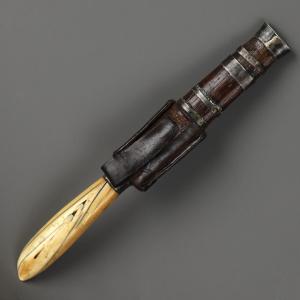
Dagger of the Hmong people, North of Vietnam, circa 1900 Handle in bovine horn. Fairly good condition. Total length 40.5 Length without scabbard 38.5cm Blade length 26.5cm Weight 391gr Weight without [...]
Long dha type knife of the Lü and Shan ethnic groups - Southeast Asia, late 19th early 20th century The Lü and Shan ethnic groups are widely distributed across the territories of North Vietnam, Laos, [...]
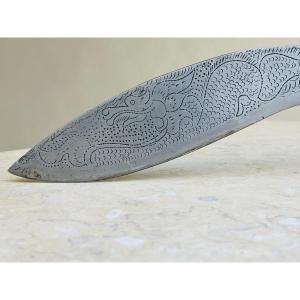
Prestigious kukuri (kukri) knife called kotimora - Nepal, 19th centurySilver handle.Wooden scabbard covered with leather enhanced with a chiseled and embossed silver and gold mount.Missing gold leaf a[...]
A very beautiful and old (16th century) O-Wakizashi with its magnificent Mumei blade from the "Bizen Osafune Mitsutada" school. The blade features beautiful Horimono depicting a Kurikara (Omote side) [...]
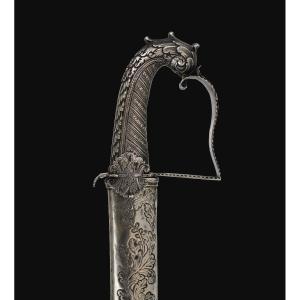
Talwar Saber - North India, 17th-18th century Blade of high quality. Very interesting because it was forged with a hybrid Damascus technique. The steel used is crucible steel (true Damascus, called wo[...]
Masterpiece, Very rare and exceptional Ivory Tanto carved in the shape of a Lobster from the early Meiji period (1858), with CITES certificate. Selling price, excluding shipping costs As part of our c[...]
Tibetan short dagger - Bhutan or Tibet, mid-20th century Horn handle, possibly yak. Openwork and chiseled metal scabbard. Single-edged blade with a traditional copper inlaid pattern towards the tip. A[...]
All-steel openwork dagger called patag - Bhutan or Tibet, probably mid-20th century Wooden handle covered with twisted metal wire and chiseled and embossed steel pommel. Scabbard in chiseled and openw[...]
JAPAN - Edo Period (1603-1868)Samurai Yari Spear.Finely burgauté wooden shaft, the last quarter decorated with a braided and gilded rope sabot, two copper rings.Straight "Ho" spear blade of triangular[...]
JAPAN - Late Muromashi (1st half of the 16th century). Samurai katana. FUSHI - KASHIRA en suite in copper with black and gold patina. TSUKA in wood covered with black dyed ray skin, braided with leath[...]
Nepalese saber called kora - Himalayas, Nepal, 18th-19th century Tubular steel handle with two-disc guard and pommel in stylistic representation of a stupa. Beautiful and strong single-edged blade, fl[...]
Strong Vietnamese dagger - Vietnam, 19th centuryRare dagger of fine quality. Deer antler handle with embossed silver decorations.Strong straight blade with four sides and double edges. Length 52.5cm B[...]
TSUBA en fer Nadekaku gata avec certificatJAPON – Période Edo (1606 – 1868)Fer ajouréH : 6,9cm – L. : 6,8cm – H. Nakago-Ana : 2,8cm64gNadekaku gata en fer ajouré en yo-sukashi de chidori stylisés.Non [...]
Pair of TSUBA for daisho, with Seiryu Engetsu sword motif. SignedJAPAN - EDO period (1603 - 1868), 19th century Bronze, alloy and goldLarge model signed Shu Ju MasanobuH: 7,35cm - W.: 6,98cm - H. Naka[...]
Vietnamese sword with animal vertebrae blade - Vietnam, 19th century Copper knuckle hilt, pommel and guard in superbly chiseled and repoussé silver sheet. Blade depicted by an animal vertebra (to be d[...]
TSUBA Mokko GataJapanEdo period (1603-1868)Iron, goldH. 8.1; L 7.5 cm; Thickness 4 mmH. Nakago Hitsu Ana: 2.8 cmTsuba decorated with a swan in flight in a landscape animated by flowers on both sides, [...]
Dha type knife of the Lü and Shan ethnic groups - South East Asia, late 19th early 20th century (4) The Lü and Shan ethnic groups are widely distributed across the territories of North Vietnam, Laos, [...]
A Vietnamese dagger - Indochina, Vietnam, 19th century early 20th century Deer antler handle with long brass and copper ferrule. Single-edged blade engraved on both sides. Length 36cm Blade length 20.[...]
An impressive Vietnamese saber called truong dao - Vietnam, 19th early 20th century Large and powerful blade flaring towards the point. The guard has some play, the vegetable cord that encircles the h[...]
Strong slaughter knife - Rural China circa 1900 Wooden handle and steel ferrule. Wooden scabbard engraved with two fantastic animals. Strong single-edged blade. Length 45cm Length without scabbard 42c[...]
Strong slaughter knife - Rural China circa 1900 Wooden handle and steel ferrule. Wooden scabbard engraved with a bird (wood splits). Remains a wax seal of export authorization. Strong single-edged bla[...]
JAPAN - Early Edo (17th century). Samurai Katana. FUSHI - KASHIRA in chased copper, partially gilded and silvered (wear) on a nanako background and on the theme of the eight Taoist hermits. TSUKA in w[...]
All-steel openwork dagger called patag - Bhutan or Tibet, 19th 1st half 20th century Wooden handle covered with steel wire and chiseled and openwork steel pommel. Scabbard in chiseled and openwork ste[...]
Short silver-plated saber - Bhutan or Tibet, circa 1900 Horn handle, possibly yak. Silver-plated scabbard. Single-edged blade with a traditional copper-inlaid pattern towards the tip. A simple weapon [...]
Indonesian saber called pedang - Indonesia, 19th early 20th century This type of saber was widely used in the Indonesian archipelago, especially Bali, Java, Sumatra... Finely carved horn handle. Small[...]
Small dagger from Tibet - Tibet or Bhutan, late 19th early 20th Fuse in beautiful blond horn and pommel in low-grade silver, chiseled and worked in repoussé. Single-edged blade. Scabbard in low-grade [...]
Sabre called mandau of the Dayak people - Borneo Islands, 1st half of the 20th century Carved wooden handle (slight crack on one side, without impact on the solidity of the whole) surrounded by a brai[...]
A saber called kharga or kora - North India or Nepal, 19th century Kharga is the name used in India. In Nepal, the term kora is used. Steel handle. Blade engraved with Sankrit texts on both sides as w[...]
A rare bow and arrows from the Himalayan regions - Probably Nepal, 19th early 20th century In polychrome lacquered wood decorated with floral and geometric motifs, Wear and loss of lacquer but very re[...]
Indian saber called "kharga" - North India, 19th century Kharga is the name used in India. In Nepal, the term kora is used. Based on the style of the handle and the silver-damascened floral decoration[...]
Kriss sword hilt (keris kris) representing Batara Bayu - Indonesia, Bali, 19th century Gilded copper alloy hilt representing Batara Bayu, Indonesian version of Vayu, the Indian god of the wind. The hi[...]
An Indian saber called kharga or kora - North India, 19th century The kharga is the name used in India. In Nepal, the term kora is used. Interesting handle with a wrap-around guard of the khanda type [...]
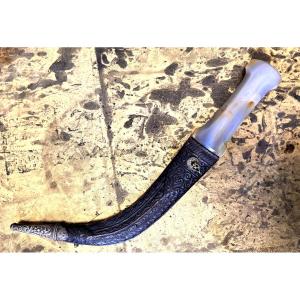
Chinese knife with jade handle - China, late 19th century The handle is celadon-colored jade. Single-edged blade attached to the handle by a silver bolster (the blade is slightly skewed compared to th[...]
Japanese arrowhead, ya-no-né, diamond-shaped with openwork “boar's eye” heartJapan - Edo period (1603-1868)SteelTotal length: 26 cm Hira-né type flat iron, lozenge shape openwork with a “boar's eye” h[...]
TSUBA in Mokko Gata with squirrel motifJAPAN - Edo period (1606 - 1868)Inlaid ironH: 9,2cm - W.: 8,2cm - H. Nakago-Ana: 2,3cm160gIron mokko gata inlaid with sentoku hira zogan. A squirrel under flower[...]
Superb Indian axe of the Zaghnal type, early 19th century, with its scabbard, embossed decoration and gilded copper engravings, very rare combat and status show weapon
An antique Burmese double dagger in a traditionally decorated scabbard. Period - 19th century Condition - Good condition Measurement - Closed length 17.6 cm
SOLD WITH A CERTIFICATE OF AUTHENTICIT[...]
Axe Head Animated by a LionEast Asia, 17th century Iron and bronze 48 cm long, 4 cm longAn important single-edged curved axe head with a bronze lion, its front legs resting on a rectangular base.Its o[...]
Machete and its sheath called Pha
Culture probably Akha Ulo, Thailand
20th century
Iron, wood and plant fibres
Total length: 55.5 ; L.: 12 cm
Machete length: 54.5 cm
Machete with iron blade [...]
JAPAN - Edo period (1603-1868). Samurai wakizashi. KASHIRA in shakudo inlaid with copper and silver depicting paulownia leaves. TSUKA in wood, covered with ray skin, braided with black silk. MENUKIS i[...]
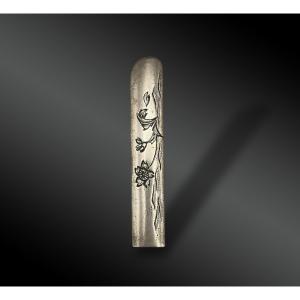
JAPAN - Edo period (1603 - 1868). Copper KOGAI decorated with a decoration of seven characters on platforms between bridges and clouds, on a nanako background. Slight wear to the tip. Dimensions: 21.2[...]
Shinsaku-to Zaimei 邦松作 "Kunimatsu Saku" sabre. Selling price (excluding shipping and support)The blade is a strong and dynamic work.This Katana blade was forged by Kunimatsu, one of the most famous b[...]
Dha type knife, South East Asia. Wooden sheath covered with silver. Ivory and silver handle. Total length: 32.8 cm. Width at +: 3.6 cm. Total weight: 0.251 kg. Good condition (traces of use). Shipping[...]
Japanese sword, Tanto
Japan
Edo period (1603-1868)
Steel, wood, lacquer, silk, brass, shakudo, gold, copper, silver, iron, sentoku
Length of cutting edge (Nagasa): 28.6 cm
Nakago: 9.7 cm - Cu[...]
Rare Mughal style dagger handle, India, in green jade with red eye stones (one missing) on a gold base. Very good condition. Dimensions: length: 11.7 cm weight: 141 grams
Tsuba Maru Gata in engraved and gilded wrought iron depicting on one side Hotei, one of the seven gods of happiness with three children in his bag of riches, on the other two children playing with a b[...]
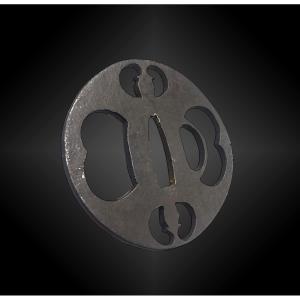
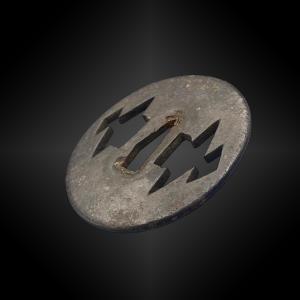
JAPAN - Edo period (1603-1868). Tsuba Jû-Mokkô Gata in wrought iron with eight four-pointed stars. Unsigned. Dimensions: 6.98 x 6.64 x 0.34 cm. Weight: 72 g. Sold with its storage box.
JAPAN - Edo period (1603-1868). Samurai tanto. FUSHI and KASHIRA in a suite in wrought iron inlaid with silver and gilded copper depicting a boat in the bamboos and a bird in flight. TSUKA in wood, co[...]
Wrought-iron Tsuba Maru Gata with a sun with twenty-eight rays.
Unsigned.
Dimensions : 7.87 x 7.67 x 0.49 cm.
Weight : 112 g.
Sold with its box and NBTHK Hozon certificate.
superb dagger with solid silver inlaid fittings
India, early 19th century
blade in woodz damascus
complete with its original scabbard
gold koft gari decorations on the grip
Proantic uses a cookie to analyze traffic and improve its service by using Google Analytics. Data sent to Google Analytics (frequency of visits to the site and pages visited) are anonymous. No other cookie tracks your activity, your personal data is not collected. Thank you for helping us to have better understanding how Proantic is used.