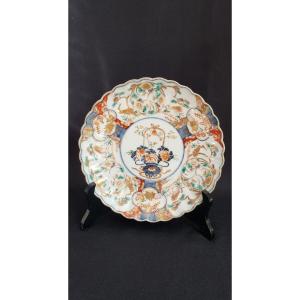
A covered vase mounted as a three-light candelabra, Imari porcelain, Japan, 19th century. The porcelain, decorated with flowers, is in excellent condition with some wear to the gilding. Total height 3[...]
Canton Plate with Polychrome Decoration, China – Canton, Late 19th Century. This beautiful and decorative Chinese plate, known as a Canton plate, is made of celadon-ground porcelain and richly decorat[...]
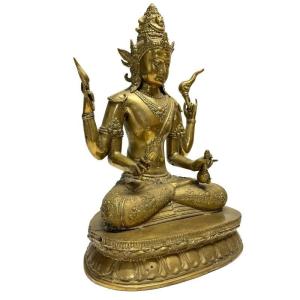
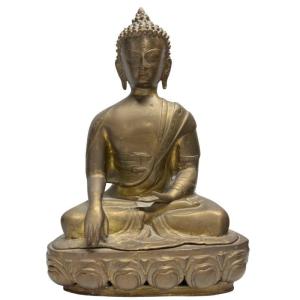
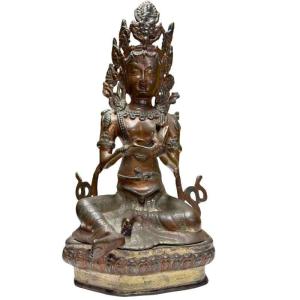
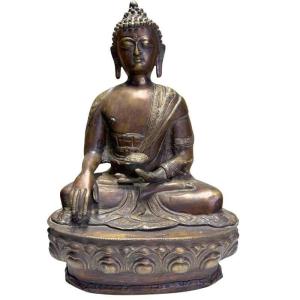
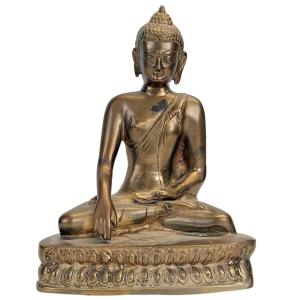
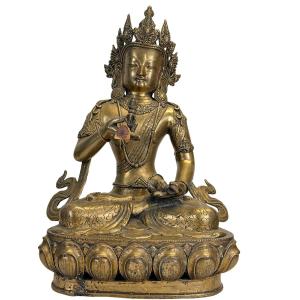
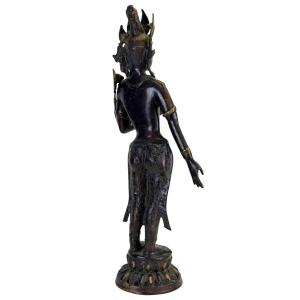
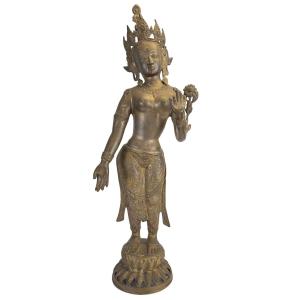
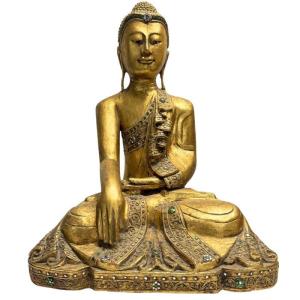
A 19th-century Tibetan gilt bronze statue of a Bodhisattva performing the Dharmachakra mudra, the gesture of "setting the wheel of Dharma in motion," a symbol of the Buddha's teachings. His two hands [...]
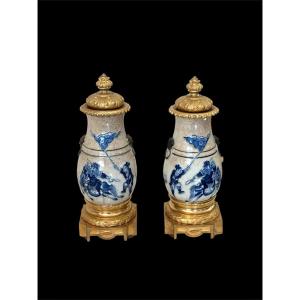
A sumptuous pair of Chinese Dehua porcelain vases, also known as "blanc de Chine." Decorated with flowering plum blossoms and Buddhist lion heads. In the style of the famous Blanc de Chine pieces from[...]
Six "images of the Palace of Spring" gathered in an album, like so many distinct scenes of eroticism where lasciviousness seems a pretext for aesthetics.The action takes place mainly indoors. Their co[...]
Tang Horse in Chinese Buffalo Bone, Metal Ornament & Glass Cabochon, 19th Century. Originating from 19th-century Chinese folk art, this important sculpture, made from a triangular piece of buffalo bon[...]
Important Chinese porcelain platter decorated with dignitaries and soldiers preparing for battle. Beautiful geometric frieze and exceptional size. Xianfeng period (1851-1861)
A charming pair of decorative stools depicting two crouching children supporting a circular tray with their arms. Carved from wood and enhanced with antique polychromy (red, green, and natural tones),[...]
A lovely covered box from the Meiji era, made of Arita porcelain, decorated with a hotei figure with a fan or a laughing Buddha, symbolizing generosity, fortune, and abundance. This box, suitable for [...]
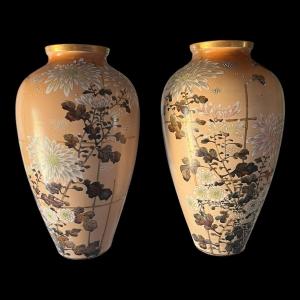
Pair of large Chinese vases dating from the late 19th century, made of ceramic and adorned with a refined decoration characteristic of the Chinese tradition, combining symbolic motifs with a rich chro[...]
JAPAN - Edo period (1603-1868). Wrought iron tsuba nagamaru-gata, chased in hira bori and gilded, decorated with a child riding a buffalo in front of a bridge on one side and a waterfall on the other,[...]
JAPAN - Edo period (1603-1868). Wrought iron tsuba mokko-gata, openwork, chased in hira bori and inlaid in iroe hira zogan of copper, gilt copper and silver with a scene of samurai engaged in a naval [...]
JAPAN - Edo Period (1603-1868). Half-mask of a samurai known as a "Mempo," made of wrought iron with a brown lacquer finish (very minor losses). Features a pronounced chin, a movable nose, white horse[...]
JAPAN - Edo period (1603-1868). Tsuba maru-gata in suaka carved with radiating motifs, kogai-hitsu hana, encircled by a mimi in shakudo. Very slight wear and oxidation. Diameter: 7.2 cm.
JAPAN - Edo Period (1603-1868). Shashimono, a white silk battle standard stamped on both sides with a bright red Torii gate design, is sewn with gussets onto a bamboo pole punctuated with black lacque[...]
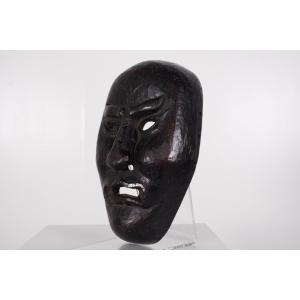
Japan - Edo Period (1603-1868). Important shishi mask in carved and glossy black lacquered wood, the mouth and interior of the mask lacquered red, the eyebrows gilded, the teeth and eyes white (some l[...]
A Very Interesting Japanese Wooden Carved Sculpture Of A Geisha In The Nata-Tsukuri Style.
Please note, this is not an unfinished sculpture, the geisha is completely recognisable and the maker has [...]
We note cracks on both pagodas, scuffs and scratches throughout, some missing pieces on the base, and a small chip on the top edge, all visible in the photos. However, the piece remains in good condit[...]
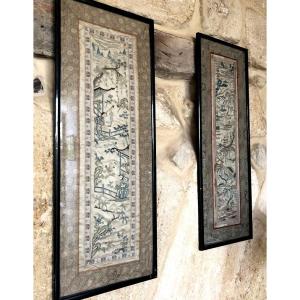
This embroidery is antique, probably from the late 19th century. It is a beautifully crafted Chinese work on silk, executed with great finesse. It likely depicts a parade with banners. As we are not s[...]
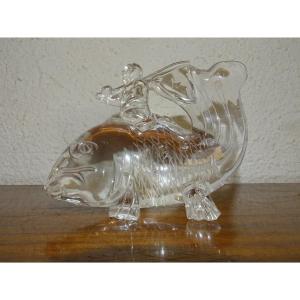
We present this original bronze object from China, depicting two laughing figures astride an enormous fish. 19th century. Perfect condition. Weight 510g. Shipping extra (E26).
Black lacquered wood Hina-Matsuri doll palace with gilding, featuring figures and furniture. Origin: Japan. Period: early 20th century. Meiji style. This miniature was created for the Japanese Doll Fe[...]
Pair of bronze Buddha hands, 19th century. Exquisite craftsmanship, particularly evident in the decorative details of the handles. Beautiful original patina. Mounted on wooden bases in the 1930s. This[...]
A boxwood netsuke depicting a seated monkey, wrapped in a finely carved kimono and rendered with careful attention to detail, shown in the act of putting on an Okame mask.
Period: Meiji period, late [...]
A boxwood okimono depicting a mouse holding a millet ear between its paws, while the young rests on its back, signed Ikko. The eyes are inlaid in horn, and the carving is finely executed, with particu[...]
A Japanese six-panel folding screen painted on silk with a gold ground, depicting a spring garden. In the foreground, peonies (botan), irises (ayame), and other seasonal flowers bloom at the base of a[...]
A Japanese six-panel folding screen, painted on paper with gold leaf, depicting a rakuchū rakugai zu (洛中洛外図), the celebrated panoramic view of the city of Kyoto.
The scene unfolds across a broad urba[...]
"Wisteria Viewing at the Kameido Tenman Shrine" 1820 The most famous Japanese artist in ukiyo-e prints during the Edo period (1603–1868), Katsushika Hokusai is the author of a world-famous work: The G[...]
View of Ohara by Hokusai Katsushika (1760-1849) 1820 The most famous Japanese artist in ukiyo-e prints during the Edo period (1603–1868), Katsushika Hokusai is the author of a world-famous work: The G[...]
Antique Chinese porcelain water or opium pipe. Late 19th century, complete with its mouthpiece. Dimensions: 13 cm high (without the stem) and approximately 10 cm in diameter. In good condition with si[...]
Antique and magnificent Japanese porcelain tea service from the Meiji period, late 19th century. Decorated with Mount Fuji and birds, very high quality. In perfect condition, it includes: 6 cups and s[...]
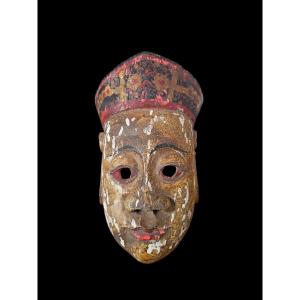
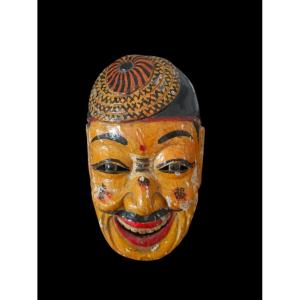
A fascinating pair of polychrome wooden masks, probably Balinese or Javanese Topeng masks. These masks appear to represent royal or noble figures. Asia, late 19th century
Indochina cigarette case with dragon motif. Beautiful piece, late 19th/early 20th century. Typical work from Southern China and Indochina. Bas-relief depicting a dragon in clouds; reverse showing pala[...]
The vase's body has four facets and is decorated with four different scenes. They are finely painted and gilded. Late 19th century (Meiji period). Inscription under the base. Height : 9.5 cm. Please s[...]
This piece of furniture is a substantial rectangular apothecary cabinet, resting on four straight legs and composed entirely of forty-five small drawers arranged on the front in a strictly orthogonal [...]
Beautiful silk purse embroidered with gold and silver thread, known as "he bao," decorated with animals and insects. Chinese work from the 19th century. Dimensions of the purse without the cords: 9cm [...]
A very pretty pair of kimono collars, of Japanese origin. Late 19th century. Embroidered on silk with gold thread. Depicting bamboo accompanied by a poem. Each piece measures 76 x 9 cm. Extremely fine[...]
KNIFE called Aikushi, signed Kadomatsu saku koreJapan - Edo period (1603-1868)Steel, wood, lacquer, silverNagasa: 51.7; Nakago: 14.2 cm(Previously restored) Kata kiri ha blade, mune hikushi, ito suguh[...]
JAPAN - Hammered iron tsuba maru gata, Edo period, with inlaid decoration of flowers in their branches in the form of a zogan in gold. Unsigned. Diameter: 8 cm
This fine Japanese Satsuma ware incense burner (kōro) was produced during the Meiji period, circa 1890–1905, and is signed Satsuma Shunzan zō (薩摩 俊山 造). The piece represents a high-quality example of [...]
Large porcelain vase with hand-painted and gilded decoration. It depicts a pair of pheasants, a phoenix, various flowers, and butterflies. Japan, Meiji period (1868-1912). Visible signature on the bas[...]
A meticulously hand-painted and gilded porcelain vase. One side depicts a woman with a child surrounded by lush vegetation, with mountains in the background. Above them, the majestic Japanese phoenix [...]
Hand-painted porcelain vase. The front scene depicts three beautiful women in elegant kimonos, above whom a flowering momiji maple tree is visible. The other side of the vase features a kacho-ga scene[...]
An unusual vase made using the Totai Shippo technique, a variation of cloisonné. In this case, the cellular glaze covers a porcelain vessel rather than a metal one. The decoration features vegetal and[...]
An unusual ceramic (earthenware) vase, made in Japan in a style reminiscent, through its colors and decorations, of Iznik ware from Turkey. It depicts birds of paradise, lush vegetation, flowers, and [...]
A bronze vase covered in multicolored lacquer and gold decorations. The hand-painted scenes depict Chinese boys playing various instruments, as well as decorations from the world of flora and fauna: b[...]
This large Meiji period (1868-1912) brush pot consists of a cylindrical section of fine wood, decorated with maki-e lacquer depicting wading birds and other birds in a wooded and leafy lakeside landsc[...]
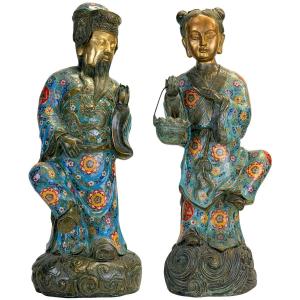
An interesting pair of two-branch candlesticks, each composed of two 18th or early 19th-century Chinese famille rose porcelain figurines depicting two figures from the Eight Immortals, likely Shoulao [...]
Important Chinese porcelain dish - 19th century, probably Guangxu period. Chinese porcelain dish with famille rose enamel decoration. In its center, a phoenix is depicted moving through a floral lands[...]
Magnificent antique Chinese-inspired embroidery panel, dating from the 19th century, entirely handmade. The fabric features a finely embroidered motif depicting traditional Asian decorative elements, [...]
Pair of Chinese Phoenixes in Polychrome Glazed Ceramic – China, circa 1840–1860. A rare and decorative pair of Chinese phoenixes in polychrome glazed ceramic, made in China around the mid-19th century[...]
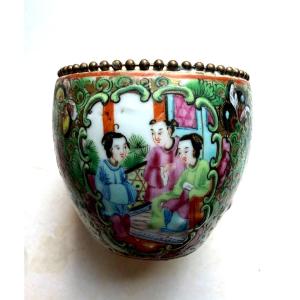
Refined large Canton porcelain punch bowl, attributed to the Famille Rose. The bowl is decorated on the inside with paintings of scrolls and animated scenes featuring palace figures, flowers, birds, a[...]
A bucket made entirely of juxtaposed wooden slats, lacquered; so far, it appears to be a typical domestic container, Chinese, from the 19th century. But I was able to translate the inscriptions, which[...]
Proantic uses a cookie to analyze traffic and improve its service by using Google Analytics. Data sent to Google Analytics (frequency of visits to the site and pages visited) are anonymous. No other cookie tracks your activity, your personal data is not collected. Thank you for helping us to have better understanding how Proantic is used.