

Japan, Lacquered Suzuribako Decorated With Sparrows By The Water, Late Edo–early Meiji Periods
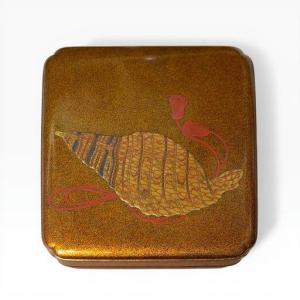
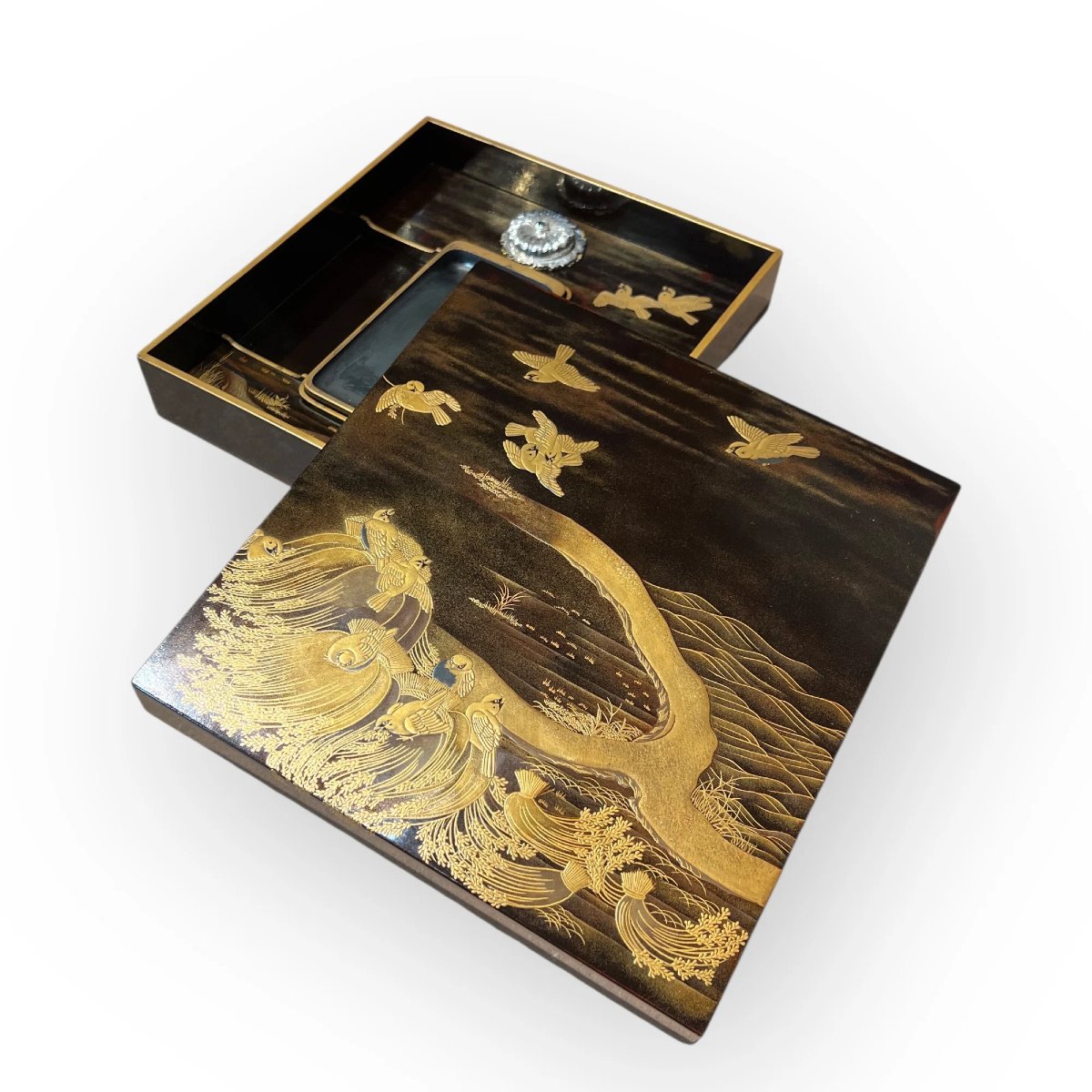
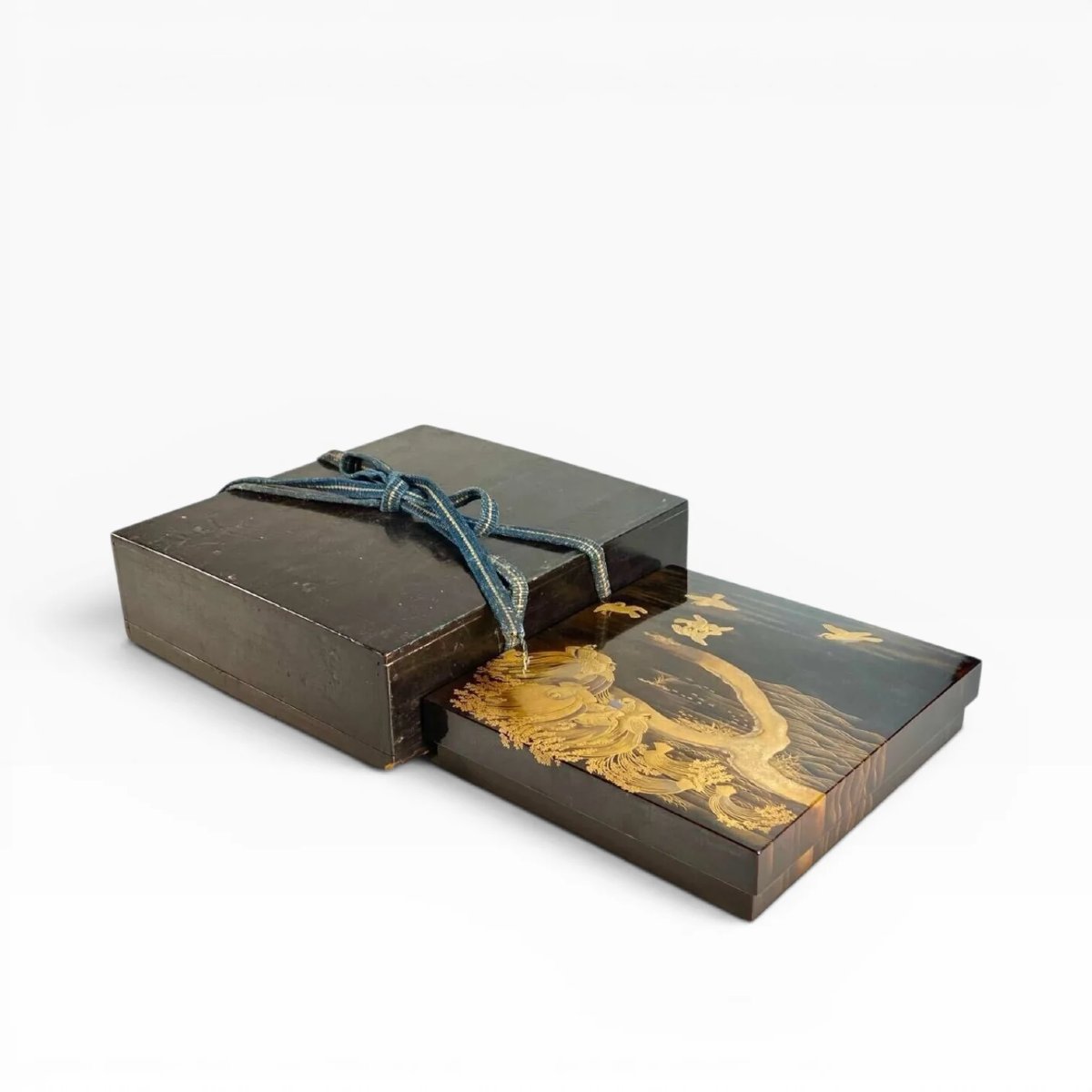
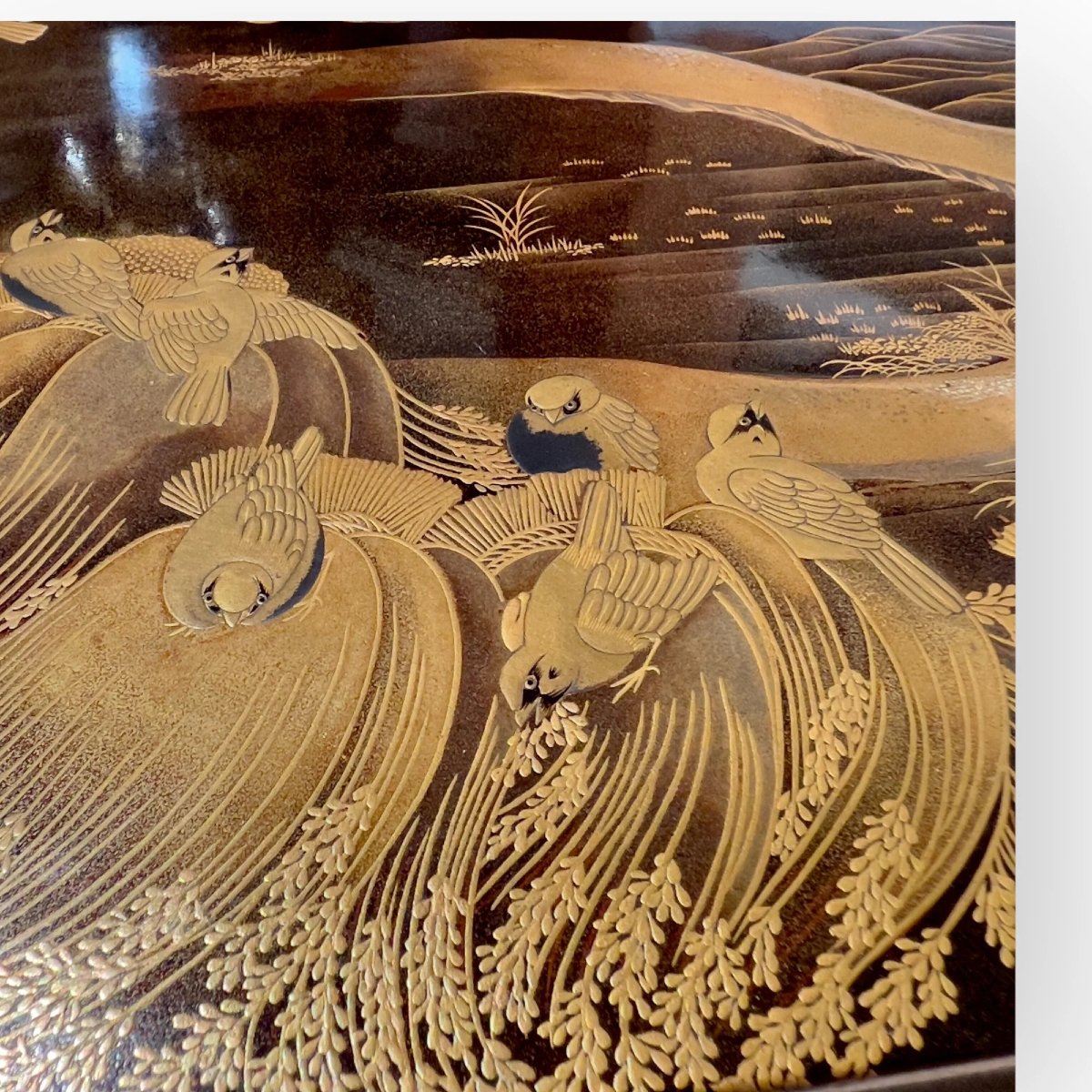
Black lacquered suzuribako with gold decoration executed in takamaki-e and hiramaki-e on a ro-iro background lightly dusted with nashiji. The lid depicts several sparrows flying over a small stream lined with grasses, while in the foreground other birds are perched on bundles of grasses. The design elegantly plays on the contrast between the dark mass of the background, the luminous meandering of the stream, and the liveliness of the birds. The technique of gold on a black background, particularly striking here, is one of the defining styles of 19th-century Japanese lacquer.
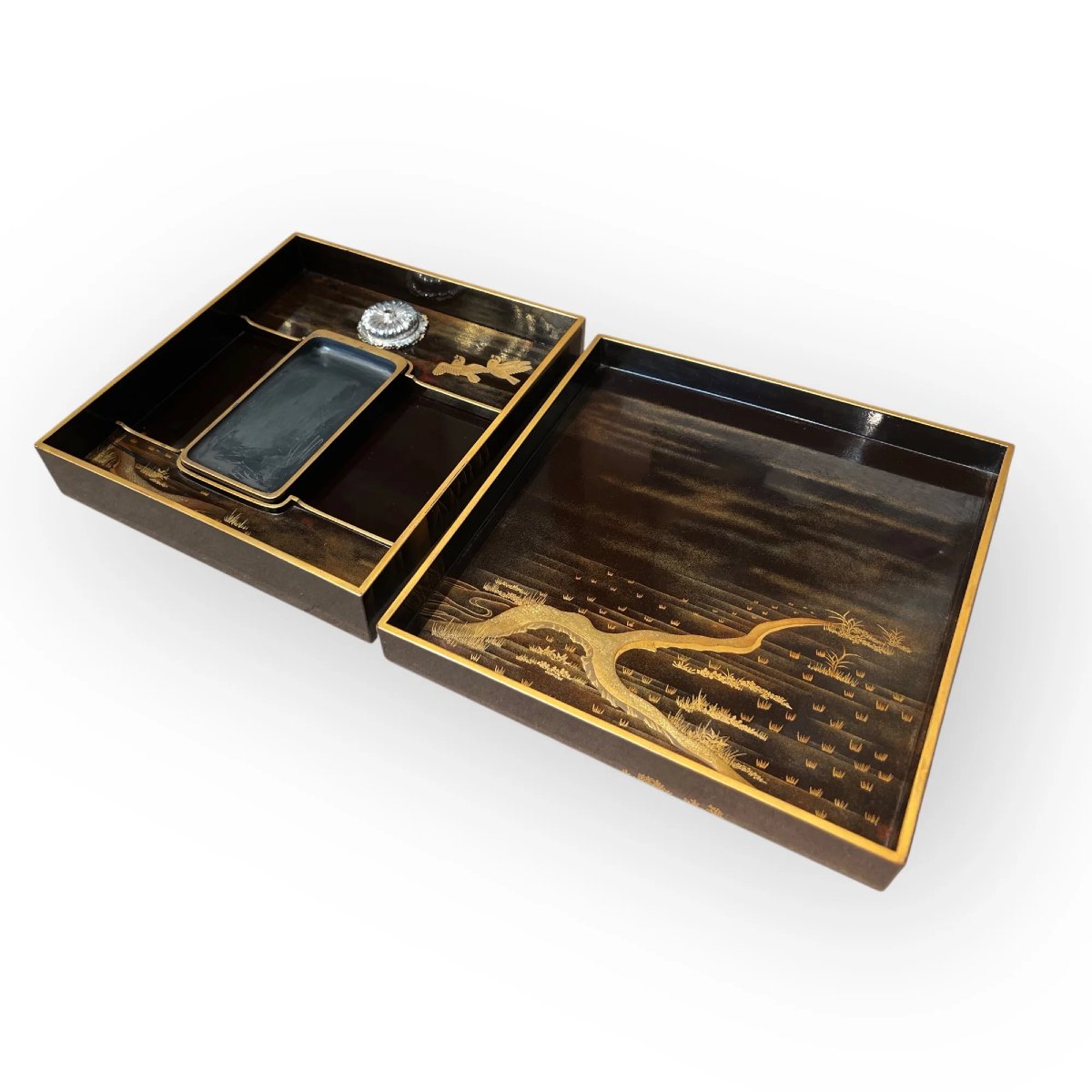
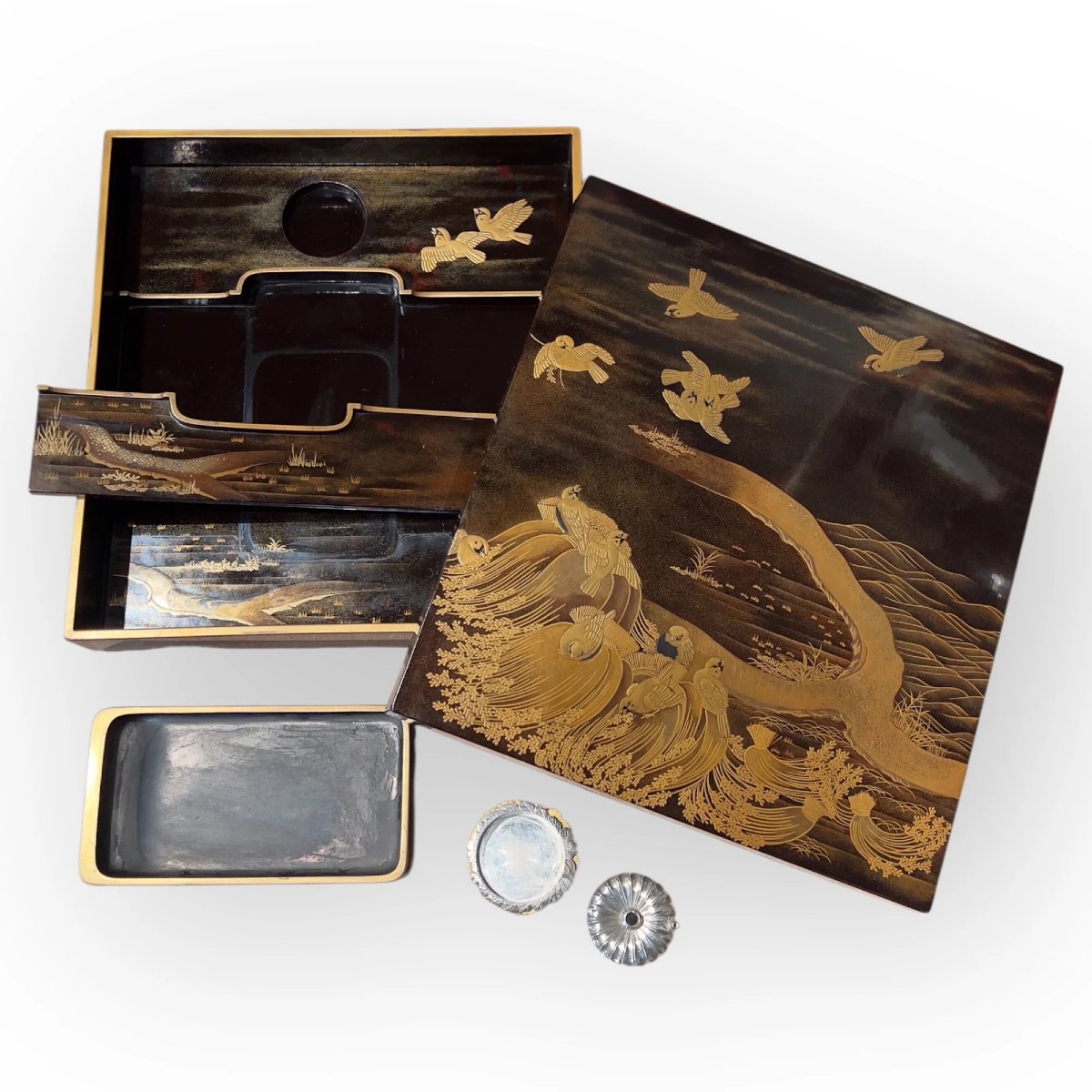
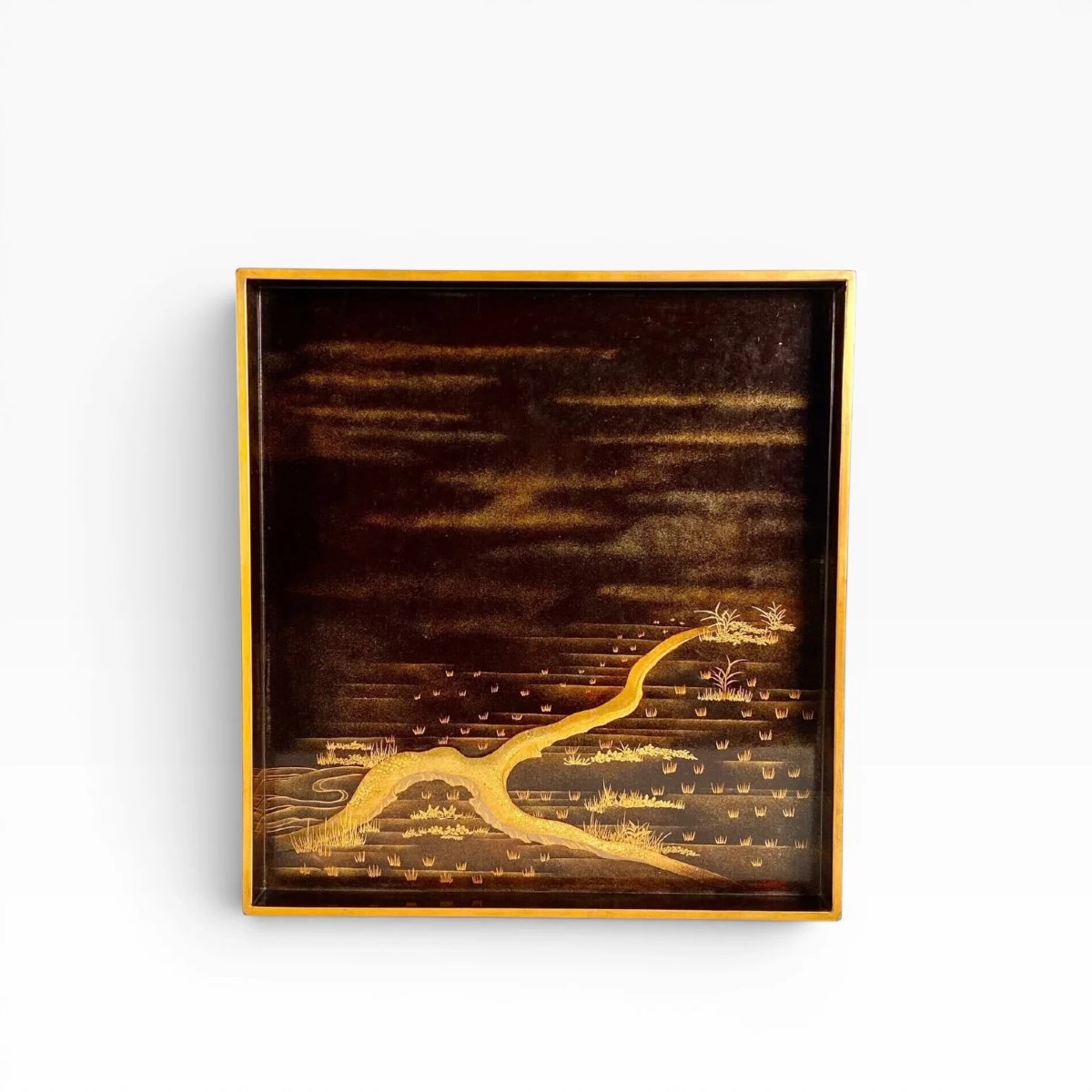
The interior of the lid features the same landscape, without the sparrows, while two birds are also depicted on the inner box. The lower section of the divider can be removed, and the decoration continues beneath this hidden part. This detail is significant: it indicates exceptionally meticulous craftsmanship, where the decoration is conceived as a unified whole across the entire object and does not stop at the immediately visible parts alone. Pieces preserved in Japanese collections clearly show that this interior decorative continuity is considered a sign of very high quality.
The box contains its gold-rimmed inkstone, as well as a small silver water container, set within a silver corolla that is itself mounted on a gilded metal base. This refinement in the treatment of the suiteki and its stand complements the richness of the lacquer decoration and reinforces the precious unity of the ensemble. The suzuribako has retained its original tomobako.
The motif of sparrows by the water’s edge is part of a long Japanese decorative tradition in which birds, grasses, and streams come together to create a living, rhythmic, and immediately comprehensible space. This type of composition, which combines the movement of the bird with the flow of the water, has several parallels in ancient suzuribako decorated with rivers and birds, notably in works held at the Tokyo National Museum and the Kyoto National Museum.
With its very deep black background, gold highlights, the quality of its decoration—extended even to the hidden parts—and the care taken with the interior elements, this suzuribako belongs to a line of fine craftsmanship that can be situated at the turning point between the late Edo and early Meiji periods.
Dimensions: height 4.5 cm; width 22 cm; depth 23.5 cm.
Period: 19th century
Style: Asian art
Condition: Good condition
Material: Lacquer
Length: 23,5
Width: 22
Height: 4,5
Reference (ID): 1826494
Availability: In stock