

Suzuribako Decorated With Horagai Motifs And A Landscape Of Pavilions, Edo Period
Suzuribako decorated with horagai and a landscape of pavilions
Japan, Edo period, 18th–early 19th century
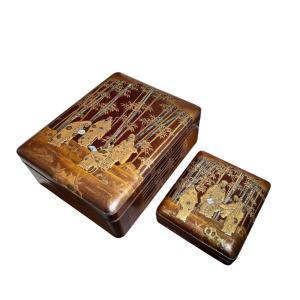
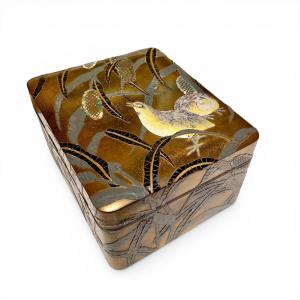
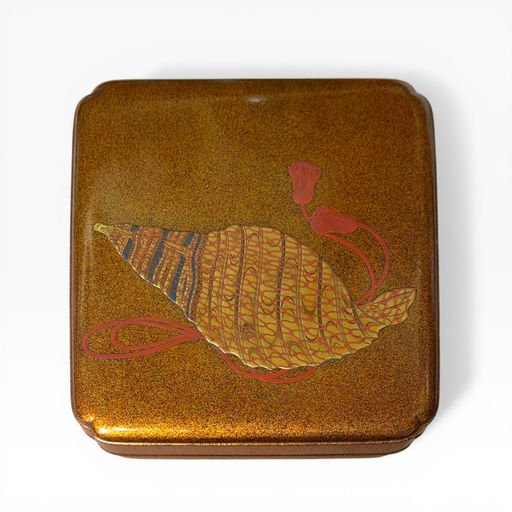
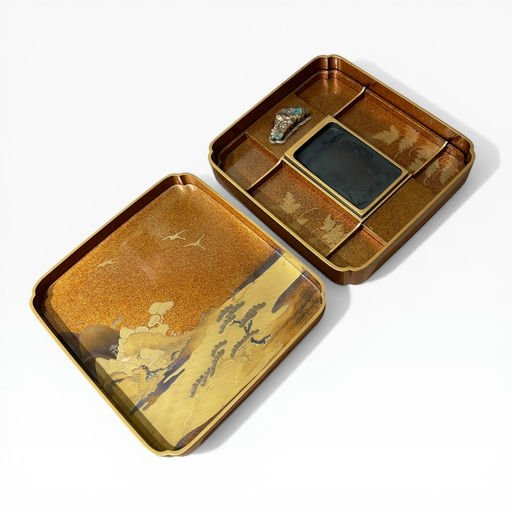
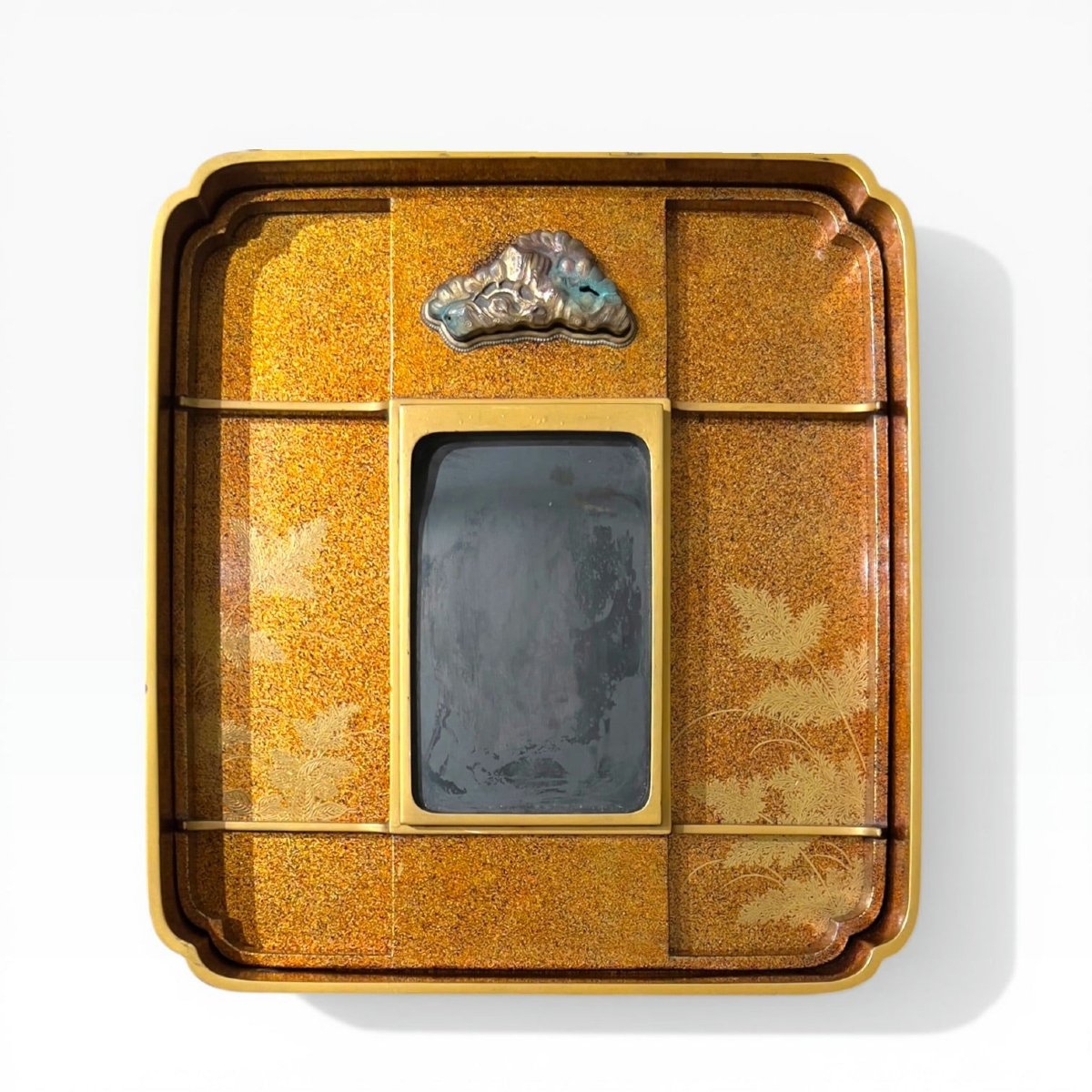
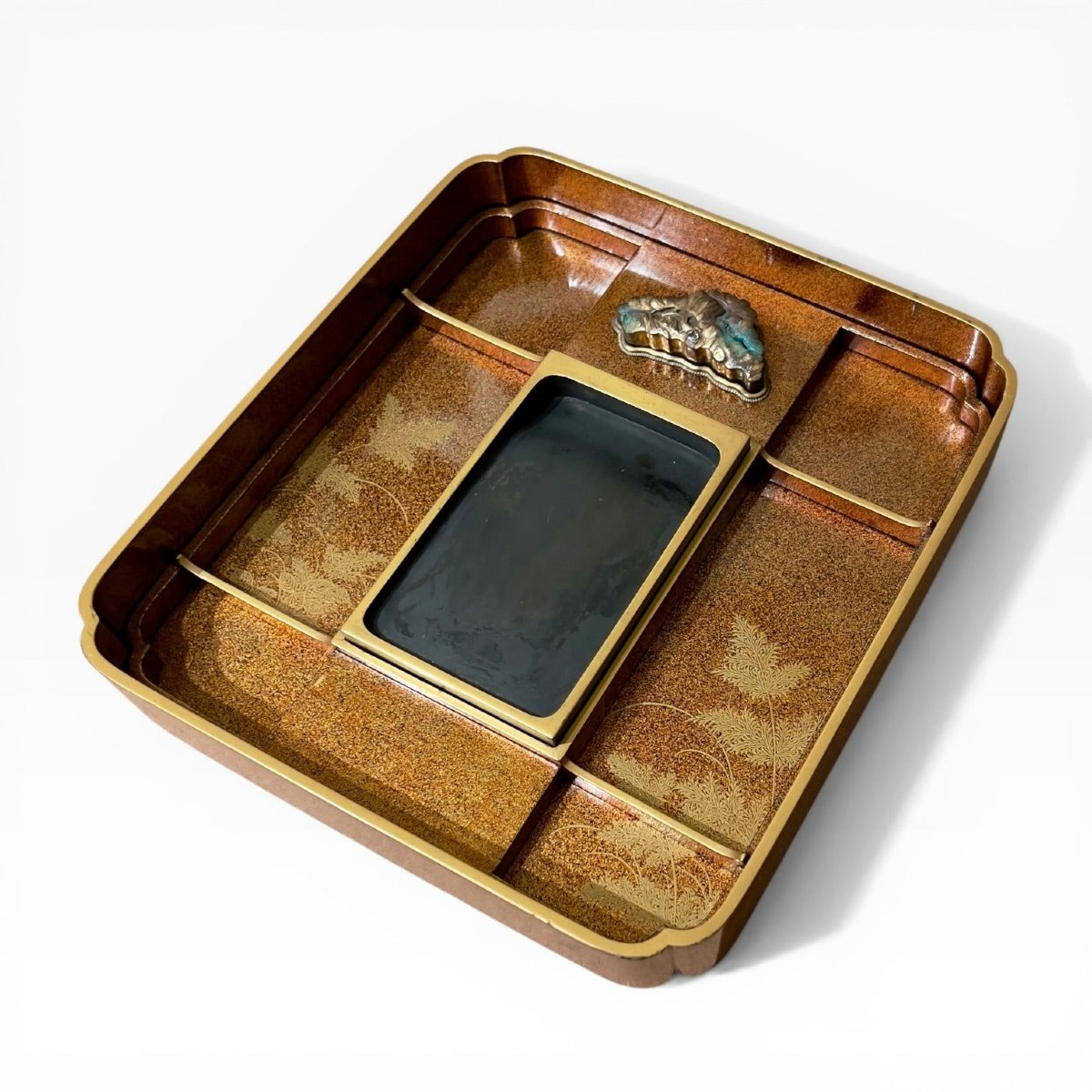
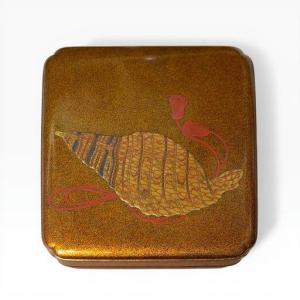
Rectangular suzuribako with rounded corners, made of lacquered wood, measuring 24.1 cm wide, 22.2 cm high, and 4.7 cm deep. The lid features, against a nashiji background, a large horagai 法螺貝—that is, a conch shell fashioned into a trumpet—enveloped in a net rendered in raised red lacquer. The interior contains the inkstone and the water container, or suiteki, here shaped like a pine branch, while the underside of the lid is adorned with a landscape of pavilions by the water’s edge. The suzuribako is a writing box designed to hold the tools needed for preparing ink and writing.
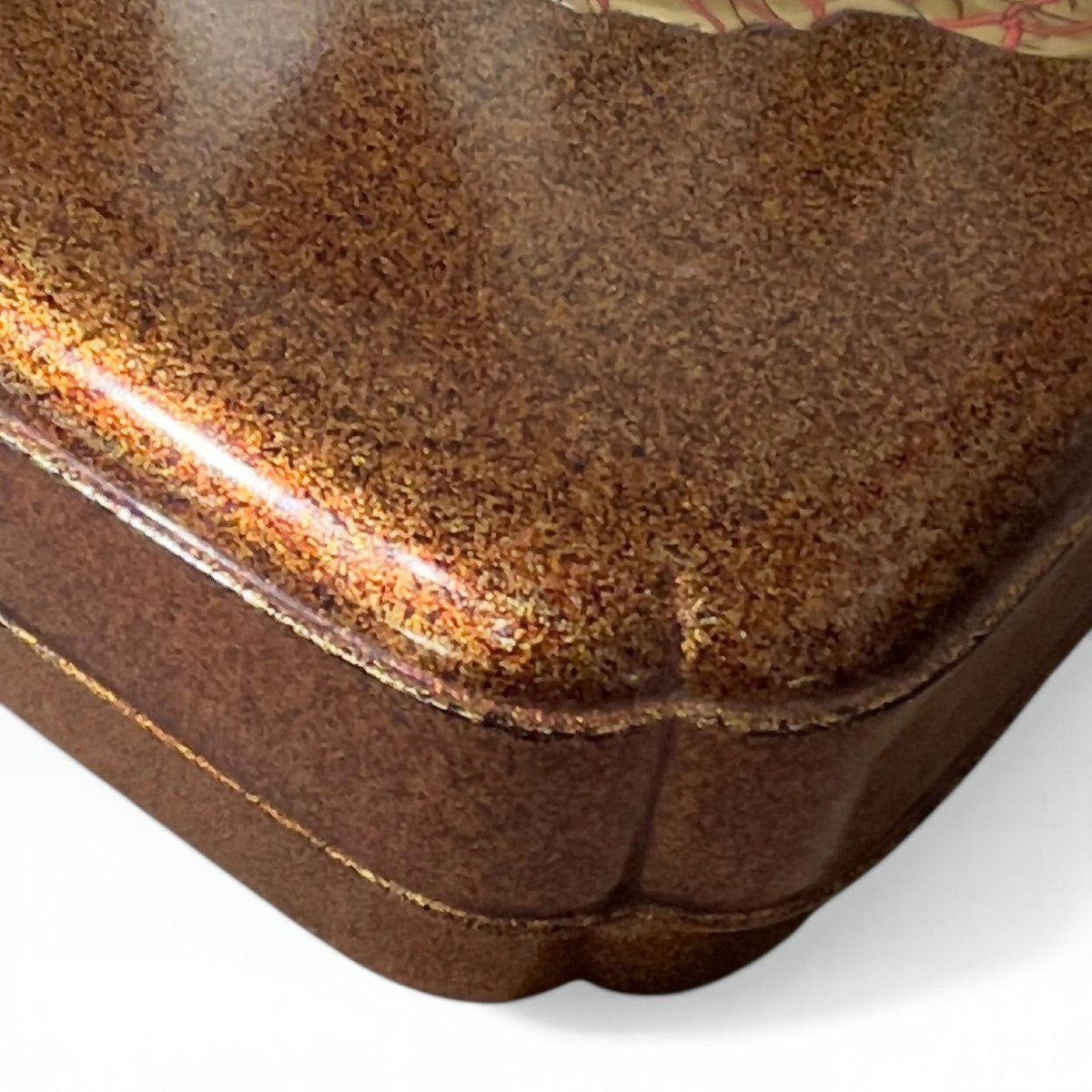
The nashiji background deserves special mention right from the start. This technique, which gives the surface the appearance of a pear’s skin through the dense scattering of fine gold flakes, creates here a luminous, warm, and very even background against which the motif stands out with great clarity. The decoration on the lid clearly combines hiramaki-e and takamaki-e. Hiramaki-e refers to the parts drawn with a thin layer, integrated into the surface, while takamaki-e refers to the more pronounced reliefs, achieved by modeling before the gold is sprinkled on. The interplay between these two techniques lends depth to the design without disrupting the smooth, refined unity of the lacquer.
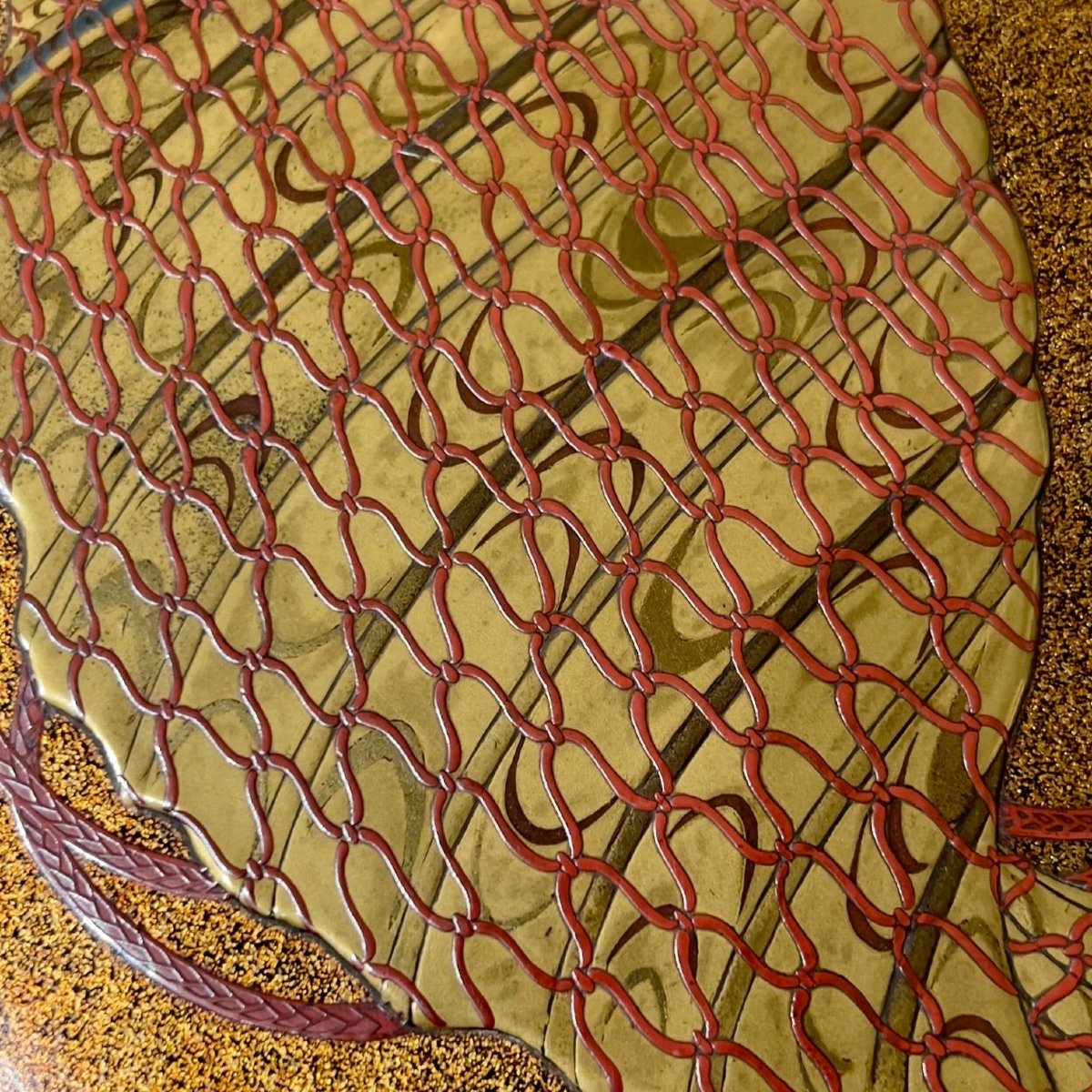
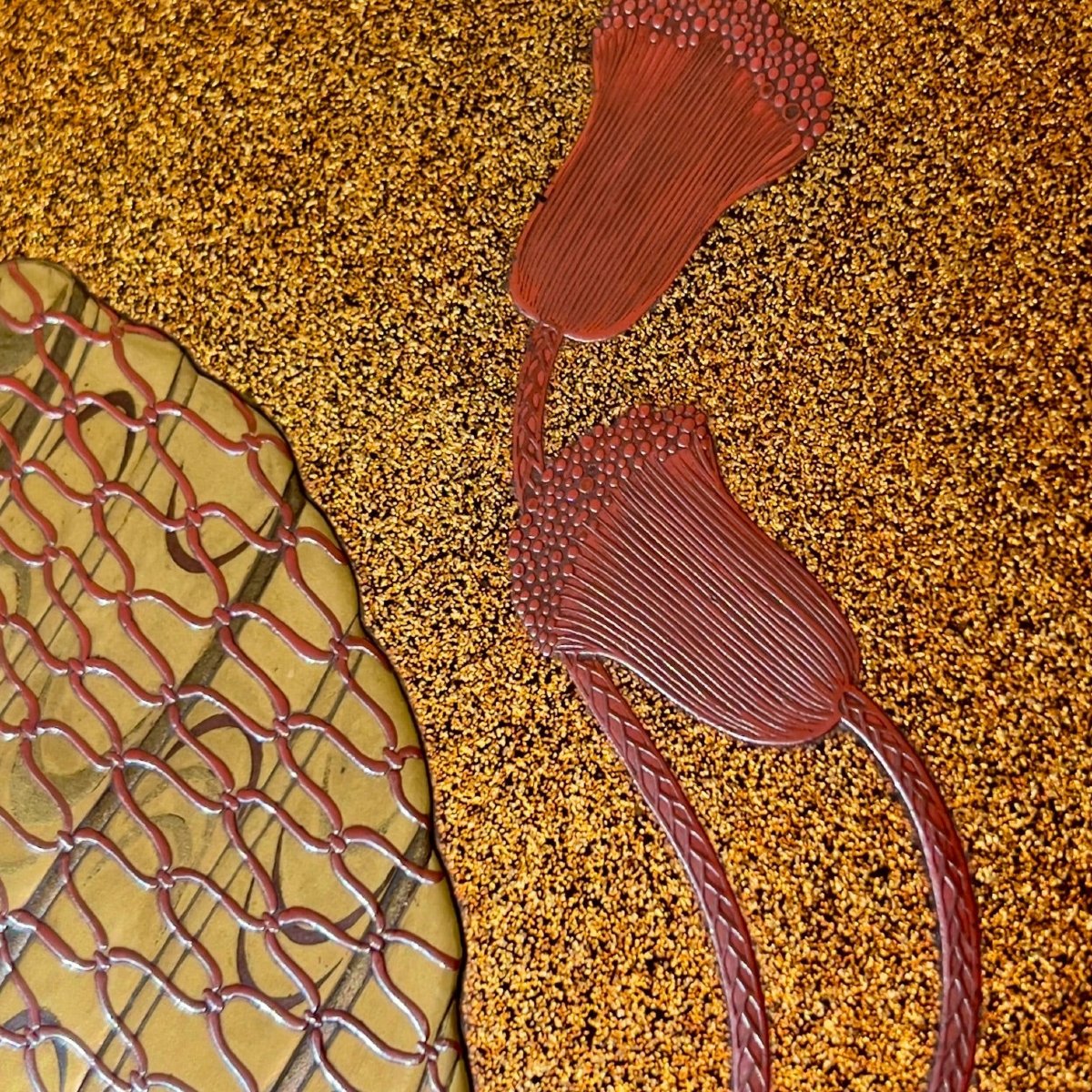
The horagai is a well-known instrument in Japanese culture, associated primarily with the yamabushi, the mountain ascetics of Shugendō. Japanese sources note that it was used to communicate in the mountains, to signal one’s presence, to mark the rhythm of certain ritual practices, and that it was also believed to have a protective function, capable of warding off evil forces. In the iconography of this box, its presence thus evokes a world of retreat, hermitage, life apart from the world, and mountain spirituality. The red cord that holds it is not a secondary detail: it is an integral part of the object’s very reality, and its extremely precise depiction is one of the box’s greatest achievements. Each strand of the weave is traced, crossed, and stretched with exceptional meticulousness, giving the decoration an almost tactile realism.
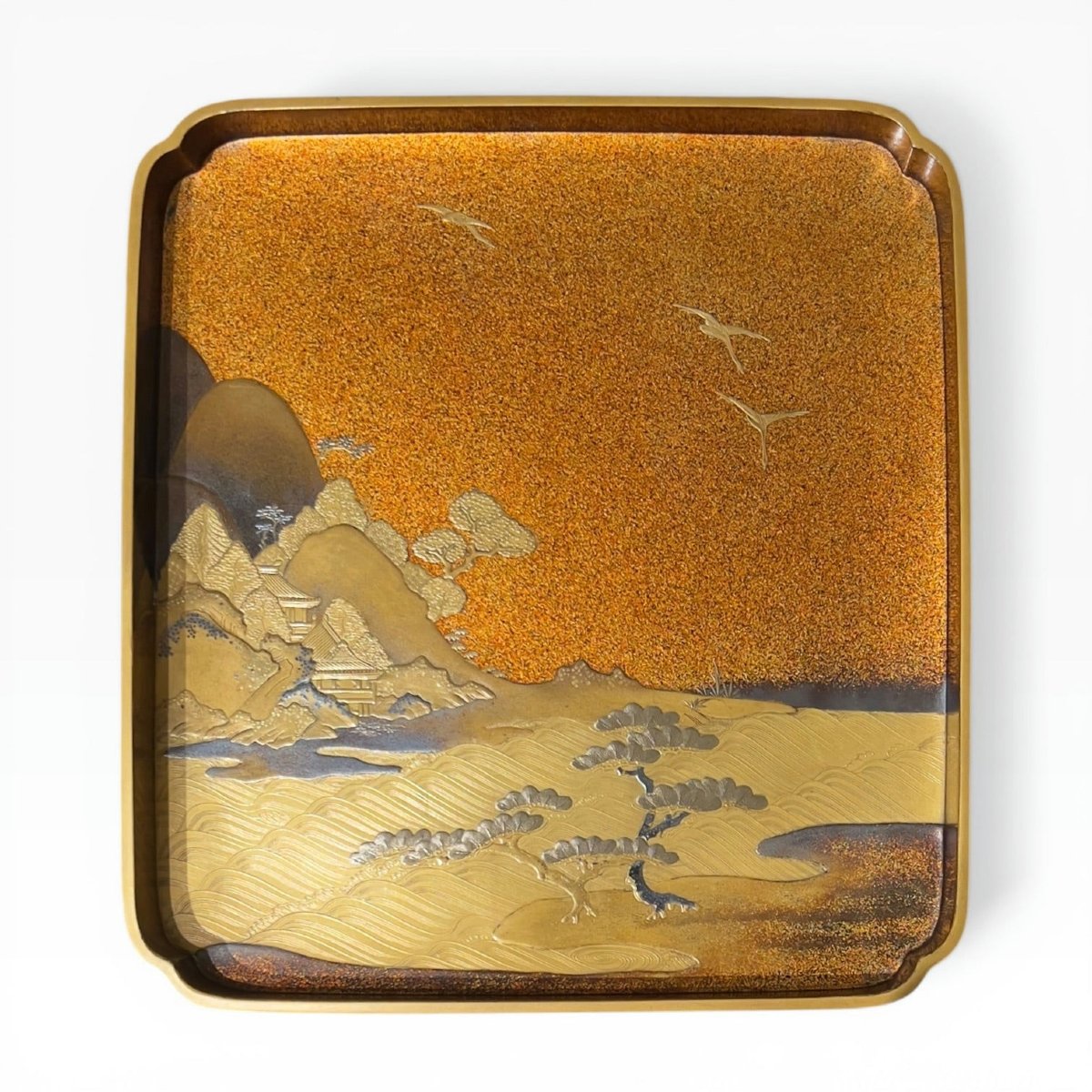
The interior takes on a different, more distinctly literary tone. The underside of the lid is adorned with a landscape of pavilions by the water’s edge, featuring pine trees, rolling hills, and birds in flight. The base echoes this atmosphere with gold-lacquered branches. Here we find ourselves within the vocabulary of the ideal landscape—secluded, contemplative, built around water, light architecture, and the pine, a tree symbolizing permanence and steadfastness. The suiteki, shaped like a pine branch, directly extends this design and demonstrates that the accessories themselves are part of the iconographic program. Thus, the box’s decoration is organized as a genuine dialogue between the world of mountain asceticism evoked by the horagai and that of writing, the mental landscape, and cultivated retreat.
It is this dialogue that gives the work its unique depth. On the exterior, the large horagai stands alone, almost monumental, with its red net in relief, creating a powerful, concentrated, almost emblematic image. Inside, the viewer enters a quieter, more expansive space, composed of water, pavilions, pine trees, and birds. The transition from the lid to the interior of the box thus corresponds to a symbolic transition: from the signal, the call, and the mountainous world to the realm of the scholar, writing, and contemplation. Such iconographic coherence, combined with such precise craftsmanship, places this piece among the highest-quality suzuribako.
Dimensions: 24.1 × 22.2 × 4.7 cm.
Japan, Edo period, 18th–early 19th century
Rectangular suzuribako with rounded corners, made of lacquered wood, measuring 24.1 cm wide, 22.2 cm high, and 4.7 cm deep. The lid features, against a nashiji background, a large horagai 法螺貝—that is, a conch shell fashioned into a trumpet—enveloped in a net rendered in raised red lacquer. The interior contains the inkstone and the water container, or suiteki, here shaped like a pine branch, while the underside of the lid is adorned with a landscape of pavilions by the water’s edge. The suzuribako is a writing box designed to hold the tools needed for preparing ink and writing.
The nashiji background deserves special mention right from the start. This technique, which gives the surface the appearance of a pear’s skin through the dense scattering of fine gold flakes, creates here a luminous, warm, and very even background against which the motif stands out with great clarity. The decoration on the lid clearly combines hiramaki-e and takamaki-e. Hiramaki-e refers to the parts drawn with a thin layer, integrated into the surface, while takamaki-e refers to the more pronounced reliefs, achieved by modeling before the gold is sprinkled on. The interplay between these two techniques lends depth to the design without disrupting the smooth, refined unity of the lacquer.
The horagai is a well-known instrument in Japanese culture, associated primarily with the yamabushi, the mountain ascetics of Shugendō. Japanese sources note that it was used to communicate in the mountains, to signal one’s presence, to mark the rhythm of certain ritual practices, and that it was also believed to have a protective function, capable of warding off evil forces. In the iconography of this box, its presence thus evokes a world of retreat, hermitage, life apart from the world, and mountain spirituality. The red cord that holds it is not a secondary detail: it is an integral part of the object’s very reality, and its extremely precise depiction is one of the box’s greatest achievements. Each strand of the weave is traced, crossed, and stretched with exceptional meticulousness, giving the decoration an almost tactile realism.
The interior takes on a different, more distinctly literary tone. The underside of the lid is adorned with a landscape of pavilions by the water’s edge, featuring pine trees, rolling hills, and birds in flight. The base echoes this atmosphere with gold-lacquered branches. Here we find ourselves within the vocabulary of the ideal landscape—secluded, contemplative, built around water, light architecture, and the pine, a tree symbolizing permanence and steadfastness. The suiteki, shaped like a pine branch, directly extends this design and demonstrates that the accessories themselves are part of the iconographic program. Thus, the box’s decoration is organized as a genuine dialogue between the world of mountain asceticism evoked by the horagai and that of writing, the mental landscape, and cultivated retreat.
It is this dialogue that gives the work its unique depth. On the exterior, the large horagai stands alone, almost monumental, with its red net in relief, creating a powerful, concentrated, almost emblematic image. Inside, the viewer enters a quieter, more expansive space, composed of water, pavilions, pine trees, and birds. The transition from the lid to the interior of the box thus corresponds to a symbolic transition: from the signal, the call, and the mountainous world to the realm of the scholar, writing, and contemplation. Such iconographic coherence, combined with such precise craftsmanship, places this piece among the highest-quality suzuribako.
Dimensions: 24.1 × 22.2 × 4.7 cm.
5 600 €
Period: 18th century
Style: Asian art
Condition: Excellent condition
Length: 24,1
Width: 22,2
Height: 4,7
Reference (ID): 1826336
Availability: In stock
Print