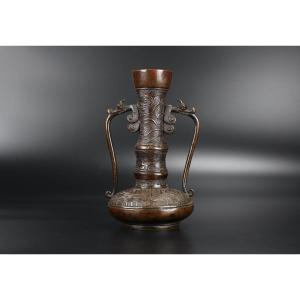
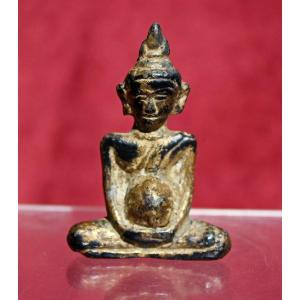
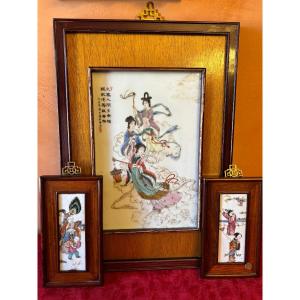
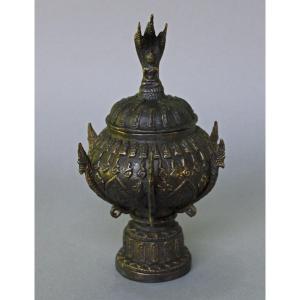
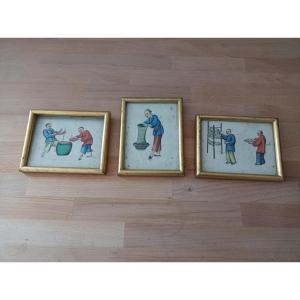
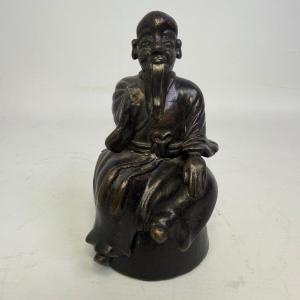
Pair of bronze Buddha hands, 19th century. Exquisite craftsmanship, particularly evident in the decorative details of the handles. Beautiful original patina. Mounted on wooden bases in the 1930s. This[...]
A boxwood netsuke depicting a seated monkey, wrapped in a finely carved kimono and rendered with careful attention to detail, shown in the act of putting on an Okame mask.
Period: Meiji period, late [...]
A boxwood okimono depicting a mouse holding a millet ear between its paws, while the young rests on its back, signed Ikko. The eyes are inlaid in horn, and the carving is finely executed, with particu[...]
A Japanese six-panel folding screen painted on silk with a gold ground, depicting a spring garden. In the foreground, peonies (botan), irises (ayame), and other seasonal flowers bloom at the base of a[...]
A Japanese six-panel folding screen, painted on paper with gold leaf, depicting a rakuchū rakugai zu (洛中洛外図), the celebrated panoramic view of the city of Kyoto.
The scene unfolds across a broad urba[...]
"Wisteria Viewing at the Kameido Tenman Shrine" 1820 The most famous Japanese artist in ukiyo-e prints during the Edo period (1603–1868), Katsushika Hokusai is the author of a world-famous work: The G[...]
View of Ohara by Hokusai Katsushika (1760-1849) 1820 The most famous Japanese artist in ukiyo-e prints during the Edo period (1603–1868), Katsushika Hokusai is the author of a world-famous work: The G[...]
Asian Relief Painting – Palace and Garden Scene – Relief Silk Embroidery. This magnificent decorative painting depicts an Asian architectural scene with a traditional palace, a grand staircase, and a [...]
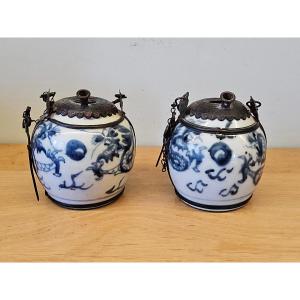
Antique Chinese porcelain water or opium pipe. Late 19th century, complete with its mouthpiece. Dimensions: 13 cm high (without the stem) and approximately 10 cm in diameter. In good condition with si[...]
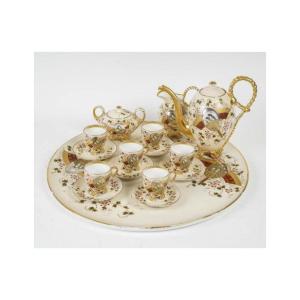
Antique and magnificent Japanese porcelain tea service from the Meiji period, late 19th century. Decorated with Mount Fuji and birds, very high quality. In perfect condition, it includes: 6 cups and s[...]
A fascinating pair of polychrome wooden masks, probably Balinese or Javanese Topeng masks. These masks appear to represent royal or noble figures. Asia, late 19th century
Indochina cigarette case with dragon motif. Beautiful piece, late 19th/early 20th century. Typical work from Southern China and Indochina. Bas-relief depicting a dragon in clouds; reverse showing pala[...]
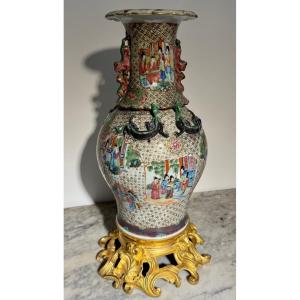
The vase's body has four facets and is decorated with four different scenes. They are finely painted and gilded. Late 19th century (Meiji period). Inscription under the base. Height : 9.5 cm. Please s[...]
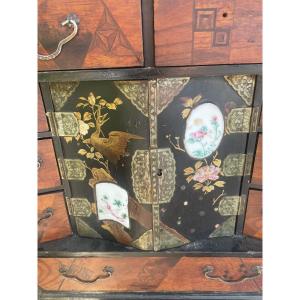
This piece of furniture is a substantial rectangular apothecary cabinet, resting on four straight legs and composed entirely of forty-five small drawers arranged on the front in a strictly orthogonal [...]
Beautiful silk purse embroidered with gold and silver thread, known as "he bao," decorated with animals and insects. Chinese work from the 19th century. Dimensions of the purse without the cords: 9cm [...]
A very pretty pair of kimono collars, of Japanese origin. Late 19th century. Embroidered on silk with gold thread. Depicting bamboo accompanied by a poem. Each piece measures 76 x 9 cm. Extremely fine[...]
KNIFE called Aikushi, signed Kadomatsu saku koreJapan - Edo period (1603-1868)Steel, wood, lacquer, silverNagasa: 51.7; Nakago: 14.2 cm(Previously restored) Kata kiri ha blade, mune hikushi, ito suguh[...]
JAPAN - Hammered iron tsuba maru gata, Edo period, with inlaid decoration of flowers in their branches in the form of a zogan in gold. Unsigned. Diameter: 8 cm
This fine Japanese Satsuma ware incense burner (kōro) was produced during the Meiji period, circa 1890–1905, and is signed Satsuma Shunzan zō (薩摩 俊山 造). The piece represents a high-quality example of [...]
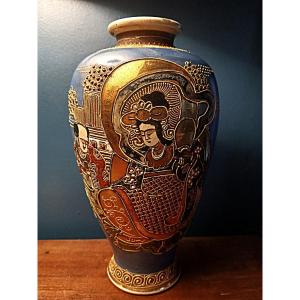
Large porcelain vase with hand-painted and gilded decoration. It depicts a pair of pheasants, a phoenix, various flowers, and butterflies. Japan, Meiji period (1868-1912). Visible signature on the bas[...]
A meticulously hand-painted and gilded porcelain vase. One side depicts a woman with a child surrounded by lush vegetation, with mountains in the background. Above them, the majestic Japanese phoenix [...]
Hand-painted porcelain vase. The front scene depicts three beautiful women in elegant kimonos, above whom a flowering momiji maple tree is visible. The other side of the vase features a kacho-ga scene[...]
An unusual vase made using the Totai Shippo technique, a variation of cloisonné. In this case, the cellular glaze covers a porcelain vessel rather than a metal one. The decoration features vegetal and[...]
An unusual ceramic (earthenware) vase, made in Japan in a style reminiscent, through its colors and decorations, of Iznik ware from Turkey. It depicts birds of paradise, lush vegetation, flowers, and [...]
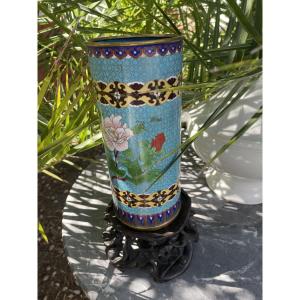
A bronze vase covered in multicolored lacquer and gold decorations. The hand-painted scenes depict Chinese boys playing various instruments, as well as decorations from the world of flora and fauna: b[...]
This large Meiji period (1868-1912) brush pot consists of a cylindrical section of fine wood, decorated with maki-e lacquer depicting wading birds and other birds in a wooded and leafy lakeside landsc[...]
An interesting pair of two-branch candlesticks, each composed of two 18th or early 19th-century Chinese famille rose porcelain figurines depicting two figures from the Eight Immortals, likely Shoulao [...]
Important Chinese porcelain dish - 19th century, probably Guangxu period. Chinese porcelain dish with famille rose enamel decoration. In its center, a phoenix is depicted moving through a floral lands[...]
Magnificent antique Chinese-inspired embroidery panel, dating from the 19th century, entirely handmade. The fabric features a finely embroidered motif depicting traditional Asian decorative elements, [...]
Pair of Chinese Phoenixes in Polychrome Glazed Ceramic – China, circa 1840–1860. A rare and decorative pair of Chinese phoenixes in polychrome glazed ceramic, made in China around the mid-19th century[...]
Refined large Canton porcelain punch bowl, attributed to the Famille Rose. The bowl is decorated on the inside with paintings of scrolls and animated scenes featuring palace figures, flowers, birds, a[...]
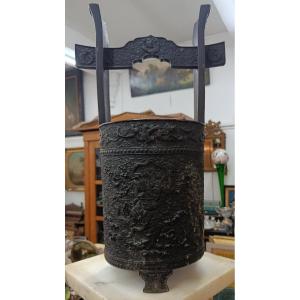
A bucket made entirely of juxtaposed wooden slats, lacquered; so far, it appears to be a typical domestic container, Chinese, from the 19th century. But I was able to translate the inscriptions, which[...]
Trishula, a trident originating in southern India, commonly used as a religious symbol in Hinduism, Balinese, and Buddhism. It is the Hindu weapon of the god Shiva, and its name means "three spears."
JAPAN - Edo Period (early 19th century). Samurai wakizashi in shirasaya style. Zoomorphic kashira in chased copper, patinated black and gold, depicting a shishi (a type of fish). Fushi in finely chase[...]
JAPAN - Edo Period (1603-1868). Samurai Tanto. FUSHI and KASHIRA in a set of chased, patinated, and gilded copper decorated with horses and flowers on a nanako background (very slight oxidation). TSUK[...]
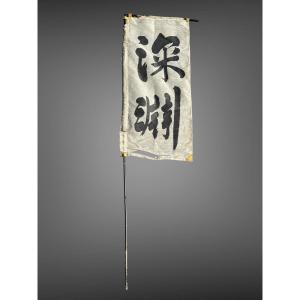
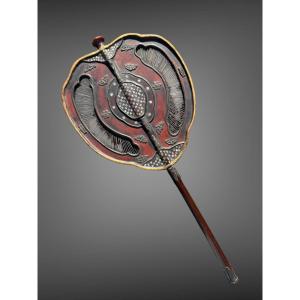
JAPAN - Edo Period (1603-1868). Samurai sahai. Command staff made of lacquered wood, leather, and paper, with gilded copper finials decorated with hearts (shaped like a boar's pupil, a symbol of coura[...]
JAPAN - Edo Period (1603-1868). Samurai Katana. FUSHI and KASHIRA in a set in silvered copper depicting stylized geese flying in clouds. TSUKA in wood covered with ray skin and black silk braid. MENUK[...]
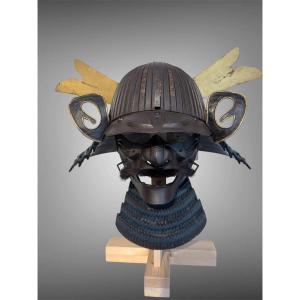
JAPAN - Edo Period (1603-1868). Half-mask of a samurai known as a "Mempo," made of brown lacquered wrought iron. Features a pronounced chin, a movable nose, light white horsehair mustache, pierced nos[...]
JAPAN - Edo Period (1603-1868). Samurai Katana. Black patinated copper kashira. Chiseled, patinated, and gilded copper fushi depicting a bamboo forest. Wooden tsuka covered with red-dyed stingray skin[...]
JAPAN - Edo Period (1603-1868). Samurai sahai. Command staff made of lacquered wood (minor losses) and paper, with silver tips decorated with hearts (shaped like a boar's pupil, a symbol of courage). [...]
Striking ritual bronze sculpture depicting a mounted rider on horseback, cast using the traditional lost-wax technique. This piece originates from the Batak culture of North Sumatra, Indonesia.
The f[...]
A lovely gadrooned dish in polychrome and gilt porcelain. Beautiful floral decoration of high quality. Perfect condition. Japan (Arita port). 19th century.
This richly carved four-doored wardrobe depicts mythical scenes and scenes of daily life, all embellished with auspicious symbols (peach blossoms, ruyi, etc.). The panels, stained red or black and enh[...]
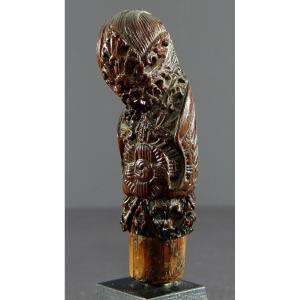
Carved bone kris (dagger) handle depicting a demon - Indonesia, 19th century. A very fine and expressive sculpture. The demon is depicted with a protruding belly and genitals. The face has a grotesque[...]
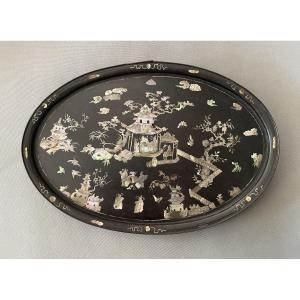
19th Century Chinese Black and Red Lacquer Coffee Table with Separate Top. The table is lacquered black with a gilt floral decoration. The edge of the separate top is lacquered black with a hand-paint[...]
SILVER AND TURQUOISE EARRING PENDANT, TIBETChina, Tibet, early 20th centurySilver, turquoiseH: 7.7 cm – W: 2.2 cmPendant made on three large registers and one small one, with silver work allowing the [...]
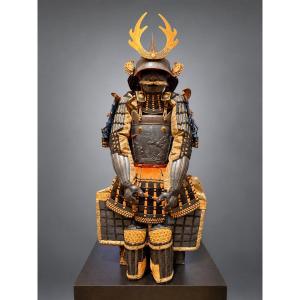
KUWAGATA – SAMURAI HELMET ORNAMENT “MAEDATE”Japan, Edo period (1603–1868)H: 29.8 cm – W: 18.4 cmGilded bronzeMaedate Kuwagata in cut and gilded bronze, pierced with an inone symbol of Marishiten, godd[...]
Exquisite Chinese wedding bed with its canopy and alcove in polychrome and carved wood. Decorated with scenes from Chinese opera ; 19th century. Beautifully crafted ; the quality of the carving is sub[...]
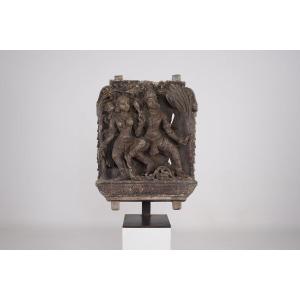
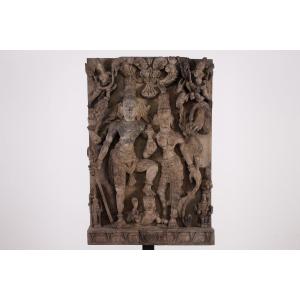
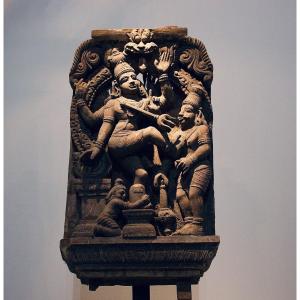
Carved wood, with an arch that has been reattached. Krishna has lost his flute. Traces of lateral fixings are visible. The cow licking Krishna's foot is an iconographic representation linked to the ve[...]
Antique Japanese inrō in black lacquer, composed of several compartments. One side is decorated with a traditional Japanese landscape featuring a pavilion, mountains, and stylized vegetation, enhanced[...]
Proantic uses a cookie to analyze traffic and improve its service by using Google Analytics. Data sent to Google Analytics (frequency of visits to the site and pages visited) are anonymous. No other cookie tracks your activity, your personal data is not collected. Thank you for helping us to have better understanding how Proantic is used.