Christ Crucified (Christus Patiens) with God the Father, the Virgin and St. JohnIn the manner of 14th century Tuscan paintingTempera on panelHeight: 150 cmWidth: 99 cmPerformed non-invasive conservati[...]
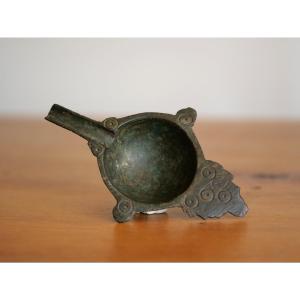
Small bronze cup decorated with triskeles within a circle (8), all surrounded by arabesque motifs. The cup is surmounted by a bird (duck?), and the whole is covered with a green patina. The object is [...]
China – Cizhou kiln, Yuan Dynasty (1279-1368) / Ming Dynasty (1368-1644) Beige glazed stoneware jar with brown glaze decoration of a character (glaze chips) Height 18cm, diameter approx. 30cm - €680 -[...]
An elegant Neapolitan chest of drawers in Louis XIV style, crafted with fine workmanship and featuring the rich decorative elements and harmonious proportions typical of the period.
It has a solid st[...]
Virgin and Child with a Goldfinch. Original polychromy. The Virgin holds the Child on her lap, supported by her left hand. In her other hand, she held an object now missing (a scepter?). The Child hol[...]
Pair of medieval capitals decorated with leaf motifs, Lombardy, 12th century.The slender shape from which the lanceolate leaves emanate, surmounted by a thick corbel, is typical of Lombard capitals pr[...]
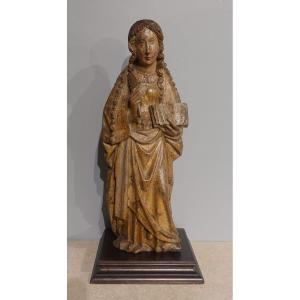
Saint John the Evangelist and the Virgin from a Crucifixion Group, Spain, circa 1500, in walnut. Superb pair of gilded and polychrome wood sculptures from the late 15th century, circa 1500, with a Got[...]
Large, shallow bowl resting on a ring-shaped ceramic foot, decorated with incised sgraffito on a white slip, composed of lozenges and crosshatching highlighted with green and yellow glazes. 10cm high,[...]
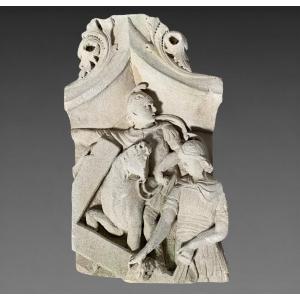
Marble architectural fragment - 15th century. The sculpture depicts carved religious scenes from the Bible. The lower part of the fragment features an inscription, likely in a Greek or Hebrew-Aramaic [...]
Sculpture depicting the Virgin and Child, carved in high relief on a limestone shaft. A striking piece that likely originated from a rood screen. The faces have been cropped, and the Virgin's face has[...]
A Lagynus wine jug, made of terracotta. Roman period (1st/2nd century AD), a jug with a lenticular body and a beautiful central carination; a typical piece of Punic ceramics.
A terracotta feeding bottle, Roman period, 3rd century, with an ovoid body, a flared neck with a strainer at its junction with a short spout. A handle on the back. The spout is nipple-shaped, clearly [...]
Small Punic terracotta amphora, Roman period, 3rd and 4th centuries. Dimensions: 27 x 17 cm, opening diameter: 4.5 cm. Weight: approximately 500 grams. A small crack on the neck, as well as two chips [...]
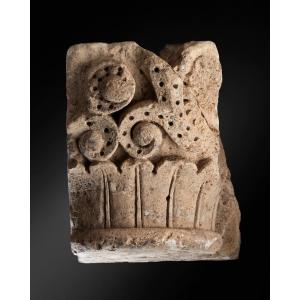
Fragment of a Romanesque marble cornice - 13th century. The fragment features a sculpted decoration with stylized plant motifs that may resemble acanthus leaves, arranged in spirals and intersected by[...]
Superb lead bulla of Robert of Anjou (Count of Provence and Forcalquier, Duke of Calabria, King of Naples and Sicily...). On the reverse, the shield with the arms of Aragon, for Yolande of Aragon, wif[...]
Archaeology. Large antique terracotta bowl on a foot. 1st-3rd century AD. Dimensions: Diameter: 28 cm. Height: 6.2 cm. In good condition, no chips or cracks, with concretions present: as shown in the [...]
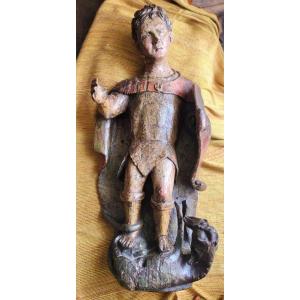
Delicate carved bone figure of Saint Sebastian, dating from the late 15th century (Late Gothic period). The saint is depicted in the traditional semi-nude pose, with the characteristic original small [...]
Fragment of a Sarcophagus with the Judgment of Paris Roman Period, 3rd century AD Stone 26 × 31 × 30 cm This fragment of a Roman sarcophagus preserves part of a relief depicting the Judgment of Paris,[...]
Marble architectural fragment – 1st century AD. This white marble fragment, dating from the 1st century AD, comes from an architectural element that likely belonged to a Roman-era sculpted decoration,[...]
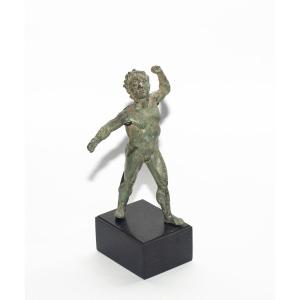
Period: 3rd – 1st century BC. Origin: Italy – Etruria. Provenance: Formerly in a private collection in southern France, by inheritance, acquired before 1970. Antique bronze statuette representing a st[...]
Period: 1st – 3rd century AD. Origin: Provincial Roman world. Provenance: Former private collection in southern France, by inheritance, acquired before 1970. Small antique statuette depicting an eagle[...]
Bronze gong with a typical green patina, dating from the 15th/16th century, Khmer period in Vietnam. The Central Highlands of Vietnam then belonged to the Khmer Empire. The center of this empire was l[...]
Roman Head of a Bearded Dionysus , Marble, 2nd Century AD. A beautiful antique marble head depicting a bearded god, probably Dionysus, sculpted during the Roman Imperial period. The slightly inclined [...]
A rare and authentic Renaissance games box from the Embriachi workshop or Lombard “certosina” tradition, produced in Northern Italy around 1470–1520.
Compact in form (15.5 × 15.5 × 7 cm), this box wa[...]
13th-14th Century Bronze Islamic Ring w Silver Inlaid Eight Pointed StarA beautiful large medieval ring with beautiful silver inlay through the ring. the main focus is the inlaid eight pointed star.Th[...]
Medieval Viking Twisted Bronze Bracelet “Arm Ring” 900 AD – 1100 ADThese kinds arm rings made of twisted metas such as bronze, brass, silver and gold where given to young male children as symbol of tr[...]
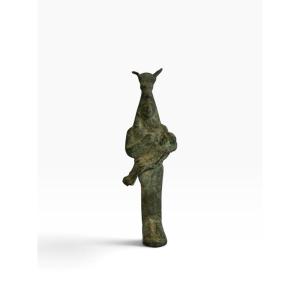
Archaeology: Bronze Osiris with a dark patina. Ancient Egypt, Late Period (664-332 BC). He holds a flail and scepter, wears the atef crown, and sports a false beard. Dimensions: Length: 6.4 cm. Width:[...]
High Carat Gold Ring Set with a Roman Magical Jasper Intaglio. Roman intaglio: 1st–2nd century AD. Mount: 20th century. MeasurementsRing size: O UK / 7.25 US / 55 EUBezel: 2.3 × 1.8 cmIntaglio: 1.8 × [...]
Very old two-handled flask, known as a pilgrim's flask, made of Roman Empire terracotta, decorated with scenes of figures surrounded by arabesques. Condition: no cracks, a small chip on the neck, wear[...]
Of a respectable size, you will find here the possibility of creating two necklaces with a set of entirely original raw red beads, each measuring 65 cm. The color is natural, attributed origin? Southe[...]
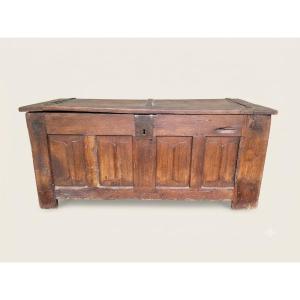
Large chest bench in solid chestnut, France, early period 1500-1600. Before this, this very simple chest bench was certainly in a castle fireplace. The top, composed of only three planks, is supported[...]
Bronze dagger from Luristan (western Iran), dating from the 2nd–1st millennium BC. The elongated triangular blade displays a beautiful antique green patina typical of buried bronzes. The cylindrical h[...]
I am offering this charming antique piece from a small collection in the Berry region. Please note that two small cabochons need to be reattached. The label is marked "Byrsa" for Carthage in Tunisia.
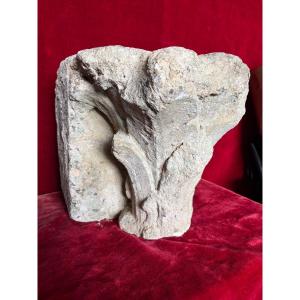
Lombard stone capital from the late Middle Ages, made between the 14th and 15th centuries. This model is known as a "waterleaf capital" because of its decoration evoking the leaves of wild rushes foun[...]
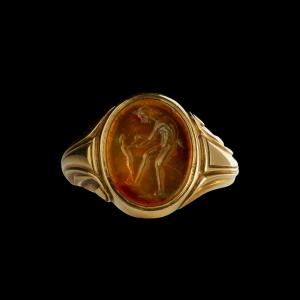
Silver and gold ring with carnelian intaglio - Roman period - 3rd century AD. A well-preserved Roman silver and gold ring from the 3rd century AD. The solid silver band measures 21 millimeters in inne[...]
This
sculpture, created in the 15th century in a French workshop, depicts
the Mater Dolorosa, the Virgin Mary mourning the death of her son,
whom she holds on her lap after the Descent from the Cro[...]
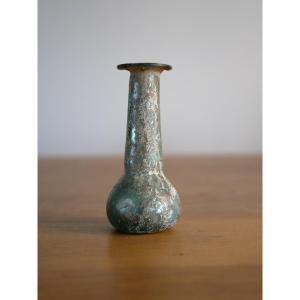
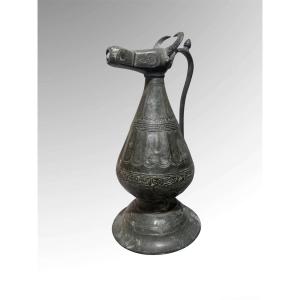
A 13th-century Persian ewer in iridescent turquoise-blue earthenware, its patina gleaming from archaeological excavations, with a zoomorphic rooster spout.
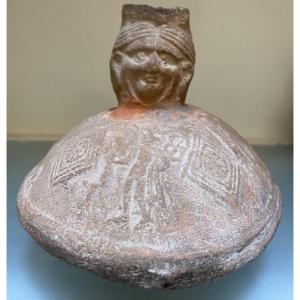
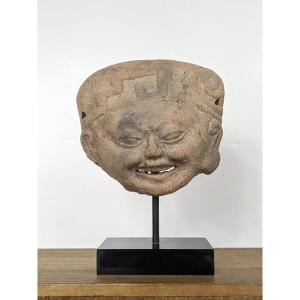
Beautiful small anthropomorphic terracotta pitcher in polychrome glaze. Pre-Columbian work, pre-16th century. Note: A chip is present on the neck. Height: 14 cm Diameter: 11 cm
A superb cathedral chair in carved and blackened oak, dating from the 17th century, with certain stylistic elements suggesting an earlier origin. This monumental cathedra, originally intended for a di[...]
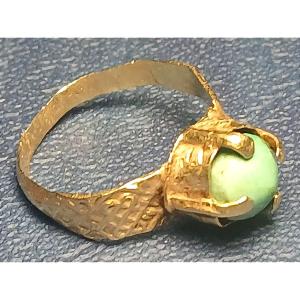
Byzantine "offering" ring, circa 400 CE. Material: orichalcum. Orichalcum is a legendary metal alloy said to have been used in Atlantis. Another alloy, probably of the same name, was used by the Roman[...]
Peru, Inca culture, 1400-1500 AD, orange-brown terracotta with traces of black ornamental paint. Bottle-shaped vase with a stirrup handle and a long tubular neck carved with a small monkey in relief, [...]
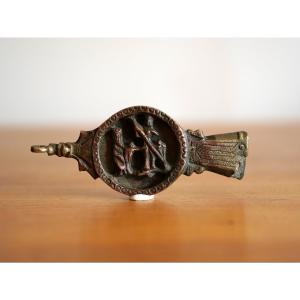
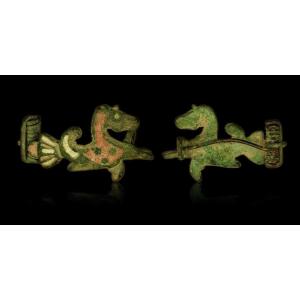
Bronze brooch (traces of gilding) with a cherub's face embossed in high relief.An Italian or French work from the late 15th and early 16th centuries, in true Renaissance style.The brooch is structured[...]
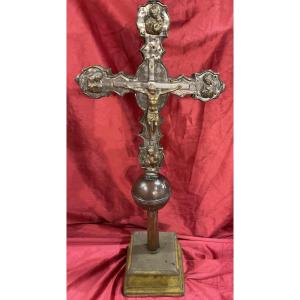
Double-sided processional cross in wood and gilt brass – France, 15th century. Discover an exceptional piece of medieval religious heritage: a double-sided processional cross made in France in the 15t[...]
Montans Sigillata Dish – Chresimus Stamp – Early 2nd Century AD. This superb sigillata dish comes from the workshops of Montans in the Tarn region and dates from the early 2nd century AD. It bears the[...]
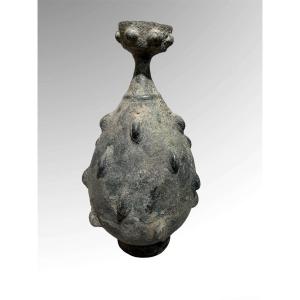
Extremely rare bronze HU vase, China, Han Dynasty (206 BC - 220 AD). Bulging body, two handles in the form of masks (rings missing). Excavated find, beautiful nuanced patina, very hardened clay on the[...]
This Roman jug embodies the tangible reality of daily life under the Empire during the 2nd and 3rd centuries AD. The object is distinguished by robust craftsmanship, characteristic of coarse ware inte[...]
This monumental bucchero nero oinochoe constitutes a masterpiece of Etruscan banquet tableware from the 7th century BC. Through its imposing dimensions (nearly 30 cm in height) and rigorous architectu[...]
Proantic uses a cookie to analyze traffic and improve its service by using Google Analytics. Data sent to Google Analytics (frequency of visits to the site and pages visited) are anonymous. No other cookie tracks your activity, your personal data is not collected. Thank you for helping us to have better understanding how Proantic is used.