



Phallic Bronze Amulet Pendant – Roman Period, 1st–2nd Century A.d. Archaeology
A very interesting bronze amulet pendant from the Roman period, dating from the 1st–2nd centuries AD, with a particularly original design.
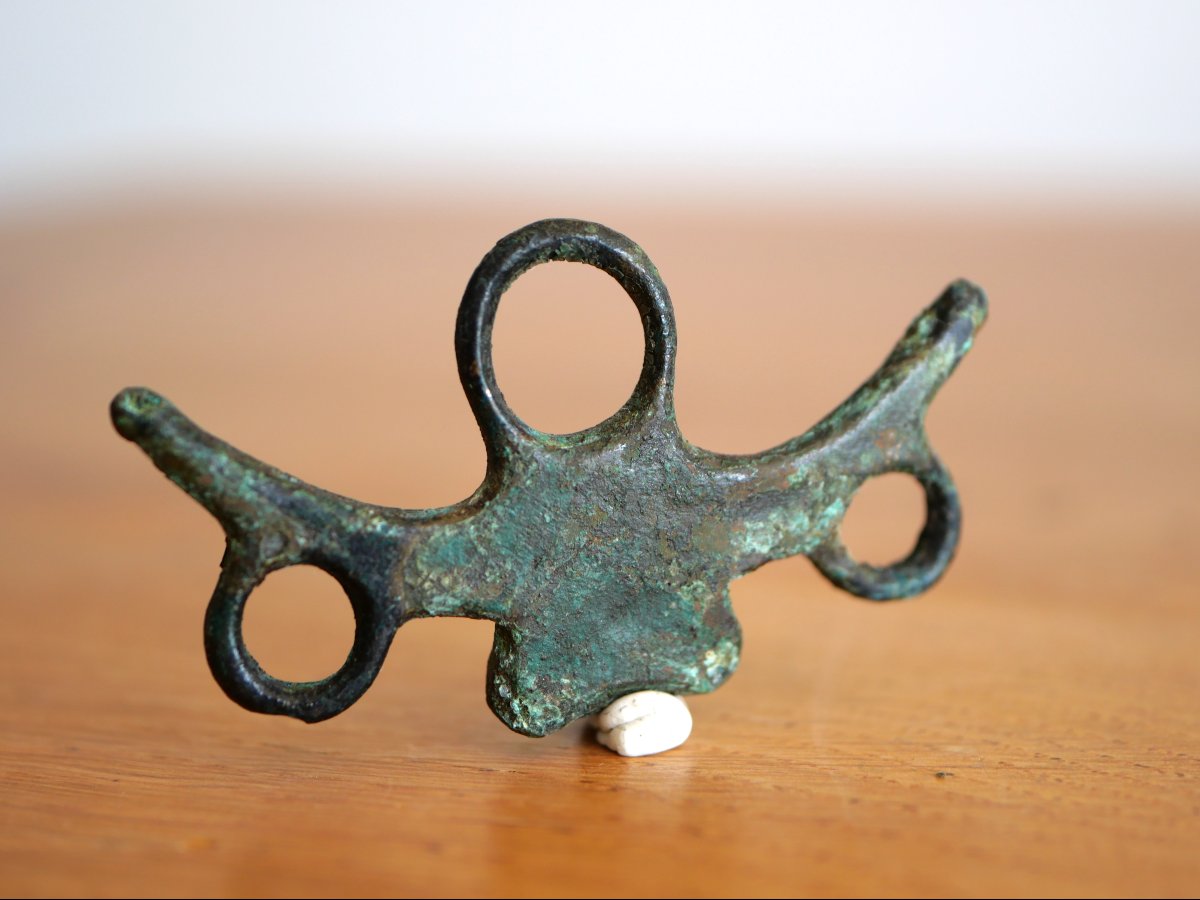
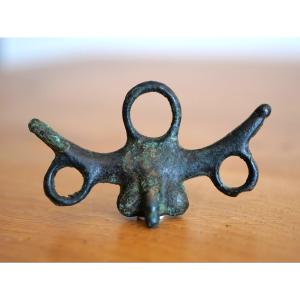
The amulet features a multiple phallic representation: a phallus viewed from the front is placed beneath the main suspension ring, while two erect phalluses extend laterally, forming a deliberately protective and apotropaic ensemble. This combination of multiple phallic representations gives this small object a particularly unusual character.
Phallic amulets were very widespread in the Roman world. Far from having solely an erotic meaning, the phallus was first and foremost considered a symbol of power, vitality, and protection. Worn as a pendant or attached to an object, it was believed to ward off the malocchio (evil eye), harmful influences, and bad luck. These objects thus served an apotropaic function, their depiction intended to repel or deflect malevolent forces. They could be worn individually or combined with other protective motifs.
Our specimen stands out for its unusual iconography featuring three phallic representations, as well as for its excellent state of preservation. It displays a beautiful, dark green patina—ancient and uniform—and remains complete with its suspension ring.
Provenance: former Burgundian collection, dispersed at auction.
A beautiful, complete Roman collectible—particularly decorative and featuring atypical iconography—that offers an original illustration of the protective beliefs of Roman antiquity.
Dimensions: 5.2 × 3.2 cm.
Price excludes shipping costs
Police Registry Ref.: A226
Professional Antique Dealer – Guarantee & peace of mind when purchasing
As a professional antiquities dealer, I am committed to offering only authentic items that have been carefully selected and are legally marketable. Each piece is chosen for its historical, aesthetic, or collectible value and undergoes a rigorous verification of its provenance.
Invoice and Traceability. Each purchase comes with a detailed invoice and a certificate of authenticity, guaranteeing the item’s provenance and ensuring complete transparency.
Legal Compliance. All items comply with current French and European legislation. Any archaeological items are offered in accordance with the Heritage Code (Articles L.542-1 et seq.). Items that may be subject to specific regulations (cultural artifacts, antiques, items made of specific materials) are sold strictly in accordance with the law.
International Buyers. Buyers outside of France are advised to verify the regulations applicable in their country regarding the importation of cultural artifacts or antiques.
Right of Withdrawal.In accordance with the law (Article L.221-18 of the Consumer Code), you have 14 days from receipt to return an item. Return shipping costs are the responsibility of the buyer. The item must be returned in its original condition.
Quality Commitment. Buying from a professional ensures security, transparency, and reliability. I am available to answer any additional questions you may have before making a purchase.
Period: Before 16th century
Style: Rome and Antic Greece
Condition: Good condition
Material: Bronze
Width: 5.2 cm
Height: 3.2 cm
Reference (ID): 1832842
Availability: In stock