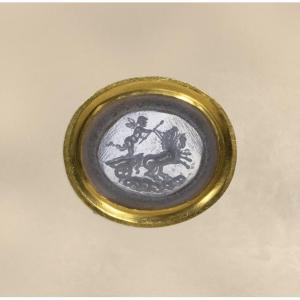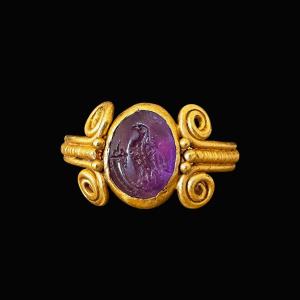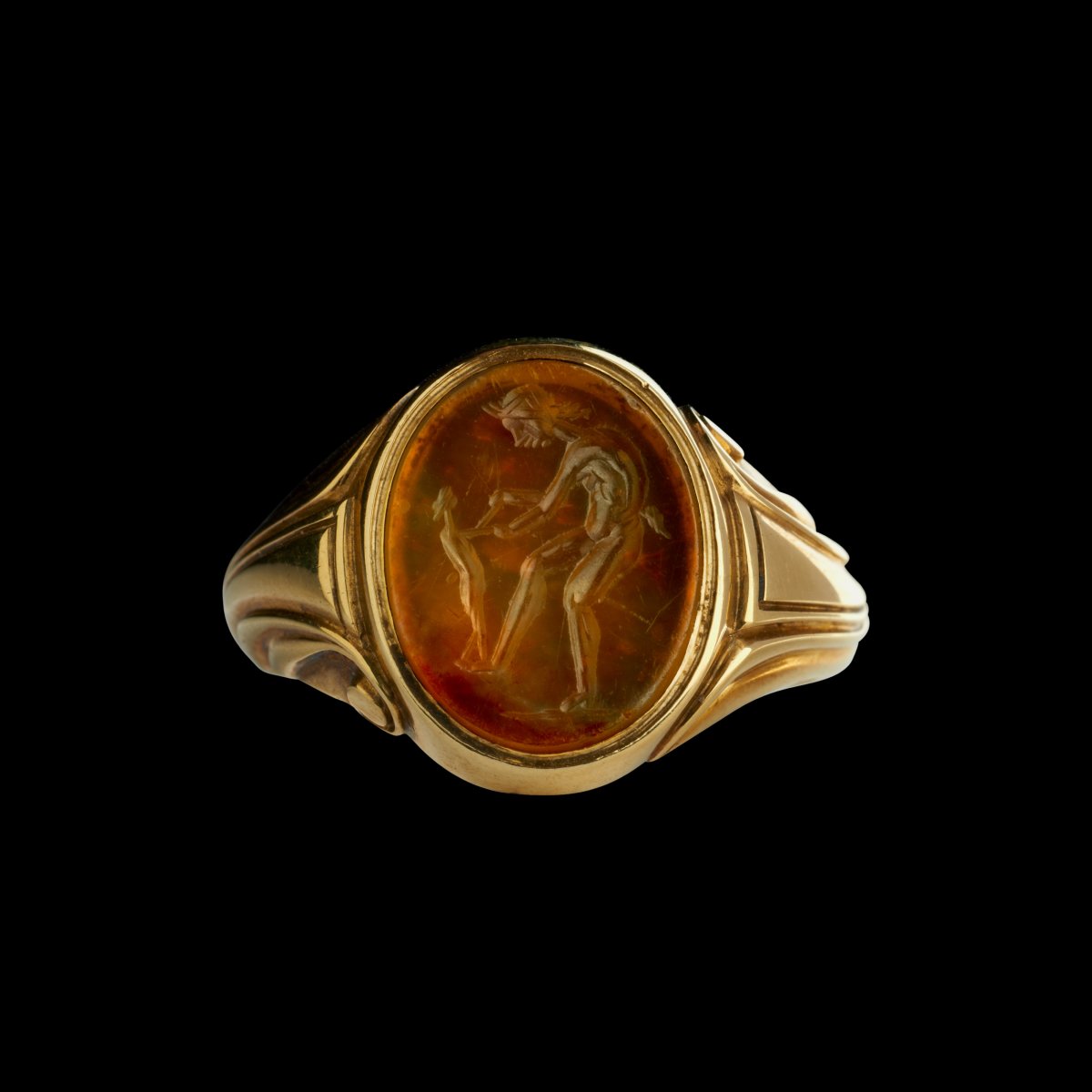
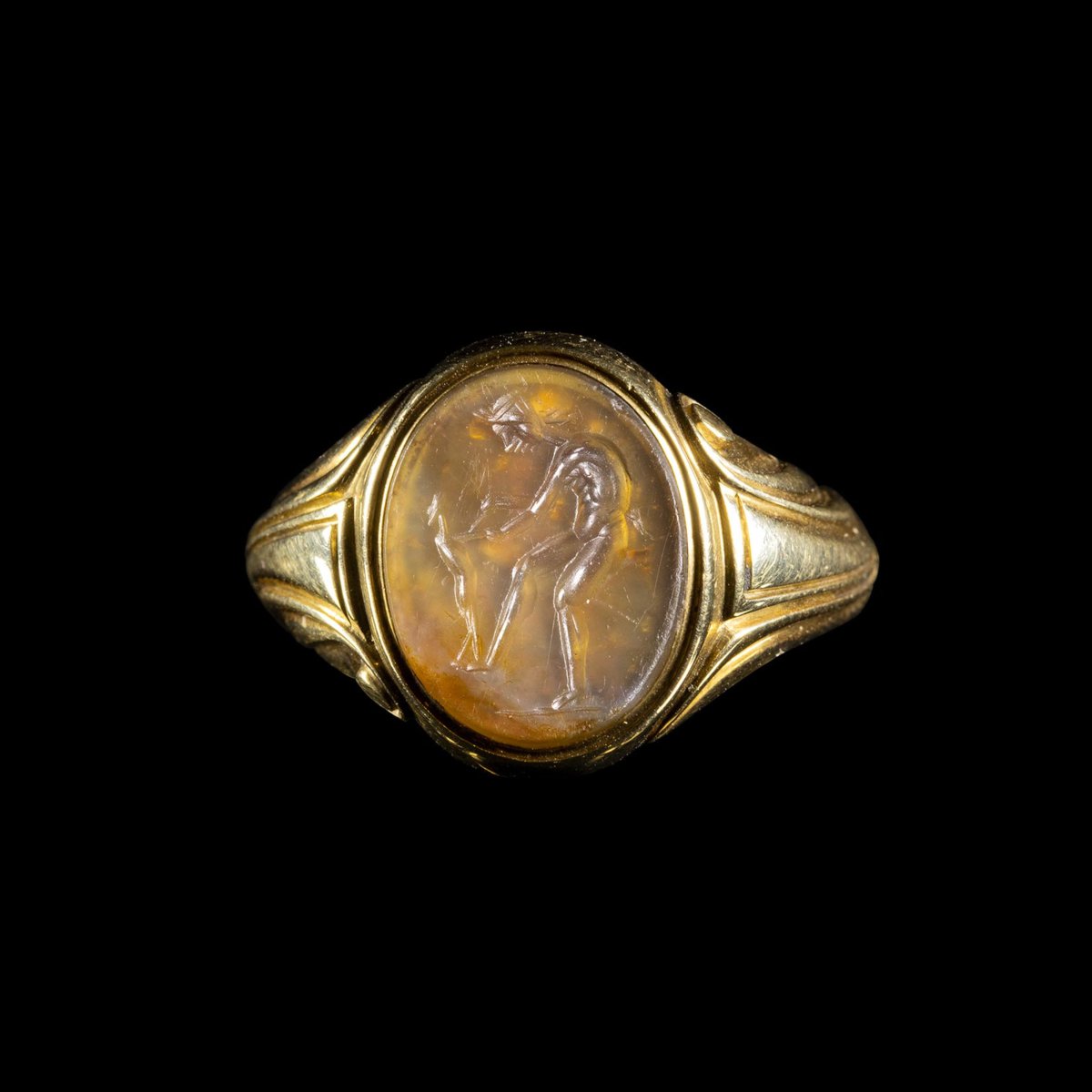
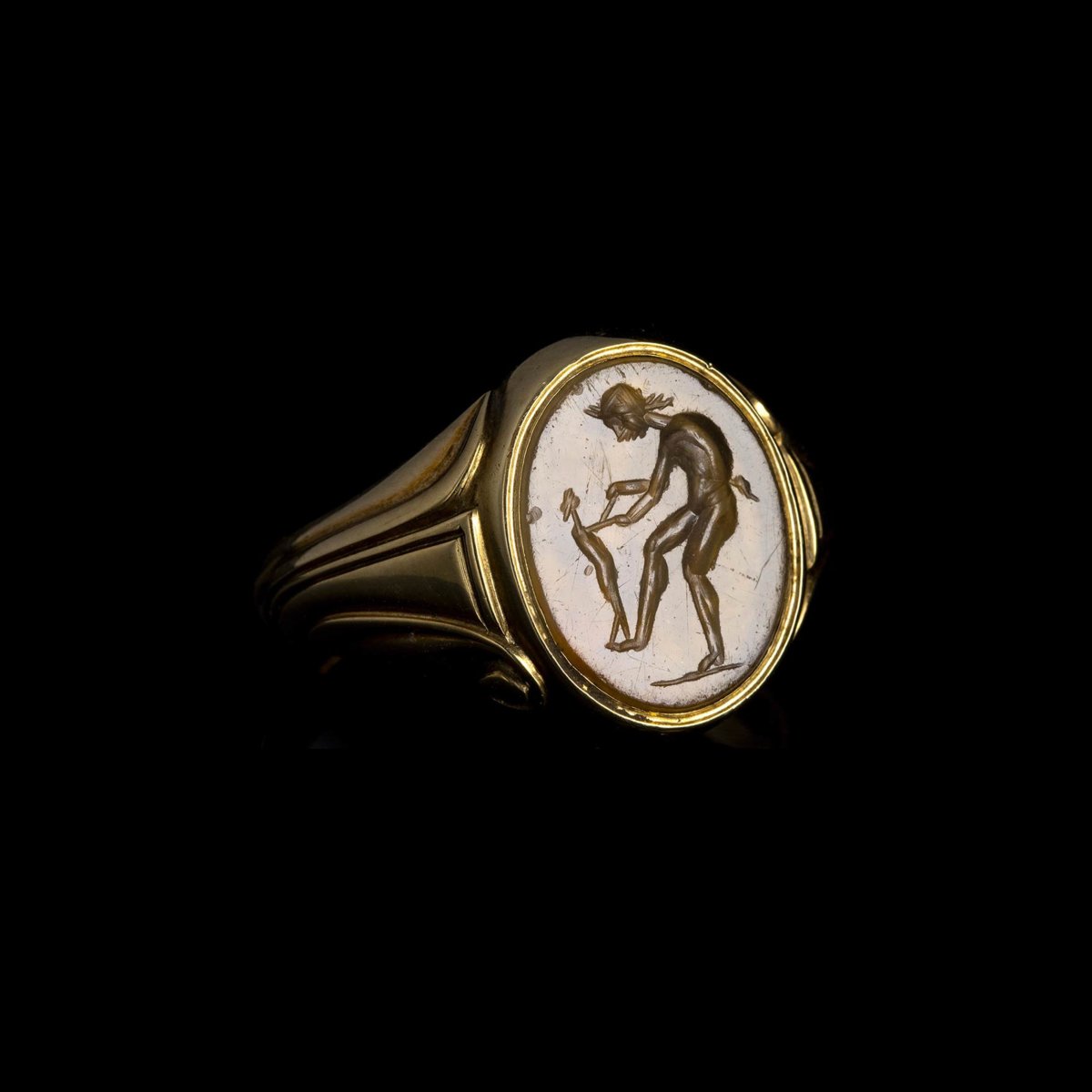


Roman Chalcedony Intaglio Depicting A Young Satyr Dancing With A Child, Set In A 19th-century Gold Ring
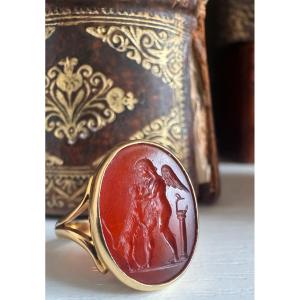
Chalcedony intaglio, Roman period, 1st–2nd century A.D. Setting: 19th-century gold ring with engraved shoulders.
Intaglio: 12 × 15 mm. Ring size: US 8½–10 / UK Q½–T½ / EU 58–63. Gross weight: 10.36 g.
Good condition; wear consistent with age, very slight chipping along the edge of the stone.
Description
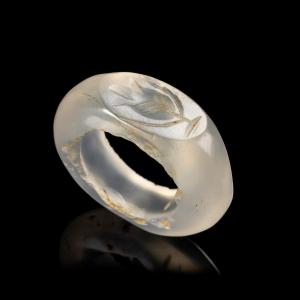
A solid ring engraved with fluting and foliage, widening toward the oval setting. A young satyr, his head crowned with a laurel wreath and turned to the left, leans forward over a line representing the ground. He holds a small child standing on its own feet by the arms; the two are dancing together. The tail, the slender, crouched body, and the tension in the limbs are engraved with a sure and economical hand.
Historical Context
The motif recurs in Roman gemstone carving; a similar gem is preserved at the Herzog Anton Ulrich-Museum in Braunschweig. Its source is Greek: the dance of the adult and the child already appears on Attic vases from the Classical period. Imperial engravers adopted these Dionysian scenes for their movement and grace.
Iconography
In the thiasos of Dionysus, the satyr is the god’s companion—half-beast, associated with wine and dance. Here, he takes on the role of teacher: the child is learning the steps while standing on his own two feet. Plato refers to the uneducated man achoreutos, “he who has not learned the chorus” (Laws II, 654a). The gem depicts education in its simplest form: a rhythm transmitted from one body to another.
Comes with a certificate of authenticity signed by Bianca Massard and Gabriele Vangelli de Cresci.
Period: Before 16th century
Style: Rome and Antic Greece
Condition: Good condition
Material: Gold
Reference (ID): 1828612
Availability: In stock