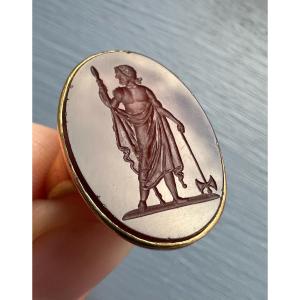


A Neoclassical Carnelian Intaglio Set In An 18k Gold Ring. Zeus Labraundos
Engraving 15 × 21 mm;
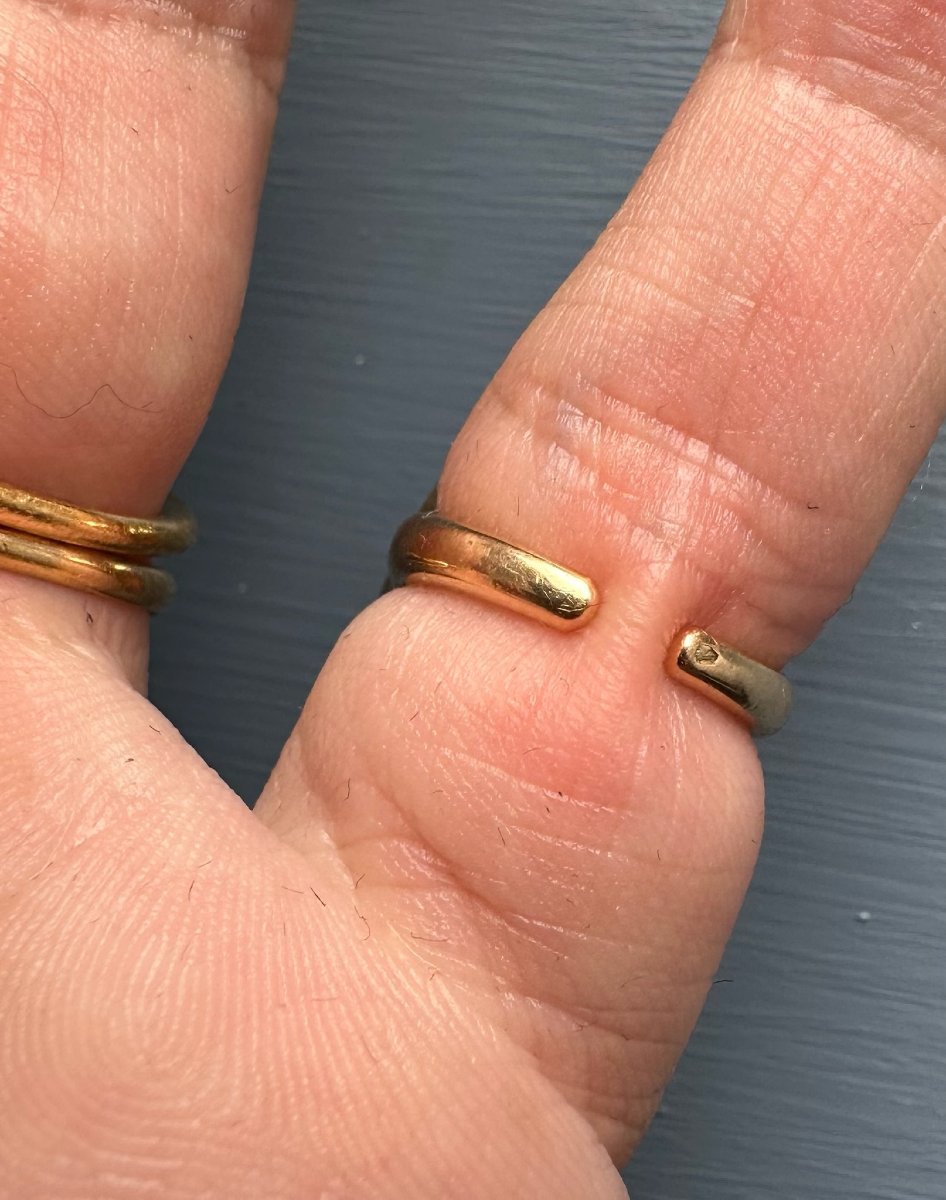
18-karat gold setting – ring size 53 (US 6½ / UK M½) — open, adjustable ring; gross weight 7.46 g.
Neoclassical intaglio, late 18th–early 19th century, based on a Carian coin type from the 4th century B.C.
Very good condition; sharp engraving; open ring on the back for adjustment; small hallmark on the band (eagle’s head)
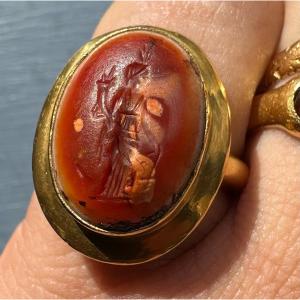
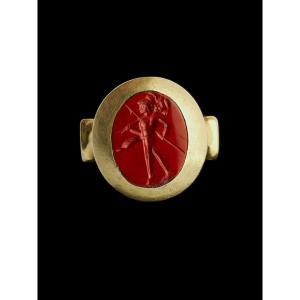
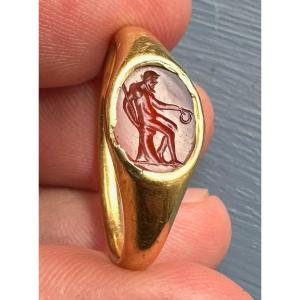
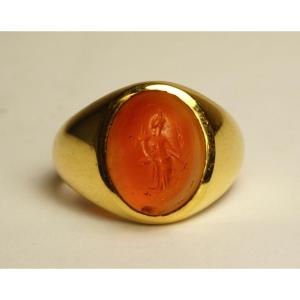
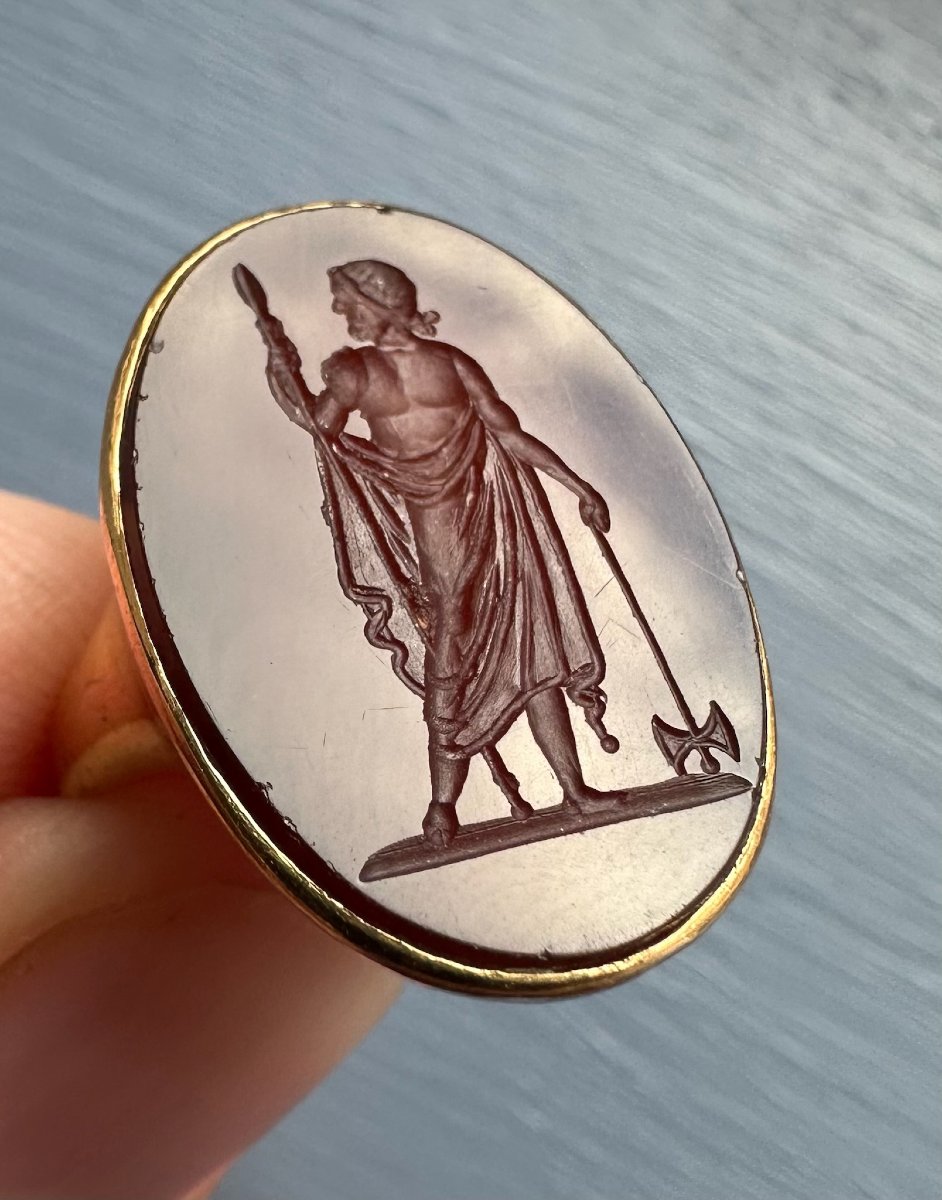
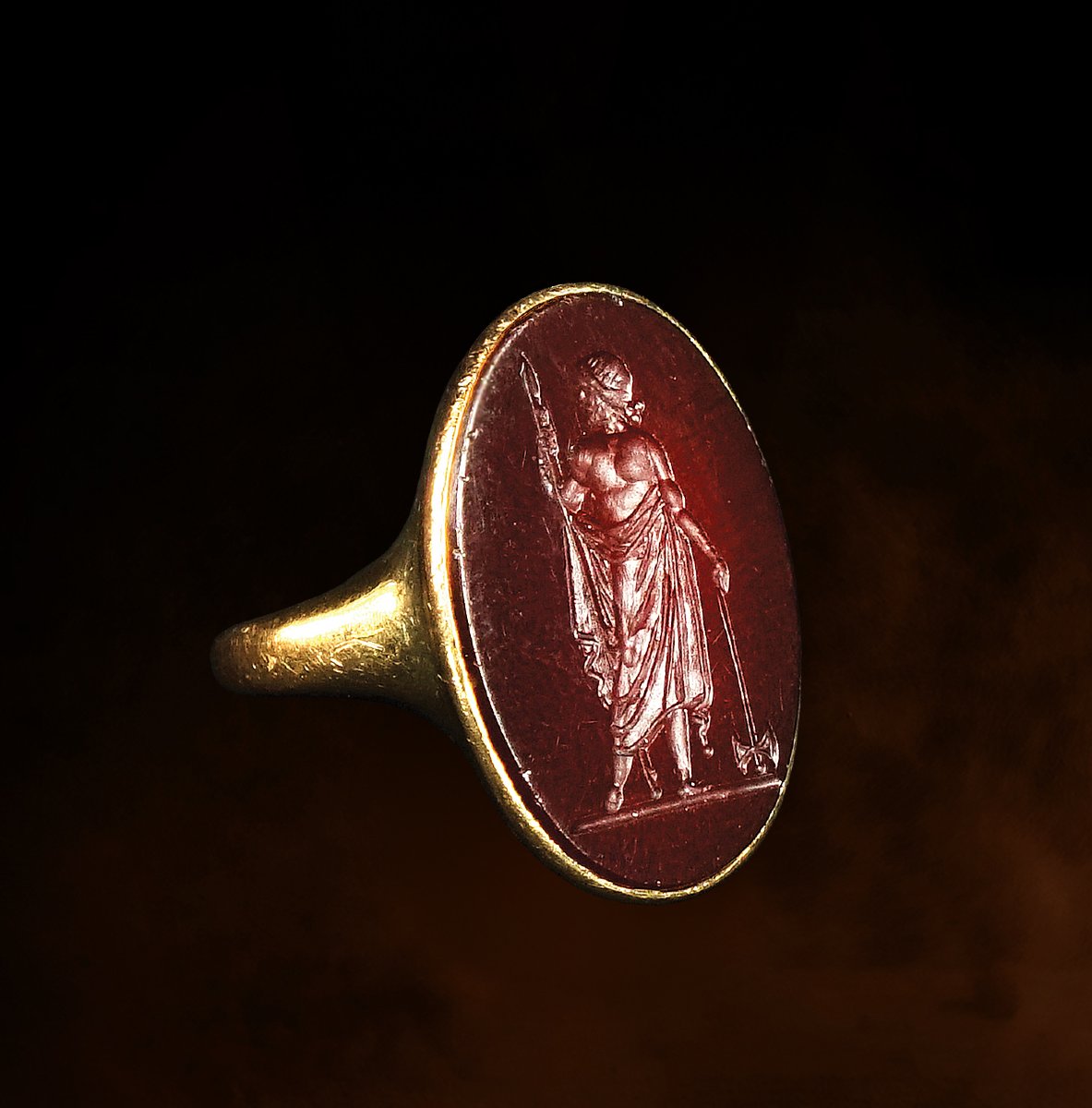
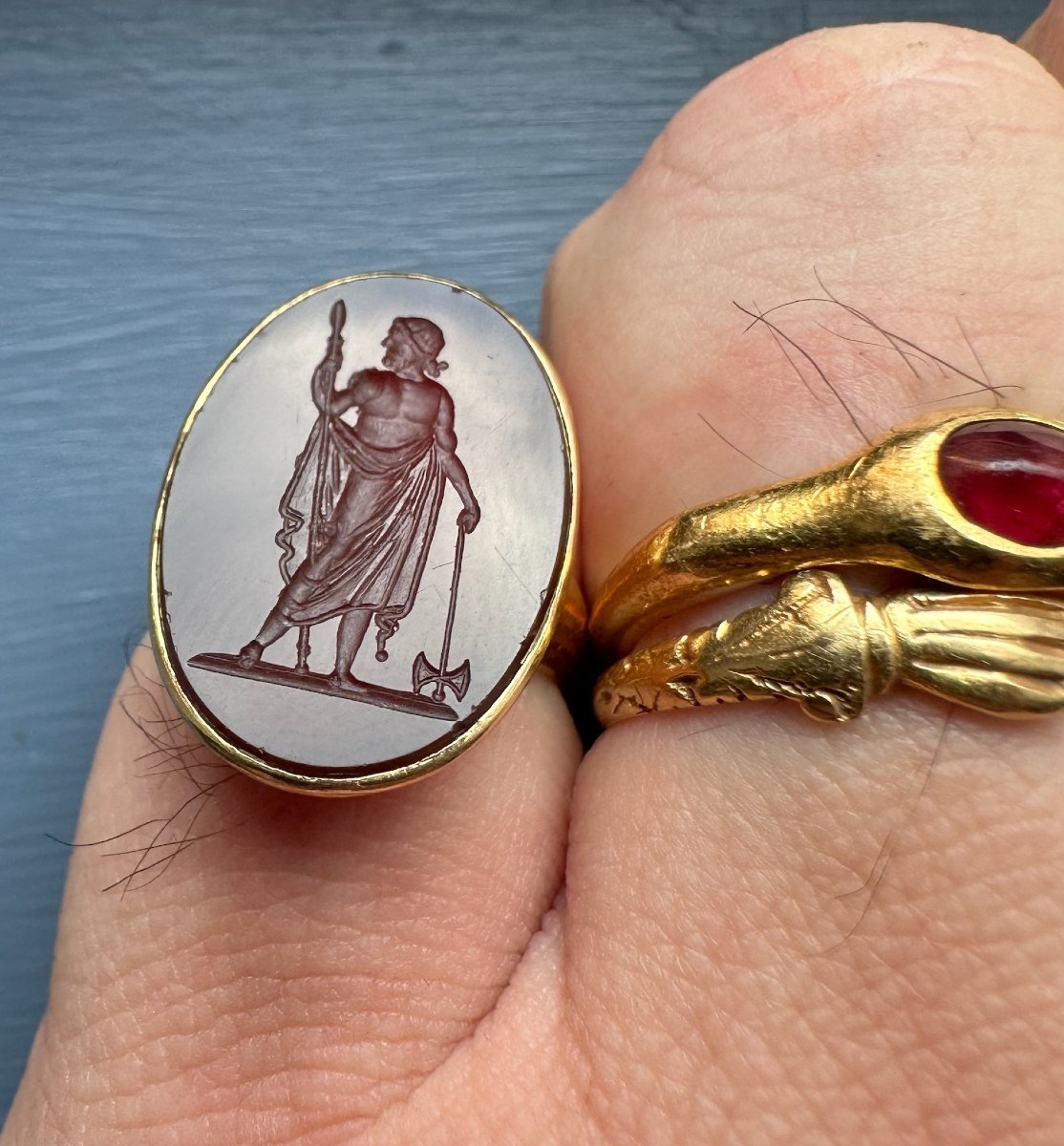
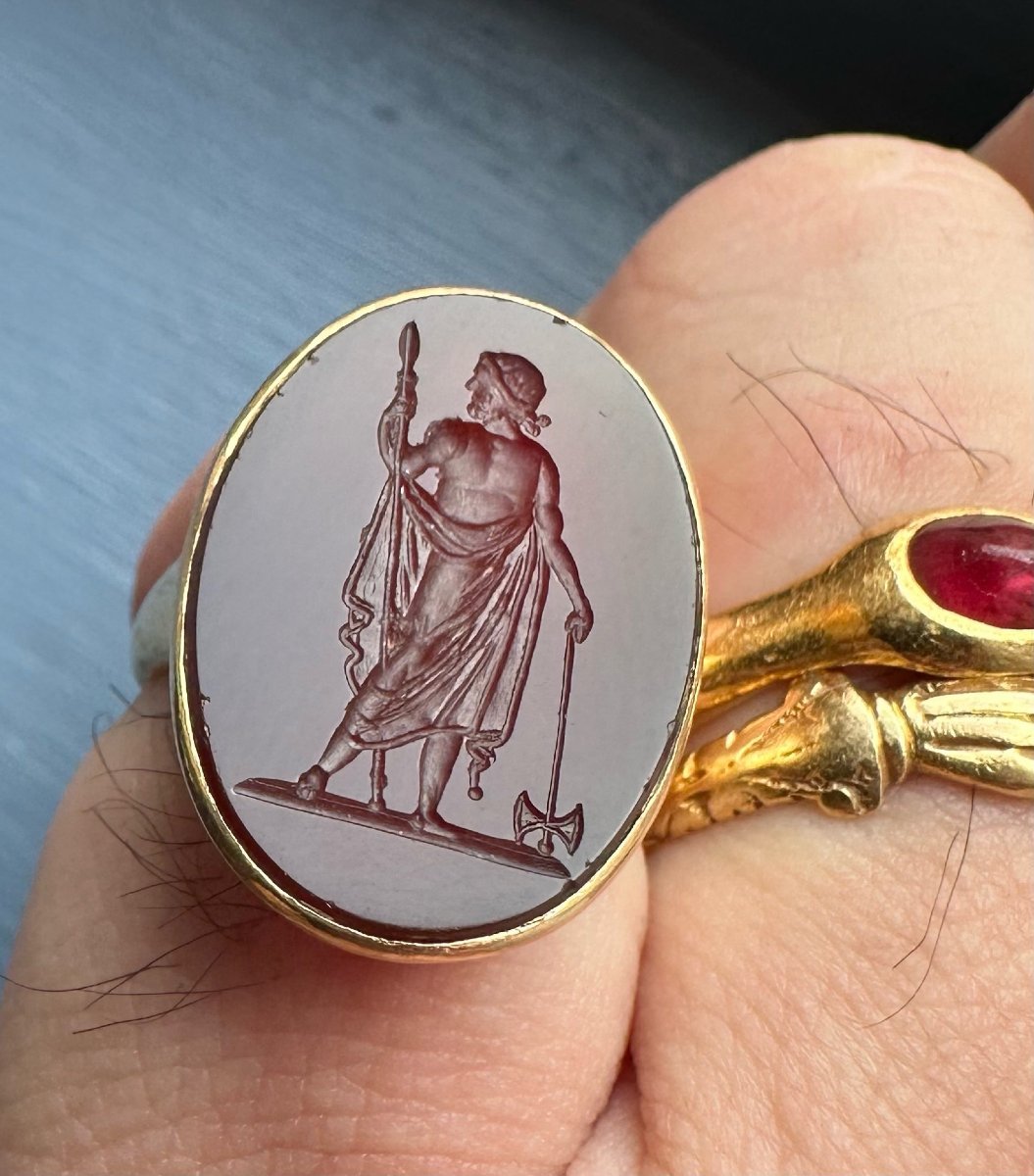
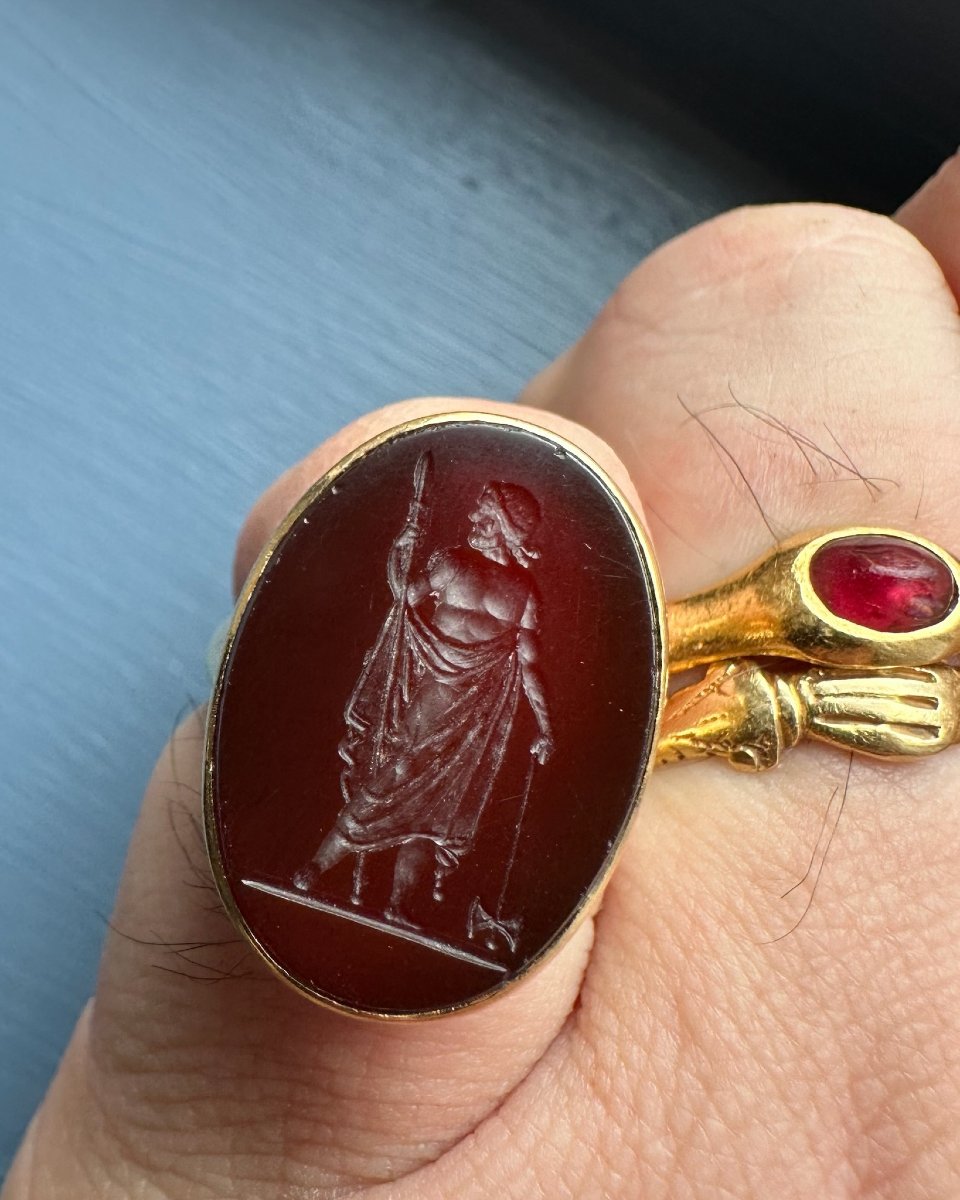
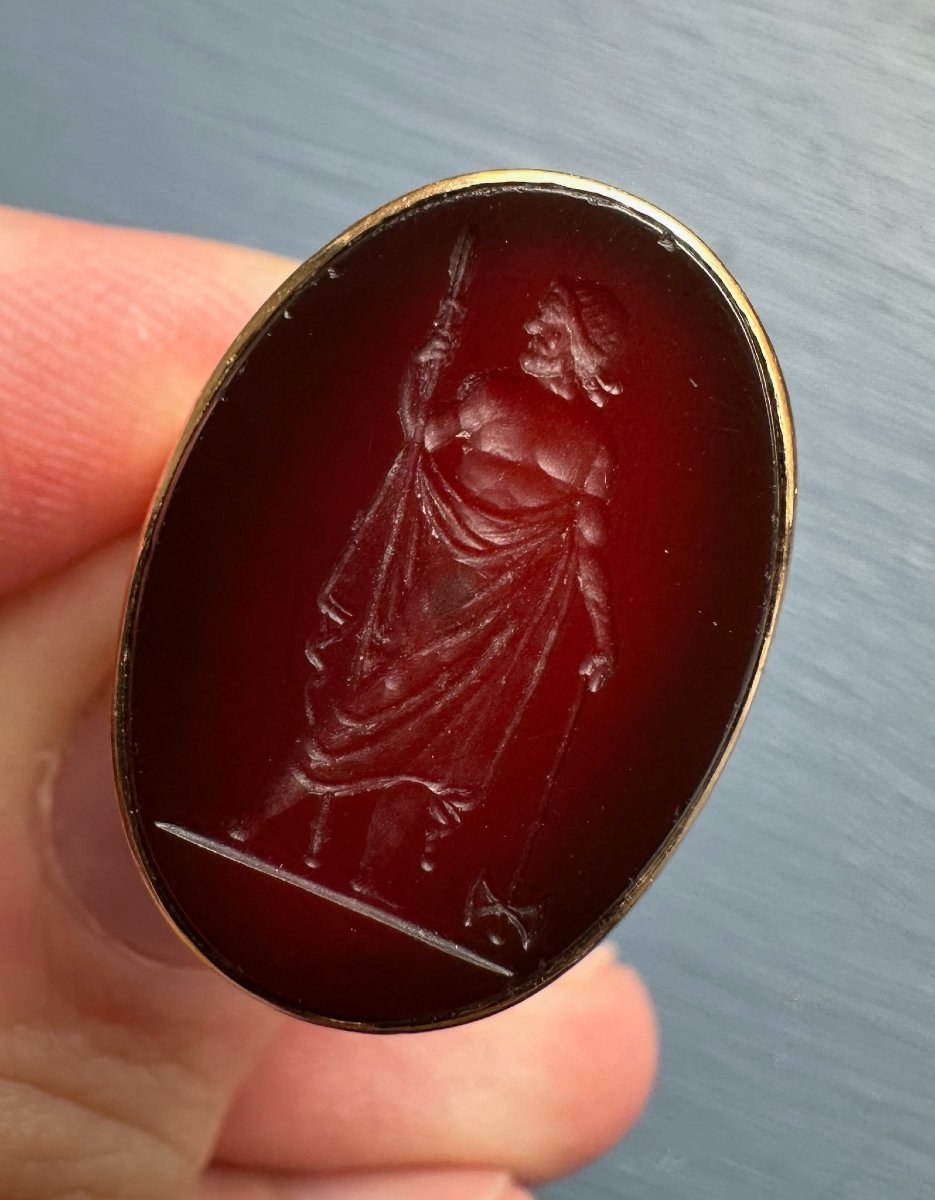
18-karat gold ring with an oval bezel setting, adorned with a large carnelian intaglio depicting Zeus Labraundos, the Carian Zeus with the double axe.
A bearded male figure, standing on a ground line, viewed from the back in a slight three-quarter profile, with his head turned in profile to the left. He wears a close-fitting cap; the cloak does not drape over the shoulders: held at both forearms, it extends behind the hips and leaves the back and torso entirely bare, its panels falling on either side down to the calves. The right hand raises a spear with a leaf-shaped tip; her left hand holds the long-handled double-headed axe, the labrys, resting on the ground. A bold and confident engraving, featuring a muscular back draped in long, supple folds: the vocabulary of Neoclassical engravers, here employed in the service of scholarly iconography.
Historical Context – Ancient Numismatics
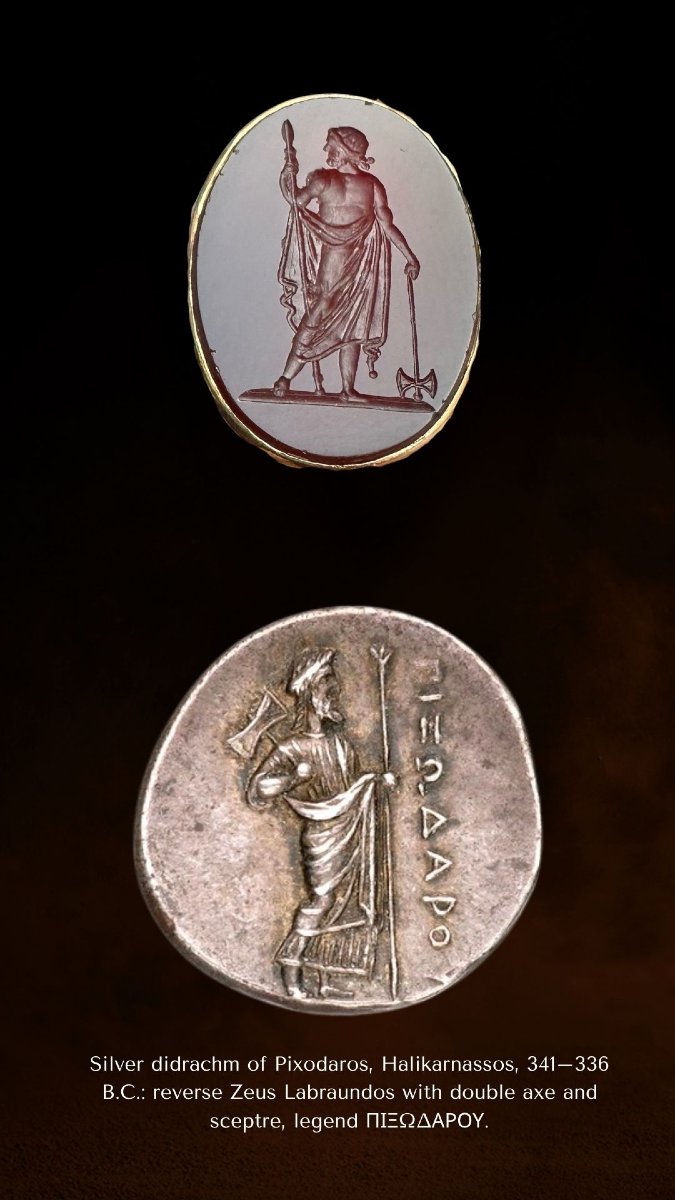
The silver tetradrachms and didrachms minted at Halicarnassus by the Hecatomnid dynasts of Caria — Maussolos (377–353 B.C.), then Pixodaros (341–336 B.C.)—feature the head of Apollo facing forward on the obverse and Zeus Labraundos standing, draped, with the double axe on his shoulder and the long scepter in his hand on the reverse.
The neoclassical engraver retained the god’s attributes and stature but reversed the perspective (figure seen from behind), placed the axe on the ground, and left the torso bare: the hieratic numismatic formula becomes a classical study of the figure from behind. This dialogue between the gemstone and the coin is characteristic of engravers active in Rome and London in the late 18th and early 19th centuries, who drew inspiration from numismatic compendia (Pellerin, Eckhel) that introduced the “Jupiter Labrandeus” to collectors.
Iconography and Symbolism
Zeus Labraundos is the god of the sanctuary at Labraunda, in the mountains north of Mylasa, patronized by the Hecatomnids. His double-headed axe is one of the oldest emblems of power in Anatolia: Plutarch reports that Heracles took it from Hippolyta, queen of the Amazons, and gave it to Omphale; preserved by the kings of Lydia, it was taken to Caria and placed in the hand of the god’s statue, which was named Labraundos, “labrys” being the Lydian word for the axe (Greek Questions, 45). Herodotus and Strabo refer to the same god as Zeus Stratios, the Zeus “of the armies.” The combination of spear and axe makes him a sovereign and warrior god, guardian of the Carian confederation—a rare subject in glyptics, which suggests a learned patron.
18-karat gold setting – ring size 53 (US 6½ / UK M½) — open, adjustable ring; gross weight 7.46 g.
Neoclassical intaglio, late 18th–early 19th century, based on a Carian coin type from the 4th century B.C.
Very good condition; sharp engraving; open ring on the back for adjustment; small hallmark on the band (eagle’s head)
18-karat gold ring with an oval bezel setting, adorned with a large carnelian intaglio depicting Zeus Labraundos, the Carian Zeus with the double axe.
A bearded male figure, standing on a ground line, viewed from the back in a slight three-quarter profile, with his head turned in profile to the left. He wears a close-fitting cap; the cloak does not drape over the shoulders: held at both forearms, it extends behind the hips and leaves the back and torso entirely bare, its panels falling on either side down to the calves. The right hand raises a spear with a leaf-shaped tip; her left hand holds the long-handled double-headed axe, the labrys, resting on the ground. A bold and confident engraving, featuring a muscular back draped in long, supple folds: the vocabulary of Neoclassical engravers, here employed in the service of scholarly iconography.
Historical Context – Ancient Numismatics
The silver tetradrachms and didrachms minted at Halicarnassus by the Hecatomnid dynasts of Caria — Maussolos (377–353 B.C.), then Pixodaros (341–336 B.C.)—feature the head of Apollo facing forward on the obverse and Zeus Labraundos standing, draped, with the double axe on his shoulder and the long scepter in his hand on the reverse.
The neoclassical engraver retained the god’s attributes and stature but reversed the perspective (figure seen from behind), placed the axe on the ground, and left the torso bare: the hieratic numismatic formula becomes a classical study of the figure from behind. This dialogue between the gemstone and the coin is characteristic of engravers active in Rome and London in the late 18th and early 19th centuries, who drew inspiration from numismatic compendia (Pellerin, Eckhel) that introduced the “Jupiter Labrandeus” to collectors.
Iconography and Symbolism
Zeus Labraundos is the god of the sanctuary at Labraunda, in the mountains north of Mylasa, patronized by the Hecatomnids. His double-headed axe is one of the oldest emblems of power in Anatolia: Plutarch reports that Heracles took it from Hippolyta, queen of the Amazons, and gave it to Omphale; preserved by the kings of Lydia, it was taken to Caria and placed in the hand of the god’s statue, which was named Labraundos, “labrys” being the Lydian word for the axe (Greek Questions, 45). Herodotus and Strabo refer to the same god as Zeus Stratios, the Zeus “of the armies.” The combination of spear and axe makes him a sovereign and warrior god, guardian of the Carian confederation—a rare subject in glyptics, which suggests a learned patron.
3 500 €
Period: 19th century
Style: Rome and Antic Greece
Condition: Excellent condition
Material: Gold
Reference (ID): 1813951
Availability: In stock
Print