


A 19th-century French Charm Seal Made Of Gilded Metal, Set With An Intaglio.
Carnelian intaglio, 13 × 16 mm
Gilded metal seal with a loop
Total height 26 mm; gross weight 5.15 g.
France, second quarter of the 19th century (c. 1825–1850).
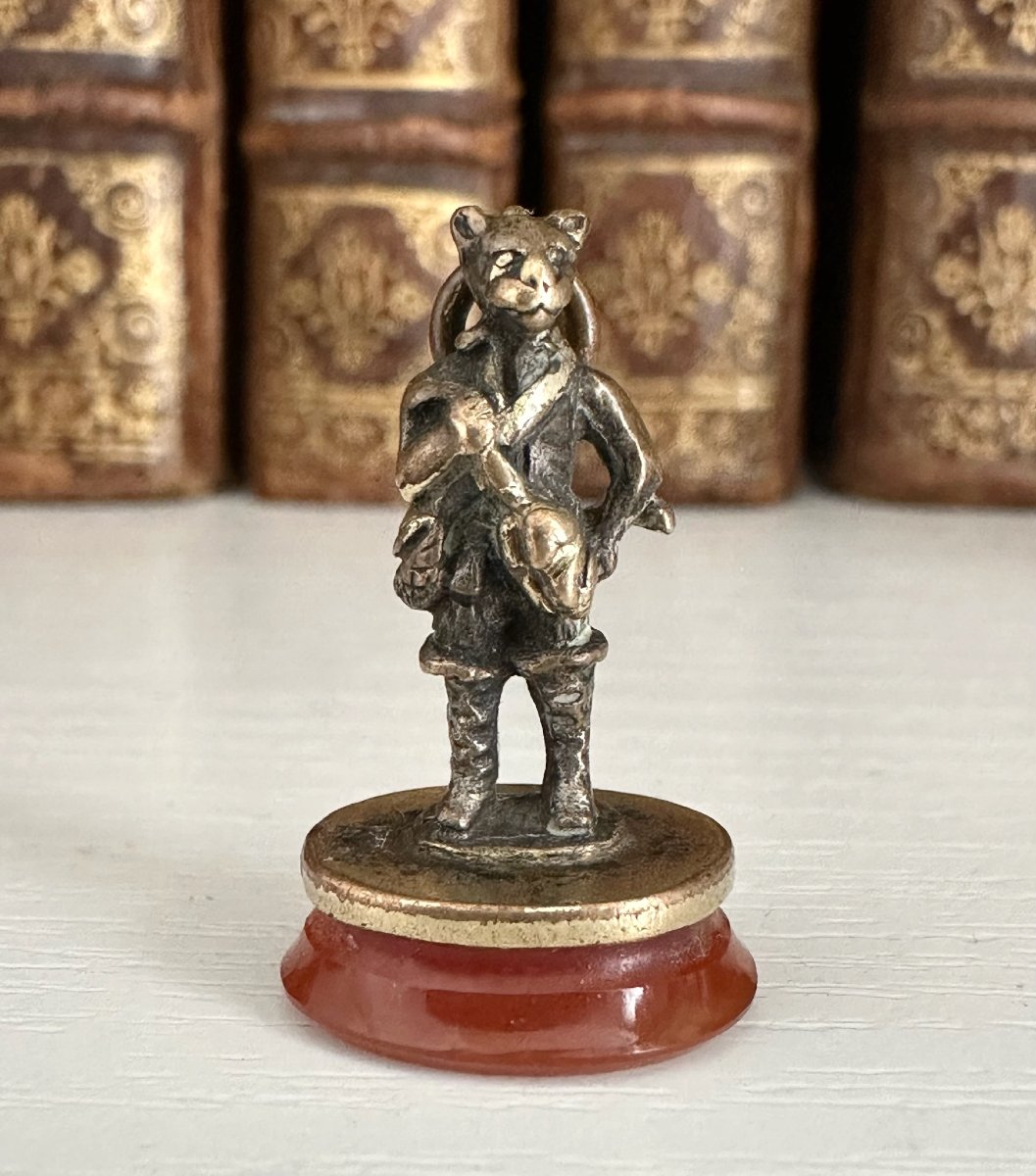
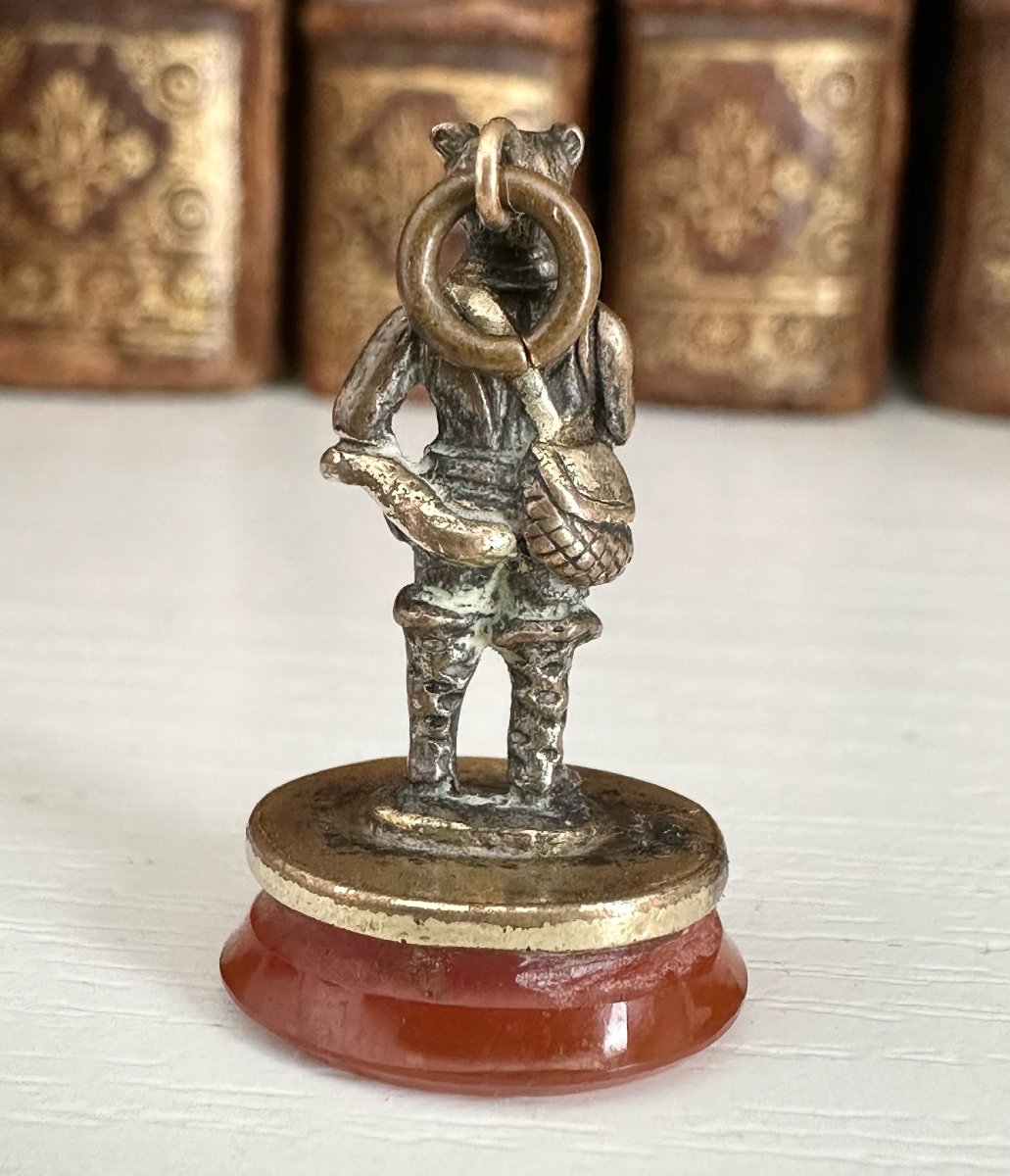
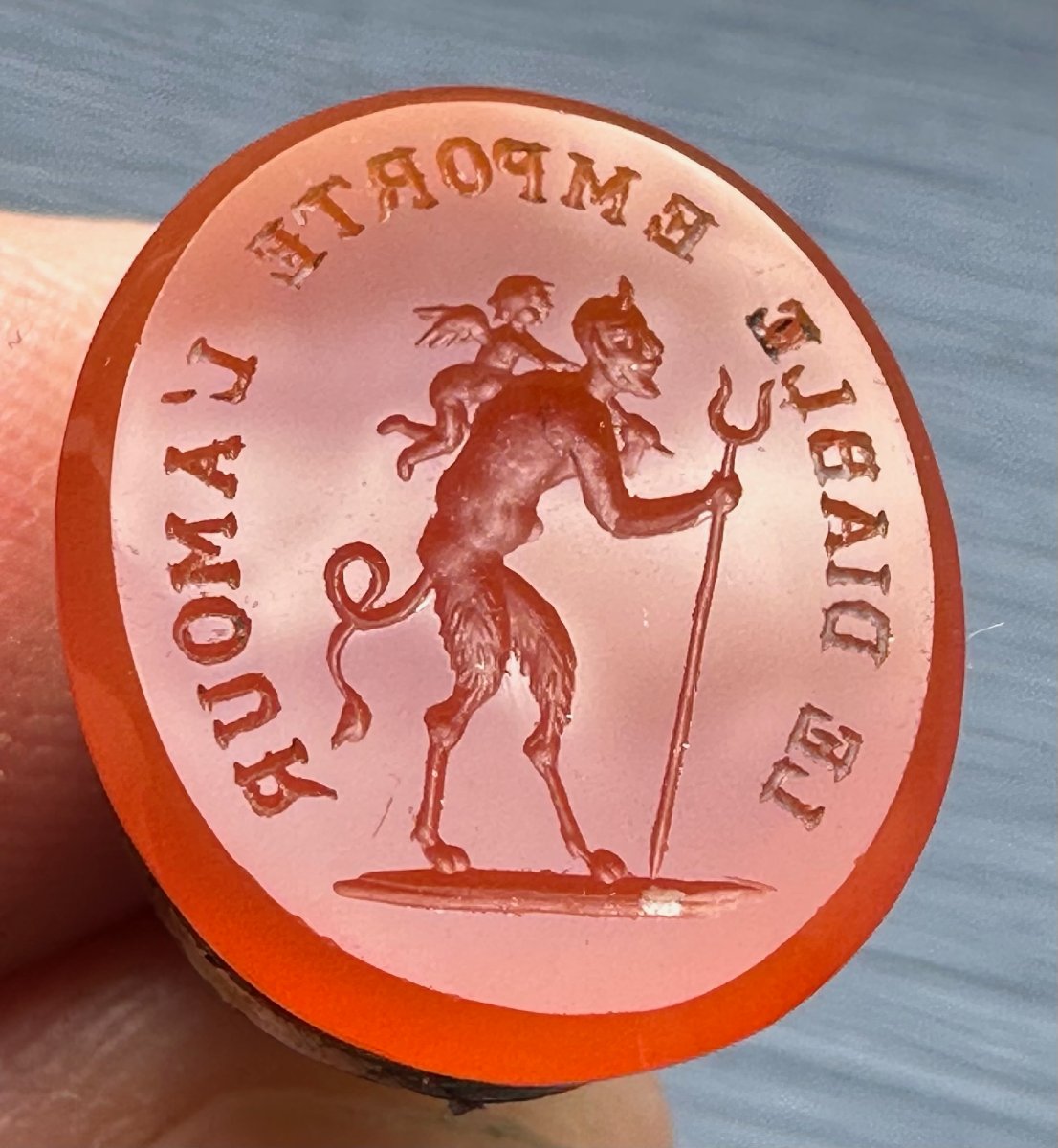
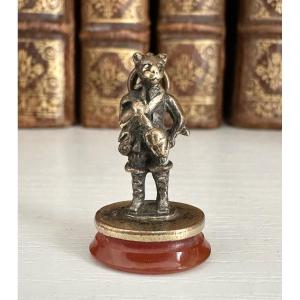
Gilded metal charm seal; the handle is shaped like Puss in Boots standing on an oval base: the cat wears a coat with rolled-up sleeves and high boots with turn-ups, carries a game bag slung over his shoulder, and clutches his prey close to him; a loop protrudes from its head. The base is set with an oval carnelian, flat-topped and beveled, engraved in intaglio to seal (the inscription reads right-side-up on the wax impression).
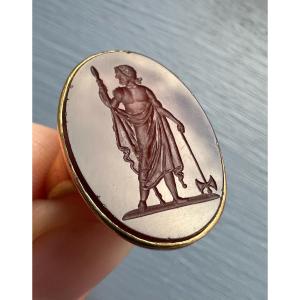
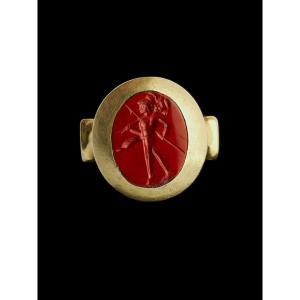
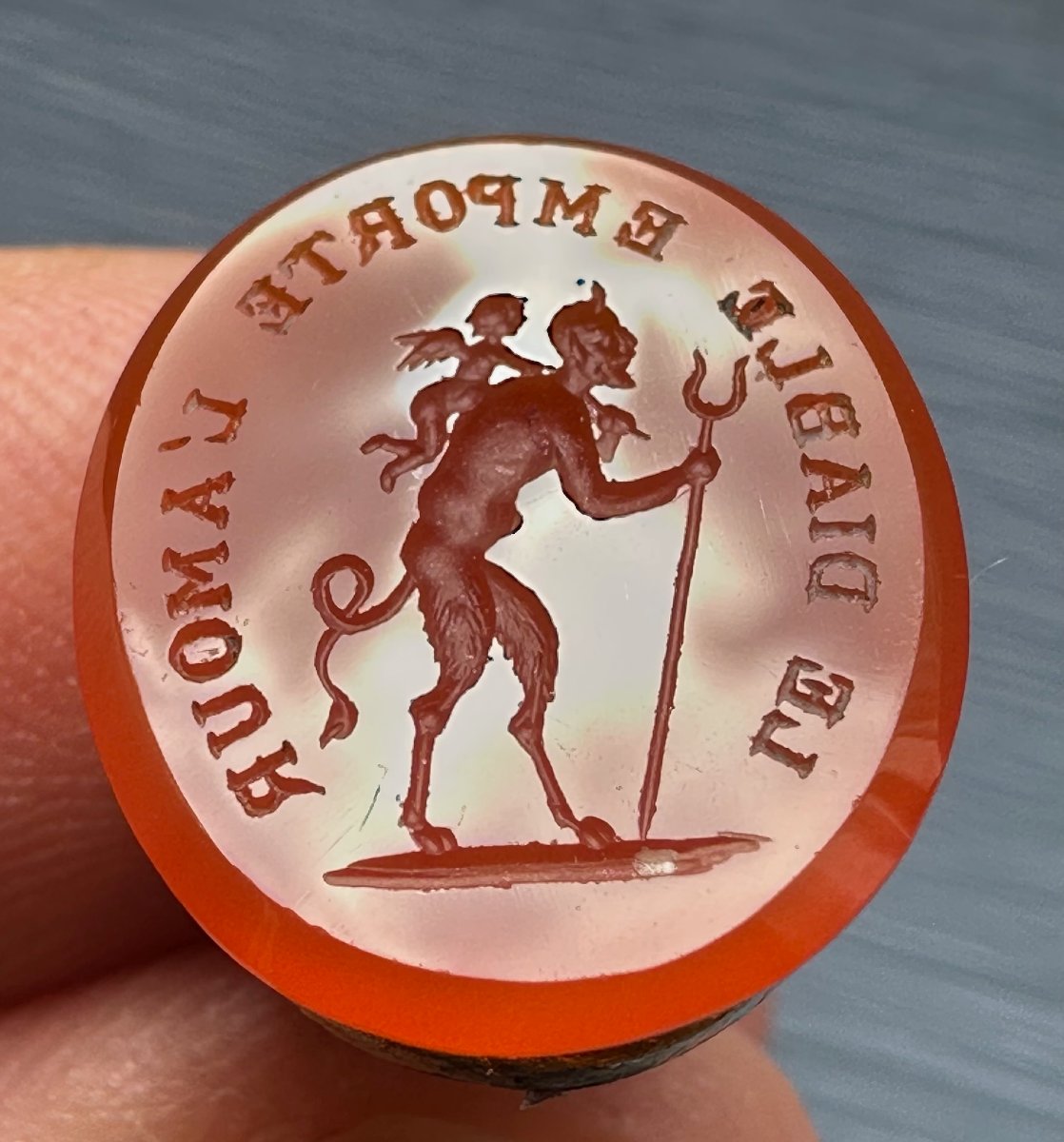
The stone depicts a devil walking to the right, horned, with hairy goat legs and a curled tail ending in a point, leaning on a long two-pronged pitchfork. On his shoulders he carries a winged Cupid, clinging to his neck. Along the border, the motto: THE DEVIL TAKES LOVE AWAY. Baseline.
Historical Context
The pendant seal and the motto seal suspended from a watch chain the pendant seal was an everyday tool for private correspondence until the envelope and the gummed stamp rendered wax obsolete around 1850. During the Restoration and the July Monarchy, Paris produced them in large quantities: handles cast in gilded bronze or pomponne, and carnelian dies engraved with mottos—witty sayings or gallant phrases rather than coats of arms. The lettering and humor of this stone are characteristic of that era. Perrault’s *Le Maître Chat*, or *Puss in Boots* (1697), had become, through the Épinal prints and illustrated editions, one of the most familiar figures in French popular imagery, long before Gustave Doré’s illustrations (1862).
Iconography and Symbolism
The motto plays on a curse and an image. “May the devil take love,” says the one who renounces it; the engraver takes the phrase literally and depicts the devil carrying off Cupid. This devil is a satyr in every respect except the name—horns, goat’s legs, the body of Pan—and the ancients had already contrasted Pan with Eros: the group of Aphrodite, Pan, and Eros from Delos (c. 100 B.C., Athens, National Archaeological Museum) and the numerous Roman marbles depicting Pan and Eros in combat, where Love always prevails, as promised by Virgil’s *omnia vincit Amor*. Here the outcome is reversed, and Love rides on the beast’s back. The cat on the handle—Perrault’s cunning character who turns a miller’s son into a marquis—adds a second sly servant: two figures who carry off what was never given to them.
Gilded metal seal with a loop
Total height 26 mm; gross weight 5.15 g.
France, second quarter of the 19th century (c. 1825–1850).
Gilded metal charm seal; the handle is shaped like Puss in Boots standing on an oval base: the cat wears a coat with rolled-up sleeves and high boots with turn-ups, carries a game bag slung over his shoulder, and clutches his prey close to him; a loop protrudes from its head. The base is set with an oval carnelian, flat-topped and beveled, engraved in intaglio to seal (the inscription reads right-side-up on the wax impression).
The stone depicts a devil walking to the right, horned, with hairy goat legs and a curled tail ending in a point, leaning on a long two-pronged pitchfork. On his shoulders he carries a winged Cupid, clinging to his neck. Along the border, the motto: THE DEVIL TAKES LOVE AWAY. Baseline.
Historical Context
The pendant seal and the motto seal suspended from a watch chain the pendant seal was an everyday tool for private correspondence until the envelope and the gummed stamp rendered wax obsolete around 1850. During the Restoration and the July Monarchy, Paris produced them in large quantities: handles cast in gilded bronze or pomponne, and carnelian dies engraved with mottos—witty sayings or gallant phrases rather than coats of arms. The lettering and humor of this stone are characteristic of that era. Perrault’s *Le Maître Chat*, or *Puss in Boots* (1697), had become, through the Épinal prints and illustrated editions, one of the most familiar figures in French popular imagery, long before Gustave Doré’s illustrations (1862).
Iconography and Symbolism
The motto plays on a curse and an image. “May the devil take love,” says the one who renounces it; the engraver takes the phrase literally and depicts the devil carrying off Cupid. This devil is a satyr in every respect except the name—horns, goat’s legs, the body of Pan—and the ancients had already contrasted Pan with Eros: the group of Aphrodite, Pan, and Eros from Delos (c. 100 B.C., Athens, National Archaeological Museum) and the numerous Roman marbles depicting Pan and Eros in combat, where Love always prevails, as promised by Virgil’s *omnia vincit Amor*. Here the outcome is reversed, and Love rides on the beast’s back. The cat on the handle—Perrault’s cunning character who turns a miller’s son into a marquis—adds a second sly servant: two figures who carry off what was never given to them.
1 250 €
Period: 19th century
Style: Napoleon 3rd
Condition: Excellent condition
Material: Metal
Reference (ID): 1819824
Availability: In stock
Print