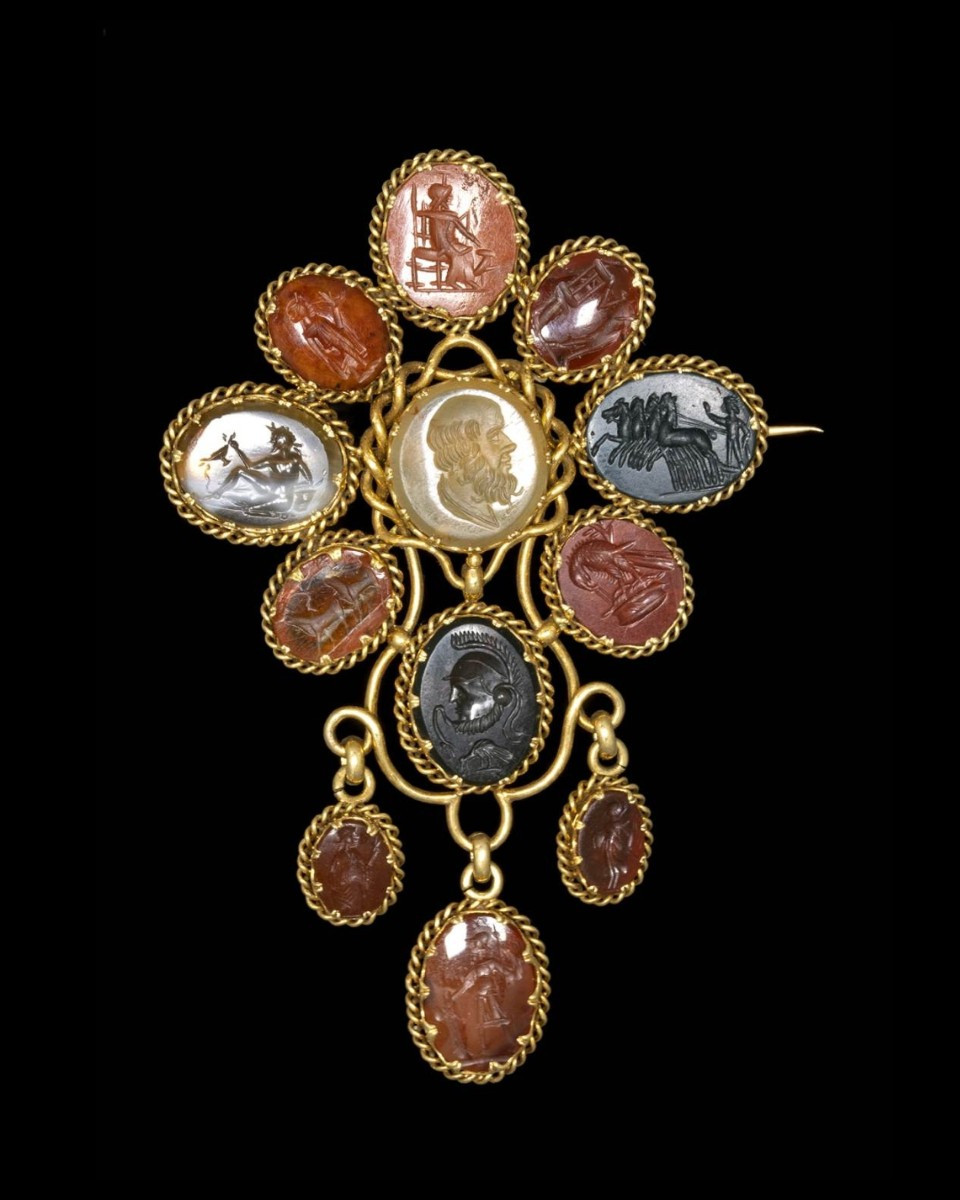
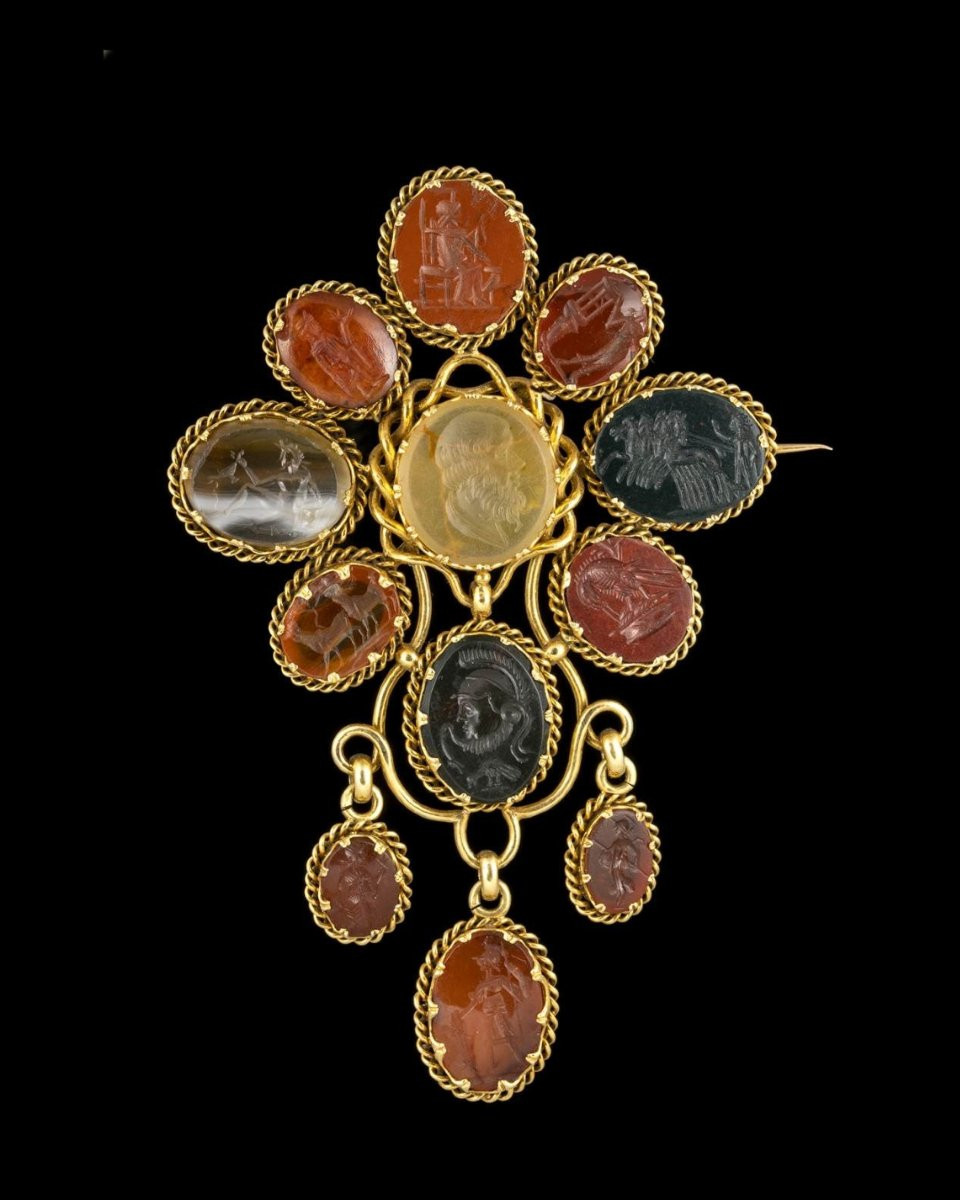


Victorian Gold Brooch Set With Twelve Intaglios On Hard Stones. Various Subjects.
Intaglio min. 7x10 mm; max 16x17 mm
Total weight: 25.90 gr
Intaglio: 2nd century A.D. - 17th century
Spindle: 19th century
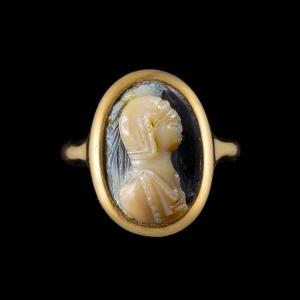
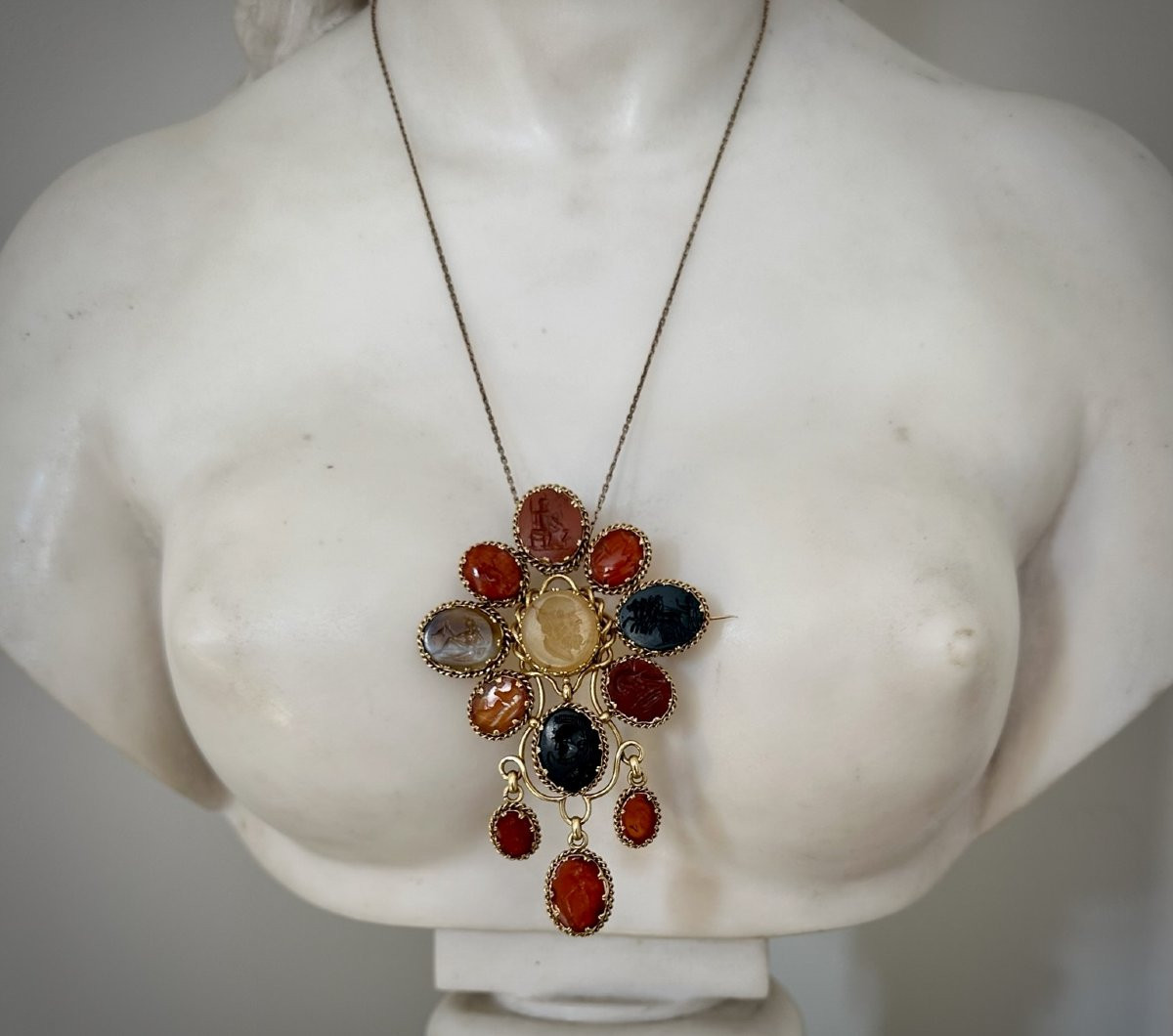
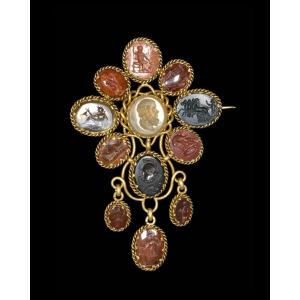
Openwork gold-mounted cruciform spindle, the central medallion set with an oval intaglio on agate depicting the bust of a bearded philosopher in profile to the right, in a gold twisted cord bezel, surrounded by a cruciform composition of eight other intaglios on carnelian, red jasper and dark green jasper, each in a twisted gold wire mount ; suspended from the lower part by three gold links, an oval intaglio depicting a helmeted bust in profile to the left, terminated by three articulated tassels set with intaglios on carnelian; on the reverse, a long gold pin.
The intaglios, clockwise from top:
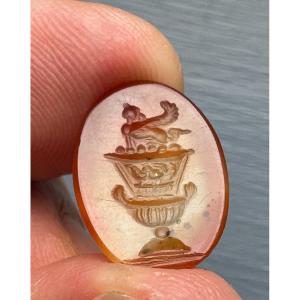
- a Roman intaglio on red jasper, Hades enthroned; - a Roman intaglio on carnelian, standing figure near a tripod; - a Roman intaglio on dark green jasper, quadriga of Helios; - a Roman intaglio on red jasper, eagle devouring its prey; - an intaglio on dark stone (jasper?), gryllos; - an intaglio on cornelian, two animals; - a post-classical intaglio, faun holding a kylix; - a Roman intaglio on cornelian, offering figure; - in the center: a post-classical intaglio on agate, bust of a bearded philosopher; - in the center of the pendant: a helmeted bust; - on the three lower tassels (from left to right): a Roman intaglio on cornelian, Spes; a Roman intaglio on cornelian, Mars; a Roman intaglio on cornelian, Athena.
Note
This brooch is part of the prestigious Victorian jewelry tradition known as "archaeological revival", which from the mid-19th century saw the dismantling and reassembling of antique and post-classical intaglio cabinets within elaborate gold jewelry designed to evoke the splendor of antiquity to the taste of modern collectors. This movement, of which the Castellani house in Rome was the emblematic figure - relayed in London by Carlo Giuliano - reached its apogee in the 1860s-1870s, a period during which Grand Tour souvenirs and inherited dactyliothèques were frequently dismantled for resertification into portable jewelry of this nature.
The present brooch brings together authentic Roman intaglios - as well as post-classical regravings perpetuating the antique repertoire. The juxtaposition of mythological subjects and emblematic motifs (gryllos, eagle) reflects the eclectic tastes of the Victorian collector and the iconographic richness of the post-classical glyptic tradition.
Total weight: 25.90 gr
Intaglio: 2nd century A.D. - 17th century
Spindle: 19th century
Openwork gold-mounted cruciform spindle, the central medallion set with an oval intaglio on agate depicting the bust of a bearded philosopher in profile to the right, in a gold twisted cord bezel, surrounded by a cruciform composition of eight other intaglios on carnelian, red jasper and dark green jasper, each in a twisted gold wire mount ; suspended from the lower part by three gold links, an oval intaglio depicting a helmeted bust in profile to the left, terminated by three articulated tassels set with intaglios on carnelian; on the reverse, a long gold pin.
The intaglios, clockwise from top:
- a Roman intaglio on red jasper, Hades enthroned; - a Roman intaglio on carnelian, standing figure near a tripod; - a Roman intaglio on dark green jasper, quadriga of Helios; - a Roman intaglio on red jasper, eagle devouring its prey; - an intaglio on dark stone (jasper?), gryllos; - an intaglio on cornelian, two animals; - a post-classical intaglio, faun holding a kylix; - a Roman intaglio on cornelian, offering figure; - in the center: a post-classical intaglio on agate, bust of a bearded philosopher; - in the center of the pendant: a helmeted bust; - on the three lower tassels (from left to right): a Roman intaglio on cornelian, Spes; a Roman intaglio on cornelian, Mars; a Roman intaglio on cornelian, Athena.
Note
This brooch is part of the prestigious Victorian jewelry tradition known as "archaeological revival", which from the mid-19th century saw the dismantling and reassembling of antique and post-classical intaglio cabinets within elaborate gold jewelry designed to evoke the splendor of antiquity to the taste of modern collectors. This movement, of which the Castellani house in Rome was the emblematic figure - relayed in London by Carlo Giuliano - reached its apogee in the 1860s-1870s, a period during which Grand Tour souvenirs and inherited dactyliothèques were frequently dismantled for resertification into portable jewelry of this nature.
The present brooch brings together authentic Roman intaglios - as well as post-classical regravings perpetuating the antique repertoire. The juxtaposition of mythological subjects and emblematic motifs (gryllos, eagle) reflects the eclectic tastes of the Victorian collector and the iconographic richness of the post-classical glyptic tradition.
6 850 €
Period: 19th century
Style: English Style
Condition: Excellent condition
Material: Gold
Reference (ID): 1757375
Availability: In stock
Print