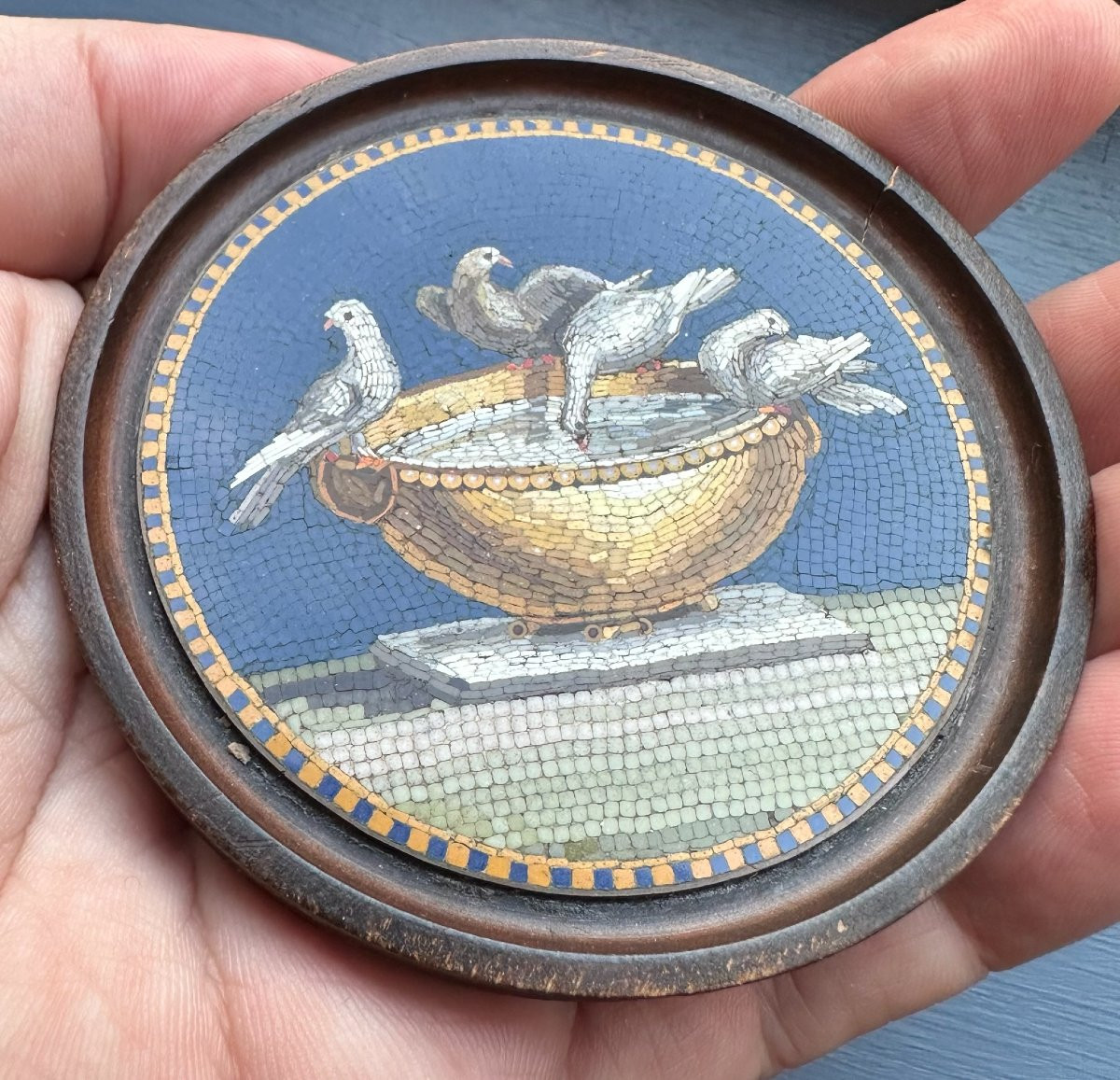


Giacomo Raffaelli, Attributed (1753-1836). A Grand Tour Micromosaic Panel — The Doves Of Pliny
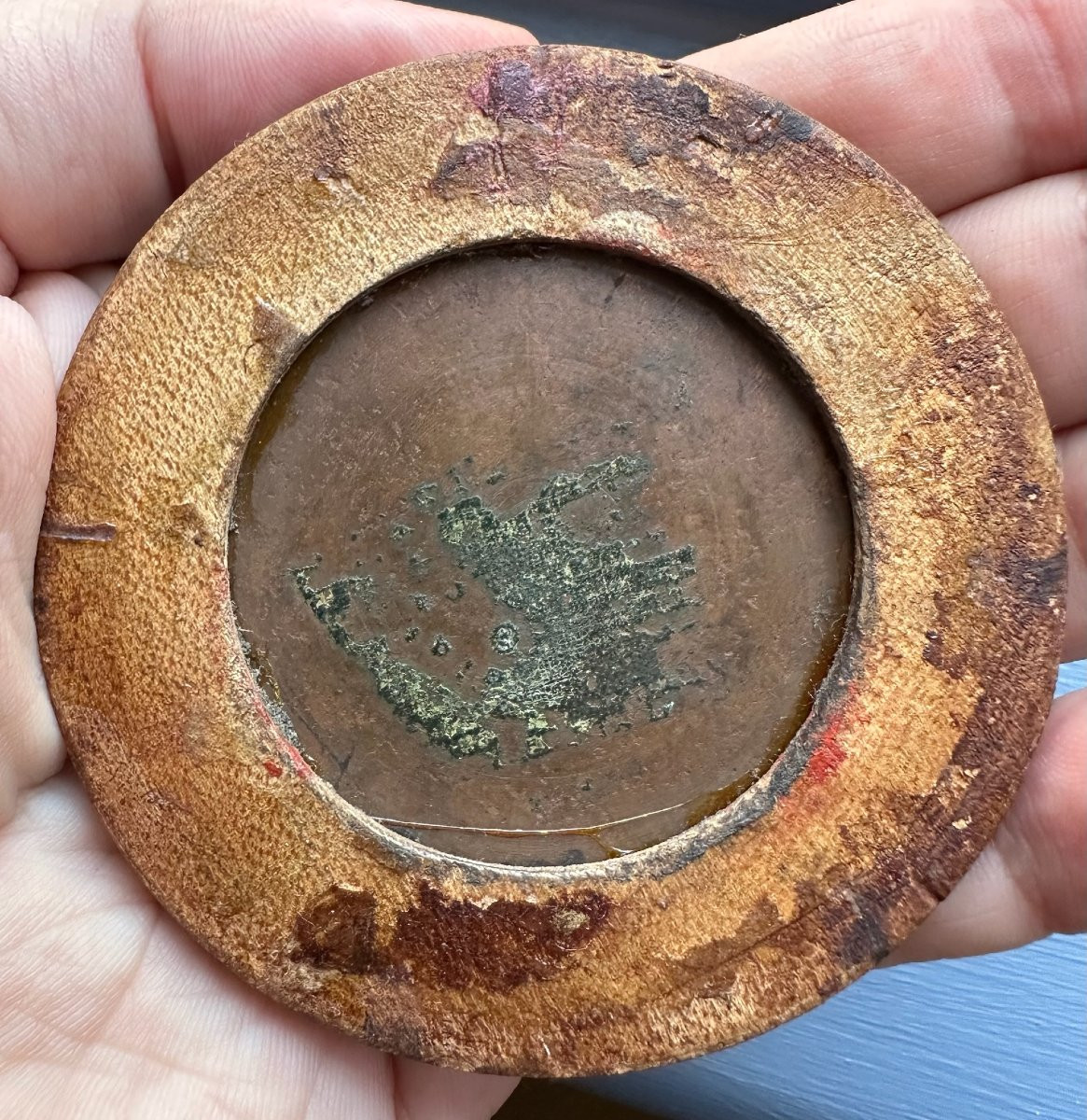
Tesserae on black ground, set in a circular wooden frame
Diameter: 77 mm
Rome, 18th century
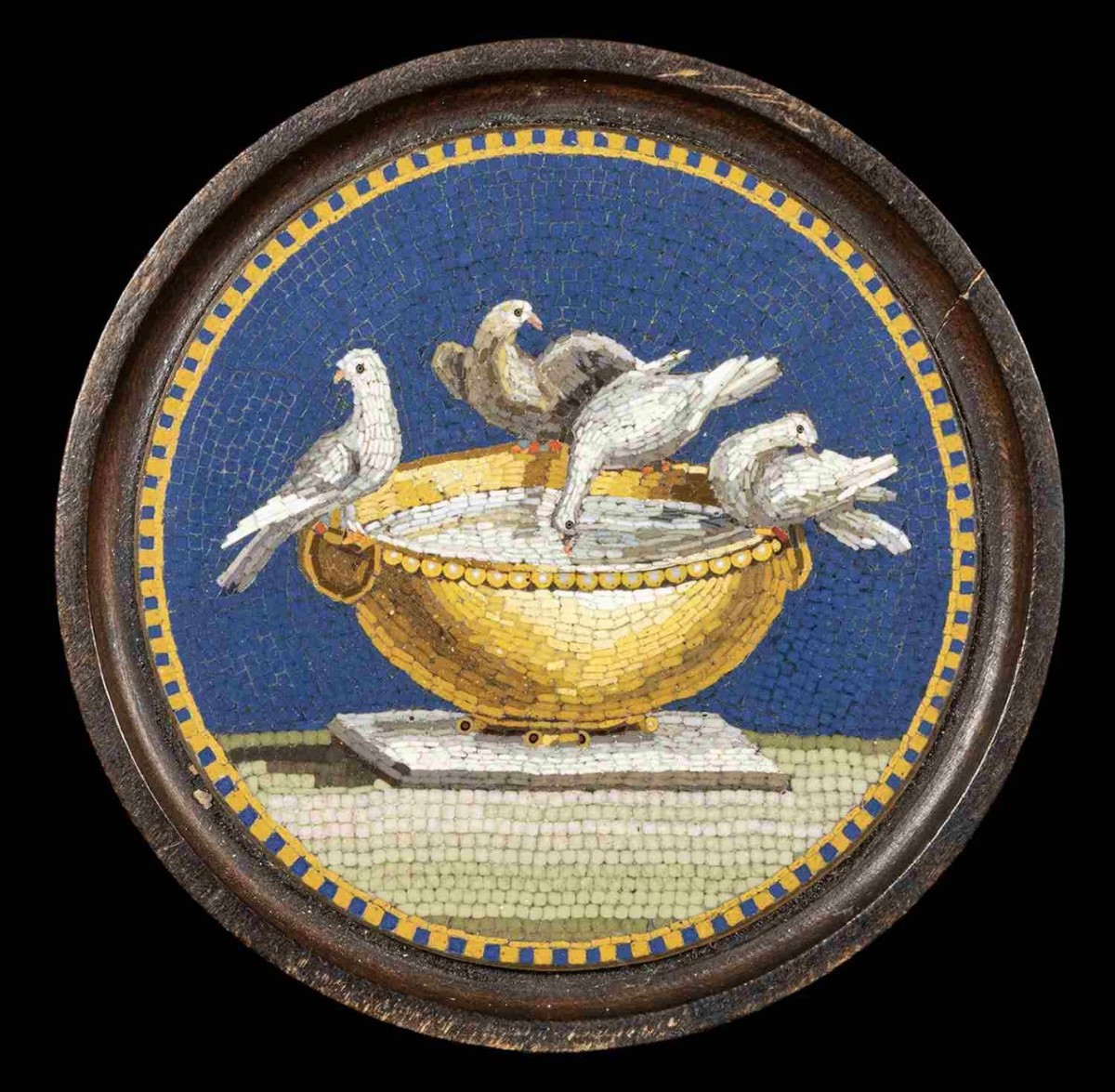
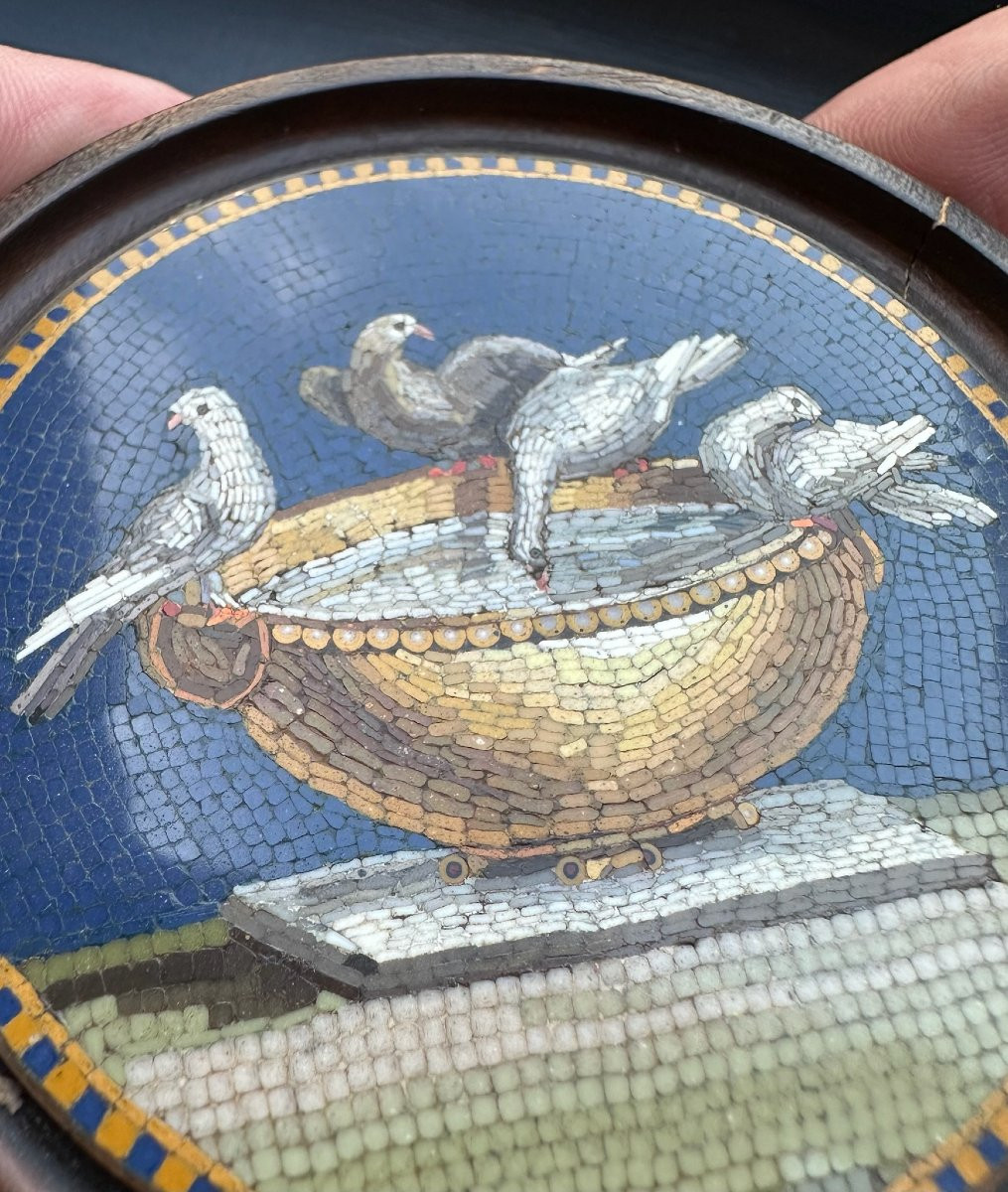
This large circular micromosaic panel depicts the celebrated composition known as the Doves of Pliny or Capitoline Doves, one of the most iconic subjects in the Grand Tour decorative arts tradition. The scene derives from a Roman floor mosaic uncovered in 1737 during excavations at Hadrian’s Villa in Tivoli, itself believed to reproduce a lost Hellenistic mosaic from Pergamon. The ancient source is recorded by Pliny the Elder in his Naturalis Historia (XXXVI, 184), in which he describes with admiration a dove drinking from a stone basin while casting its shadow upon the water, as others perch and preen along the rim of a cantharus.
The present work belongs to the circle of Giacomo Raffaelli (Rome, 1753–1836), the foremost master of Roman micromosaic art and the principal exponent of the technique during the late eighteenth and early nineteenth centuries. Raffaelli returned to this composition on at least five documented occasions; the earliest known example, dated 1778, is preserved in the British Museum, London, while further autograph versions are held in the J. Paul Getty Museum, Los Angeles, the Vatican Museums, the Gilbert Collection, London, and the Savelli Collection, Rome.
The exceptional density and refinement of the tessellation — characteristic of the Roman mosaico minuto tradition — attest to the high technical standard of execution, consistent with workshop production in Raffaelli’s immediate circle.
Diameter: 77 mm
Rome, 18th century
This large circular micromosaic panel depicts the celebrated composition known as the Doves of Pliny or Capitoline Doves, one of the most iconic subjects in the Grand Tour decorative arts tradition. The scene derives from a Roman floor mosaic uncovered in 1737 during excavations at Hadrian’s Villa in Tivoli, itself believed to reproduce a lost Hellenistic mosaic from Pergamon. The ancient source is recorded by Pliny the Elder in his Naturalis Historia (XXXVI, 184), in which he describes with admiration a dove drinking from a stone basin while casting its shadow upon the water, as others perch and preen along the rim of a cantharus.
The present work belongs to the circle of Giacomo Raffaelli (Rome, 1753–1836), the foremost master of Roman micromosaic art and the principal exponent of the technique during the late eighteenth and early nineteenth centuries. Raffaelli returned to this composition on at least five documented occasions; the earliest known example, dated 1778, is preserved in the British Museum, London, while further autograph versions are held in the J. Paul Getty Museum, Los Angeles, the Vatican Museums, the Gilbert Collection, London, and the Savelli Collection, Rome.
The exceptional density and refinement of the tessellation — characteristic of the Roman mosaico minuto tradition — attest to the high technical standard of execution, consistent with workshop production in Raffaelli’s immediate circle.
2 950 €
Period: 18th century
Style: Other Style
Condition: Excellent condition
Material: Stone
Reference (ID): 1715118
Availability: In stock
Print