


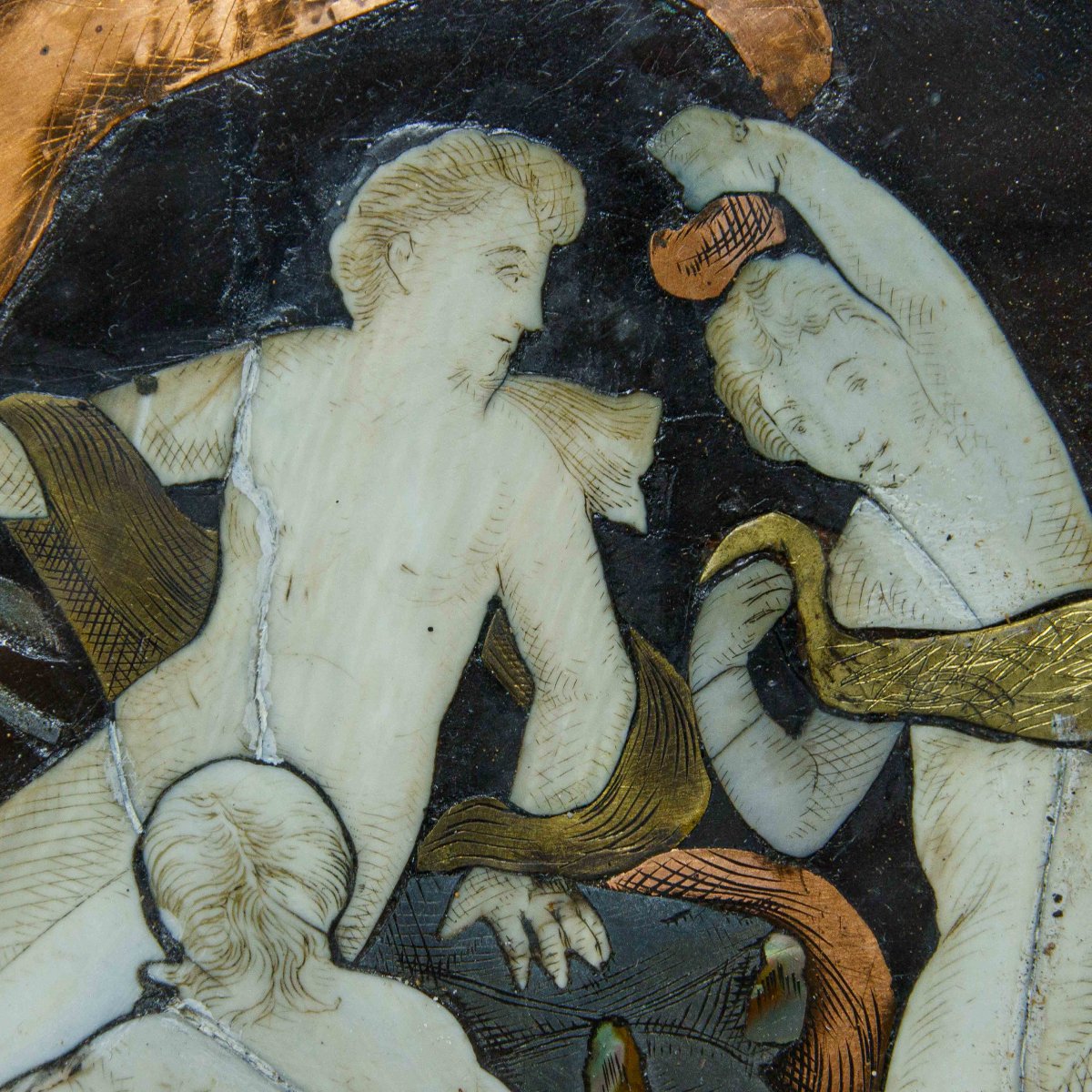


Late 18th Century, Triumph Of Galatea
Late 18th century
Triumph of Galatea
Ivory inlay, mother-of-pearl and metal sheets on blackboard, diam. 16 cm
With ebonized wood frame, cm 27 x 26.5 x 3
Accompanied by CITES certificate
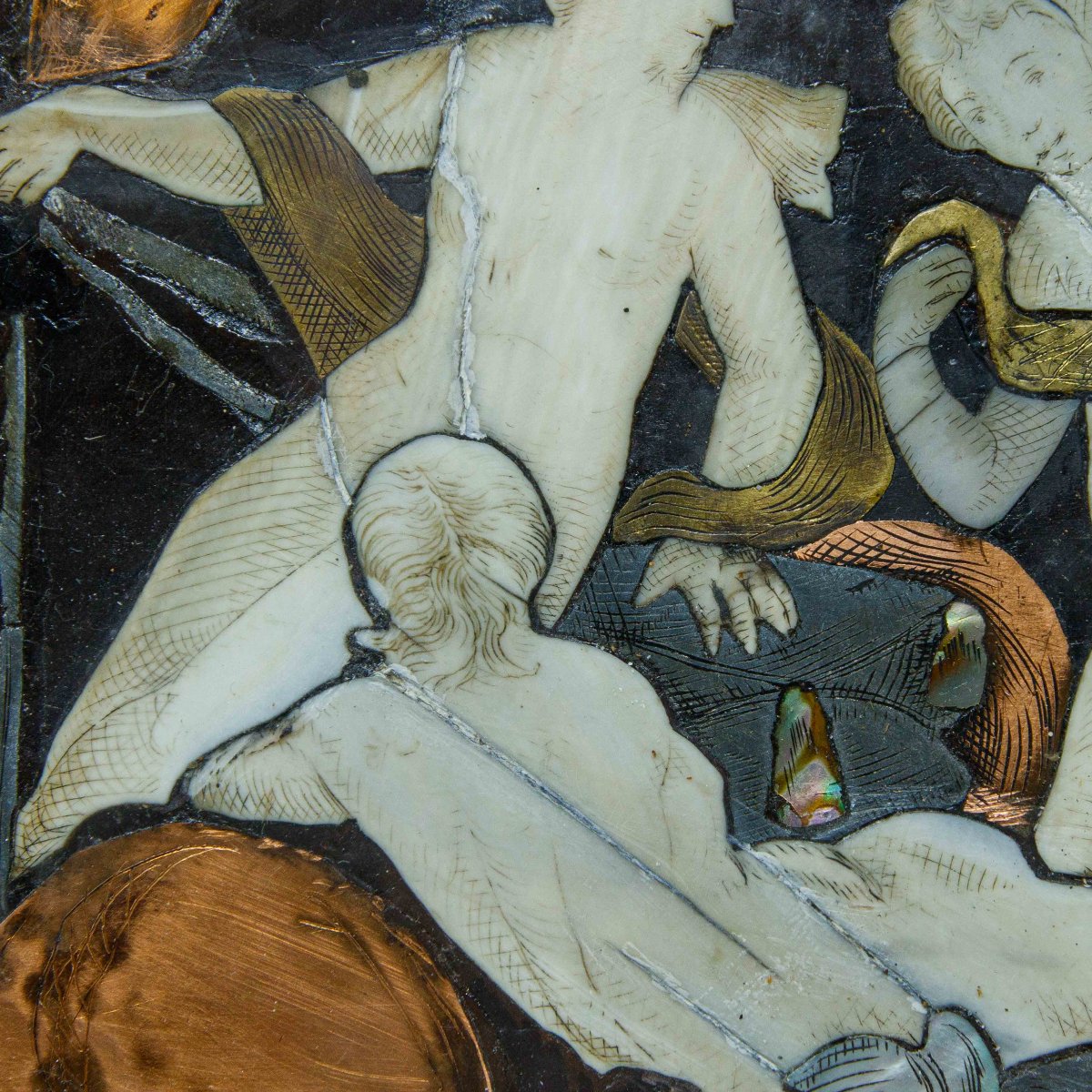
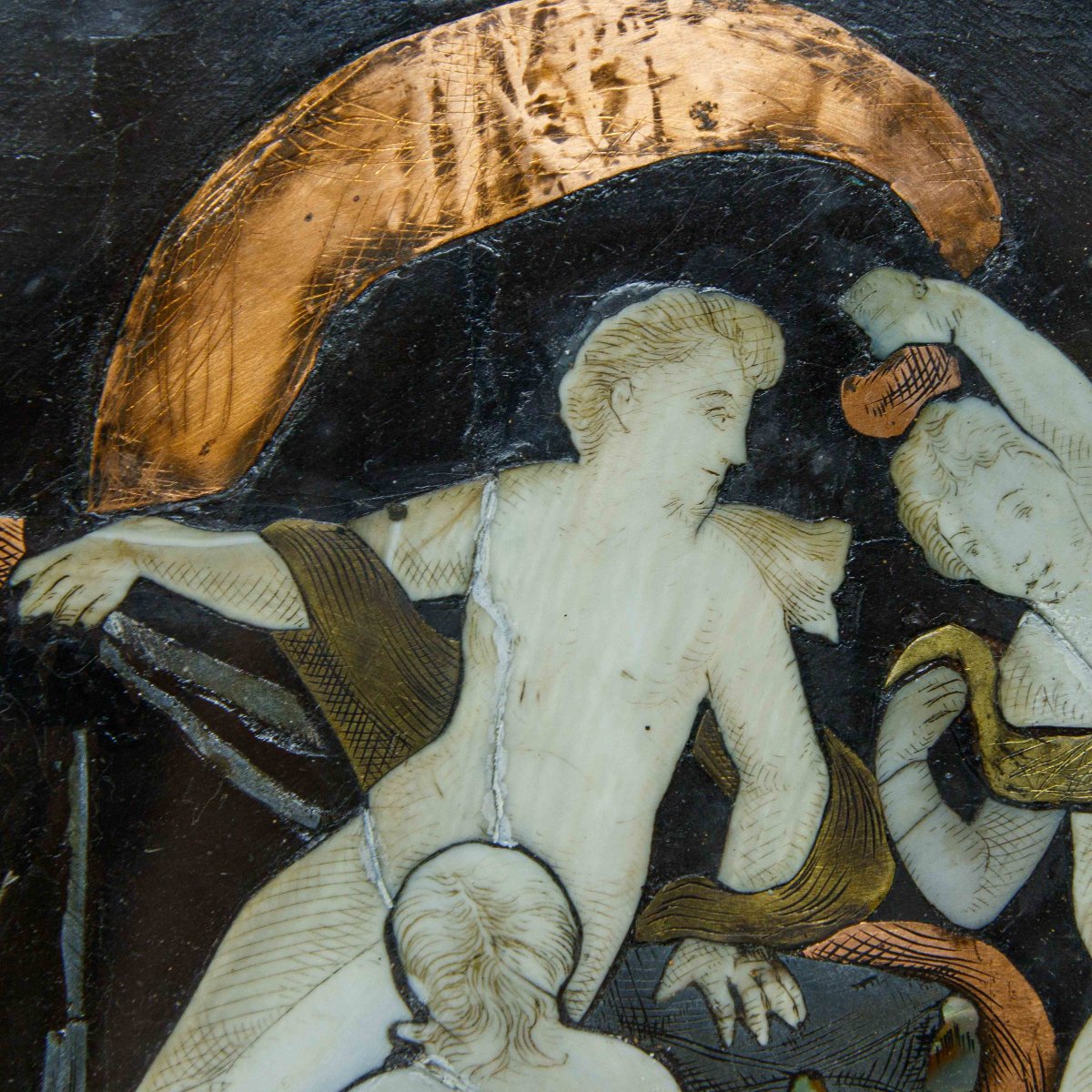
The artefact in question constitutes a valuable example of applied and decorative art, dating back to the late 18th and early 19th centuries, a period characterised by the full influence of Neoclassicism. The work is configured as an inlay (or inlay), a technique that involved the precise juxtaposition and setting of heterogeneous materials on a solid base. The choice of support, a deep black slate slab, is not accidental, but responds to the need to create a deep monochrome background. This base served as a repoussoir, enhancing by contrast the brightness and chromia of the inlaid materials, an effect that recalls pictorial chiaroscuro and gives the work an austere elegance. The execution of the central tondo, enclosed by a sober wooden ebonization, demonstrates a notable mastery in the use of precious materials: ivory, used for the plastic rendering of the mythological figures of this Triumph of Galatea, in particular for the semi-naked bodies, exploits its ivory hue and its workability to suggest the softness of the flesh tones and anatomical perfection, in line with neoclassical aesthetic ideals; mother-of-pearl, whose iridescences of this material, obtained from shells, are strategically used to simulate effects of brilliance, probably for water, waves or to give lustre to specific details; the metal foils, inserted here with pictorial function, adding luminous and precious details to draperies, jewelry or finishes, contributing to the overall sense of luxury of the work. The subject depicted is of classical mythological origin: the Triumph of Galatea. The composition, dense and dynamic within the circular format, captures the sea nymph Galatea in a moment of exaltation, probably accompanied by a Triton or her lover Acis. The figures, immersed in a marine environment suggested more than described, are wrapped in a floating red-orange drape that introduces the only dominant warm chromatic element and contributes to the sense of ascending and triumphal movement of the scene. The iconography, rendered here in its simplicity, recovers the famous pictorial models of the great masters, such as Luca Giordano or Jacques Stella. Overall, the artefact constitutes an eloquent testimony to Italian craftsmanship, which was able to adapt traditional techniques of semiprecious stone inlay to a highly manufactured production of decorative art.
Triumph of Galatea
Ivory inlay, mother-of-pearl and metal sheets on blackboard, diam. 16 cm
With ebonized wood frame, cm 27 x 26.5 x 3
Accompanied by CITES certificate
The artefact in question constitutes a valuable example of applied and decorative art, dating back to the late 18th and early 19th centuries, a period characterised by the full influence of Neoclassicism. The work is configured as an inlay (or inlay), a technique that involved the precise juxtaposition and setting of heterogeneous materials on a solid base. The choice of support, a deep black slate slab, is not accidental, but responds to the need to create a deep monochrome background. This base served as a repoussoir, enhancing by contrast the brightness and chromia of the inlaid materials, an effect that recalls pictorial chiaroscuro and gives the work an austere elegance. The execution of the central tondo, enclosed by a sober wooden ebonization, demonstrates a notable mastery in the use of precious materials: ivory, used for the plastic rendering of the mythological figures of this Triumph of Galatea, in particular for the semi-naked bodies, exploits its ivory hue and its workability to suggest the softness of the flesh tones and anatomical perfection, in line with neoclassical aesthetic ideals; mother-of-pearl, whose iridescences of this material, obtained from shells, are strategically used to simulate effects of brilliance, probably for water, waves or to give lustre to specific details; the metal foils, inserted here with pictorial function, adding luminous and precious details to draperies, jewelry or finishes, contributing to the overall sense of luxury of the work. The subject depicted is of classical mythological origin: the Triumph of Galatea. The composition, dense and dynamic within the circular format, captures the sea nymph Galatea in a moment of exaltation, probably accompanied by a Triton or her lover Acis. The figures, immersed in a marine environment suggested more than described, are wrapped in a floating red-orange drape that introduces the only dominant warm chromatic element and contributes to the sense of ascending and triumphal movement of the scene. The iconography, rendered here in its simplicity, recovers the famous pictorial models of the great masters, such as Luca Giordano or Jacques Stella. Overall, the artefact constitutes an eloquent testimony to Italian craftsmanship, which was able to adapt traditional techniques of semiprecious stone inlay to a highly manufactured production of decorative art.
2 400 €
Period: 18th century
Style: Other Style
Condition: Good condition
Material: Ivory
Diameter: 16
Reference (ID): 1671516
Availability: In stock
Print