






18th Century
Artist: 18ème Siècle
18th century
Devotional panel with Clement XI
Painted and gilded paper and wax ovals
With frame, cm 38 x 42
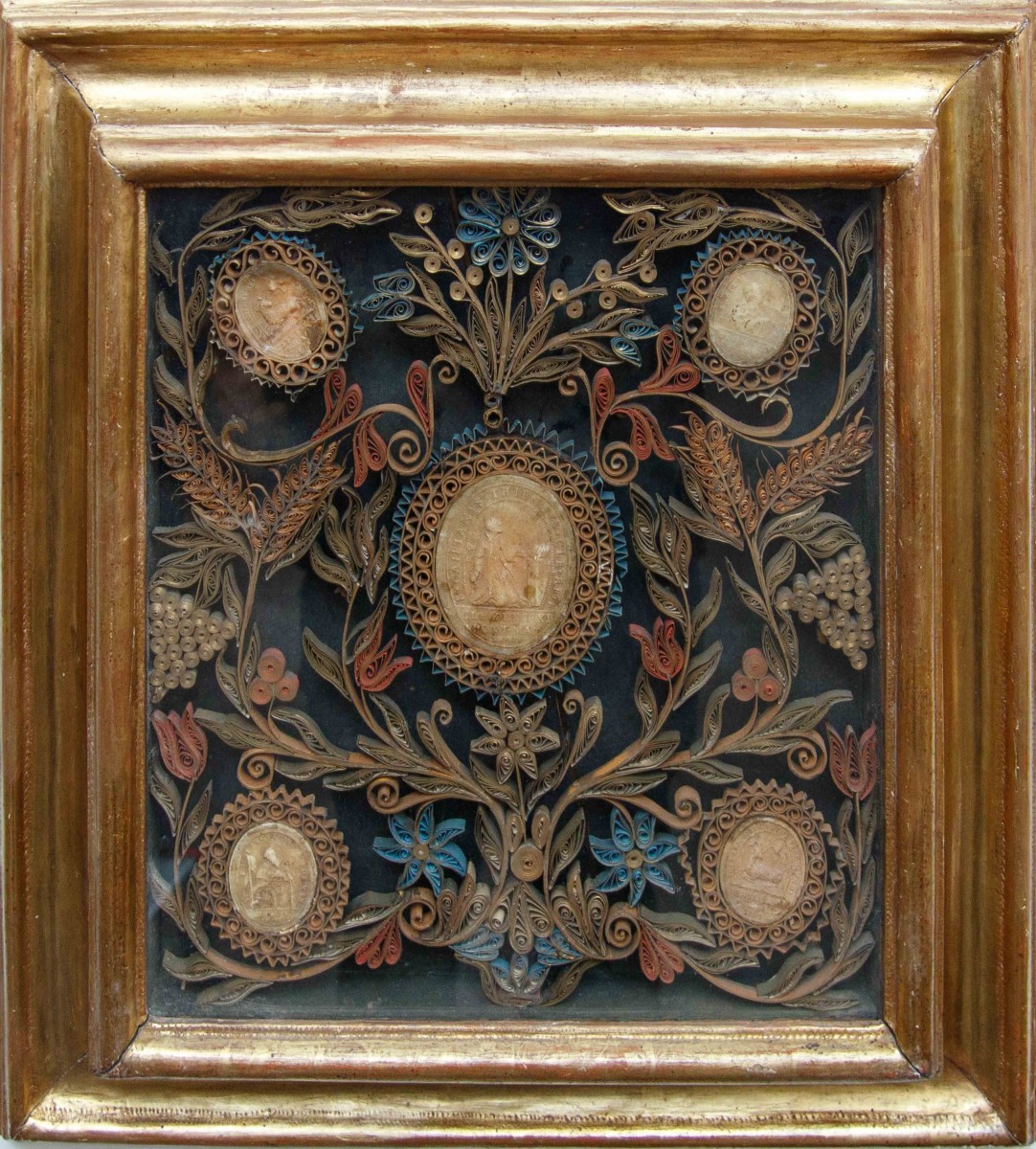
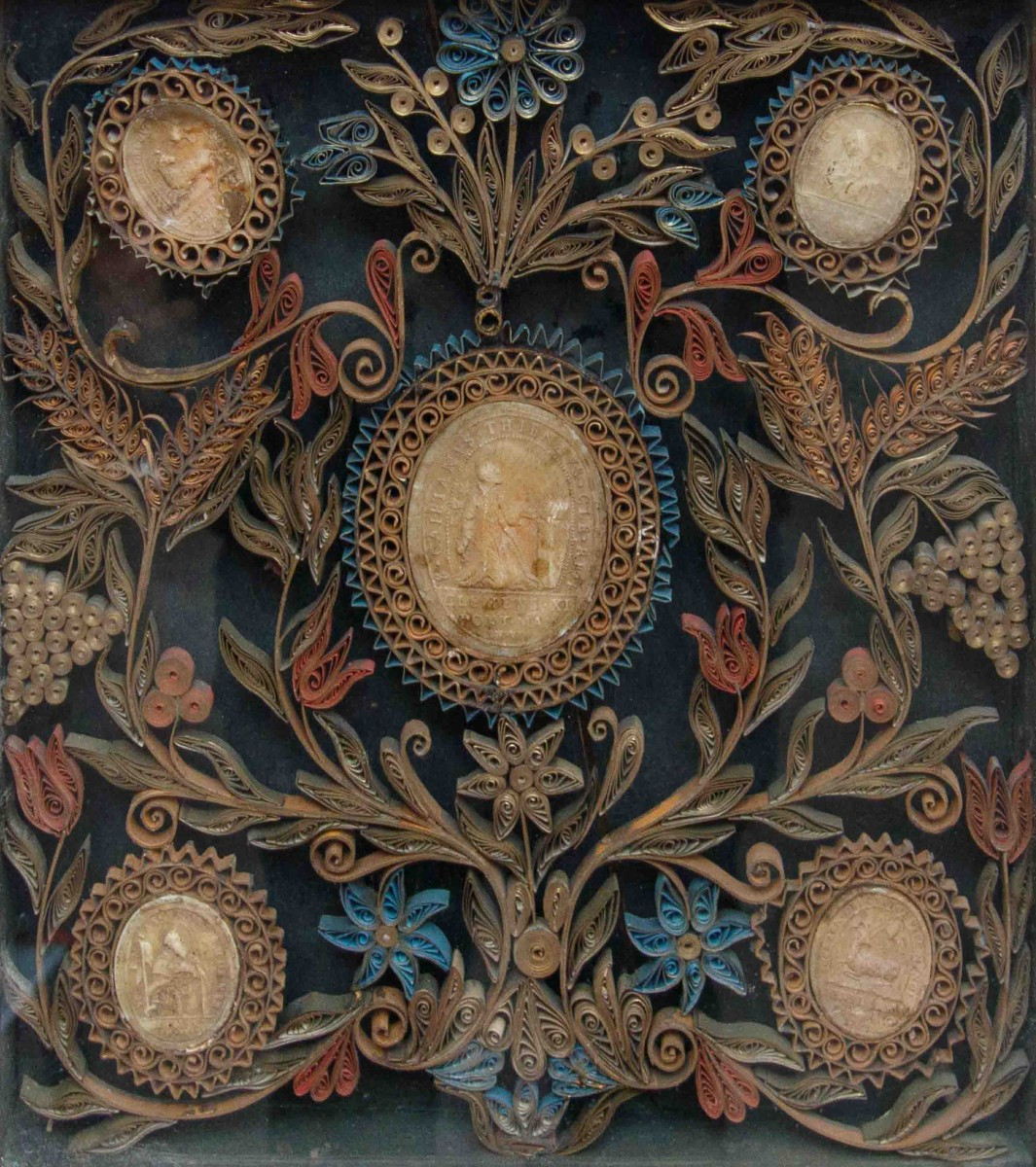
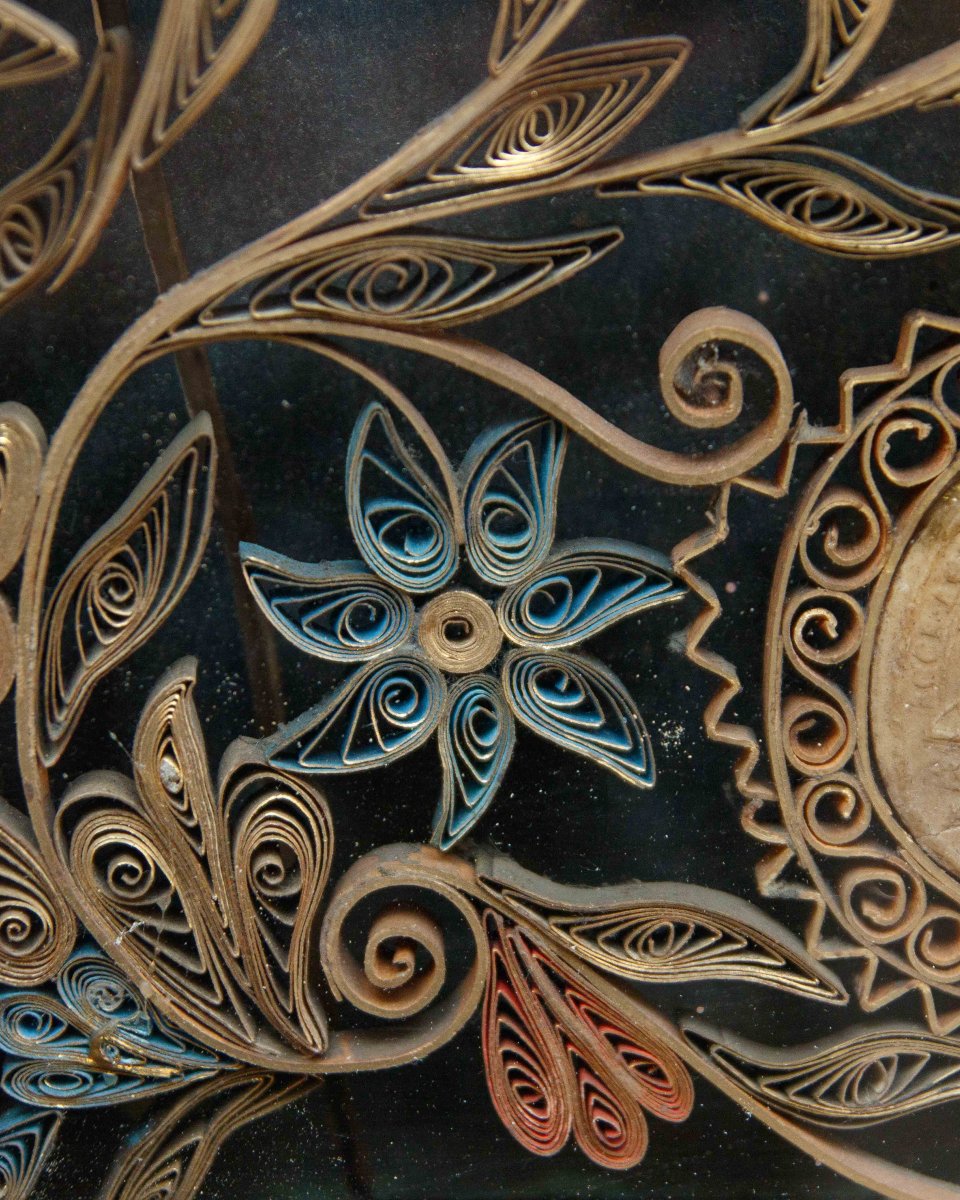
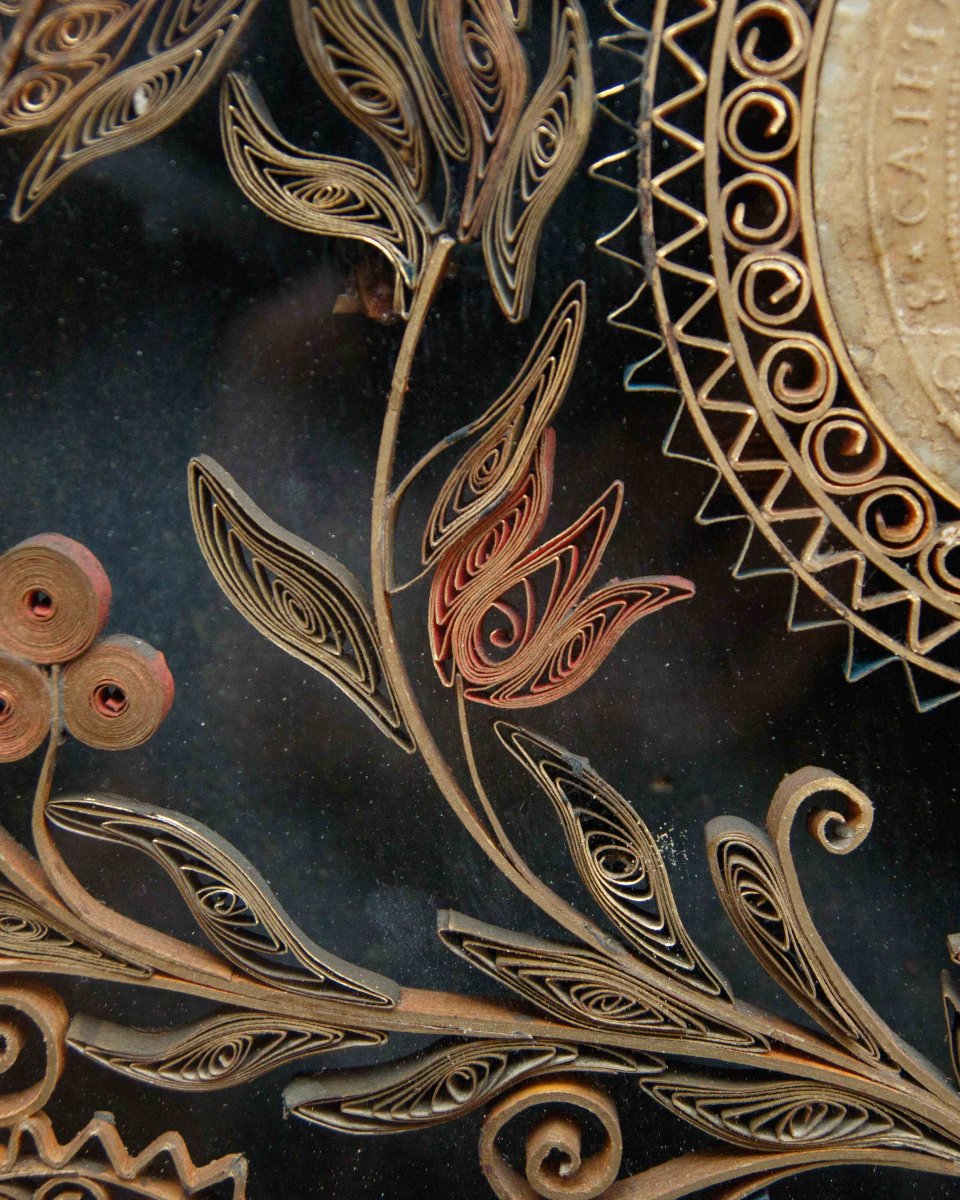
The artefact illustrated here is a valuable example of a devotional panel created using the paperoles (or papier roulés) technique, an expression which in Italian translates as "rolled paper". This artisanal practice consists of the processing of thin strips of paper, in this case painted in polychrome and enriched with gilding, which are shaped to create relief ornaments intended to frame images or sacred objects, with a strong contrast provided by the dark background support. This particular form of artisanal production developed from the 17th century onwards, spreading mainly in female convent environments in France, Germany, Switzerland and Italy.
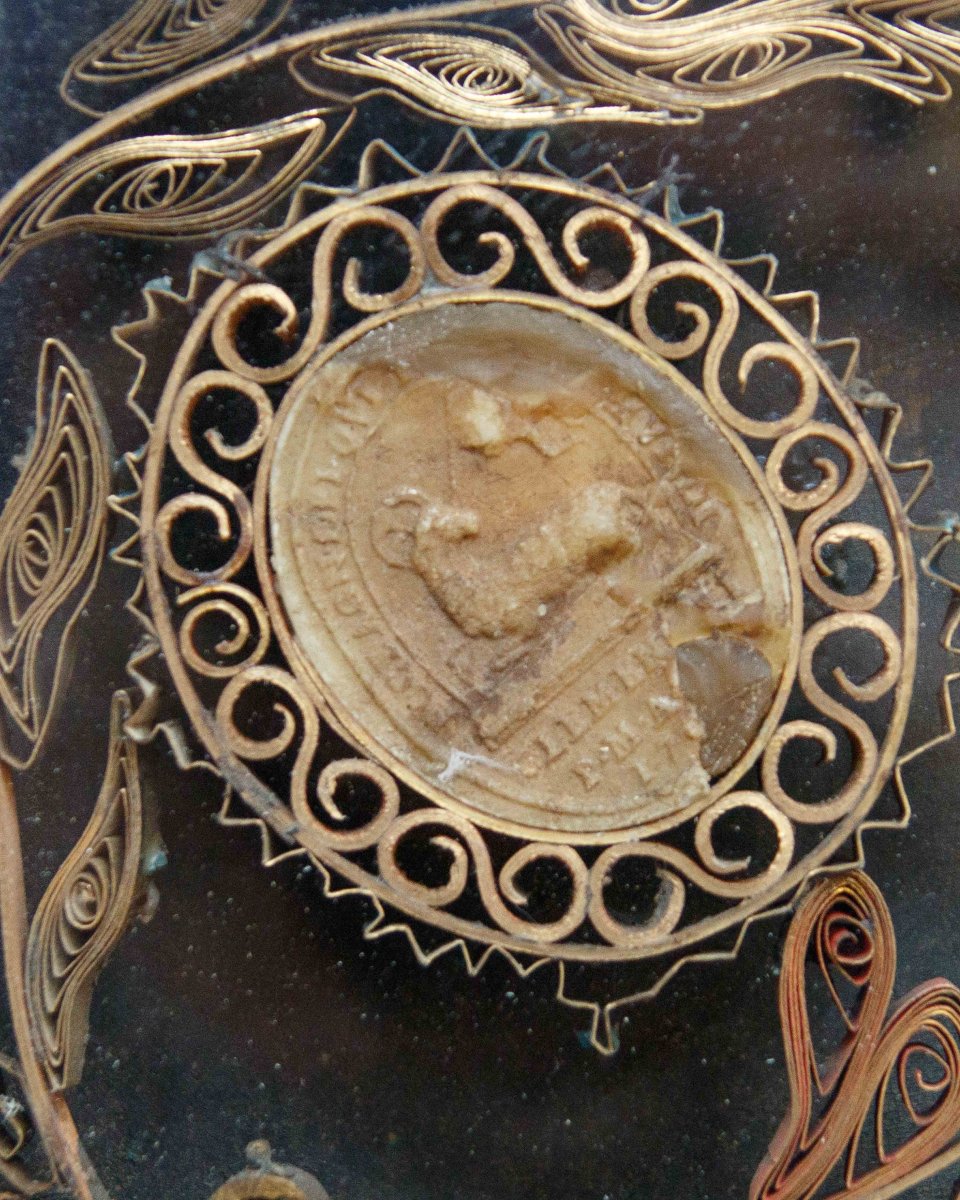
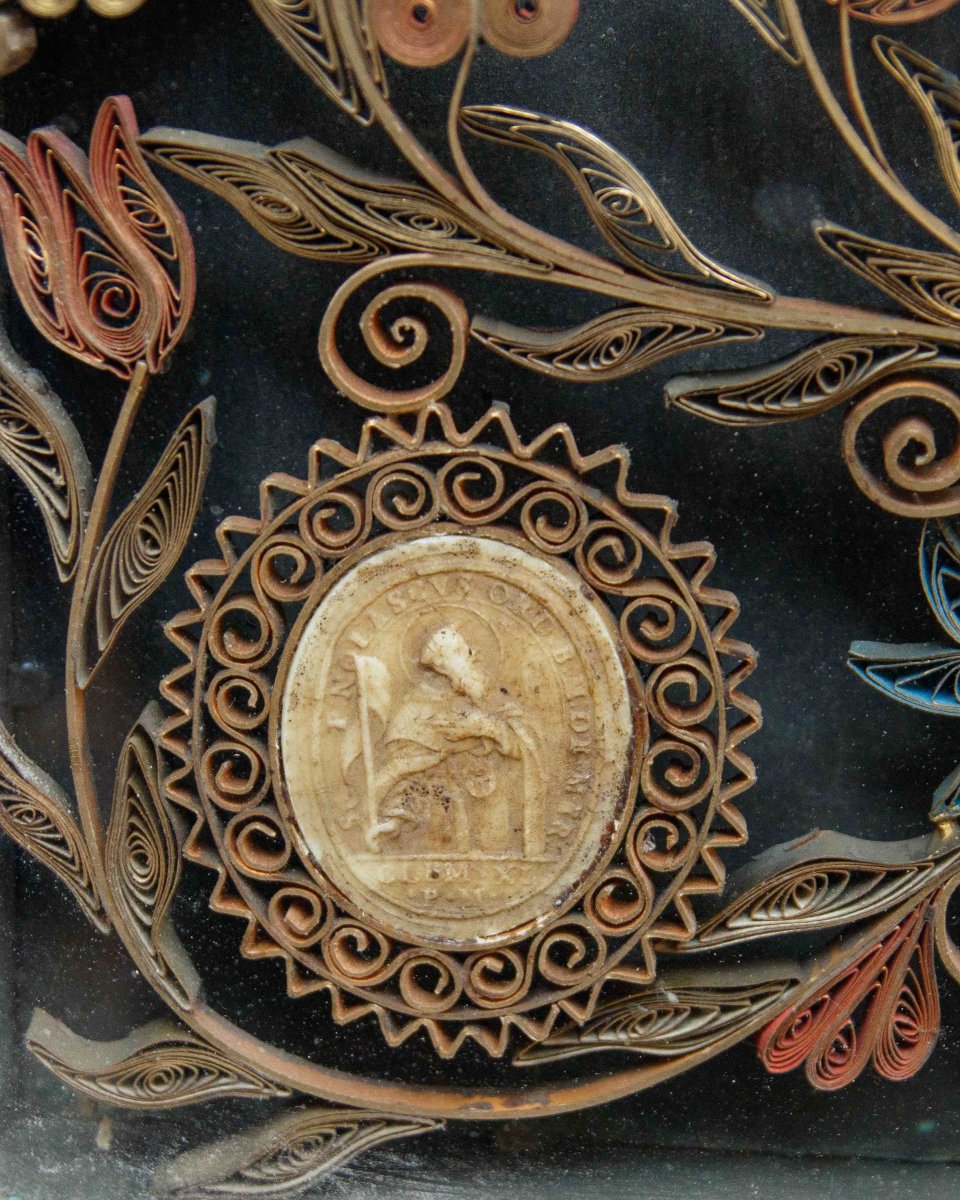
In the panel under examination, the paper was shaped to create a complex decorative apparatus characterised by lush phytomorphic elements. These elements branch off from the center of the lower section and develop by wrapping around five wax ovals, discs obtained from the casting of the Pasquale Wax. The custom of breaking the Paschal candle into minute fragments to distribute them to the faithful has been attested in Roman churches since the 5th century. Later, the practice evolved into the custom of reusing wax to create discs (often sealed or imprinted), on which the image of a Saint was depicted on the verso and, on the recto, the Agnus Dei, the Lamb of God. The preparation of this wax, through the mixing of the Sacred Chrism with the molten wax of the Paschal candle, was initially entrusted to the apostolic subdeacons. Responsibility later passed to the Papal Sacristan, then to the Cistercians of the Monastery of Santa Pudenziana and San Bernardo alle Terme in Rome, and finally to the Monastery of Santa Croce in Gerusalemme. The oval in the centre of the panel depicts Pope Clement XI (pontificate 1700 -1721), around which the inscription "CLEMENS XI PONT MAXI” can be read, surrounded by four other ovals of slightly smaller dimensions which bear the image of the Agnus Dei and other religious, elements that make the work datable to the 18th century. Pope Clement XI (Giovanni Francesco Albani) was primarily known for promoting a difficult foreign policy marked by power conflicts with the great powers, culminating in the papal occupation of Comacchio. In theology, he issued the bull Unigenitus (1713) against Jansenism, which caused a major schism in the French Church. He was a great patron of the arts and sciences, enriching the Vatican collections and promoting important architectural works in Rome. His pontificate, though troubled, was crucial to the redefinition of relations between the Holy See and the European states in the eighteenth century.
Devotional panel with Clement XI
Painted and gilded paper and wax ovals
With frame, cm 38 x 42
The artefact illustrated here is a valuable example of a devotional panel created using the paperoles (or papier roulés) technique, an expression which in Italian translates as "rolled paper". This artisanal practice consists of the processing of thin strips of paper, in this case painted in polychrome and enriched with gilding, which are shaped to create relief ornaments intended to frame images or sacred objects, with a strong contrast provided by the dark background support. This particular form of artisanal production developed from the 17th century onwards, spreading mainly in female convent environments in France, Germany, Switzerland and Italy.
In the panel under examination, the paper was shaped to create a complex decorative apparatus characterised by lush phytomorphic elements. These elements branch off from the center of the lower section and develop by wrapping around five wax ovals, discs obtained from the casting of the Pasquale Wax. The custom of breaking the Paschal candle into minute fragments to distribute them to the faithful has been attested in Roman churches since the 5th century. Later, the practice evolved into the custom of reusing wax to create discs (often sealed or imprinted), on which the image of a Saint was depicted on the verso and, on the recto, the Agnus Dei, the Lamb of God. The preparation of this wax, through the mixing of the Sacred Chrism with the molten wax of the Paschal candle, was initially entrusted to the apostolic subdeacons. Responsibility later passed to the Papal Sacristan, then to the Cistercians of the Monastery of Santa Pudenziana and San Bernardo alle Terme in Rome, and finally to the Monastery of Santa Croce in Gerusalemme. The oval in the centre of the panel depicts Pope Clement XI (pontificate 1700 -1721), around which the inscription "CLEMENS XI PONT MAXI” can be read, surrounded by four other ovals of slightly smaller dimensions which bear the image of the Agnus Dei and other religious, elements that make the work datable to the 18th century. Pope Clement XI (Giovanni Francesco Albani) was primarily known for promoting a difficult foreign policy marked by power conflicts with the great powers, culminating in the papal occupation of Comacchio. In theology, he issued the bull Unigenitus (1713) against Jansenism, which caused a major schism in the French Church. He was a great patron of the arts and sciences, enriching the Vatican collections and promoting important architectural works in Rome. His pontificate, though troubled, was crucial to the redefinition of relations between the Holy See and the European states in the eighteenth century.
2 400 €
Period: 18th century
Style: Other Style
Condition: Good condition
Material: Paper
Width: 42
Height: 38
Reference (ID): 1691111
Availability: In stock
Print