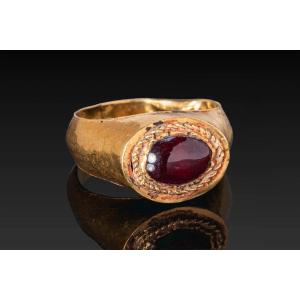
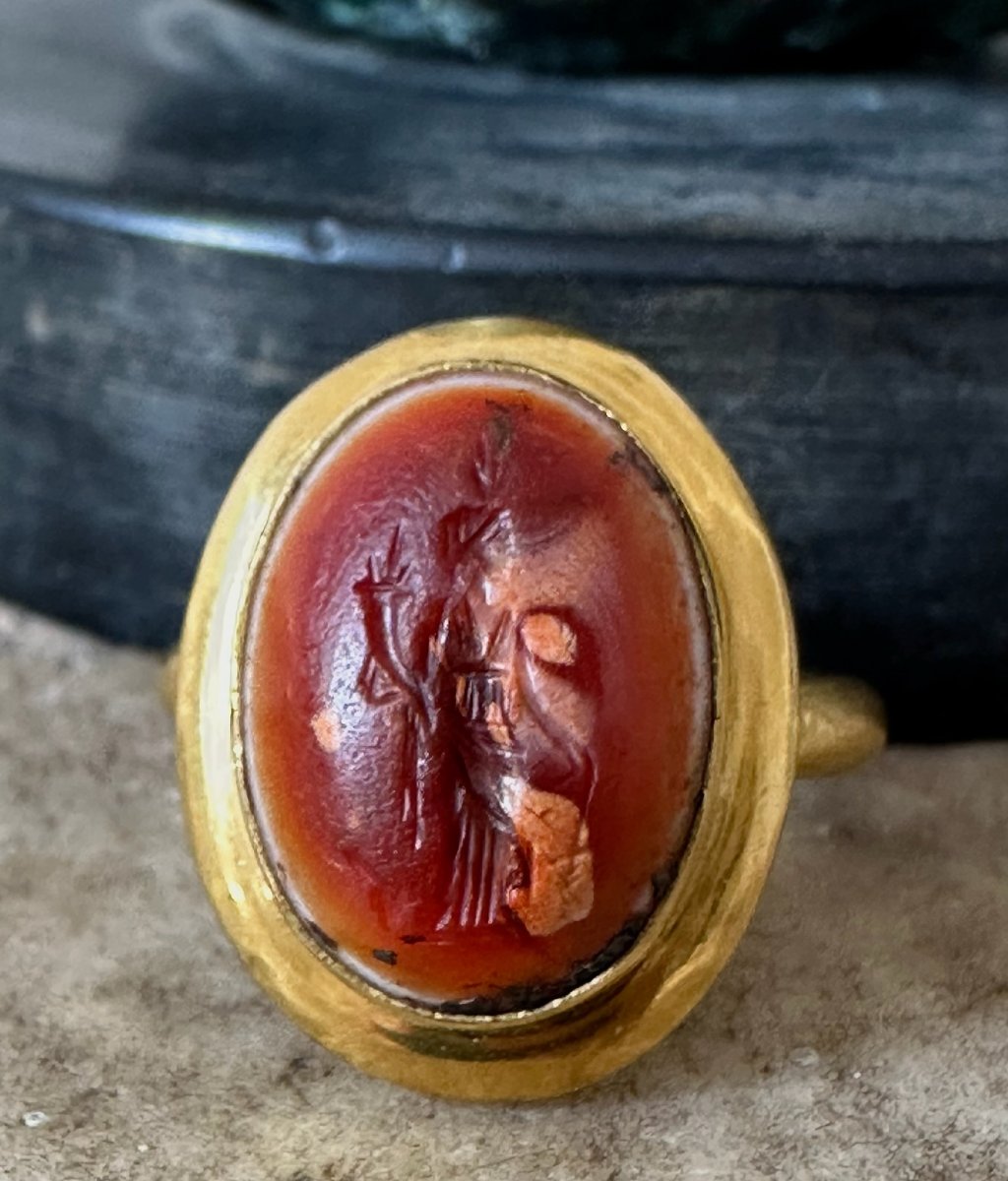
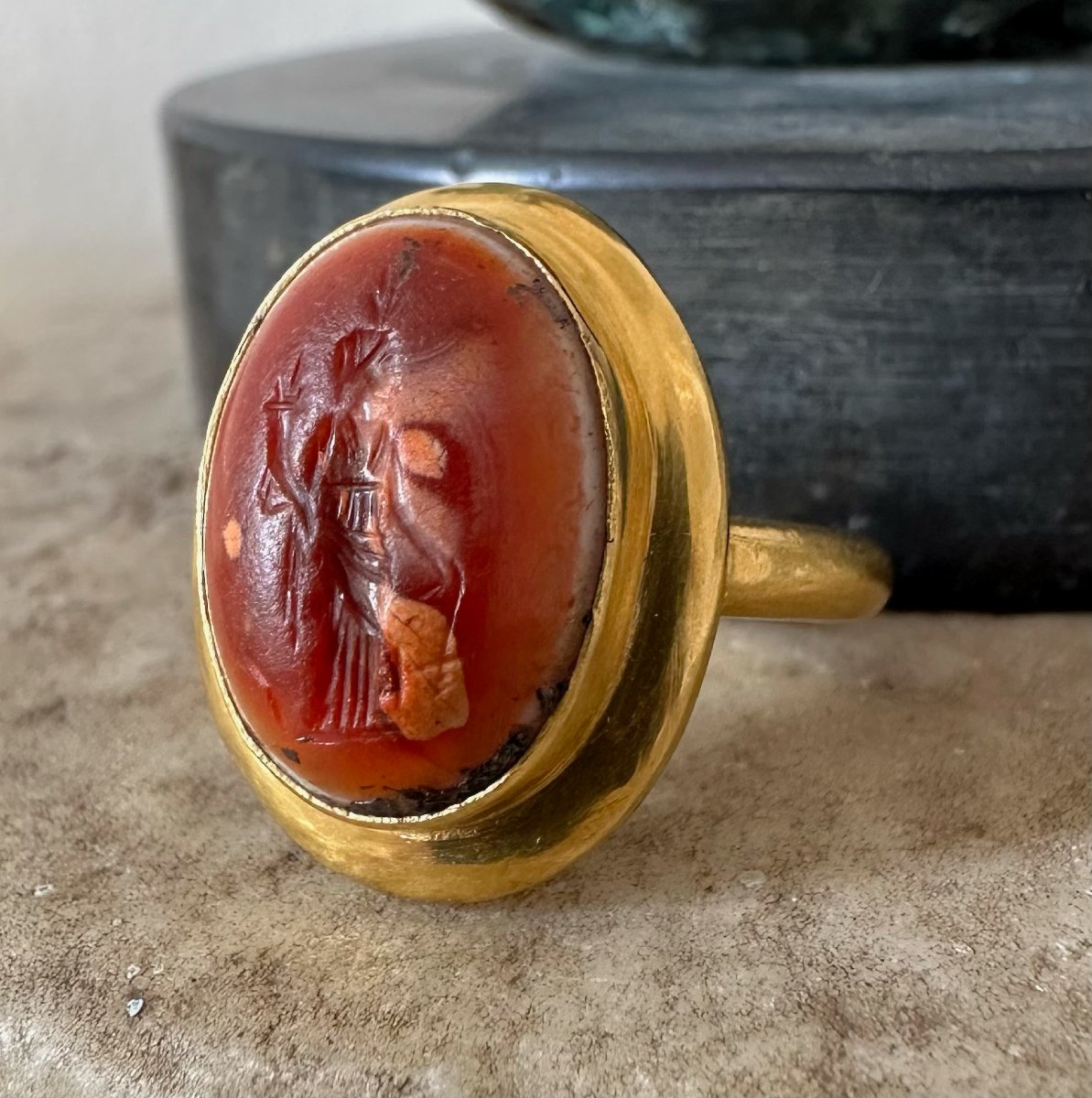
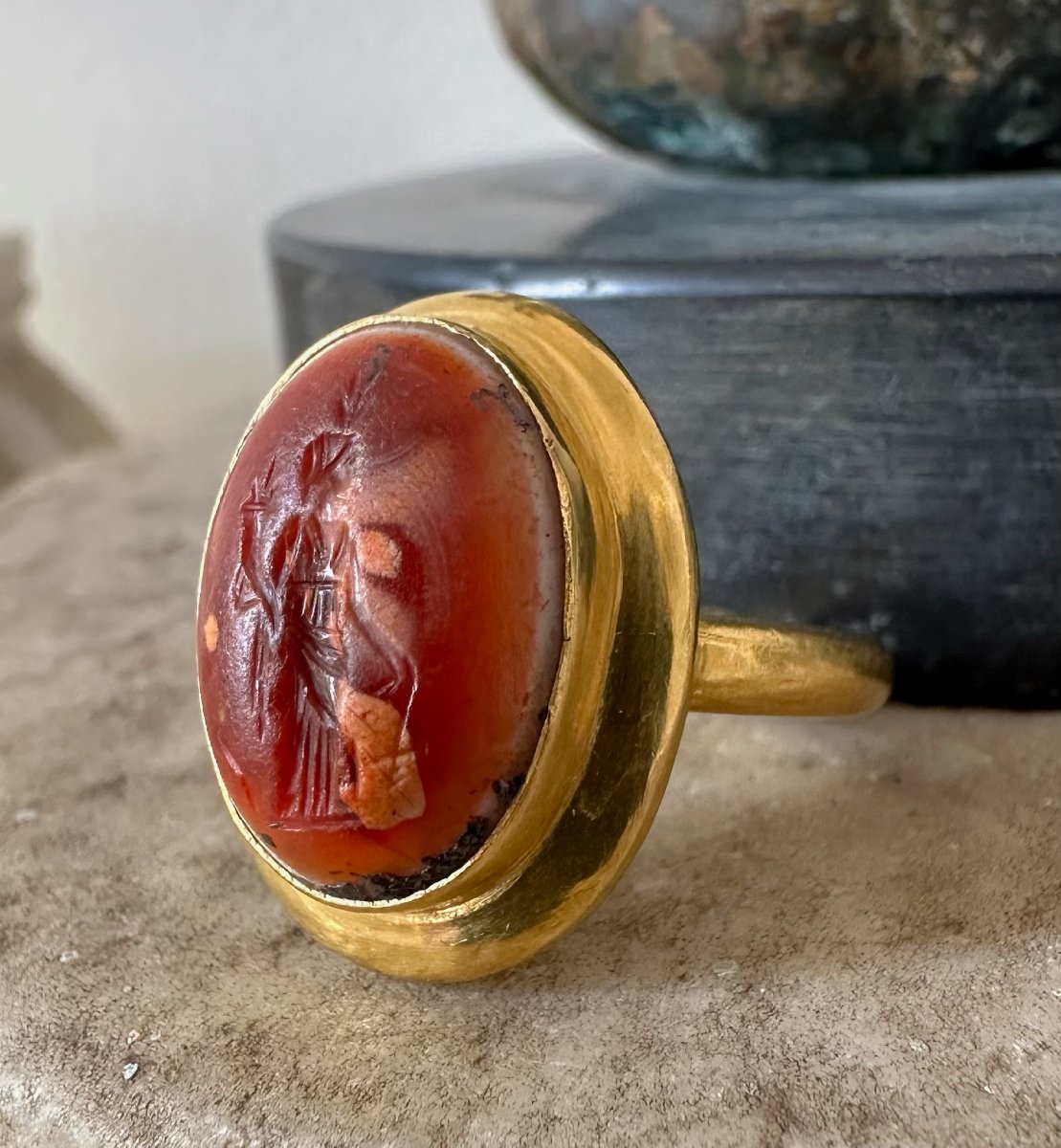
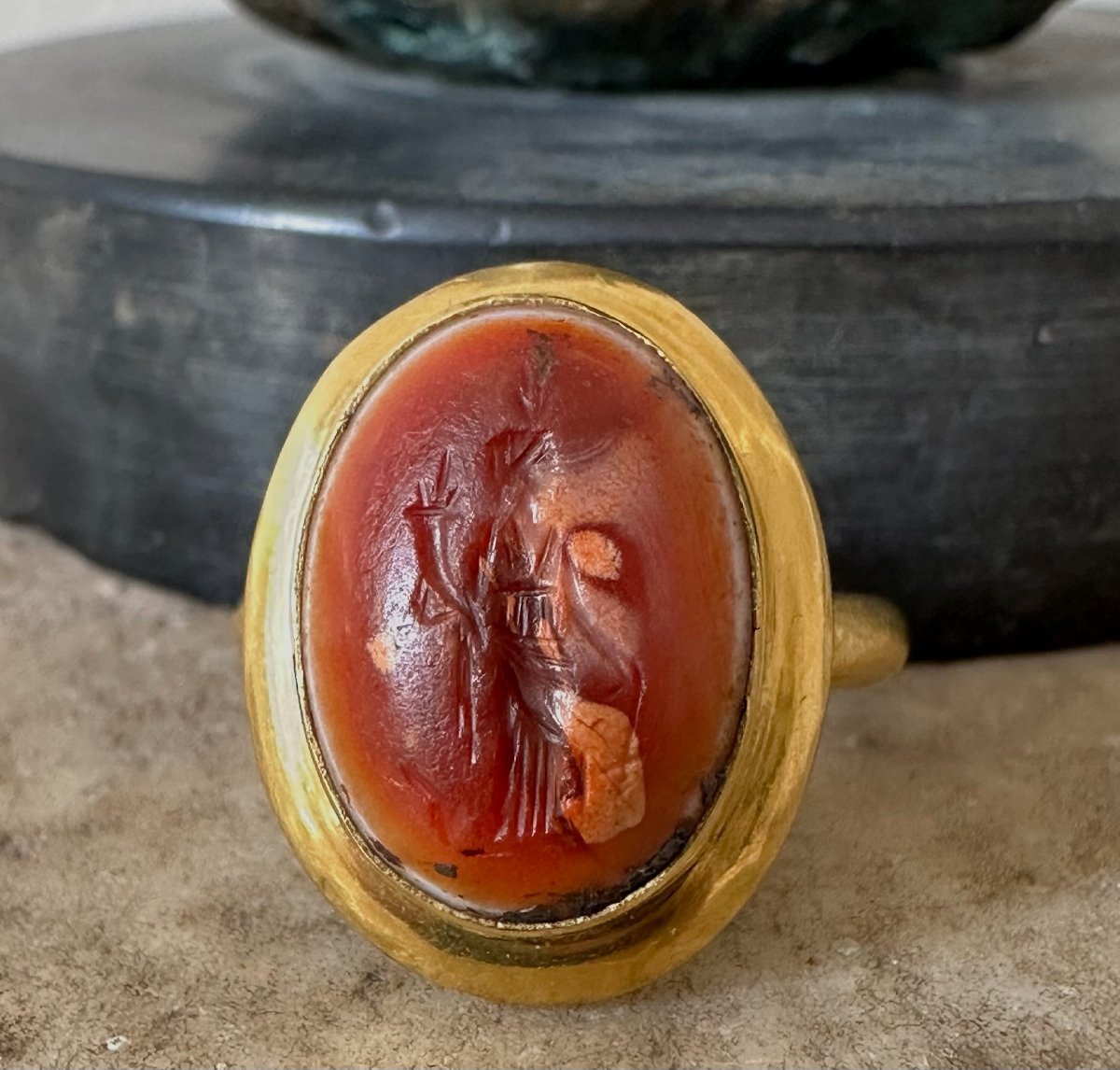


A Solid 18-karat Gold Ring Set With A Roman Agate Intaglio. Isis-fortuna.
Intaglio 12 × 6 mm
18-karat gold ring – size 53 (adjustable); weight 10.15 g.
Roman intaglio, 1st–2nd century AD; later setting
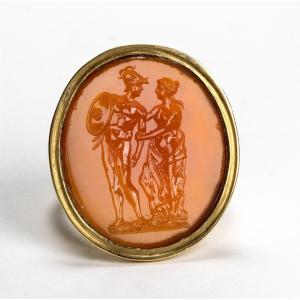
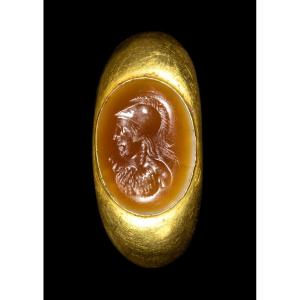
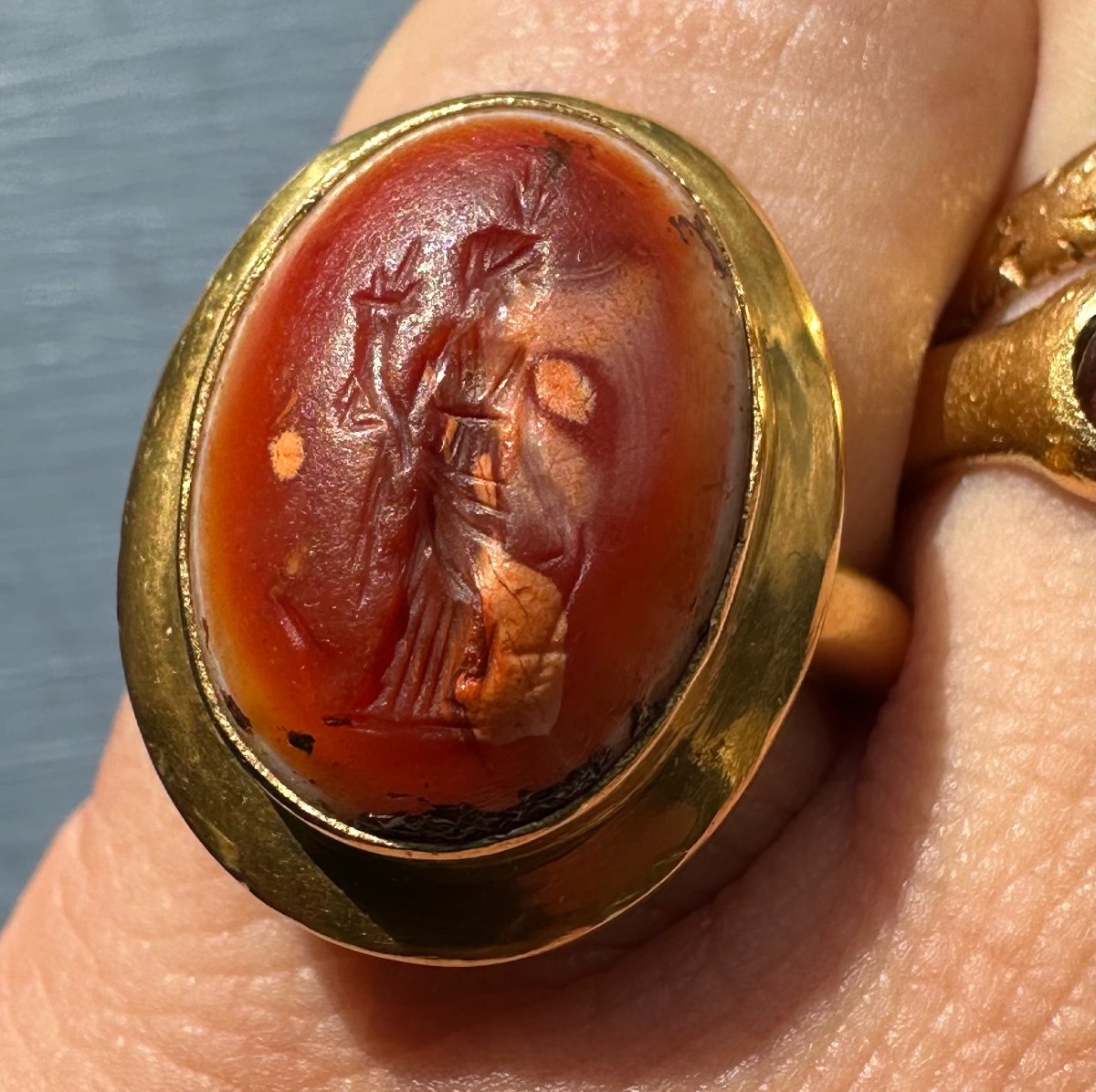
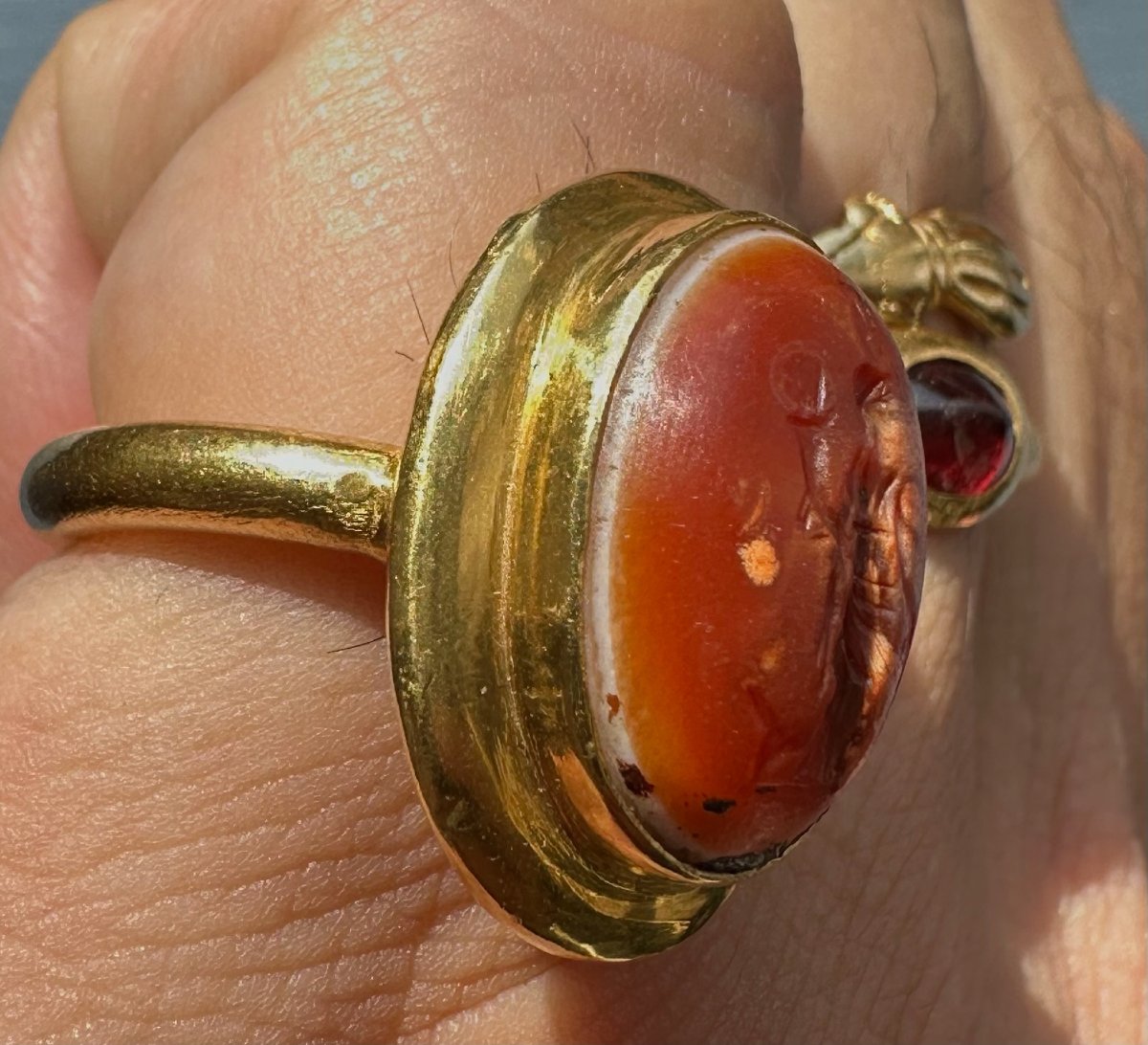
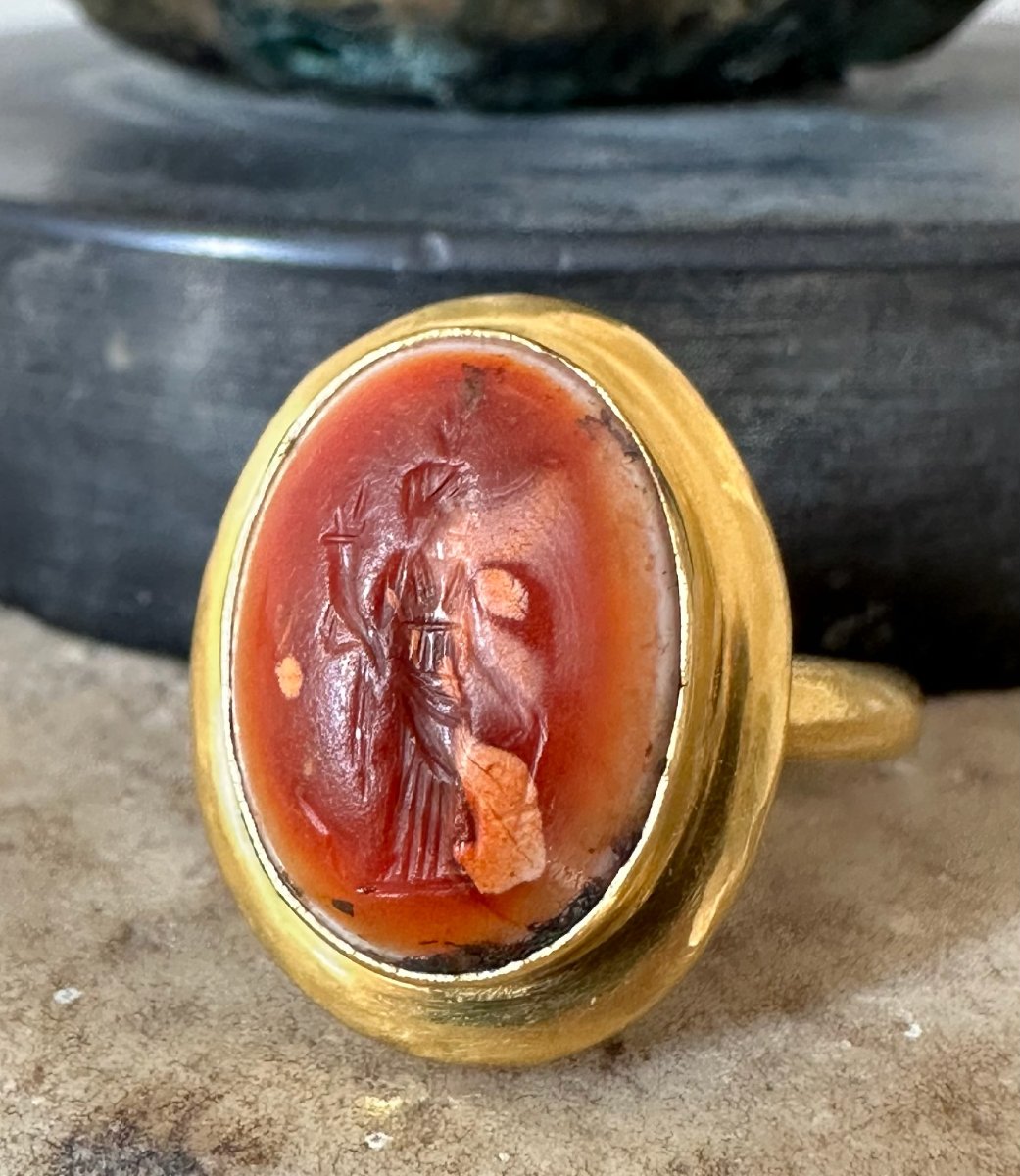
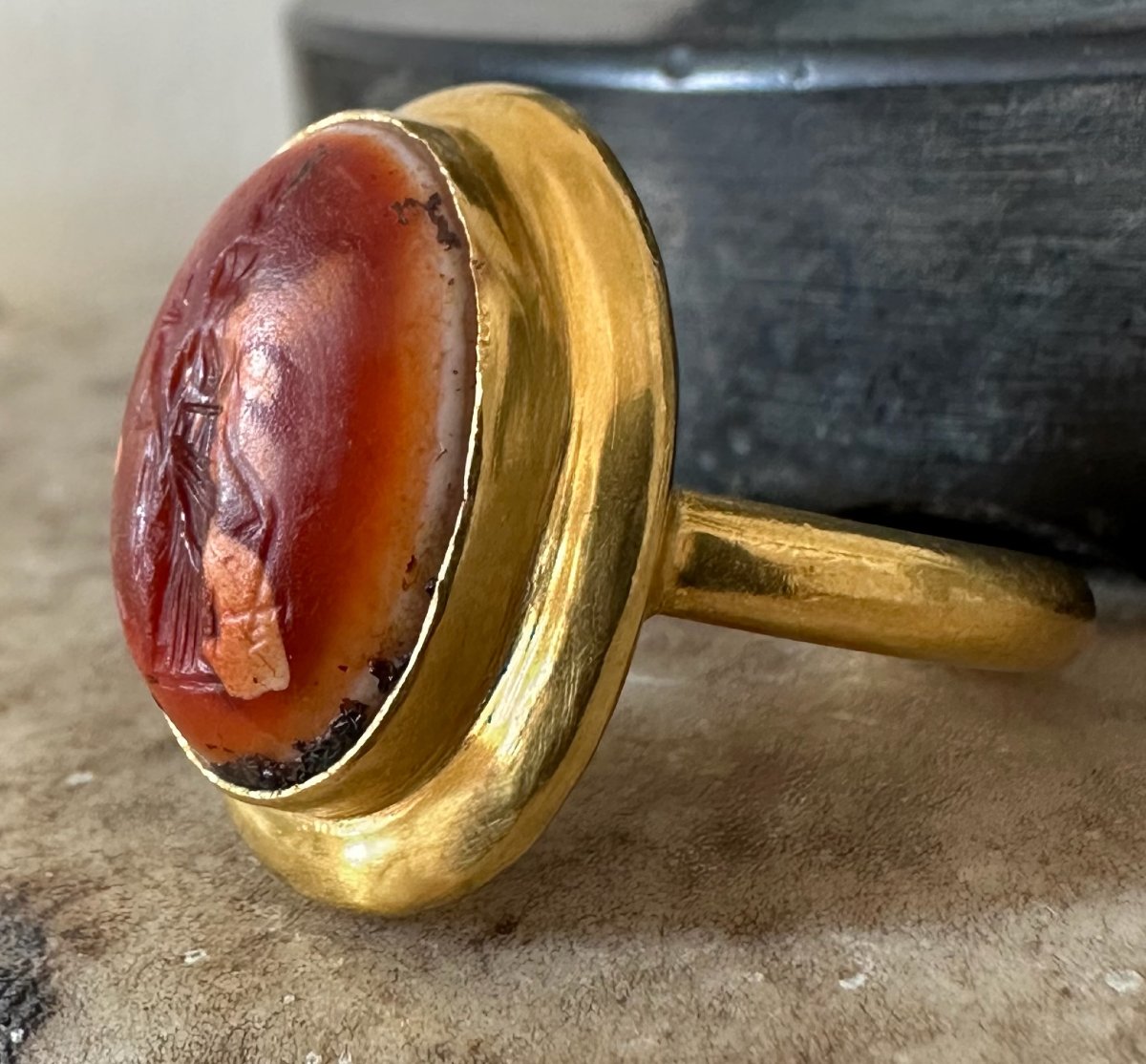
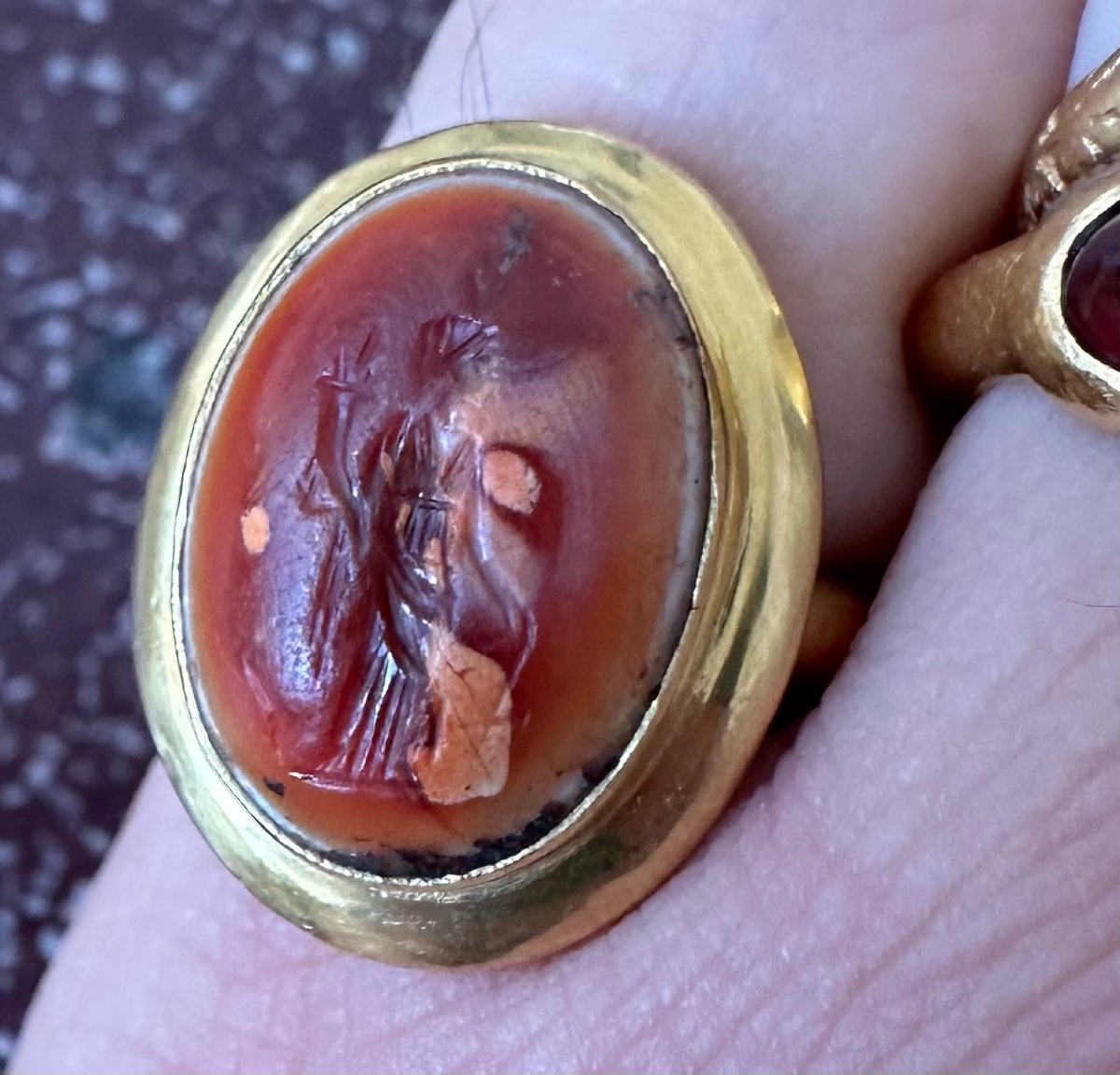
A solid 18-karat gold ring with a smooth band and a wide oval bezel, closed-set with a domed Roman agate intaglio of unusually generous dimensions, depicting Isis-Fortuna standing.
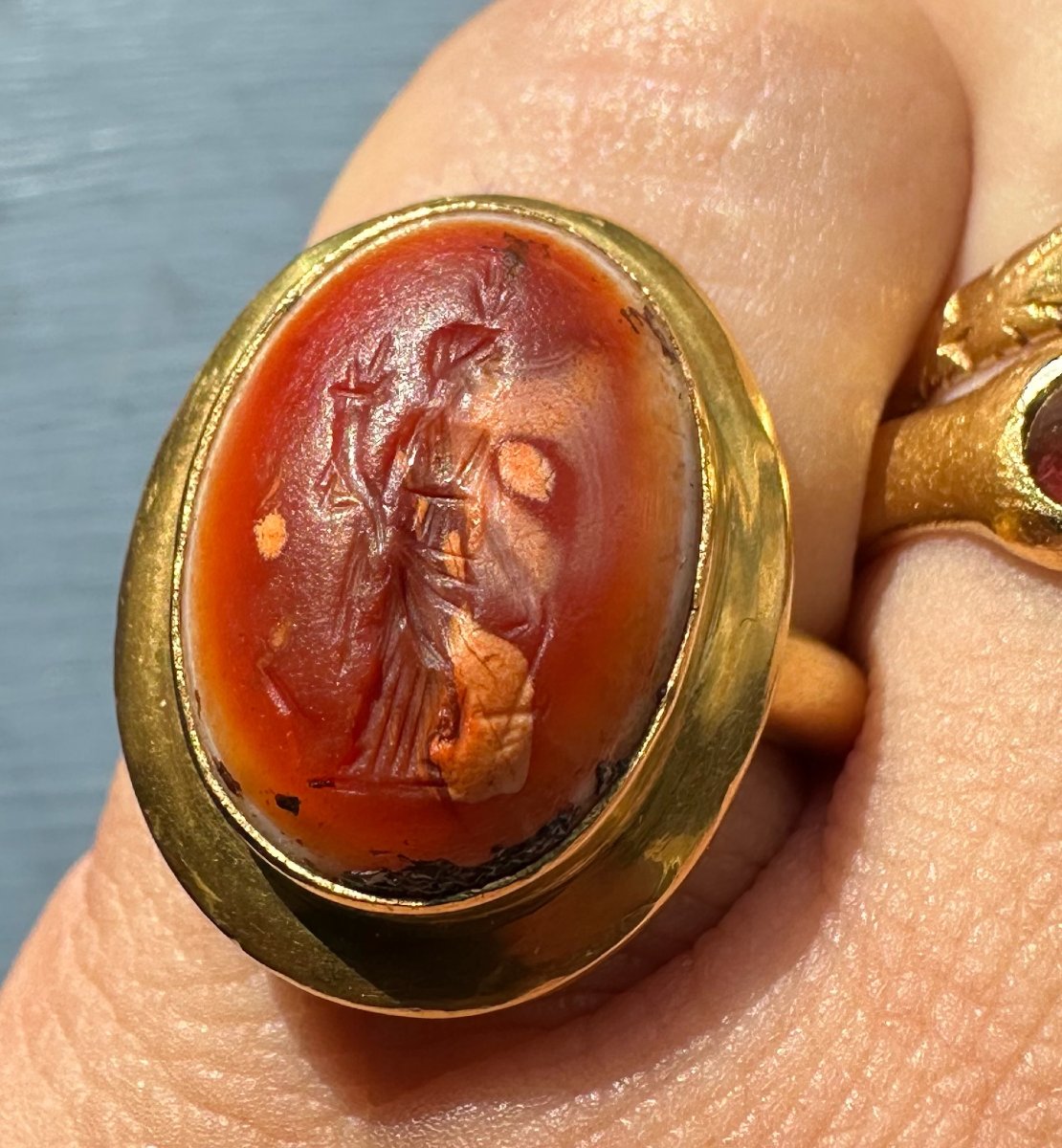
The goddess is depicted facing forward, her head turned to the right, wearing a long chiton and a himation whose folds fall in parallel lines to her feet. On her head is the Isiac crown.
To her left is a long rudder on which her hand rests; to her right, a cornucopia held against her shoulder. Base line. The stone is a banded agate with a light outer zone and reddish-orange spots.
Beneath the stone, at the lower edge of the setting, traces of iron oxidation indicate a former iron mount.
Historical Context
Fortuna is the most common subject on Roman ring stones, from Augustus to the Severan dynasty, and her fusion with Isis is one of the major religious developments of the Empire. Isis, mistress of the sea and of fate, was worshipped in Alexandria as Isis Tyche; in Italy, this type appears in Pompeii, Preneste, and the Isea district of Rome, and then on gemstones and coins as early as the 1st century. The Isiac crown on a Fortuna figure holding a rudder and a cornucopia is the hallmark of this syncretism. On a seal, the goddess who governs, who gives, and who holds the keys to fate was the natural emblem of a life under protection—worn by sailors, merchants, and freedmen. Pliny counts agate among the most sought-after stones for engraving and sees its beauty primarily in its spots and veins (Hist. nat. 37, 139–142).
Iconography and Symbolism
The rudder is the instrument of steering: Fortune steers the course of events just as the helmsman steers the ship. The cornucopia, the horn of Amalthea, symbolizes abundance that flows without measure. The crown brings a third power: Isis, who reunited Osiris and reigns over destiny itself—the goddess who, in Apuleius’s work, tells Lucius that she alone can extend the thread of his life beyond what Fortune has spun. Together, the three attributes express the Roman concept of fortune—not blind chance, but a power that can be directed, and thus won over. The mottled stone suits her well: a goddess who distributes nothing uniformly.
18-karat gold ring – size 53 (adjustable); weight 10.15 g.
Roman intaglio, 1st–2nd century AD; later setting
A solid 18-karat gold ring with a smooth band and a wide oval bezel, closed-set with a domed Roman agate intaglio of unusually generous dimensions, depicting Isis-Fortuna standing.
The goddess is depicted facing forward, her head turned to the right, wearing a long chiton and a himation whose folds fall in parallel lines to her feet. On her head is the Isiac crown.
To her left is a long rudder on which her hand rests; to her right, a cornucopia held against her shoulder. Base line. The stone is a banded agate with a light outer zone and reddish-orange spots.
Beneath the stone, at the lower edge of the setting, traces of iron oxidation indicate a former iron mount.
Historical Context
Fortuna is the most common subject on Roman ring stones, from Augustus to the Severan dynasty, and her fusion with Isis is one of the major religious developments of the Empire. Isis, mistress of the sea and of fate, was worshipped in Alexandria as Isis Tyche; in Italy, this type appears in Pompeii, Preneste, and the Isea district of Rome, and then on gemstones and coins as early as the 1st century. The Isiac crown on a Fortuna figure holding a rudder and a cornucopia is the hallmark of this syncretism. On a seal, the goddess who governs, who gives, and who holds the keys to fate was the natural emblem of a life under protection—worn by sailors, merchants, and freedmen. Pliny counts agate among the most sought-after stones for engraving and sees its beauty primarily in its spots and veins (Hist. nat. 37, 139–142).
Iconography and Symbolism
The rudder is the instrument of steering: Fortune steers the course of events just as the helmsman steers the ship. The cornucopia, the horn of Amalthea, symbolizes abundance that flows without measure. The crown brings a third power: Isis, who reunited Osiris and reigns over destiny itself—the goddess who, in Apuleius’s work, tells Lucius that she alone can extend the thread of his life beyond what Fortune has spun. Together, the three attributes express the Roman concept of fortune—not blind chance, but a power that can be directed, and thus won over. The mottled stone suits her well: a goddess who distributes nothing uniformly.
2 800 €
Period: 20th century
Style: Rome and Antic Greece
Condition: Excellent condition
Material: Gold
Reference (ID): 1816734
Availability: In stock
Print