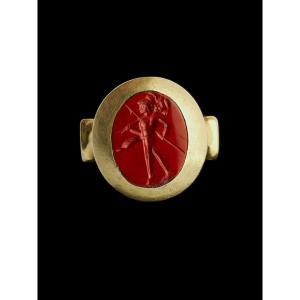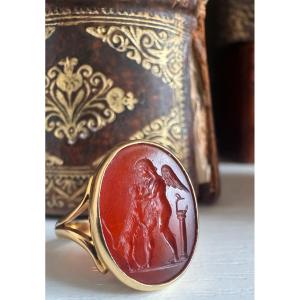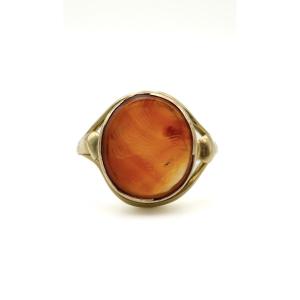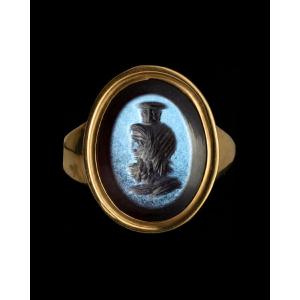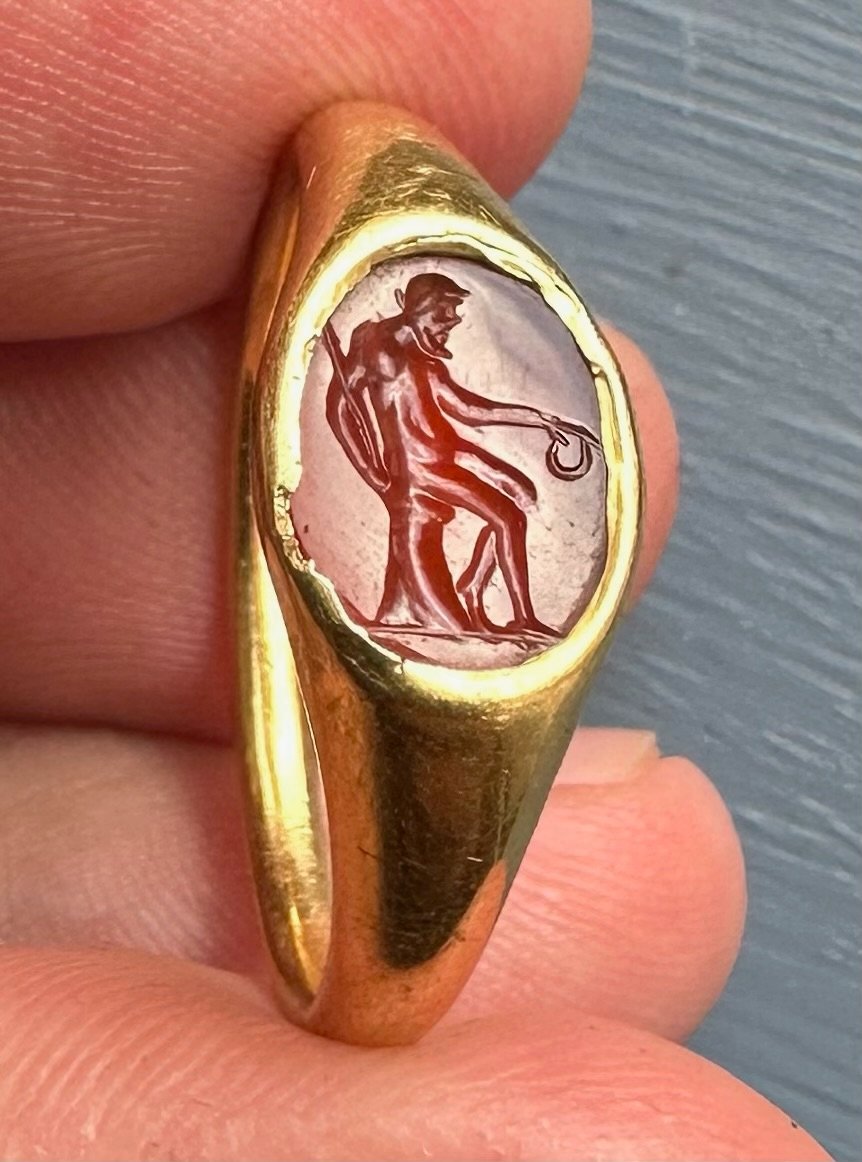
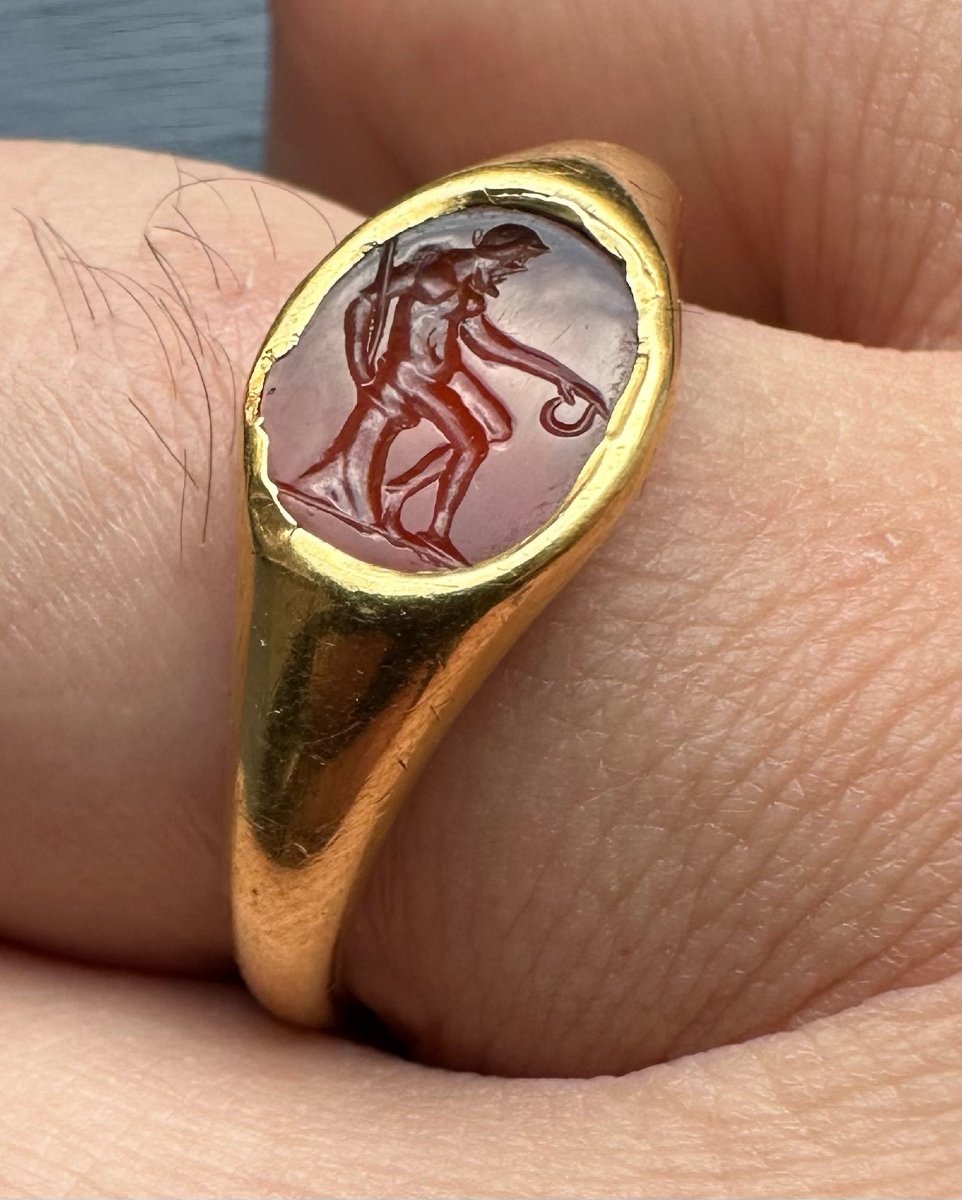
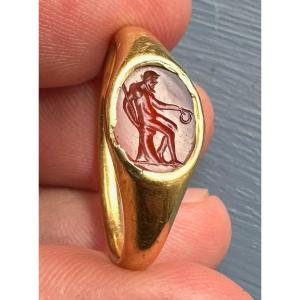


Late Renaissance (or Earlier) Gold Ring Set With A Carnelian Intaglio. An Old Man
Intaglio 8 × 10 mm
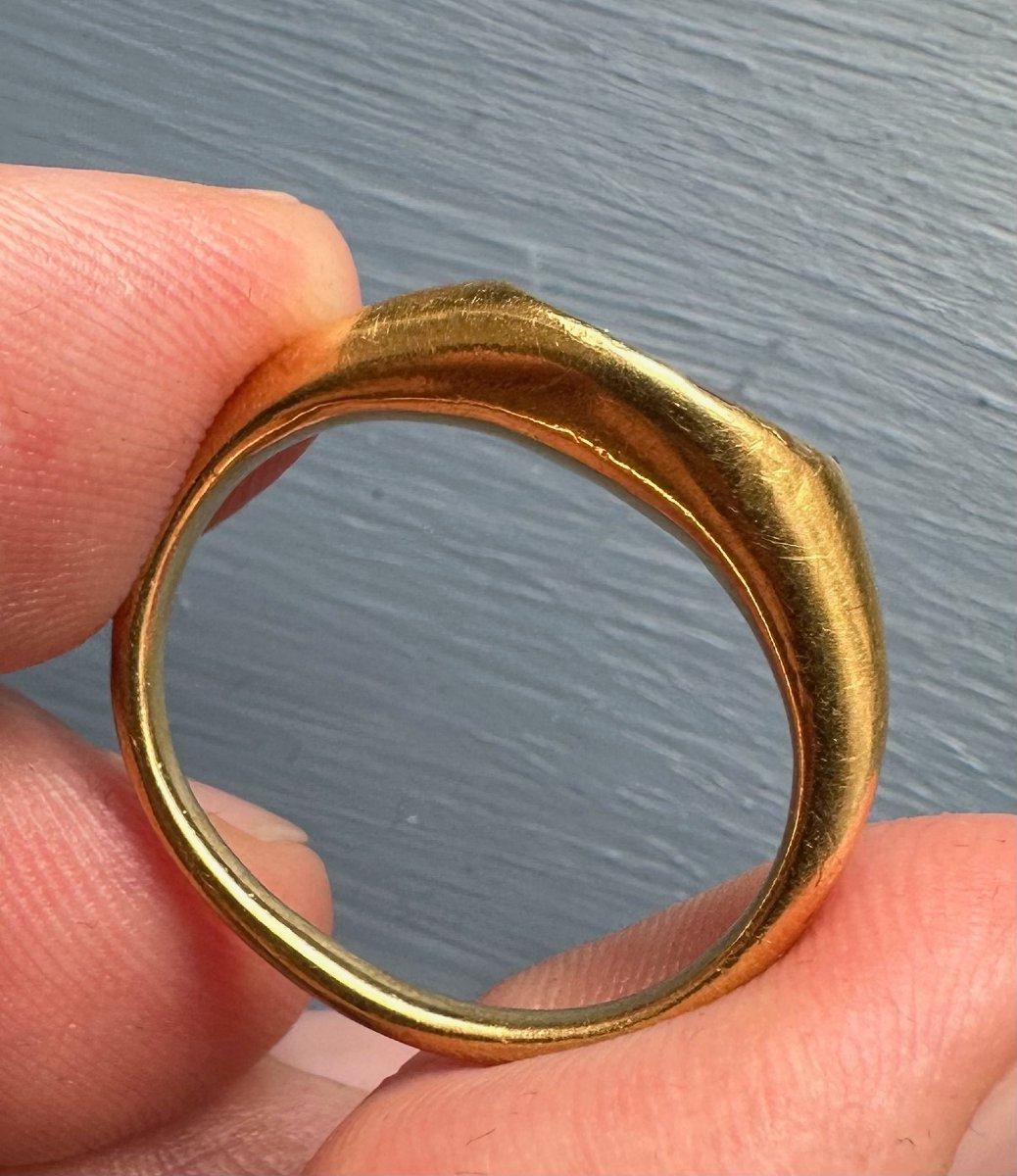
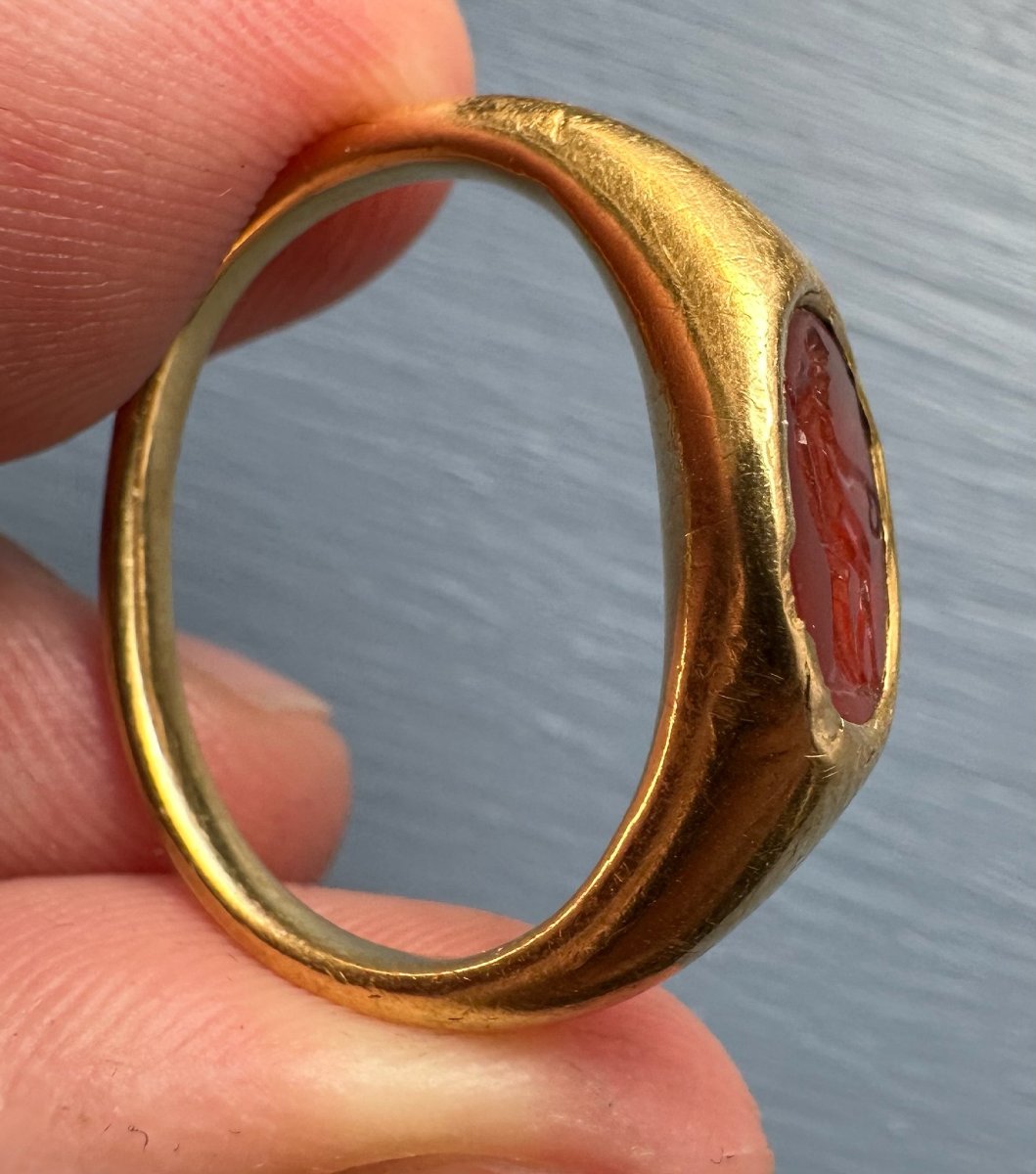
Gold ring—ring size 59 (US 9 / UK R½); gross weight 6.19 g.
Ring and intaglio, Late Renaissance or earlier, 14th–16th century.
Very good condition; clear engraving; small chip at the edge of the setting on the left; the stone is intact.
The figure is nude, seated on a rock or a tree trunk, with the left leg bent and the right leg extended. A close-fitting cap covers the head; the beard is long and pointed. The left arm passes behind the body and rests on a staff leaning against the shoulder; the right arm is extended forward, the hand grasping the handle of a short, curved tool—a sickle or a pair of tongs, viewed in profile. Ground line. A small, lively engraving, with rounded forms and an energetic profile, in the classical style.
Historical Context—Renaissance Glyptic Art
Engraved stones continued to be worn throughout the period from Antiquity to the Renaissance: ancient intaglios were set into medieval rings, and as early as the 14th century, Italian and Northern European engravers carved new stones in the classical style, first for seals, then for the cabinets of 15th- and 16th-century collectors. The smooth gold band, flaring seamlessly toward the setting, belongs to this world. Two gods share the figure’s attributes. Saturn is the old man with the sickle and scepter; Vulcan, the bearded blacksmith wearing a craftsman’s cap, seated at the anvil with a hammer and tongs—a highly prized iconography during the Renaissance, from Mantegna to Piero di Cosimo, in which Vulcan’s forge symbolizes the arts and crafts of civilization.
Iconography and Symbolism (If this refers to Saturn)
The Roman Cronus, who castrated his father Uranus with a sickle and devoured his own children before being overthrown by Jupiter; exiled to Latium, he taught agriculture to mankind and reigned over the Golden Age. For the Renaissance, following Ficino, Saturn is also the planet of contemplation and melancholy, the patron of scholars—a seal perfectly suited for a learned hand. If it is Vulcan: the lame god of fire and the forge, husband of Venus, creator of Achilles’ weapons and Jupiter’s thunderbolts; the Renaissance saw his forge as the cradle of the arts. In both cases, the seated old god, with his staff and blade, is an emblem of mastery—over time or over matter.
Comparanda
The ring type
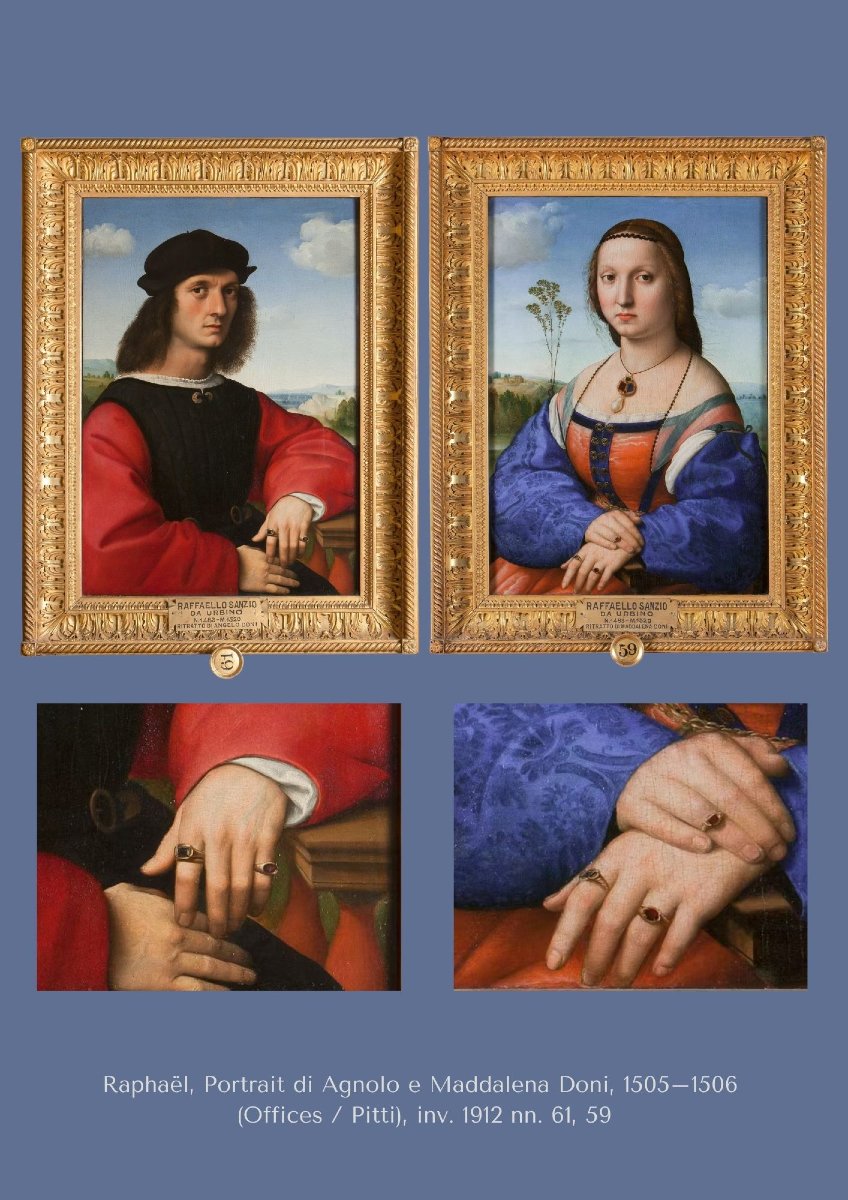
– Raphael, Portraits of Agnolo Doni and Maddalena Doni, c. 1505–1506, Florence, Uffizi Galleries (Palatine Gallery, Pitti Palace). Agnolo wears two gold rings with oval settings, one with a dark stone and the other with a red stone; Maddalena wears four.
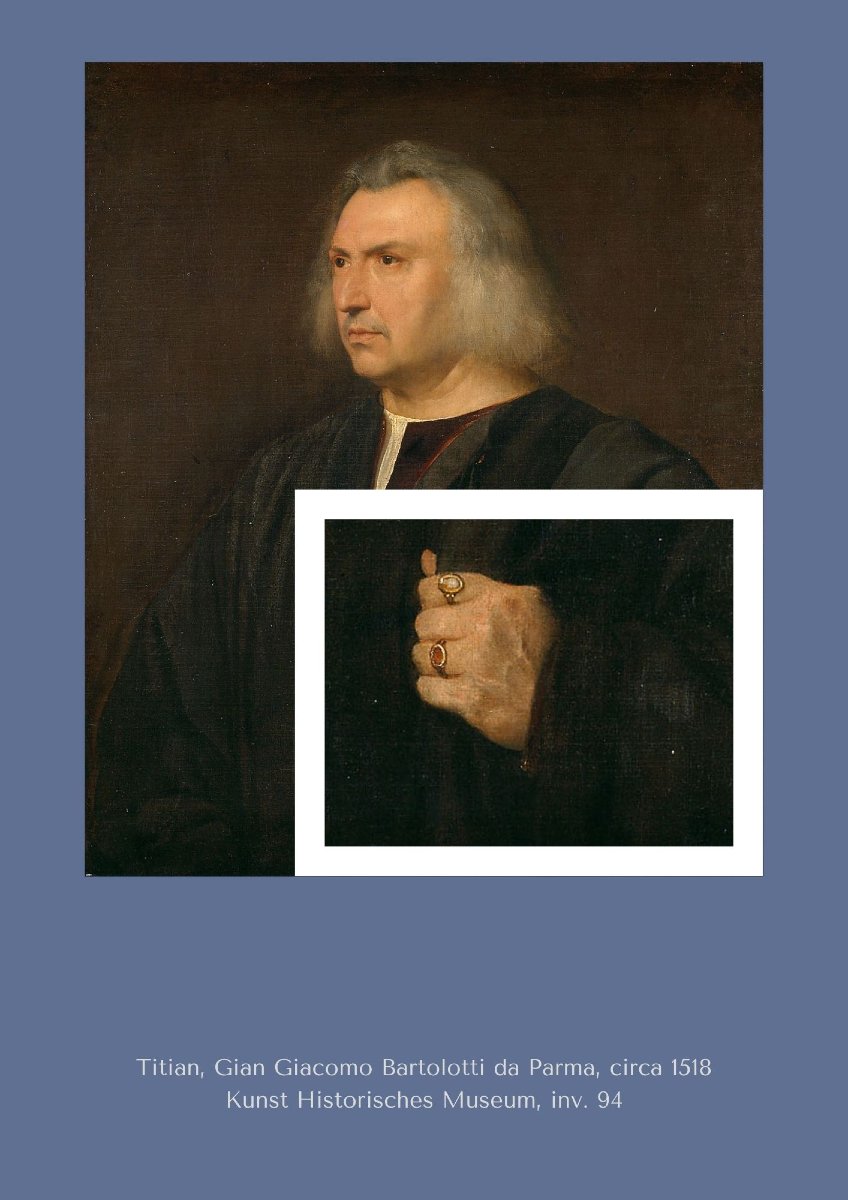
– Titian, Portrait of the Physician Gian Giacomo Bartolotti da Parma, c. 1515–1518, Vienna, Kunsthistorisches Museum, inv. GG 94. Two gold rings with oval settings on his left hand, one of which has a red stone.
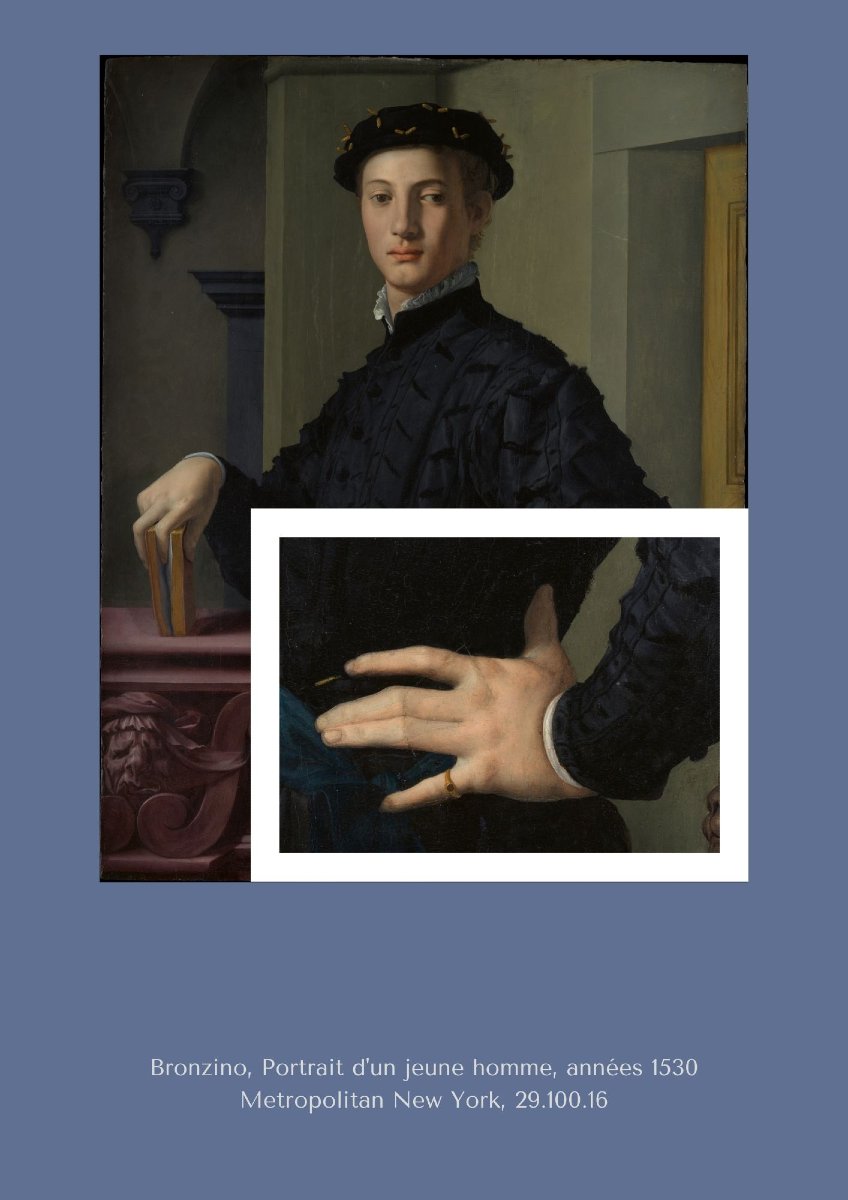
– Bronzino, Portrait of a Young Man, 1530s, New York, The Metropolitan Museum of Art, inv. 29.100.16. A plain gold ring with a small, dark, oval setting on his right hand.
Comparanda
Vulcan in the Renaissance
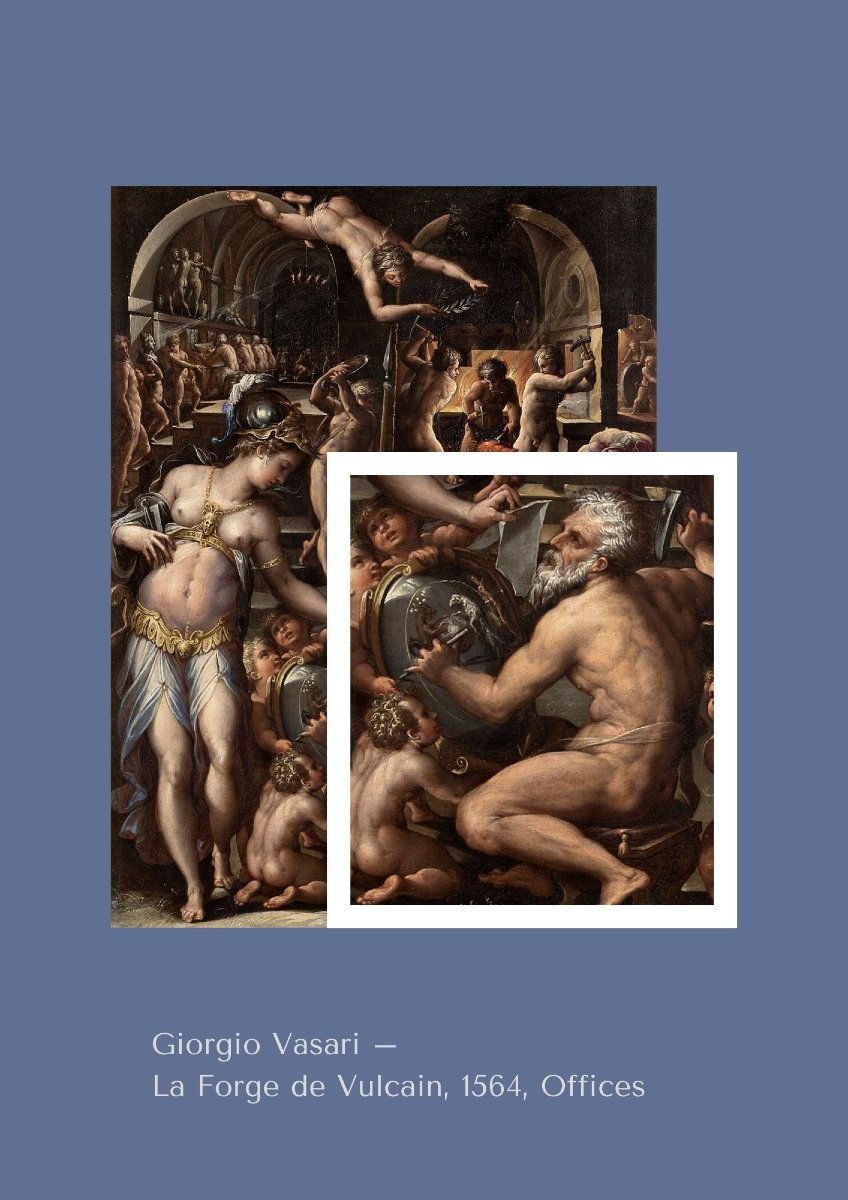
– Giorgio Vasari, The Forge of Vulcan, 1564, Florence, Uffizi Galleries. A bearded, nude Vulcan, seated in profile at work.
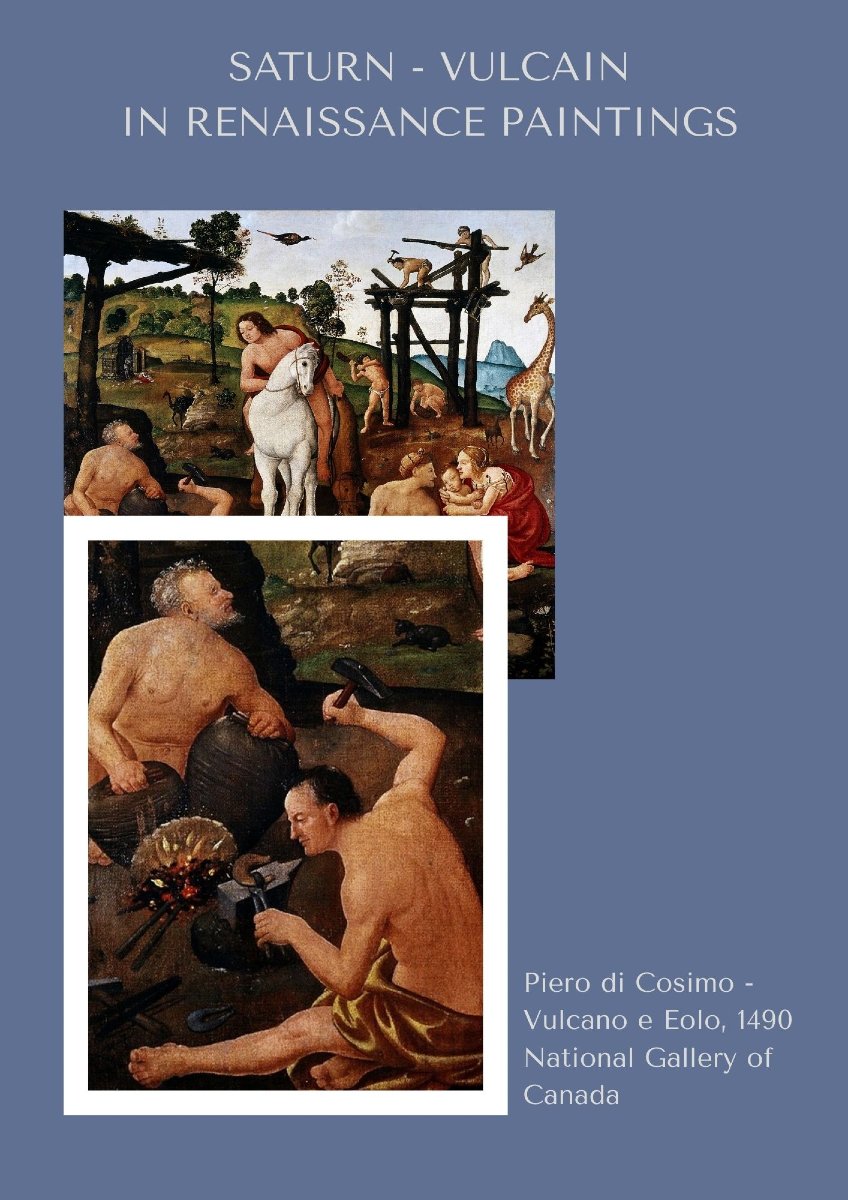
– Piero di Cosimo – Vulcan and Aeolus, 1490, National Gallery of Canada
2 600 €
Period: 16th century
Style: Rome and Antic Greece
Condition: Good condition
Material: Gold
Reference (ID): 1813994
Availability: In stock
Print