

Circle Of Valerio Belli (1468-1546). A Large Renaissance Agate Intaglio. Mythological Scene
Artist: Entourage De Valerio Belli (1468-1546)
Dim. 28 x 40 x 8 mm
Italy, 16th century
Iconography
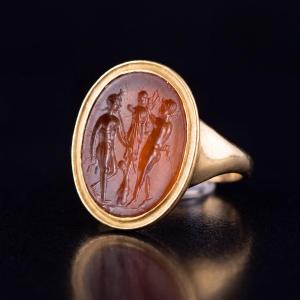
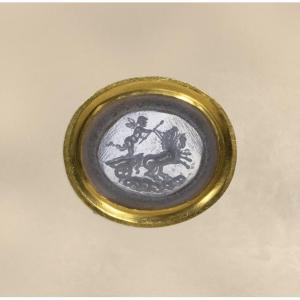
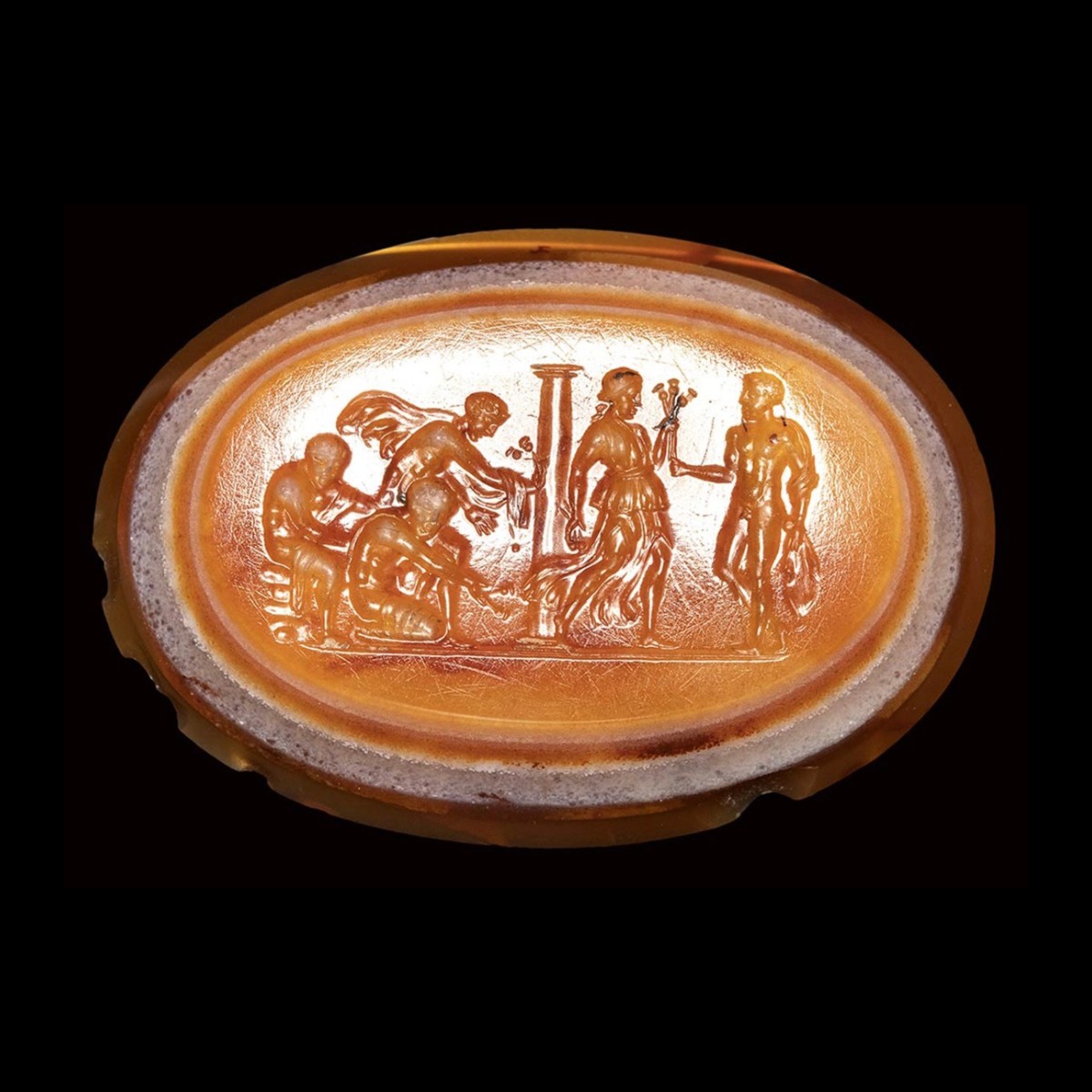
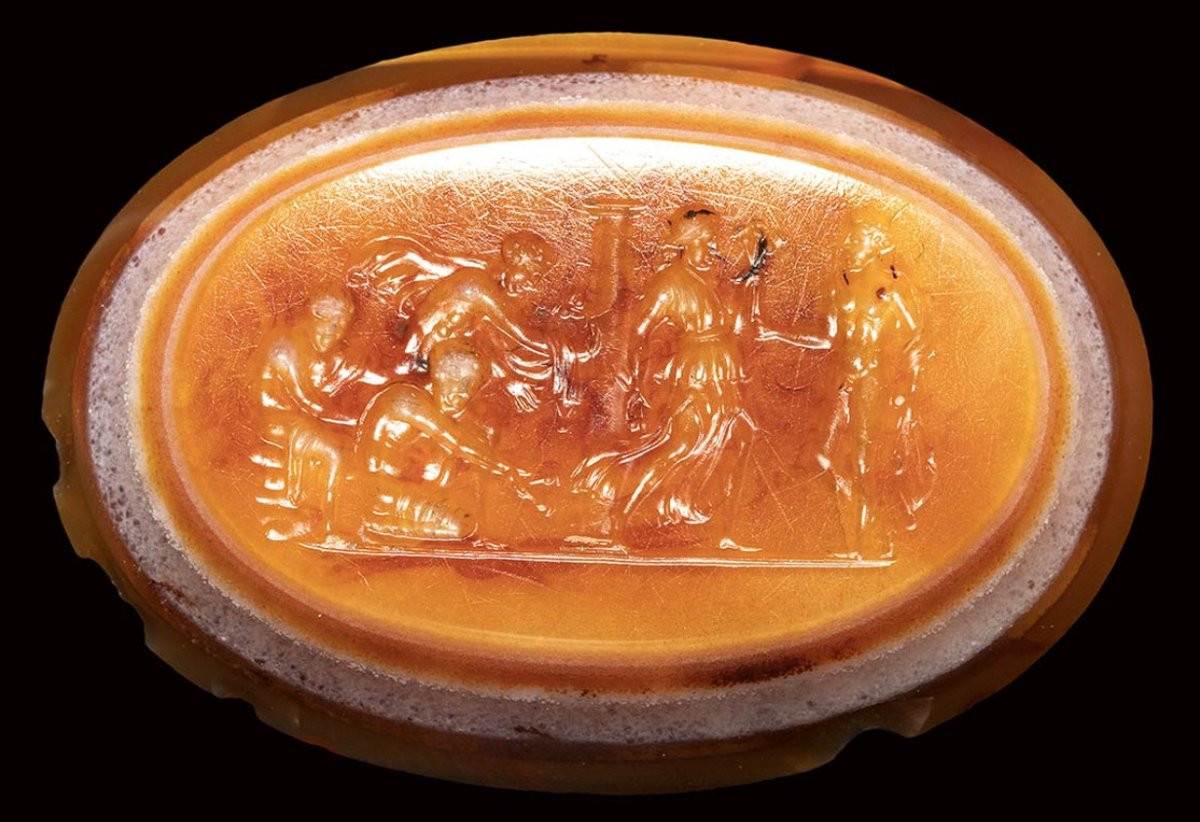
This finely executed allegorical scene depicts Triptolemus receiving poppy flowers from Ceres, goddess of agriculture. According to mythology, these flowers, once distributed to farmers, bestow sweet sleep and peaceful rest. The female figure has also been interpreted as a personification of Night.
The composition is structured around a central column, dividing the scene into two halves. On the left, three farmers are depicted: one standing, one kneeling, and one seated, offering flowers. On the right, Ceres presents the poppies to Triptolemus, shown nude save for a flowing cloak.
The work demonstrates exceptional technical and artistic mastery, executed on a particularly large and beautifully banded three-layered agate. Some signs of wear consistent with age and use.
An other interpretation sees in this scene the draped female figure—
personifying Night — walks to the left, offering poppy flowers to a nude male figure. Behind her, to the right beneath a tree, three figures are shown bending: two male and one female.
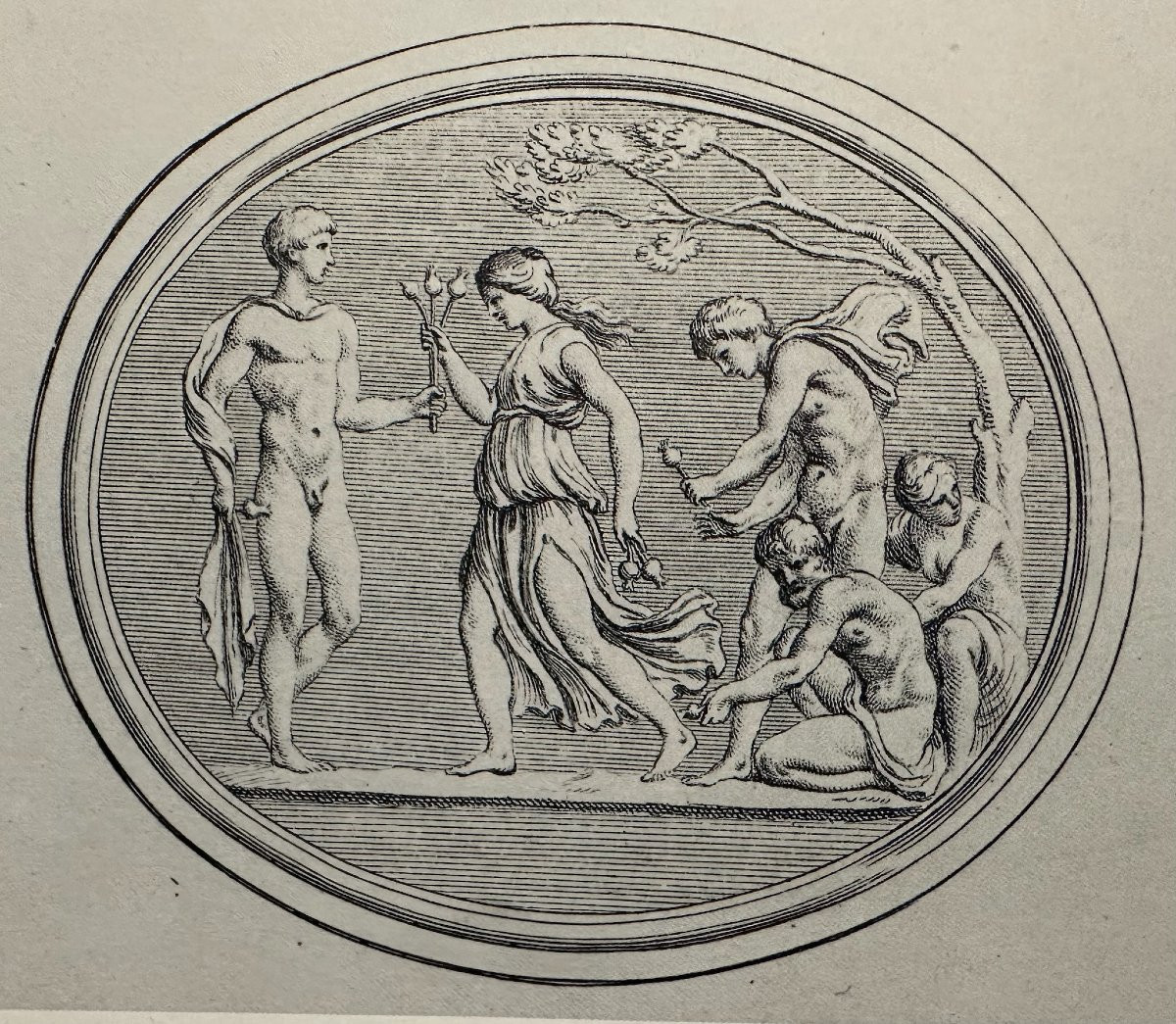
The composition is elegantly structured around a central column, dividing the scene into two halves. The iconography evokes the myth of Triptolemus receiving poppies from Ceres, which, once distributed to farmers, bestow sweet sleep and peaceful rest. The female figure has traditionally been identified as Night (Nox), a poetic interpretation first proposed by Pierre-Jean Mariette.
ATTRIBUTION & ART HISTORICAL CONTEXT
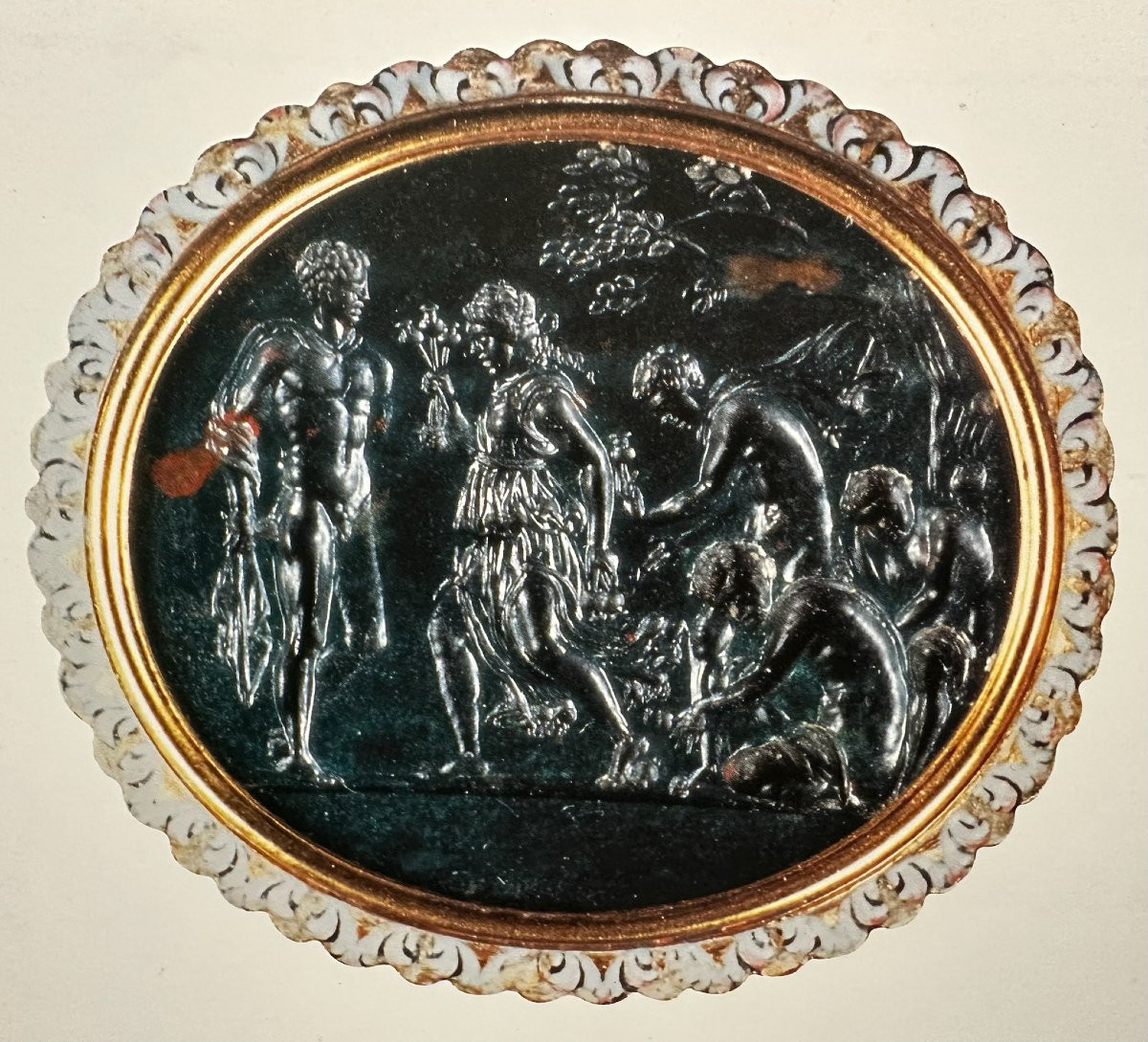
This intaglio derives from a celebrated model by Valerio Belli, called il Vicentino (c. 1468–1546), the foremost gem engraver and rock crystal carver of the Italian Renaissance. The attribution to Belli was established by Ernst Kris (1929) and is supported by the characteristic treatment of the female figure, consistent with other feminine creations by the master.
The evocative title Night Distributing Poppies was coined by Pierre-Jean Mariette, who illustrated the original stone in his landmark Traité des pierres gravées (1750).
The success of this composition is attested by numerous period replicas, testifying to its enduring appeal among collectors from the 16th to the 18th century.
COMPARANDA
Original model:
- Bloodstone intaglio, Bibliothèque nationale de France, Cabinet des Médailles, Paris (Chabouillet 1858, no. 2383; Mariette 1750, vol. II, pl. LX; Reinach 1895, pl. 88, 60; Valerio Belli Vicentino 2000, p. 359, no. 157)
- Replicas at the Hermitage Museum, Saint Petersburg:
- Carnelian, 16th century (inv. I 5376, 30 × 35 mm)
- Sardonyx, 16th century (inv. I 5370, 24 × 30 mm)
- Onyx, 17th century (inv. I 5374, 26 × 31 mm)
- Carnelian-onyx, 18th century (inv. I 12467, 31 × 43 mm)
Further references:
- Raspe-Tassie 1791, nos. 8263, 8264
- Cades 61, no. 30
- Lewis 1996, no. 98
- L.P. Stefanelli, La Collezione Paoletti, vol. 1, p. 134, no. 198 AUTHENTICATION CERTIFICATE
Italy, 16th century
Iconography
This finely executed allegorical scene depicts Triptolemus receiving poppy flowers from Ceres, goddess of agriculture. According to mythology, these flowers, once distributed to farmers, bestow sweet sleep and peaceful rest. The female figure has also been interpreted as a personification of Night.
The composition is structured around a central column, dividing the scene into two halves. On the left, three farmers are depicted: one standing, one kneeling, and one seated, offering flowers. On the right, Ceres presents the poppies to Triptolemus, shown nude save for a flowing cloak.
The work demonstrates exceptional technical and artistic mastery, executed on a particularly large and beautifully banded three-layered agate. Some signs of wear consistent with age and use.
An other interpretation sees in this scene the draped female figure—
personifying Night — walks to the left, offering poppy flowers to a nude male figure. Behind her, to the right beneath a tree, three figures are shown bending: two male and one female.
The composition is elegantly structured around a central column, dividing the scene into two halves. The iconography evokes the myth of Triptolemus receiving poppies from Ceres, which, once distributed to farmers, bestow sweet sleep and peaceful rest. The female figure has traditionally been identified as Night (Nox), a poetic interpretation first proposed by Pierre-Jean Mariette.
ATTRIBUTION & ART HISTORICAL CONTEXT
This intaglio derives from a celebrated model by Valerio Belli, called il Vicentino (c. 1468–1546), the foremost gem engraver and rock crystal carver of the Italian Renaissance. The attribution to Belli was established by Ernst Kris (1929) and is supported by the characteristic treatment of the female figure, consistent with other feminine creations by the master.
The evocative title Night Distributing Poppies was coined by Pierre-Jean Mariette, who illustrated the original stone in his landmark Traité des pierres gravées (1750).
The success of this composition is attested by numerous period replicas, testifying to its enduring appeal among collectors from the 16th to the 18th century.
COMPARANDA
Original model:
- Bloodstone intaglio, Bibliothèque nationale de France, Cabinet des Médailles, Paris (Chabouillet 1858, no. 2383; Mariette 1750, vol. II, pl. LX; Reinach 1895, pl. 88, 60; Valerio Belli Vicentino 2000, p. 359, no. 157)
- Replicas at the Hermitage Museum, Saint Petersburg:
- Carnelian, 16th century (inv. I 5376, 30 × 35 mm)
- Sardonyx, 16th century (inv. I 5370, 24 × 30 mm)
- Onyx, 17th century (inv. I 5374, 26 × 31 mm)
- Carnelian-onyx, 18th century (inv. I 12467, 31 × 43 mm)
Further references:
- Raspe-Tassie 1791, nos. 8263, 8264
- Cades 61, no. 30
- Lewis 1996, no. 98
- L.P. Stefanelli, La Collezione Paoletti, vol. 1, p. 134, no. 198 AUTHENTICATION CERTIFICATE
6 950 €
Period: 16th century
Style: Renaissance, Louis 13th
Condition: Excellent condition
Reference (ID): 1683368
Availability: In stock
Print