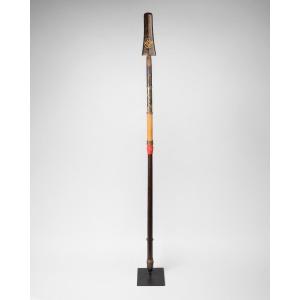
Trishula, a trident originating in southern India, commonly used as a religious symbol in Hinduism, Balinese, and Buddhism. It is the Hindu weapon of the god Shiva, and its name means "three spears."
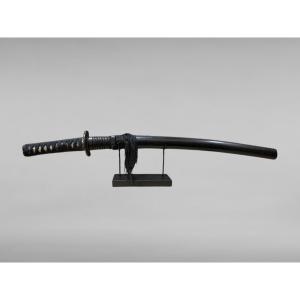
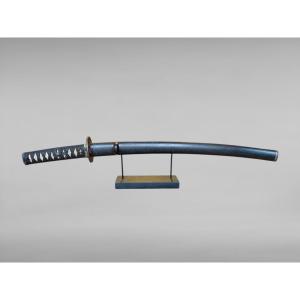
JAPAN - Edo Period (early 19th century). Samurai wakizashi in shirasaya style. Zoomorphic kashira in chased copper, patinated black and gold, depicting a shishi (a type of fish). Fushi in finely chase[...]
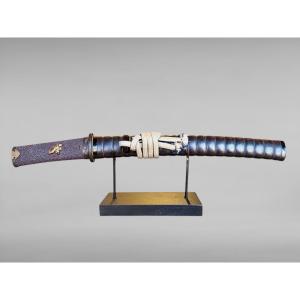
JAPAN - Edo Period (1603-1868). Samurai Tanto. FUSHI and KASHIRA in a set of chased, patinated, and gilded copper decorated with horses and flowers on a nanako background (very slight oxidation). TSUK[...]
JAPAN - Edo Period (1603-1868). Samurai Katana. FUSHI and KASHIRA in a set in silvered copper depicting stylized geese flying in clouds. TSUKA in wood covered with ray skin and black silk braid. MENUK[...]
JAPAN - Edo Period (1603-1868). Samurai Katana. Black patinated copper kashira. Chiseled, patinated, and gilded copper fushi depicting a bamboo forest. Wooden tsuka covered with red-dyed stingray skin[...]
Carved bone kris (dagger) handle depicting a demon - Indonesia, 19th century. A very fine and expressive sculpture. The demon is depicted with a protruding belly and genitals. The face has a grotesque[...]
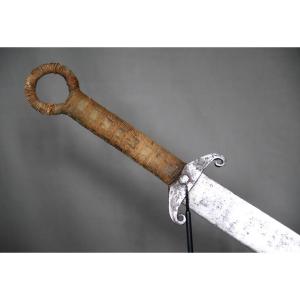
Chinese Saber - China, late 19th/early 20th century. This rustic saber is notable for retaining its original, traditional lacing around the handle. It has a slightly curved, single-edged blade and a r[...]
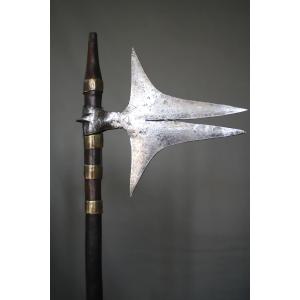
This large war halberd originates from Indochina. It was collected in the 19th century by a French Officer. The shaft has been shortened for an exhibition, but since the cut is at an angle, it would b[...]
Indian bulova axe - Northeast India, 19th century. The bulova axe is a rustic weapon of the indigenous peoples of Northeast India. The axe head is usually crescent-shaped. This one has a much rarer fo[...]
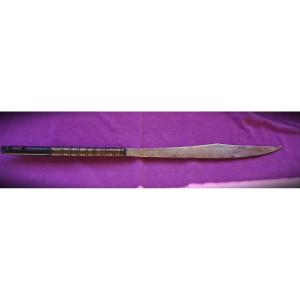
Era: Mid-19th century, Rattanakosin period (around 1860), reign of King Mongkut (Rama IV), era represented in the film "Anna and the King". Origin: Siam (now Thailand) Materials: Silver damask steel b[...]
Daisho (dagger) with two wakizashi (swords), the blade of the larger one certainly not being the original. This may have been done for ceremonial purposes or for a merchant who was not allowed to carr[...]
Katana from the late Edo to Meiji period. Blade: Otoshi-zukuri (V-shaped cross-section with two faces) blade, Iori-mune (two-sided) blade spine. O-kissaki (long) points. Shinoji (11 mm) (face 1). Jiga[...]
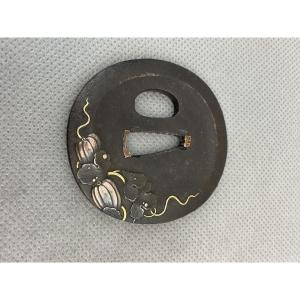
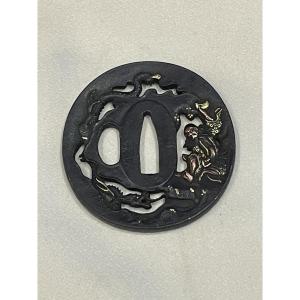
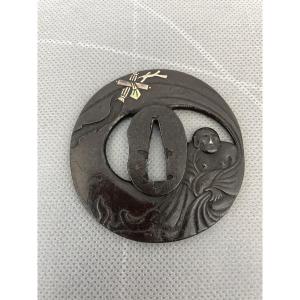
Nagamaru Gata (oval) shaped tsuba, signed. Made of openwork iron in the Maru Bori style and inlaid with gilded and silvered brass in the Hira Zogan style. Depicting two figures facing each other: on o[...]
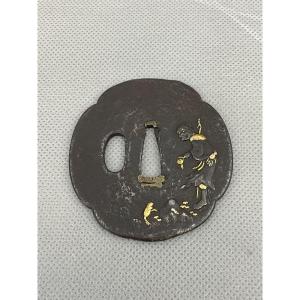
Mokko-gata (quadrilobed) tsuba, signed, in iron inlaid with gilt and silvered copper in Hira Zogan style, depicting a Gama Sennin figure with his toad. A signature difficult to identify. The presence [...]
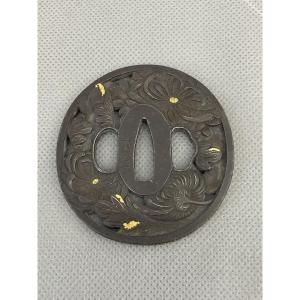
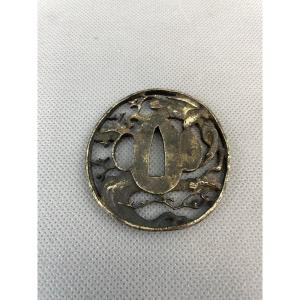
A very beautiful and large tsuba in the Nagamaru Gata style, made of finely chiseled and openwork iron in the Maru Bori style, inlaid with gilt copper. It depicts chrysanthemums in bloom amidst foliag[...]
JAPAN - Edo Period (1603-1868). Samurai Wakizashi. FUSHI and KASHIRA in a set, in chased, patinated, and gilded copper, decorated with five monkeys perched on a nanako background. TSUKA in wood covere[...]
JAPAN - Edo Period (1603-1868). Samurai Tanto. Patinated copper kashira, inlaid, gilded, and silvered, decorated with bamboo branches on a textured background. Wooden tsuka covered with purple-dyed st[...]
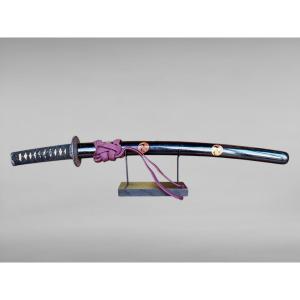
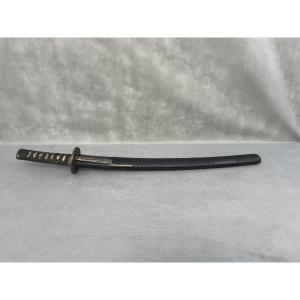
Samurai Wakizashi sword. Japan, Edo period (1603-1868). The sword itself dates from the early 1800s. Ray skin scabbard. Length: 75 cm. Weight: 810 grams. Good condition.
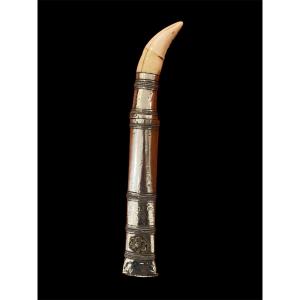
Ceremonial weapon. Straight, double-edged blade of pamor (Damascus steel), connected to the hilt by a metal "mendak" ring with filigree decoration. The marine ivory (sperm whale tooth) hilt is stylize[...]
66 cm wakizashi. Torii Zori shaped blade, Toran Ha temper line, Iori Mune shaped spine. O Kissaki shaped blade tip. Length 48 cm. This blade is damaged in places with the presence of Kizu (a type of s[...]
Yari in the shape of a spear, or more precisely, a straight-pointed spear. Shagreen, burgone inlays. At the bottom, the hirumaki protects the shaft from damage by contact with the ground, but it can a[...]
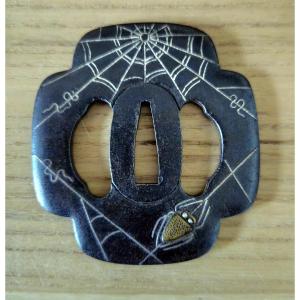
Antique tsuba from the late Edo period, made of shakudo (brass), 19th century. Shipping not included. Weight: 98 grams. Dimensions: 65.9 x 70.2 cm. Thickness: 4.86 mm. Type: Tate Ito Gata (cross-shape[...]
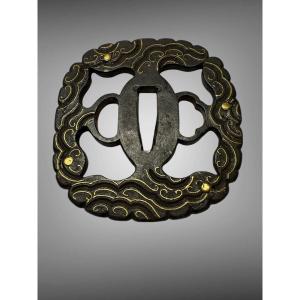
Very rare antique tsuba from the Late Edo period, in sukashi (openwork) style, mid-19th century. Shipping not included. Weight: 153g. Dimensions (H x W): 83.6 x 85.2 cm. Thickness: 4.25 mm. Type: Unco[...]
JAPAN - Edo Period (1603-1868). Samurai Wakizashi. Simple patinated copper KASHIRA. Chiseled, patinated, silvered, and gilded copper FUSHI depicting a bird on a cherry blossom branch (minor wear). Woo[...]
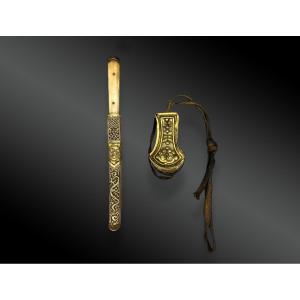
WOMEN'S KNIFE, WITH NEEDLE HOLDER Tibet, 19th century Steel, iron, brass, bone, leather Total length: 18.6 cm; Blade length: 8.6 cm Straight blade with one cutting edge, with a groove on each side. Ha[...]
JAPAN - Edo Period (1603-1868). Samurai Wakizashi. KASHIRA in stamped and chased copper with high relief decoration of plant motifs (wear). FUSHI in chased metal with plant motifs. TSUKA in wood cover[...]
TSUBA Naga Maru GataJapanEdo period (1603–1868)Iron, goldH: 6.5 cm; W: 6.2 cm; Thickness: 3 mm H. Nakago Hitsu Ana: 2.5 cmTsuba chiselled with a Ryū dragon with golden whiskers.SignedRef.: 5904Text an[...]
JAPAN - Edo Period (1603-1868). Samurai Wakizashi. FUSHI - KASHIRA in a suite of chased, patinated, and gilded copper decorated with dragons in clouds against a nanako background. TSUKA in wood covere[...]
JAPAN - Meiji Period (1868-1912). Polychrome carved wooden katanakake depicting a dragon-carp with a red lacquered mouth and eyes highlighted by glass beads. It consists of two carved elements joined [...]
Kriss knife Java Island, Indonesia Early 19th century Wood, pamor.Total length 38 cm; Blade length: 29.5 cm; Handle length: 8.3 cm The handle, called ukiran, is made of finely carved and engraved woo[...]
Short sword of the Jian type, China, late 19th/early 20th century. Vertically grooved wooden grip, crack on one side. Brass pommel and guard engraved with the Shou symbol. Flat, double-edged blade wit[...]
Dagger called a Dha, a dagger with a forged iron blade, single-edged and ending in a beveled point. The cylindrical grip is made of bone, while the ferrule is made of wood covered with a silver inlay [...]
Maru Gata shaped tsuba in iron with openwork and inlaid Hira Zogan decoration from Shibuichi. The decoration depicts a Hotei holding his bag of riches with copper and silver inlays of a scroll. Diamet[...]
Tsuba in the shape of a Naga Maru Gata iron bowl. Chiseled background in Hira Bori. The decoration represents rock with copper and silver inlays of motifs evoking the sacred ropes of a Shinto temple s[...]
Mokko-gata shaped tsuba in Shibuishi iron, chiseled in Hira Bori and inlaid with Iroe Taka Zogan in gilt copper and silver. Decorated with a dragon in the waves. Dimensions: 76 mm x 69 mm. R:2025-0838[...]
Mokko-gata (quadrilobed) tsuba. Made of iron with Taka Zogan decoration in gilt copper and silver. Shibuichi decoration of butterflies, grasshoppers, and snails. The presence of Seki Gane indicates it[...]
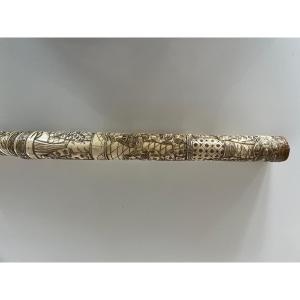
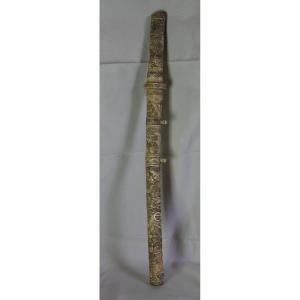
Wakizashi, Small Japanese Sword, Late 19th Century, Carved Bone. Small Japanese sword known as a Wakizashi. Carved bone. 14 samurai figures. Very high quality. Late 19th century. Complete, very good c[...]
Late 19th Century Japanese Katana Sword. A theatrical sword, also known as a Japanese katana. Carved bone. Depicts figures from ancient Japanese theater. Four minor damages. Late 19th century. Dimensi[...]
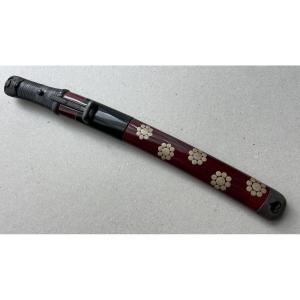
superb tanto in Aikushien style, sublime condition, lacquered leather tsuka, red lacquered saya with family kamon, shibuishi and shakudo fittings, weapon of beautiful proportions and solid constructio[...]
Kriss or kreiss composed of a Damascus steel blade and a wooden handle. Between the two a ring set with red stones resembling garnet. The original scabbard is made of painted wood. This kriss was made[...]
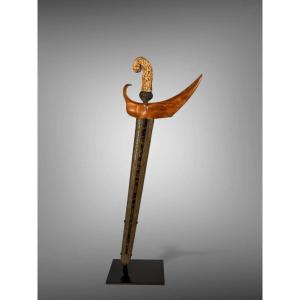
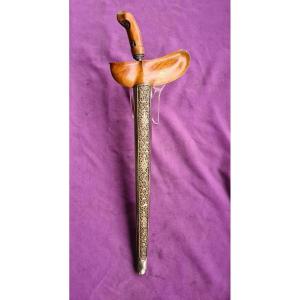
This kriss is Indonesian, typical of the island of Java, Surakarta style. The shape of the blade, the shape of the scabbard, the handle and the metal ring are characteristic of this region of Surakart[...]
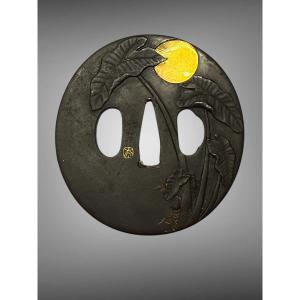
Tsuba (Japanese sword guard) of katana Late Edo/early Meiji period (circa 1850-1880) Signature Kotobuki saku 寿 作 + golden kakihan Material Iron, gold and copper inlay Decor Taro leaves and moon (obv[...]
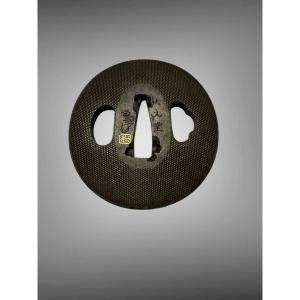
Form: Maru-gata (round)Dimensions: 64 mm (H) 60 mm (L) approx. 4 mm (thickness)Weight: 91 gSubject: Wrought iron (tetsu)Decor: Nanako-ji background (regular granulation with the punch) on thetwo s[...]
Type: Tsuba (鍔) Diameter: 88 mm Weight: 191 g Main material: iron (tetsu), dark patinated. Ornamentation: golden inlays (probably in nunome zōgan 布 目 象 嵌, gold leaf inlay technique). P[...]
Wrought iron tsuba (tetsu nikubori tsuba). Pattern: Tête demort (dokuro), herbs and bird. Symbolic: Impermanence, zen meditation on death and nature. School: Shoami (Edo) or independent craftsman infl[...]
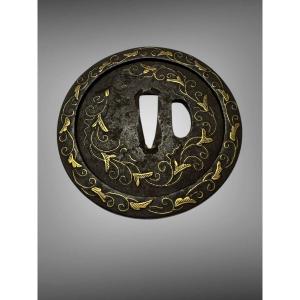
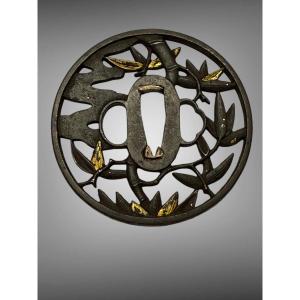
NAGA MARU GATA shaped tsuba In openwork iron in yo-sukashi with foliage and flower decoration. Small dents on the nakago hitsu ana (trace of adjustment) during assembly. Traces of oxidation due to tim[...]
Japanese lacquered quiver with this accessories. The quiver is 94 cm long and can hold a dozen arrows, it is accompanied by a gourd-shaped netsuke to keep powders surely for the giriko (powder to prot[...]
This is a miniature tachi, dating from the early Meiji period (1868-1911), therefore the last third of the 19th century. Its small size clearly indicates it as a votive object, probably either intende[...]
Proantic uses a cookie to analyze traffic and improve its service by using Google Analytics. Data sent to Google Analytics (frequency of visits to the site and pages visited) are anonymous. No other cookie tracks your activity, your personal data is not collected. Thank you for helping us to have better understanding how Proantic is used.





























 Le Magazine de PROANTIC
 TRÉSORS Magazine
 Rivista Artiquariato