"Kriss Knife, Java Island, Indonesia, Early 19th Century "
Kriss knife Java Island, Indonesia
Early 19th century
Wood, pamor.
Total length 38 cm; Blade length: 29.5 cm; Handle length: 8.3 cm
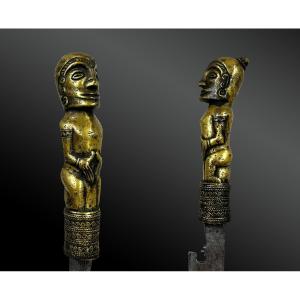
The handle, called ukiran, is made of finely carved and engraved wood representing the Wayang deity, with delicately formed long hair.
The double-edged pamor blade is wavy. A metal ring, called a mendak, marks the junction between the ukiran and the blade.
The handle is remarkable for its fineness and the depth of its patina.
The kris is a weapon specifically for men. A marker of social status and wealth, it was also symbolically given to a young boy who had become a man.
The more elaborate the blade and the more precious the materials used for the handle, the higher the rank of its owner.
The ukiran, almost always carved in an anthropomorphic style, is considered an allegory of its owner. Thus, the head represents the handle, the body the blade, and the clothing the sheath. It should be noted that the traditional garment of Balinese men is the sarong—the same name given to the kriss sheath.
The kriss, endowed with magical powers, is considered a vehicle for spirituality. It is passed down through inheritance, which increases its power.
Ref. 6449
Text and photos © FCP CORIDON










 Le Magazine de PROANTIC
 TRÉSORS Magazine
 Rivista Artiquariato