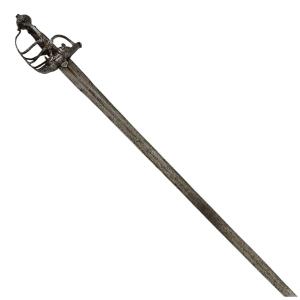
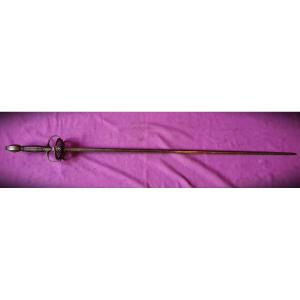
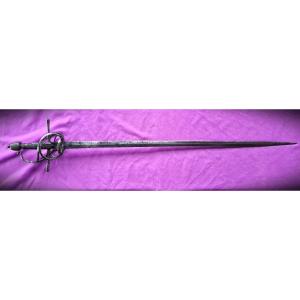
This rapier with amulti branches hilt is from Germanic origin, dating from the first quarter of the 17th century. The blade bears a crescent moon hallmark on the ricasso, which Lenkiewicz lists (in "1[...]
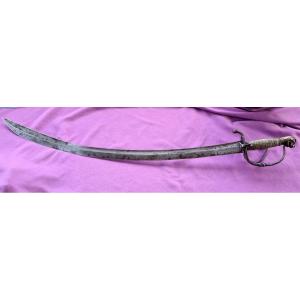
A Walloon-type cavalry saber - Probably Germanic, 17th century. Curved blade with a single edge and a false edge on the last third. The wolf of Passau is engraved on one side. Walloon-style hilt. Miss[...]
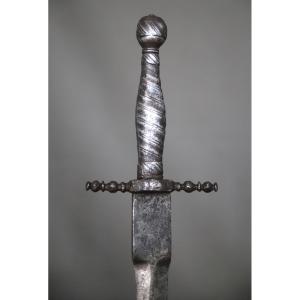
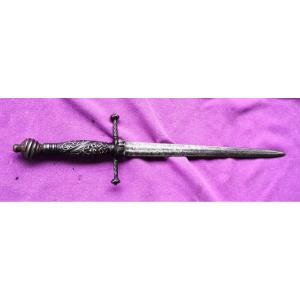
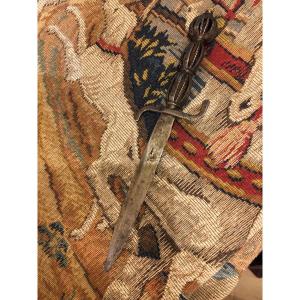
Renaissance dagger - Western Europe, late 16th/early 17th century. Blade with a strong, flat ricasso, later becoming four-sided and double-edged. Maker's marks (very faded but discernible) are present[...]
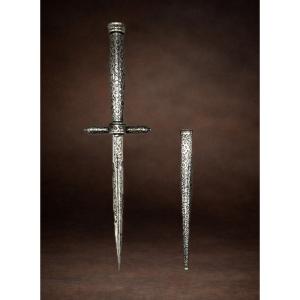
Civil ceremonial stylus (stiletto da cintura) in fully engraved and chiseled steel, Northern Italy (Lombardy - Veneto), around 1620–1650.Remarkable example of the Italian art of steel decoration in th[...]
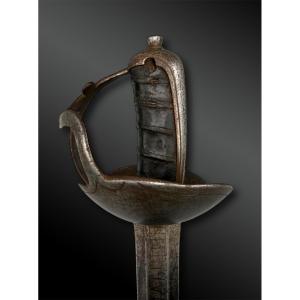
A superb English Civil War period “Mortuary” sword. Broad double-edged blade that shows the maker’s mark ‘Andrea Ferrara’ running along the central fuller, as well as armory stamp to either side of th[...]
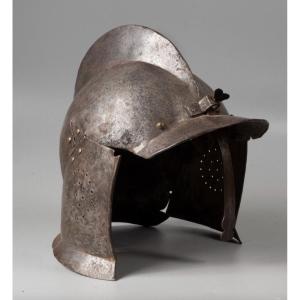
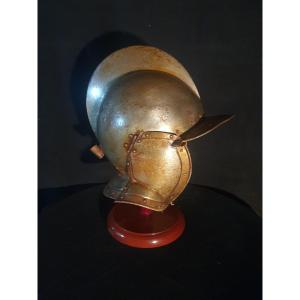
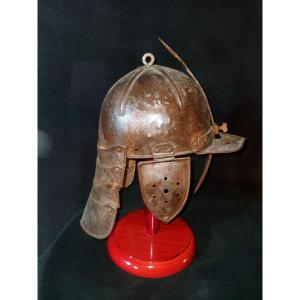
Burgundian Helmet. Crested helmet forged in one piece. Visor fixed by rivets, cheek pieces pierced and articulated. Removable nasal guard and plume holder at the rear. 17th century. Height: 26 cm
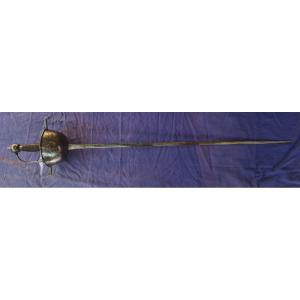
Spanish rapier (sword) with a tang - Spain, late 17th-first half of the 18th century. The hilt has a tang, two large quillons, and a guard branch. The grip is made of beautiful fluted horn. This type [...]
Sword signed Enrique CoelSpain17th centurySteel, leatherTotal length: 98 cm; Blade length: 84.3 cmStraight double-edged blade with a flat edge, with a fuller in the first third, engraved with ‘por la [...]
Germany produced large quantities of antler powder pouches during the Renaissance. The finest pieces were made in the south of the country, in Nuremberg and Augsburg. The quality of these pouches vari[...]
A rapier with a very refined cut, dating from the first half of the 17th century, around 1630-1640. The openwork hilt is richly decorated with floral and vegetal motifs, punctuated by cartouches depic[...]
This stiletto is a fairly large model designed for fighting. The style of the handle might initially suggest Italian craftsmanship, but the blade, with its cross-shaped globus, its shape, and its deco[...]
This stiletto likely originated in Northern Italy, although a Southern German origin is also possible. Its large size makes it a model designed for combat. It dates from the 17th century. Stilettos fi[...]
A 17th-century wheellock arquebus converted to flintlock, chambered for 14 balls per pound, fitted with a smoothbore octagonal barrel, then a round one. The weapon is mounted in brass, including the l[...]
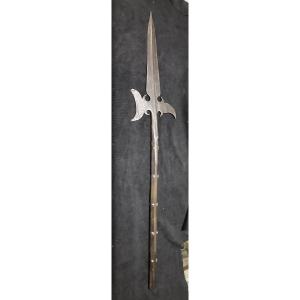
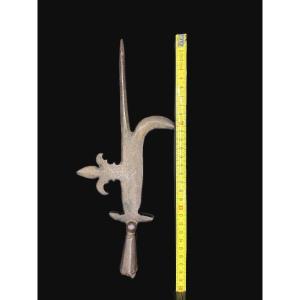
17th-century halberd. Asymmetrical iron head with an axe and hook, 44 cm long, including an 8 cm long socket; 9.5 cm long brace with two nails. Rebuilt wooden shaft. Overall length 98.5 cm. Good condi[...]
This dagger is somewhat difficult to classify; it could be defined either as a variant of a "mercy dagger" or as a rather atypical stiletto. The blade, with its robust ricasso, would suggest a mercy d[...]
A heavy german or flemish cabasset.Heavy, one-piece, heavily ridged skullcap with a small, backward-sloping point. The lower edge is encircled by brass lining rivets with decorative rosettes (some inc[...]
A swordsman's rapier with a thick blade, Hispano-Portuguese, 17th century. The thick blade has a lenticular cross-section and a small faceted iron pommel with a rivet button, securing the guard branch[...]
A straight, rigid thrusting dagger with a chain-piercing point and longitudinal fullers pierced with trefoil and cruciform motifs on the first half. The cylindrical guard terminates in small spherical[...]
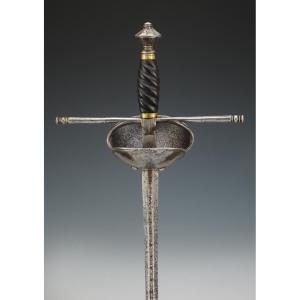
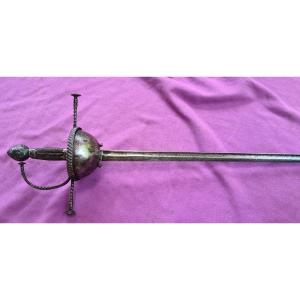
This is a beautiful and long rapier called "a la taza" in Italian style that can be dated to the mid-17th century. The very deep bowl of the Taza corresponds to Italian taste. The very large arms "fin[...]
This rapier called "taza rapier" (rapier with bowl guard) dates from the first half of the 17th century. It comes from the region of South Germany with an Italian influence. If the very deep bowl corr[...]
This rapier is a typical Spanish model. The blade dates from the 17th century, it is the work of the famous and prestigious Enrique Coel / Coll, or Heinrich Coel /Kohl (several spellings exist) who wa[...]
Miniature knife used for sharpening quills. Spanish work from the 17th or 18th century. A miniature version of the classic Spanish knife, made in Albacete. Bronze and bone handle. Dimensions: 7.5 cm.
Exquisite Bone-Inlaid Stock | Functional Iron Sight | Superb Historical Craftsmanship
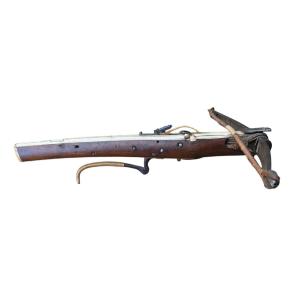
A beautifully preserved and exceptionally crafted 17th-century hunting crossbow, originating from Switzerland or [...]
HAUTE EPOQUE, CUTLERY COLLECTIONImportant italien hunting dagger, richly engraved steel, and ebony (?) handle decorated with engraved iron platesThe knife has retained its original embossed leather sc[...]
This armet is probably Germanic, a very similar example is exhibited, mounted on a half cuirassier armor, dated from the 4th quarter of the 16th century, at the Museum of Art and History of Geneva. Ot[...]
17th Century, large stiletto (40 cm) called "misericorde" in wrought iron and steel. The fully forged fuse has slightly domed sides, olive pommel, guard with two curved quillons, ending in a heart wit[...]
Renaissance dagger (knife dagger) - Excavated piece, 17th centuryThe steel has suffered from time and is corroded. The corrosion has stabilized and the whole remains solid. The filigree on the wooden [...]
Ring dagger, called left hand, LOUIS XIII° - LOUIS XIV° - XVII° period, origin ITALY or SPAIN. Iron mount with fluted olive pommel and rivet button. Filigree steel wire fuse. Guard with curved quillon[...]
This stiletto is typically Italian, and can be dated to the 17th century. This type of weapon was used to inflict narrow and deep wounds, very difficult to treat at the time. The section of this blade[...]
Spain, Toledo, 17th century taza rapier. Iron mount with filigree reverse chevron fuse and thin band with baguettes. Faceted olive pommel and prominent rivet button. Symmetrical straight quillon endin[...]
Large and rare crossbow with a block called a "windlass". Straight arbor with a small shoe in fruitwood, bone table decorated with lines and adorned with coats of arms in succession. Strong bow and st[...]
Rapier in Taza, SPAIN, 17th - 18th century. Iron frame in the shape of a shell with one branch. Wooden fuse and pommel in urn with sides and rivet button. Straight quillon. Strong straight blade with [...]
Gilded bronze medal representing on one side Saint John the Baptist with the inscription S IOAN . BAPTIST and on the other the holy house of Nazareth carried by two angels SAN. CASA ROMA. This type of[...]
This duelling rapier is very unusual. It is a so-called "flamberge" rapier of Toledo origin, which dates from the early years of the 17th century. The blade bears the prestigious signature of Francisc[...]
This sword can be classified as war rapier, or cavalry sword, depending on the authors. It is fromGermanic manufacture, and dates from the first quarter of the 17th century.
BLADE: It has a lenticul[...]
It is a so-called "pillow" rapier which, strictly speaking, was placed at the bedside to allow its owner to have a weapon on hand in the event of a nocturnal attack. In a broader sense, the so-called [...]
Rare large bronze Saint-Benoit medal. On the obverse, we can see Saint Benedict face-on, his right hand outstretched and his left hand holding his saint's toga. Inscriptions: SP BENEDICTUS On the reve[...]
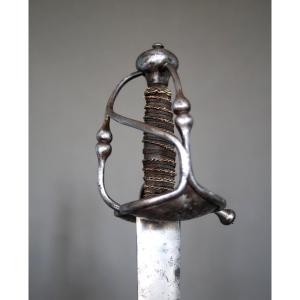
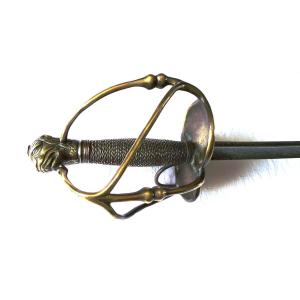
Strong cavalry sword with Walloon type mount, probably from Central Europe, from the 17th - 18th century. Brass frame with pommel in the shape of a lion's head with short mane. Guard with 2 branches w[...]
Burgundian helmet in wrought iron from the 17th century. Excellent condition for this very beautiful complete piece with crest and small visor and nape with hemmed edges and movable cheeks. Turned woo[...]
This is a beautiful, elegant ring dagger dating from the second half of the 17th century. His style already foreshadows the shapes that would be fashionable at the beginning of the 18th century. It mo[...]
SPANISH IRON SWORD called bivalve, 18th century. 25880AJC. Iron sword called bivalve. Asymmetrical shell with molded edge larger on the guard side than the counter-guard. Straight cylindrical quillons[...]
Although Walloons from the end of the 17th century and the beginning of the 18th century are encountered from time to time, earlier cavalry swords are much rarer. This weapon is a dragon sword, which [...]
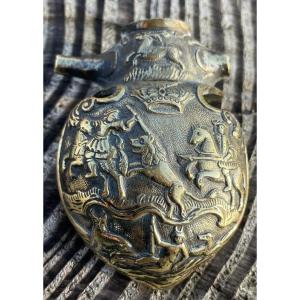
German hunting dagger guard in bronze richly decorated with a lion hunting scene, topped with the crown of the Holy Roman Empire, and on the lower part a Diana the huntress. Very fine ornamentation wi[...]
This rapier is mounted in an austere manner, reflecting the taste of its owner. It is simple but nothing is missing, the blade is solid, the bowl is made of thick metal, the quillons are robust and th[...]
Medieval style sunbonnet helmet in worked and forged metal from the 17th and 18th centuries. Excellent condition for this complete and very decorative piece with its adjustable vertical axis, its arti[...]
Powder flask engraved with a griffin hunting scene
17th century
Horn and iron
H. 27.5cm - L. 10cm
Horn engraved with a griffin hunting scene by two soldiers in arms, circles on the reverse and r[...]
Swiss sabers are rare on the market. Often, those which one meets are unfortunately incomplete, and in rather poor state.
This one is complete, with the original guard shell and grip wire binding. Ev[...]
very decorative morion with etchings
helmet forged from one single piece
decorations bearing unidentified coats of arms
probably Germany or flanders
old small repair of period on edge
helmet and [...]
Venice, Italy, late XVIth or early XVIIth cty
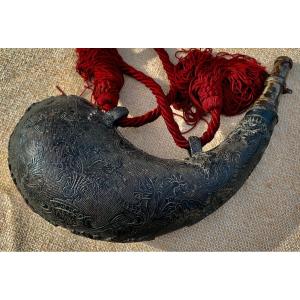
Stunning and very rare embossed Leather Powder Horn, chiseled with flowered vase on pedestals, and mascarons,...
The powder pear consists of 2 parts w[...]
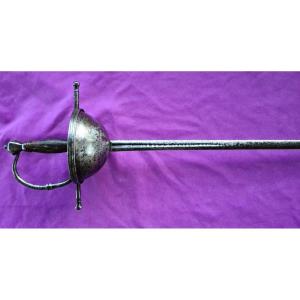
It is a beautiful Taza rapier, of Spanish inspiration but of Germanic manufacture.
It can be dated between the last quarter of the 16th century and the first quarter of the 17th century.
BLADE: It p[...]
Proantic uses a cookie to analyze traffic and improve its service by using Google Analytics. Data sent to Google Analytics (frequency of visits to the site and pages visited) are anonymous. No other cookie tracks your activity, your personal data is not collected. Thank you for helping us to have better understanding how Proantic is used.






















 Le Magazine de PROANTIC
 TRÉSORS Magazine
 Rivista Artiquariato