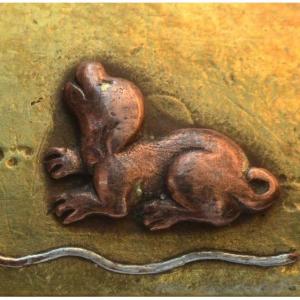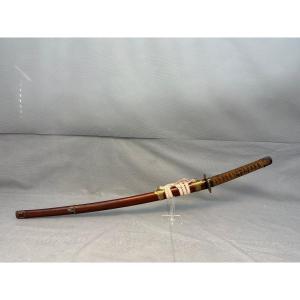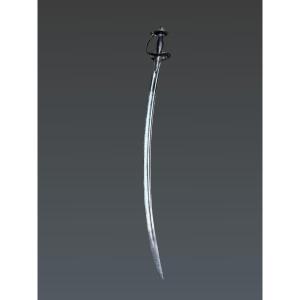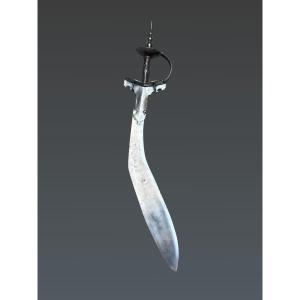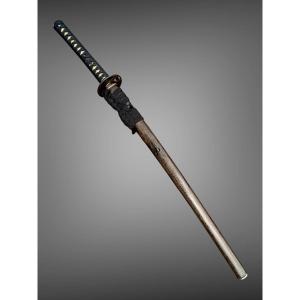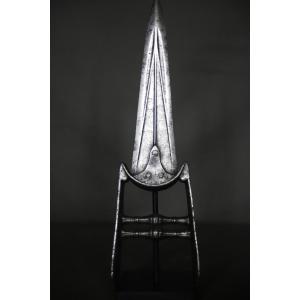
Indian dagger (katar) - India, 17th-18th century. Double-edged blade with a reinforced point (commonly called a "mail-piercing" or "armor-piercing" dagger). Forged steel handle. Solid, no play. Length[...]
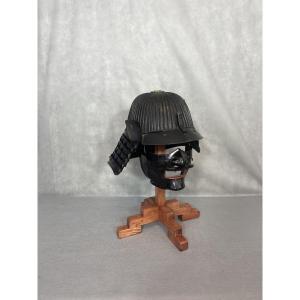
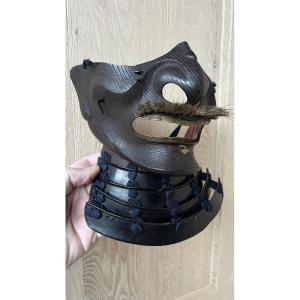
Very beautiful hand forged iron mask with a typical expression; yasurime parallel lines across the entire mask, typical work of the Iwai school, 17th century, black lacquered plates and navy blue suga[...]
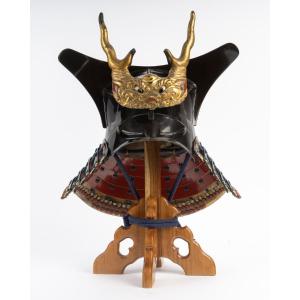
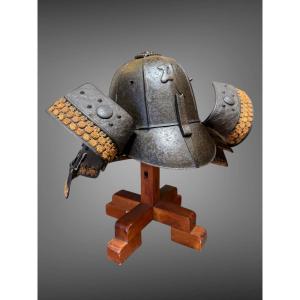
JAPAN - Edo period (1603-1868). KABUTO composed of eight wrought iron plates, the front plate decorated with a Chinese character. THEHEN NO ANA (opening at the top) in copper and copper with three de[...]
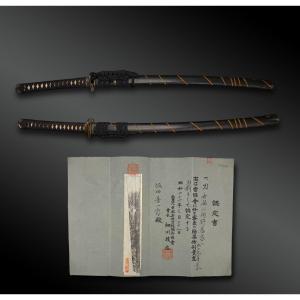
A very fine wakizashi by Hisamichi with a Tokubetsu certificate. Muromachi period. It has a 56 cm nagasa (stem). It retains its 19th-century polish and is extremely well preserved. It features a very [...]
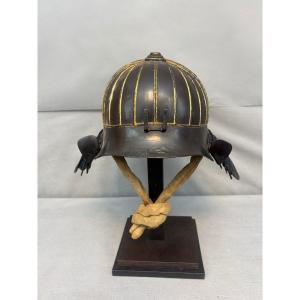
JAPAN - Momoyama Period (1573-1603). KABUTO composed of 62 strips of matte brown lacquered wrought iron, assembled with small raised rivets. THEHEN NO ANA (opening at the top) in patinated and gilded [...]
Very beautiful, high-quality samurai saddle, constructed of lacquered wood with various reliefs, Kamon from the Asano Yukinaga family, signed underneath, Early Edo period
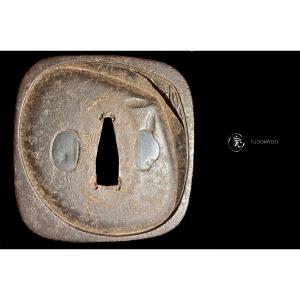
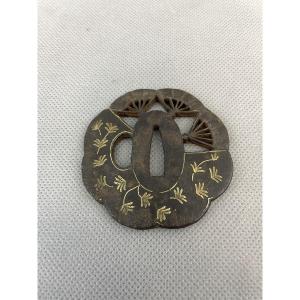
Kikka-gata shaped iron tsuba. Openwork in the Maru Bori style with three fans.The rest of the tsuba is inlaid with Hira Boran foliage and branches. One side is slightly more oxidized. Dimensions: 72 m[...]
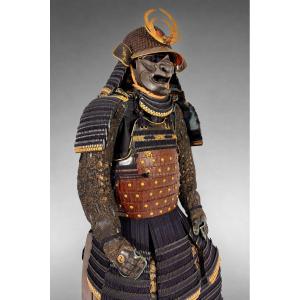
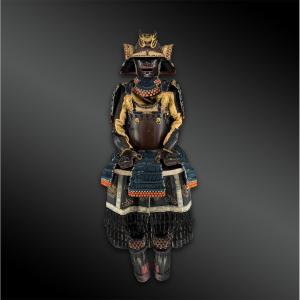
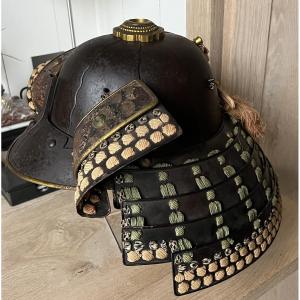
Brown lacquered Yokohagido-type armor, Geuroku period, late 17th century, circa 1680-1700. Kabuto (helmet) of the suji-bashi type with 59 plates; the fukigaeshi (guards) are missing, no lining. Weight[...]
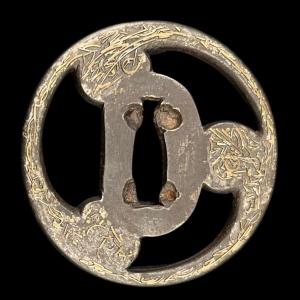
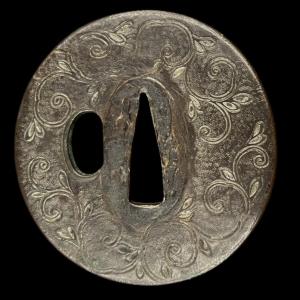
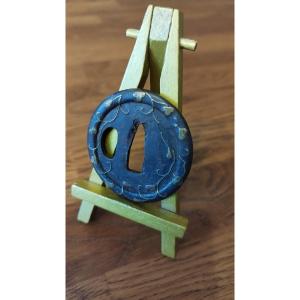
Magnificent antique tsuba from the mid-Edo period, made of shakudo (brass), 17th century. Shipping not included. Weight: 107 grams. Dimensions: Diameter 81 mm. Thickness: 3.1 mm. Type: Maru Gata (Roun[...]
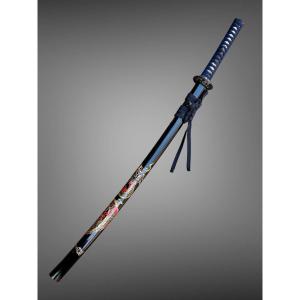
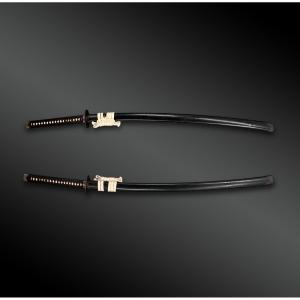
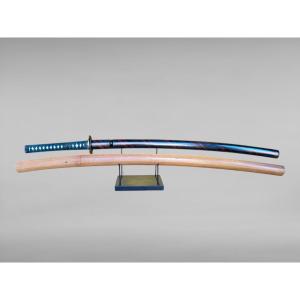
SABER known as Katana signed Tango no Kami Fujiwara Shigetsune and Echizen Oite Toyohara with Tokubetsu Hozon certificateEchizen Province, JapanEdo period (1660-1680)Steel, wood, lacquer, copper, horn[...]
A very fine wakizashi with its original Shinto blade, "Heianjo Ju Masakuni" (平安城政国), featuring a magnificent koshirae and shirasaya, along with a Sayagaki.
Price includes shipping within the EU, [...]
JAPAN, 17th-18th century. Katana with a shinogi-zukuri blade, gunome hamon, nakago with a mekugi-ana, signed Mikawa (no) kamiDaidô. Koshirae with black lacquer scabbard, iron maru-gata tsuba decorated[...]
A kabuto that belonged to the military commander Todo Takamitsu of the Todo clan of Ō-mi. A third-generation descendant of the elder sister of Todo Taka-tora (1556-1630), daimyo, general under Nobunag[...]
Kanbun era (1661-1673). Musashi ProvinceOf the honzukuri, iorimune, chugissaki, torizori type, and a koi-tame hada forge. A suguha and nie temper ending with a komaru böshi.The nakago suriage is pierc[...]
JAPAN - 9th year of the Kanbun era (1669). Samurai katana in shirasaya. FUSHI - KASHIRA in patinated, silvered and gilded copper suite decorated with cherry blossoms (associated with spring) on a nana[...]
SABER called Katana signed Hizen Kuni (No) Ju Mutsu (No) Kami TadayoshiJapan Edo period (1603-1868)17th centurySteel, wood, lacquer, silk, gold, copper, shakudoNagasa: 71 ; Nakago: 21 cmSori: 2.6 cm [...]
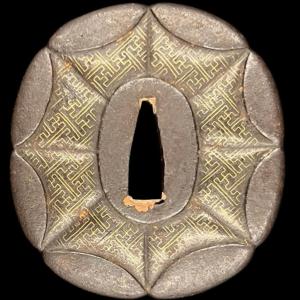
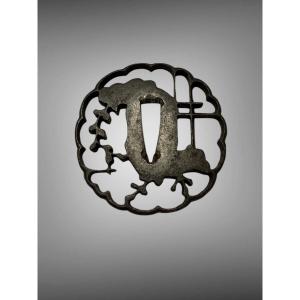
Samurai sword tsuba or guard in iron inlaid with brass, representing a fishing net, Dewa province, Shonai school, Edo period, 17th century. The fishing net symbolizes happiness and victory. A similar [...]
Japanese Wakizashi, EDO Period, Signed by the Swordsmith Nagayoshi - SDC25WAK001High-quality sword, used by the Japanese male caste in the 16th century, or even by a samurai...The inscription engraved[...]
Forged from iron and shaped into the form of a "Hachi Mokko Gata" using the "sukashi" (openwork) technique, the negative space is an integral part of the design, as is the solid form representing a ch[...]
An exceptional Japanese katana dating from the Edo period (1603-1868), signed on the tang Bizen Osafune Ju Sukesada, and bearing the additional inscription Oite Naniwatsu Saku Kore on the reverse side[...]
Tsuba Maru-Gata EDO period (1603-1868) Wrought iron inlaid with copper and gold with the motif of a Yōkai in the form of an eagle holding a gourd in its hand The other side represents a Torii The outl[...]
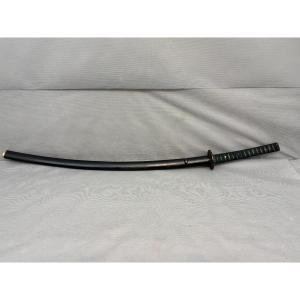
The elegance and mastery of the art of Japanese blacksmithingThis Shinto period (Edo era) katana illustrates the excellence of Japanese blacksmiths at a time when the craftsmanship and aesthetics of w[...]
BladeHIRA TSUKURI shaped blade signed Bôshû ju KiyonagaNagako (blade tang) Ha Hagari Kuri JiriYakiba (tempering line) GUNOME typeThe Nagasa (blade length) 28.5 cmSome kizuSaya (scabbard)37.5 cm, in le[...]
Katana Blade: Period: Late Edo period, signed Heian jo Ju Osumi No Kami Taira Hiromitsu. Shape: Shinogi katana, with an Iori Mune back and an O Kissaki point. Nagako (blade tang): Ha Agari Kuru Jiri, [...]
Tsuba Kaku-Maru-Gata EDO period (1603-1868) Wrought iron added to the motif of two dragons surrounded by intertwined scrolls Japan 17th century Very good condition (see photos) Dimensions 6 x 6.5 x 0.[...]
JAPAN - Early Edo (17th century). Samurai Katana. FUSHI - KASHIRA in chased copper, partially gilded and silvered (wear) on a nanako background and on the theme of the eight Taoist hermits. TSUKA in w[...]
Axe Head Animated by a LionEast Asia, 17th century Iron and bronze 48 cm long, 4 cm longAn important single-edged curved axe head with a bronze lion, its front legs resting on a rectangular base.Its o[...]
Rare and Quite Unusual Antique Tsuba and Tanto of Heianjo type and Naga Maru Gata type from the Edo Period. With the typical Heianjo Tsuba decoration (leaves and scrolls) in Shakudo (with brass).
[...]
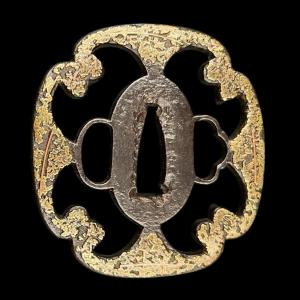
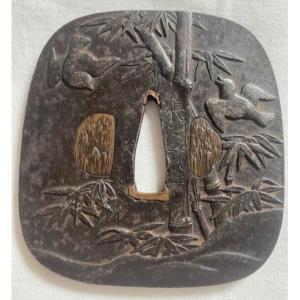
Superb, Edo Period Sukashi Tsuba, with Shakudo decoration (with traces of gold) with a Monkey and a bird in the pines.
Materials: Iron
Finish: Sukashi
Shape: Naga Maru Gata (oval)
Dimensions: 8.[...]
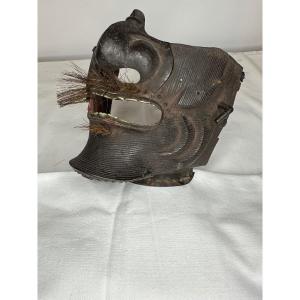
JAPAN - Edo period (1603-1868) Half-mask of samurai called "Mempo" in wrought iron decorated with lines reproducing wrinkles. Pronounced chin, movable nose, holes for a horsehair moustache (missing), [...]
Exceptional Christian tsuba from the AKITO SHOAMI school, Edo period. A cross on each side in gold; tsuba with gold inlays. Tsuba for Katana. Diameter of 8.2 cm. Shipping costs not included.
Japan, early EDO period, circa 1610. Zunari helmet (kabuto) with 3 plates in black lacquered iron, neck protector (shikoro), hineno with 5 lamellae, laced in brown, beige and green. Central ornament ([...]
Superb yasurime mask engraved with parallel lines
early 17th century
combat piece with large opening of the face
beautiful tare in kiritsuke kozane
laced petroleum color blue green
black lacquer [...]
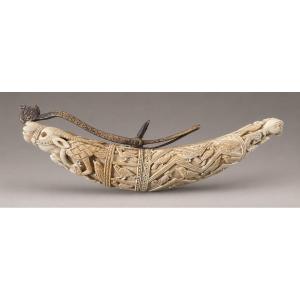
The “khanjar” is a type of dagger originating from Persia and widely adopted in most Islamic cultures. Besides its functional use, the “khanjar” was also worn to indicate rank or social status. The mo[...]
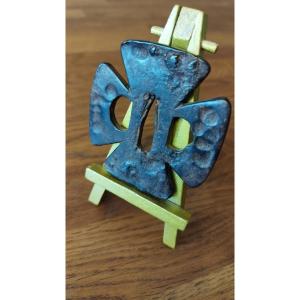
Rare Tsuba, Tate Ito Gata type (Christian cross), with a Tsuchime Ji hammered finish. Materials: IronFinish: Tsuchime Ji (the surface of the Tsuba is hammered).Shape: Tate Ito Gata, square in shape wi[...]
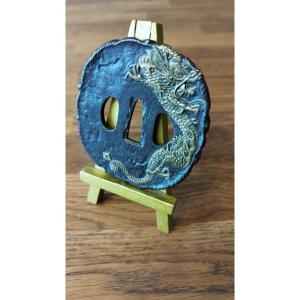
Superb, old Tsuba with a Shakudo air dragon decoration, in the rare “Awa Gata” style, with twisted border.
Materials: Iron
Finish: Tsuchime Ji (the surface of the Tsuba is hammered).
Shape: Awa [...]
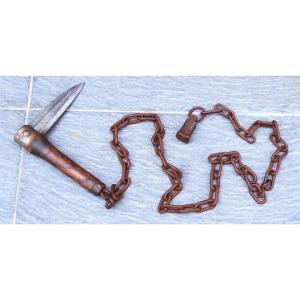
JAPAN, KUSARIGAMA, EDO period (1603 - 1868) From the 17th to the 19th century. Kobudo weapon composed of a KAMA + Chain + Weight. Traditional Japanese weapon consisting of a KAMA (Japanese equivalent [...]
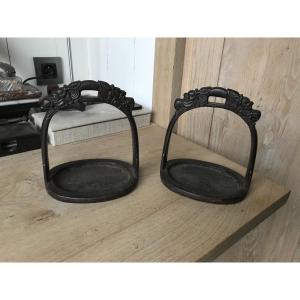
Feudal Japan, pair of stirrups for Samurai called "ABUMI", Mid-EDO period, 1603 - 1868, 17th - 18th century. Abumis were used from the 5th century by the Samurai class of feudal Japan. Stirrup in open[...]
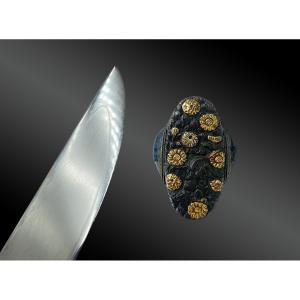
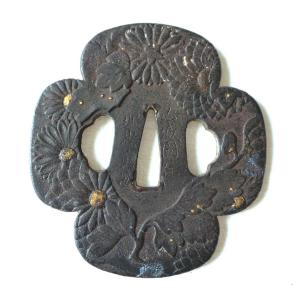
Iron tsuba in the shape of Mokko Gata, (four-lobed) with a bas-relief motif of chrysanthemum flowers whose pistil is enhanced with gold. The two openings Kogai bitsu and Kozuba bitsu are identical in [...]
Suji bachi kabuto with 62 blades, signed Joshu-JU Saotome IEHARU Period, like all Saotome : early Edo, around 1650 Impeccable construction and finishes This helmet is representative of the superior r[...]
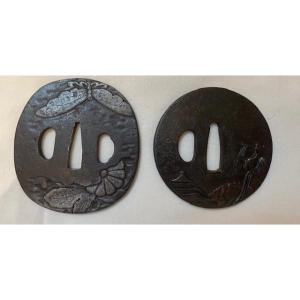
Set of two tsuba from the Edo period. One is decorated with a landscape with a willow and the other with a decoration of a butterfly and a chrysanthemum. Dimensions of the first 7 cm. Dimensions of th[...]
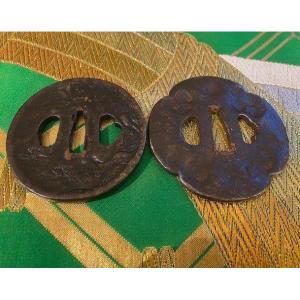
Lot of two tsuba, from the Edo period. One is decorated with a landscape. Dimensions: 7.6 x 7.4 cm The other is decorated with tembon. Dimensions: 8.2 x 8.2 cm
Lot of two tsuba from the Edo period. A shoji-patterned tsuba. Dimensions 6.9 x 6.6 cm. A very thick iron tsuba with a thickness of 1.4 cm. Dimensions 7 x 7 cm.
Iron tsuba representing Darouma. Decor inlaid with copper, gold and silver. Tsuba signed, but the name of the blacksmith is illegible. Edo period. Dimensions: 8.7 x 8.2 cm
Samouraï Kabuto type 12 ken Il date du début de la période Edo 17ème siècle Casque en fer naturel avec 12 lattes et 62 grands rivets SHIKORO (couvre-cou) à 5 degrés en fer laqué noir et tressage en pl[...]
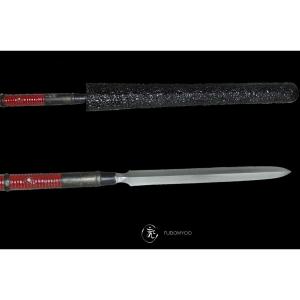
Spear or Japanese yari from the 16th-17th century Edo period. The blade is sharp and polished and the shaft (in bamboo) and the scabbard are lacquered (black relief). The blade has a straight temper l[...]
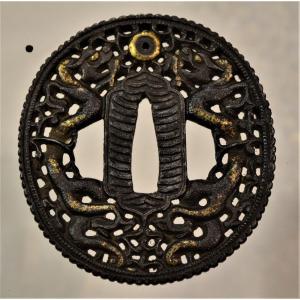
Cut iron tsuba. Decor of dragons and sacred pearls. Inside the beads, tiny iron balls are movable. The style is called Namban. This kind of tsuba is little represented without however being rare. But [...]
Japanese sword hilt (tsuba) in cut iron and damascened with gold (nunome-zogan). The metal is finely carved with dragons chasing the sacred pearl in the Namban style. The pearl is pierced and contains[...]
Proantic uses a cookie to analyze traffic and improve its service by using Google Analytics. Data sent to Google Analytics (frequency of visits to the site and pages visited) are anonymous. No other cookie tracks your activity, your personal data is not collected. Thank you for helping us to have better understanding how Proantic is used.