

Moghul Prime-cord Powder Chest Made Of Carved Ivory, Decorated With Antilopes And Parakeets
ORIGIN Northern India, Mughal art
DATE Second half of the 17th century
MATERIALS Carved ivory, engraved steel damascened with gold, inlaid eyes
DIMENSIONS Length: 24 cm
DOCUMENT CITES Certificate No. 2024/BE00635/CE
Description
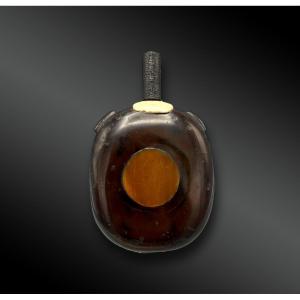
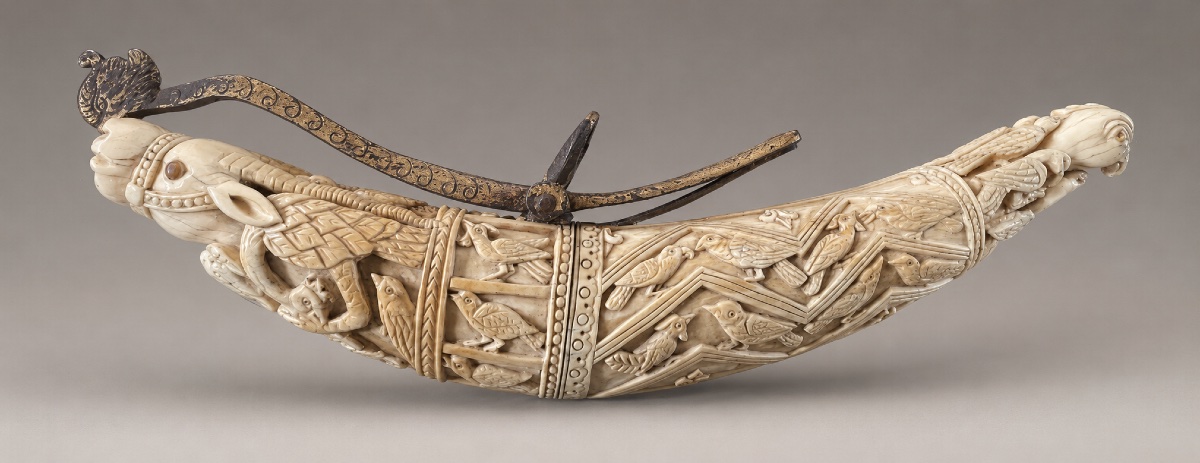
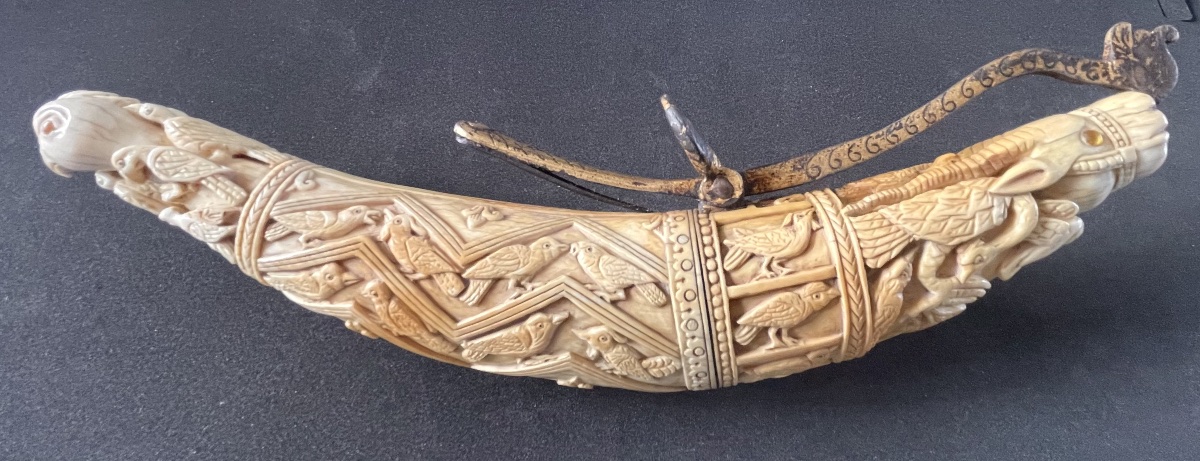
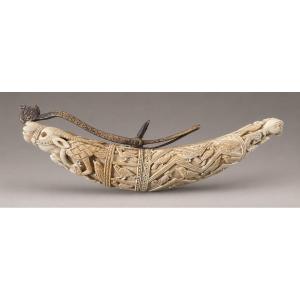
An exceptional Mughal ivory powder flask with a curved, “banana-shaped” form, entirely carved in high relief on the lower portion with a profuse animal motif dominated by antelopes and birds.
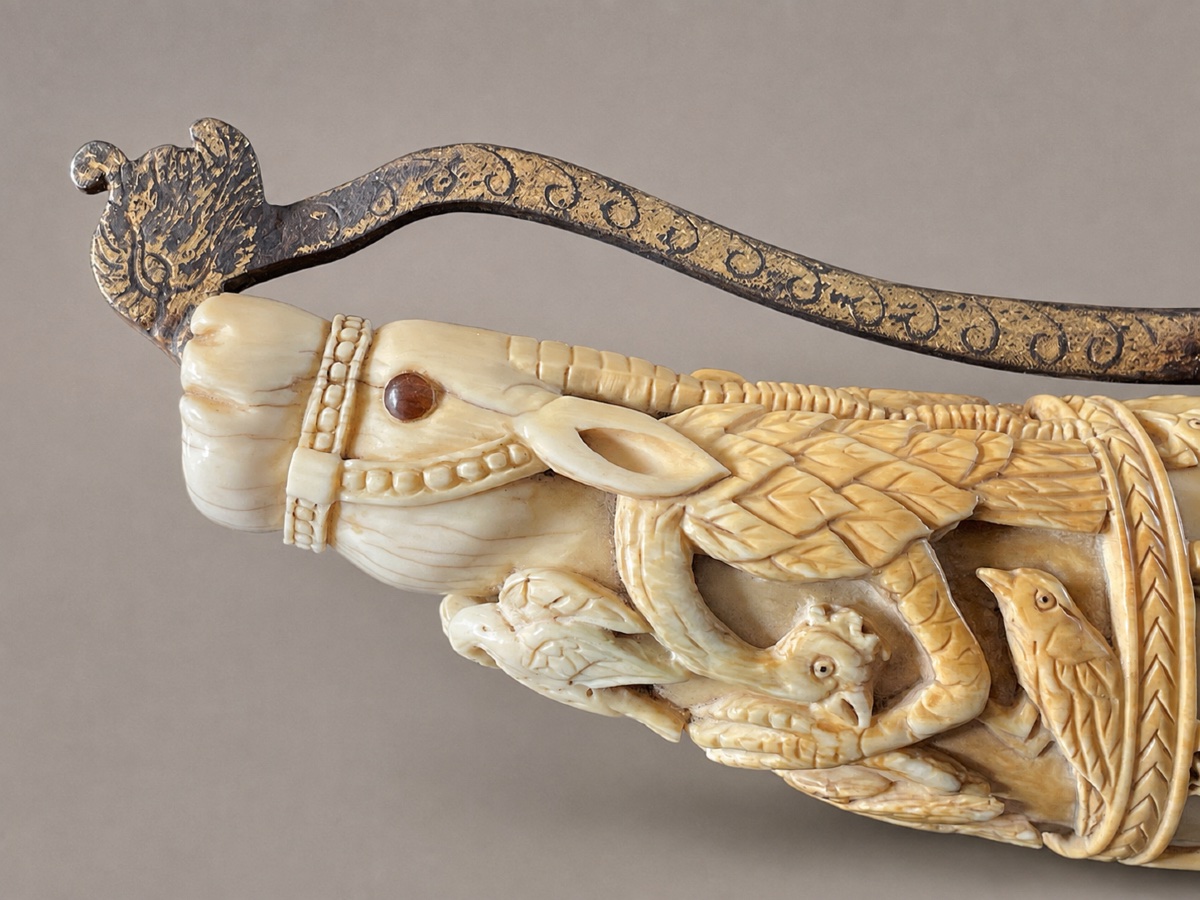
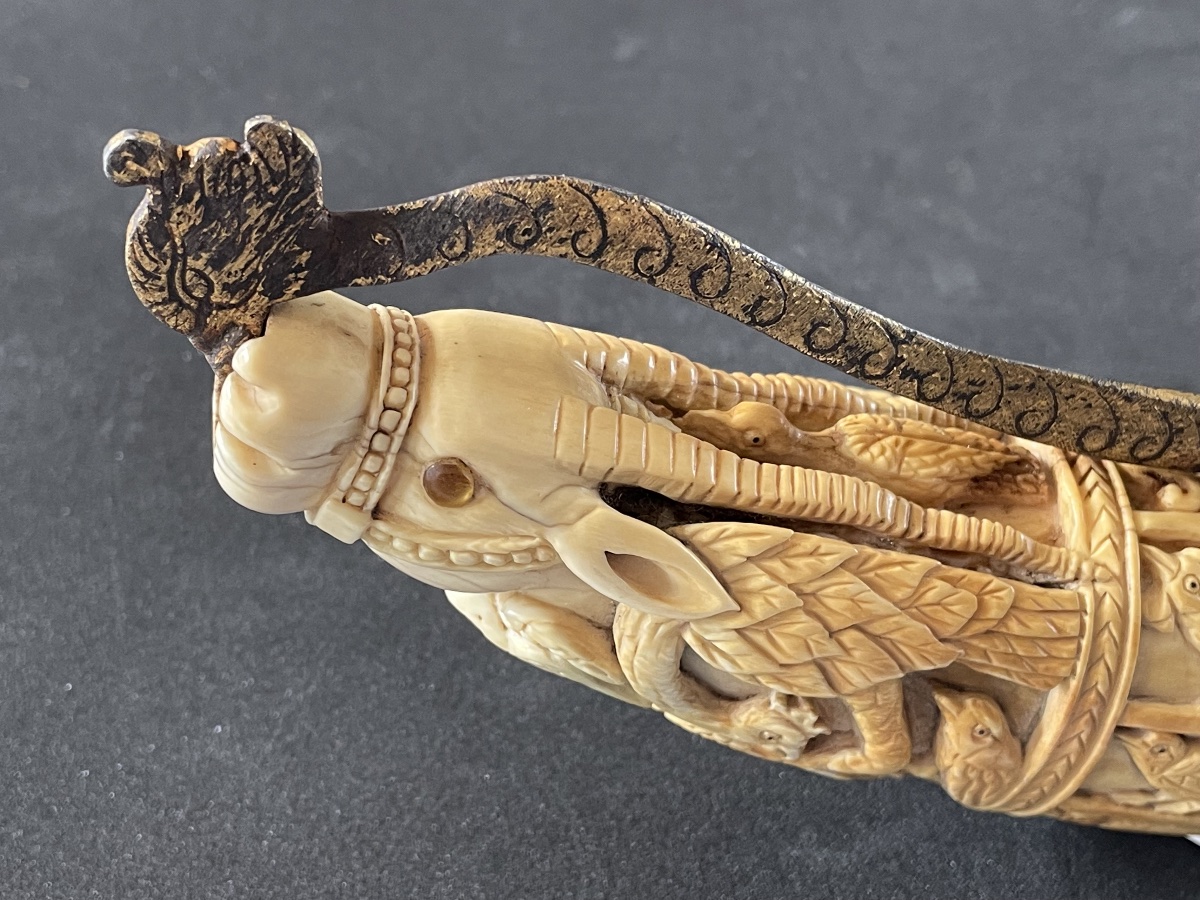
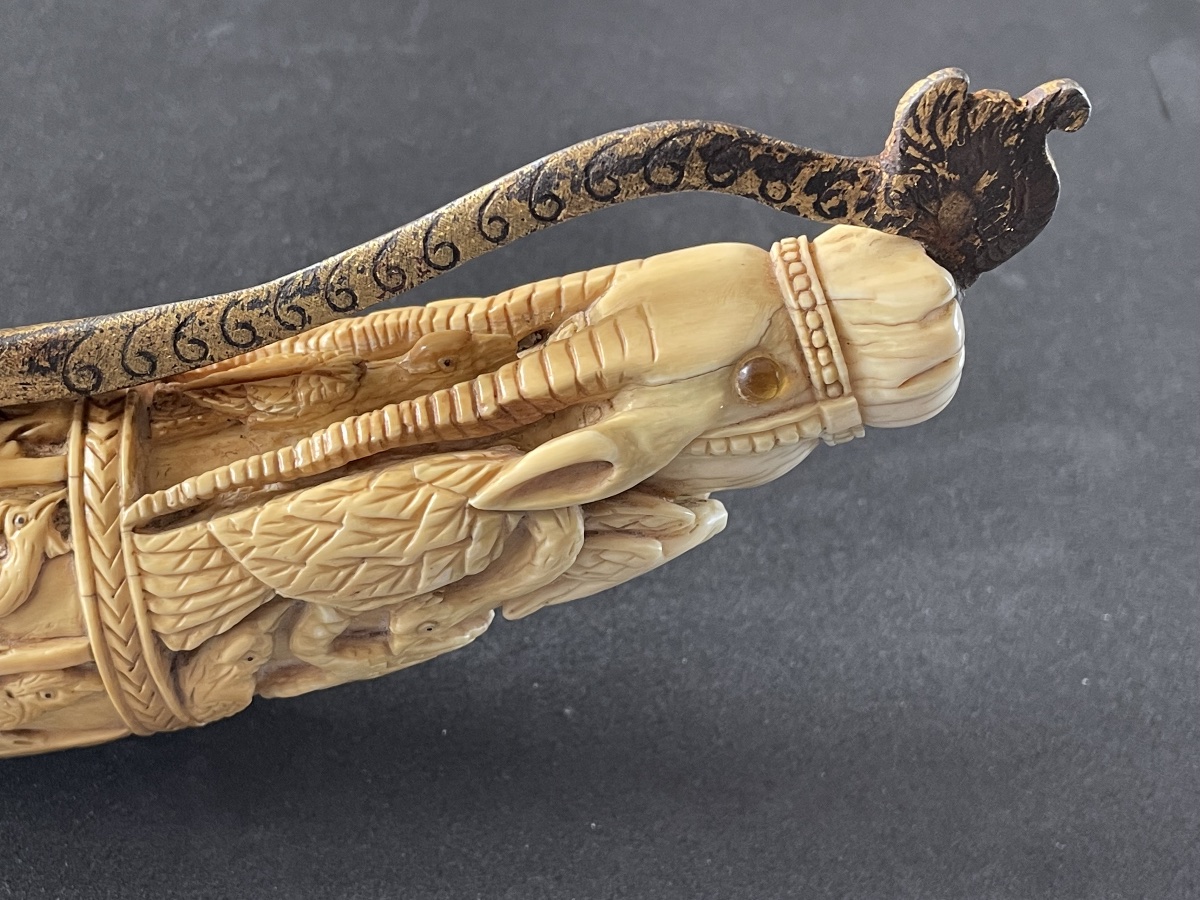
One end is formed by two antelope heads leaning against each other, arranged symmetrically on either side of the flask. Their elongated muzzles are encircled by a beaded band; their eyes are inlaid with reddish-brown cabochons, and their long, ringed horns, curving backward, follow the curve of the vessel. Around the heads and beneath the horns is a dense composition of parakeets with meticulously detailed wings and plumage.
At the opposite end appears a monumental parakeet head with a powerfully curved beak, also surrounded by birds stacked on several levels. Its eye is accentuated by an amber-colored cabochon. The bird’s silhouette blends into the overall curve of the powder flask and serves as one of its highlights.
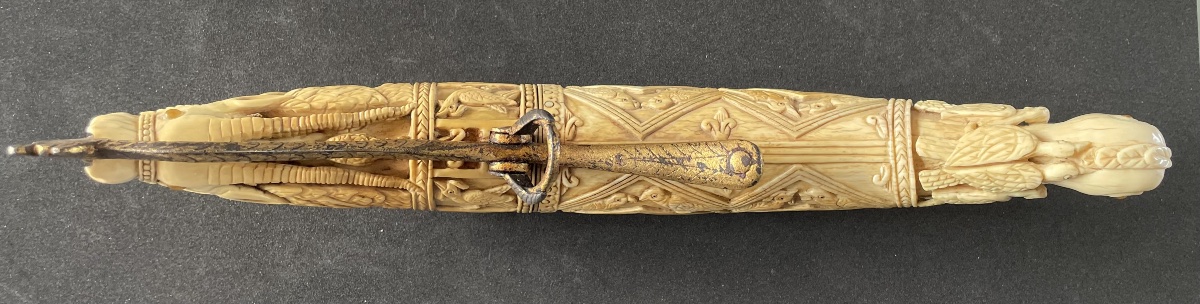
The central section is covered with a multitude of birds depicted in profile, perched on branches or set within compartments delineated by broken lines. Fleurons, beaded borders, and chevron friezes punctuate the composition. This geometric structure organizes the profusion of figures while emphasizing the object’s arched shape.
The scale of the decoration, the layering of the figures, and the alternation between low relief, high relief, and elements carved almost in the round attest to a high level of mastery in ivory carving.
Mechanism and Function
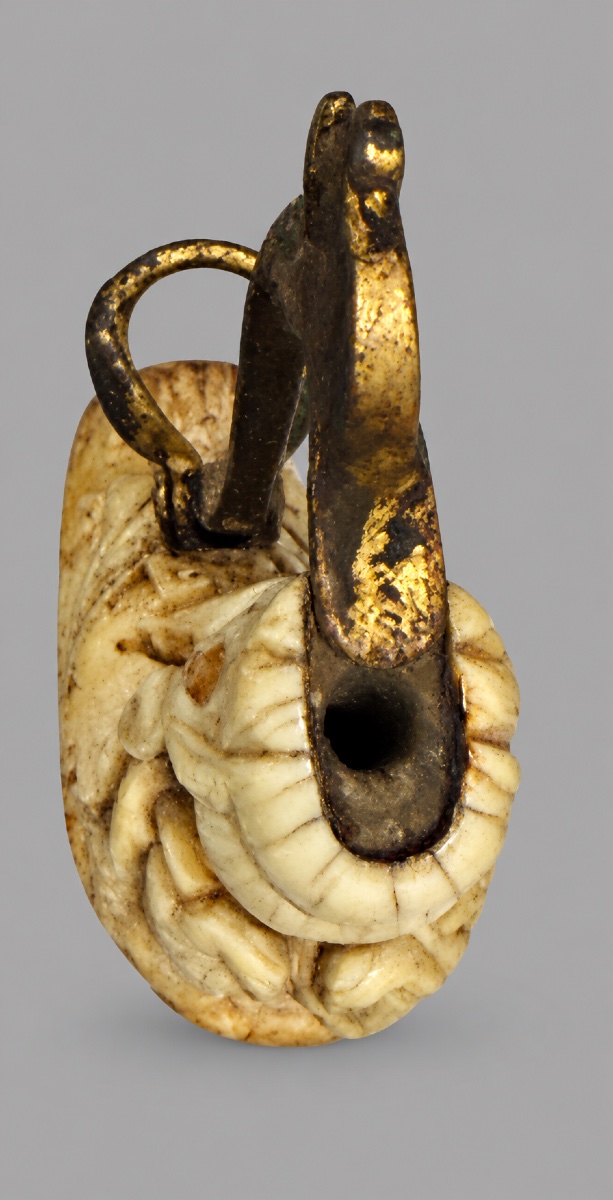
The powder horn retains its steel firing mechanism, consisting of long, articulated arms that follow its curvature. These arms are adorned with a plant motif engraved and damascened in gold. The upper arm ends in a large, cut-out and engraved palmette; the central ring was used to hang the object from a belt or a sash.
This small container held the very fine powder used to prime the pan and the fuse of a musket. Pulling the lever opened the outlet at the end, allowing a controlled amount of powder to be poured out, which then ignited the main charge placed in the barrel.
Artistic Context
Mughal ivory powder flasks constitute a small group of prestige objects produced in the imperial or princely workshops of 17th-century India. Their naturalistic decoration draws heavily on Mughal painting and its penchant for depictions of wildlife, hunting scenes, and composite creatures.
The Metropolitan Museum of Art notes that these zoomorphic powder boxes were among the first Mughal decorative objects to reach Europe: several are already documented in princely art and natural history cabinets from the mid-17th century onward. The David Collection also notes that examples of this type were present as early as this period in the Danish Royal Kunstkammer.
This powder flask is distinguished by the almost exclusively ornithological nature of its decoration. Whereas many examples feature felines attacking gazelles or composite animals, this one combines two antelope heads with an exceptional array of parakeets, culminating in an imposing bird’s head. The preservation of the damascened gold mechanism further underscores its quality and rarity.
Museum and bibliographic references
• The Metropolitan Museum of Art, New York, Priming Flask, India, second half of the 17th century, ivory, iron, and copper alloy, L. 25.1 cm, inv. 36.25.2419.
• The Metropolitan Museum of Art, New York, Priming Flask, India, second half of the 17th century, ivory, steel, pigment, and resin, L. 26 cm, inv. 36.25.2420; on display in Gallery 379.
• The David Collection, Copenhagen, Powder horn, India, 17th century, carved ivory, L. 24.5 cm, inv. 1/1974.
• Los Angeles County Museum of Art, Powder Primer Flask (baruddan), Mughal Empire, late 17th century, ivory and gilded metal mechanism, L. 20.96 cm, inv. M.83.218.6.
• Jean-Baptiste Clais, “Imperial Mughal Ivory Priming Flasks. A First Catalogue,” Journal of the David Collection, vol. 5, 2021, pp. 96–151.
Condition
Very good condition.
Period: 17th century
Style: Asian art
Condition: Excellent condition
Material: Ivory
Reference (ID): 1810843
Availability: In stock