THIS OBJECT WAS SOLD
Canaanite Fusiform Juglet (middle Bronze) With Certificate Of Authenticity
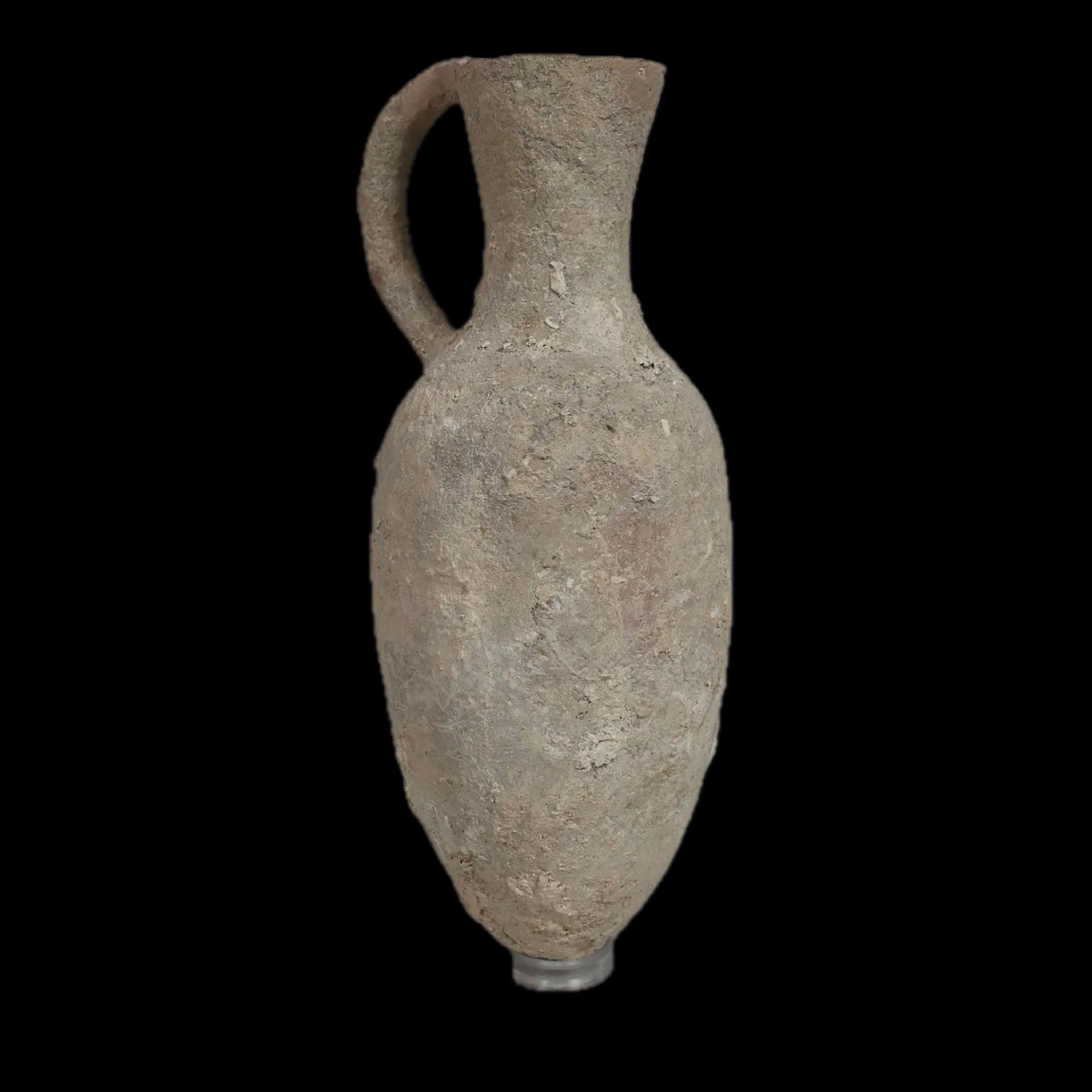
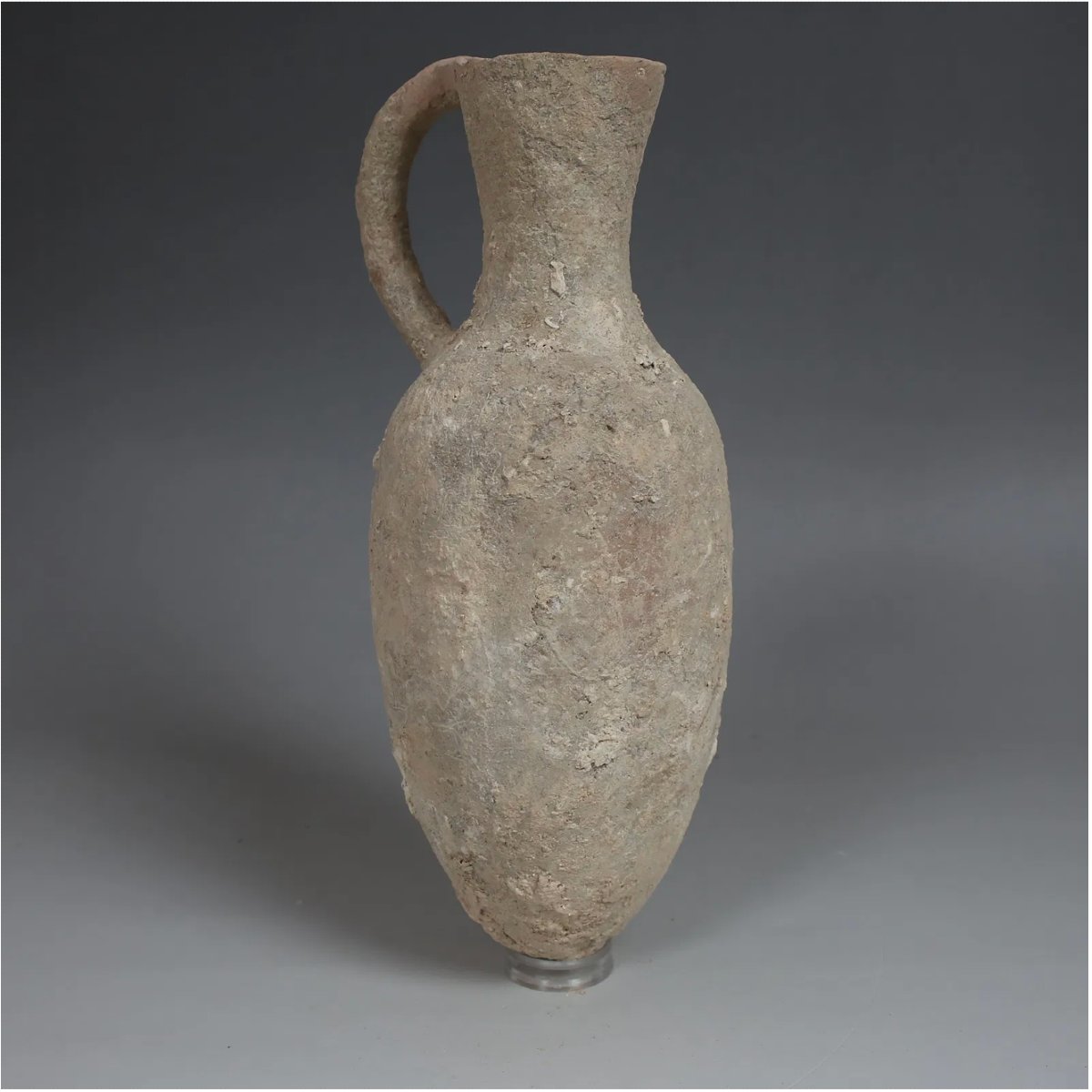
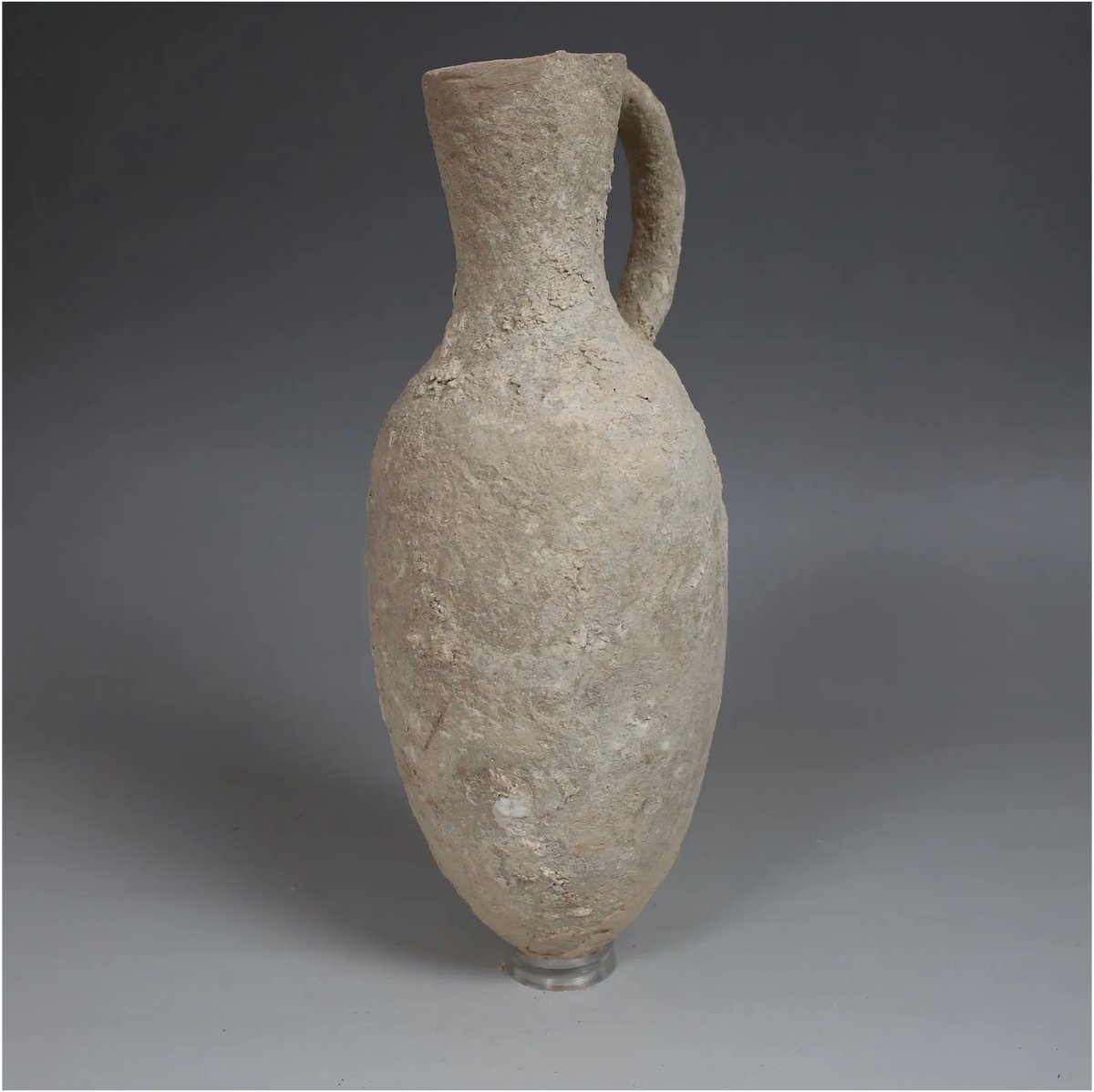
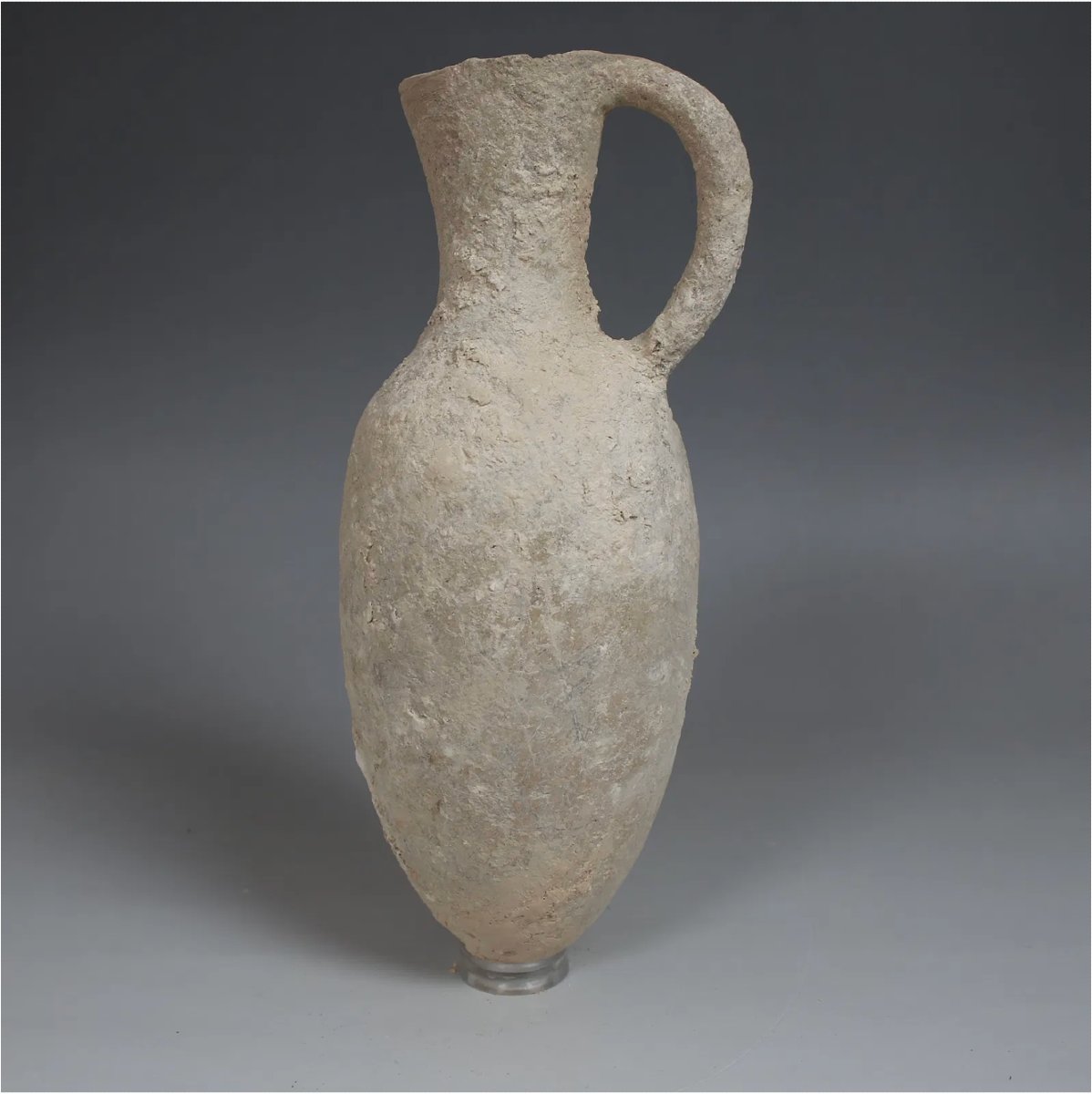


This fusiform juglet is an archetypal example of Levantine ceramic production during the Middle and Late Bronze Ages. Its slender silhouette, designed for efficient dipping and pouring, is here magnified by an exceptional state of preservation. The object is entirely preserved in its "as-found" condition: a dense layer of calcareous concretions and gray-white sediments envelopes the terracotta. This mineral crust, far from being an imperfection, constitutes the ultimate seal of authenticity. It attests to a millennia-old chemical interaction with the burial soil and guarantees that the piece has undergone no aggressive modern acid cleaning, offering the rarity of a "fresh from excavation" condition.
Characteristics
Object: Vertical Handled Jug (Dipper Juglet).
Culture: Canaanite (Levant).
Period: 1900 – 1400 BC (Middle to Late Bronze Age).
Material: Beige ceramic, significant surface calcareous concretions.
Dimensions: Height: 200 mm | Diameter: 94 mm.
Condition: Intact; surface covered with a thick sedimentary patina (excavation concretions).
Provenance: Ex-private Jerusalem collection, formed between 1975 and 1990.
Documentation: Sold with Certificate of Authenticity.
Historical Context Canaan, a commercial crossroads between Egypt and Mesopotamia, developed a ceramic tradition focused on functionality. This type of elongated vessel, classified by archaeologists as a dipper juglet, was designed to be dipped into large storage jars (pithoi) to draw out wine or oil, or to contain precious liquids (perfumes, ointments). Its narrow shape facilitated insertion and limited evaporation. Found in both domestic and funerary contexts, it bears witness to the daily life of the Semitic populations of the 2nd millennium BC.
Formal and Material Analysis
Morphology: The piece presents a cylindrical body tapering toward a slightly convex base, typical of vessels intended to be suspended or immersed. The neck flares into a tulip shape to facilitate precise pouring. The single handle, connecting the shoulder to the rim, forms a robust functional loop.
Surface Condition and Sedimentation: Visual examination focuses on the texture: the surface is matted by intense calcareous crystallization. These whitish and grayish deposits are distributed homogeneously, conforming to the slightest irregularities of the clay. This sedimentation is the geological signature of burial in a dry, calcareous environment, characteristic of tombs in the Levant region.
Technique: Although masked by the patina, the regularity of the profile indicates shaping on a fast wheel, a technique mastered by Canaanite artisans.
Cultural and Decorative Value This juglet possesses first-rate documentary value. Unlike pieces cleaned for the art market, it retains the integrity of its archaeological history. It is a tangible witness to the biblical and historical strata of the region. For the collector, it offers the mineral aesthetic of pure archaeology, directly evoking the conditions of its rediscovery after nearly four thousand years of silence.
Expertise Report The authenticity of the piece is supported by technical analysis and history:
Typology: The fusiform shape is consistent with ceramic productions of the Middle Bronze II to Late Bronze Age in the Levant.
Patina: The density and adherence of the calcareous concretions are reliable indicators of antiquity, impossible to reproduce artificially with such realism.
Traceability: The ancient provenance (Jerusalem collection, 1975–1990) guarantees the geographical origin and the antecedence of the discovery.
Explore similar pieces and discover your ideal find:
archeology