THIS OBJECT WAS SOLD
Neolithic Flint Tool From The Michelsberg Culture — With Certificate Of Authenticity
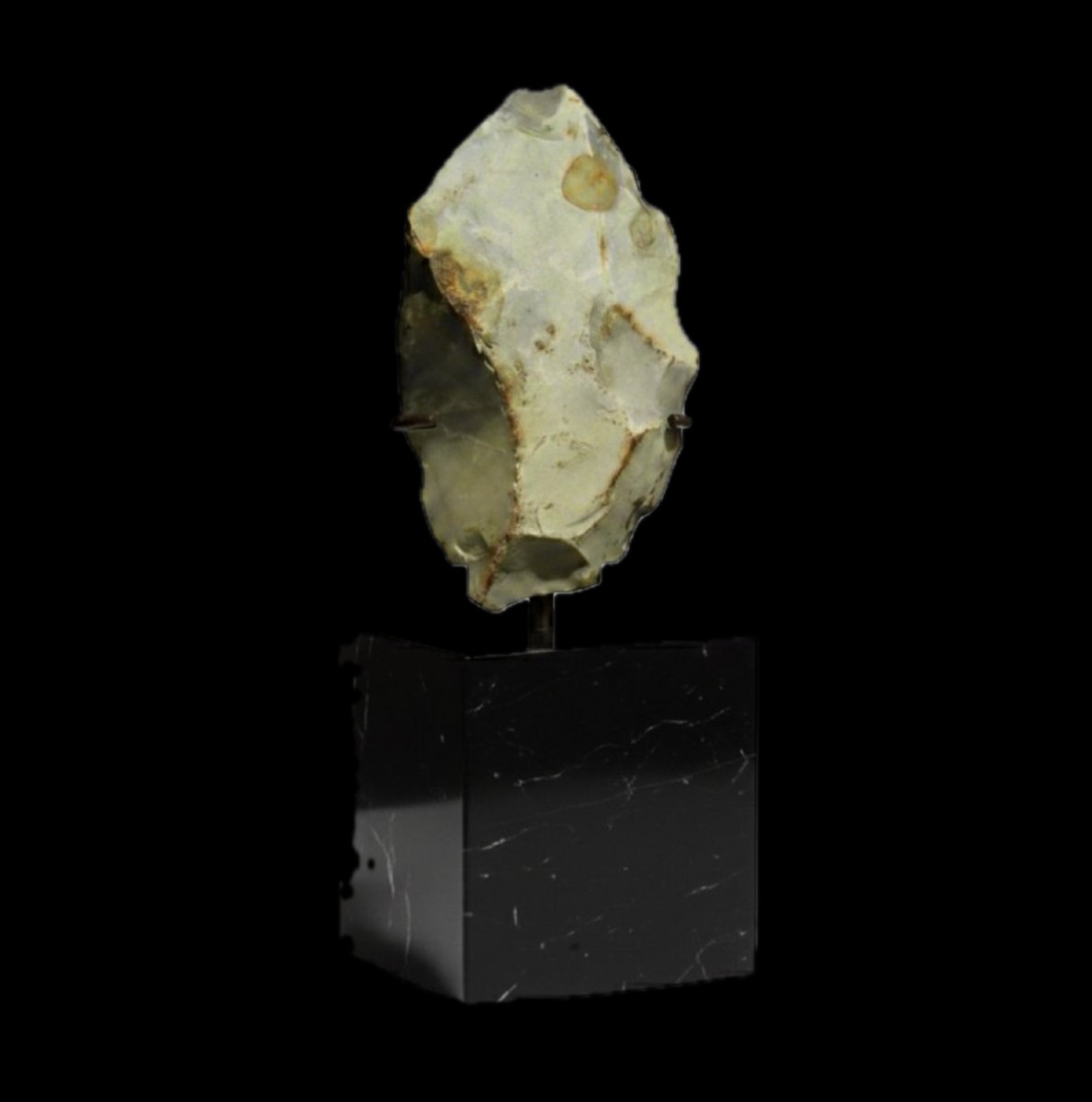
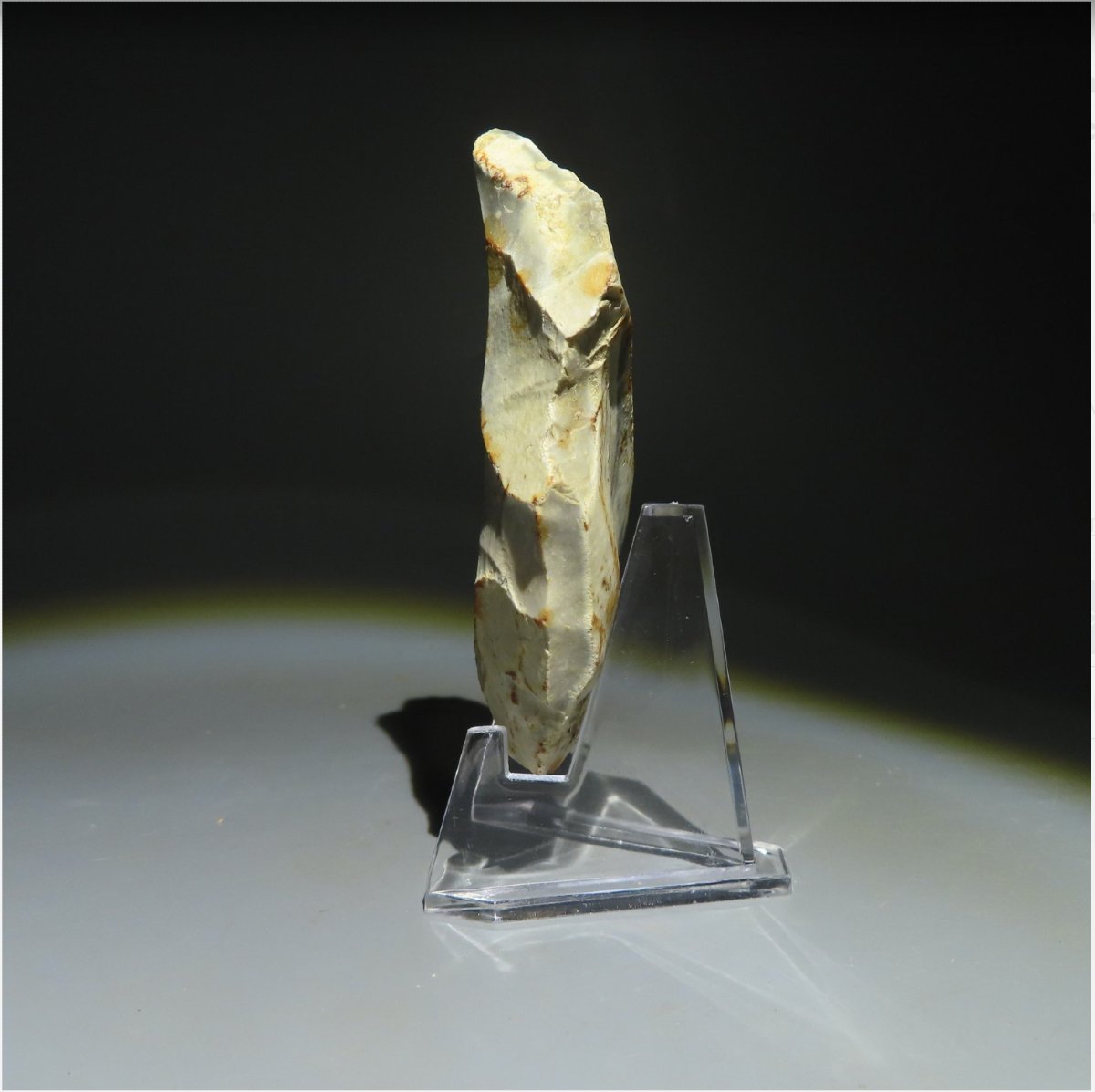
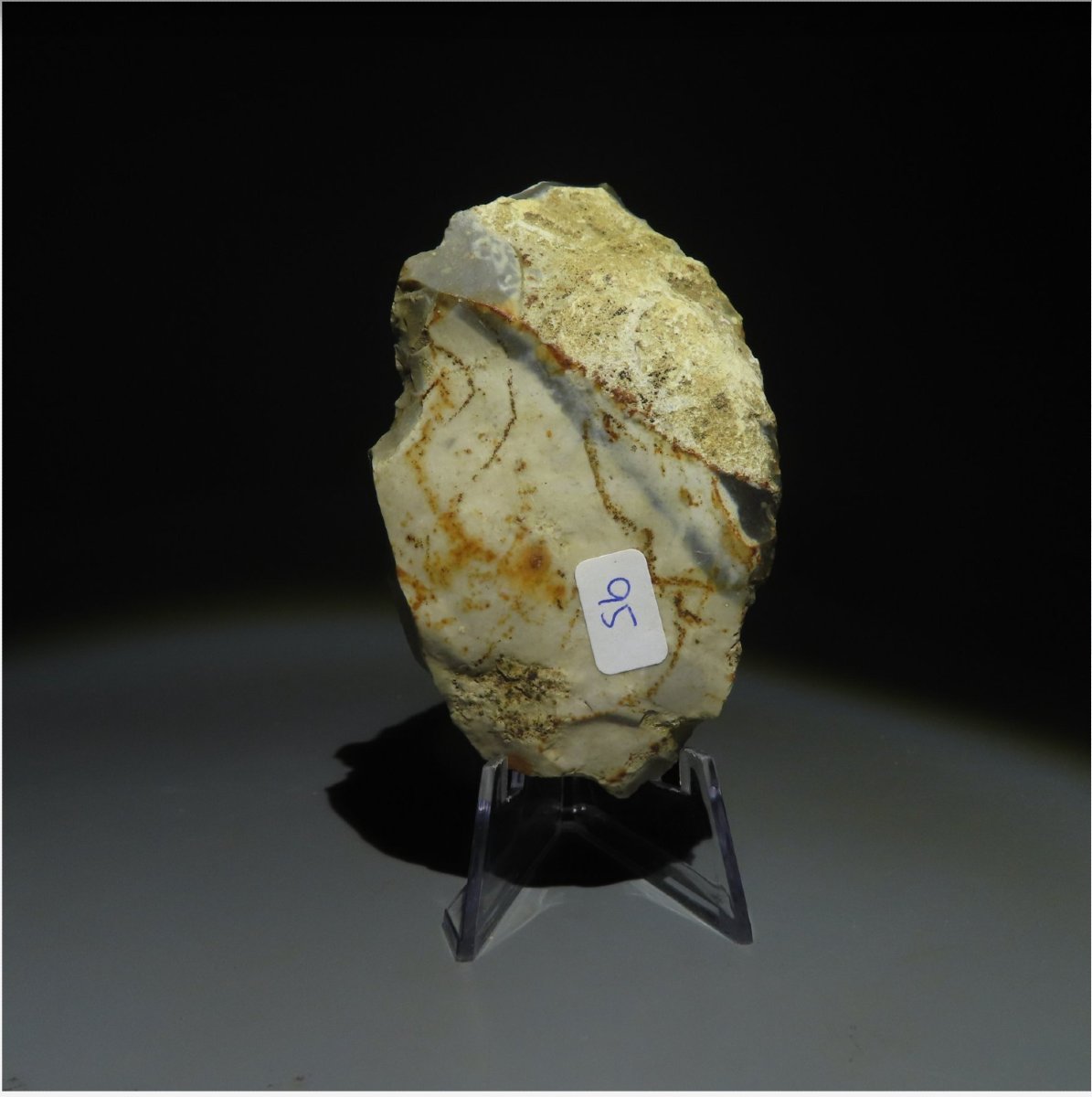
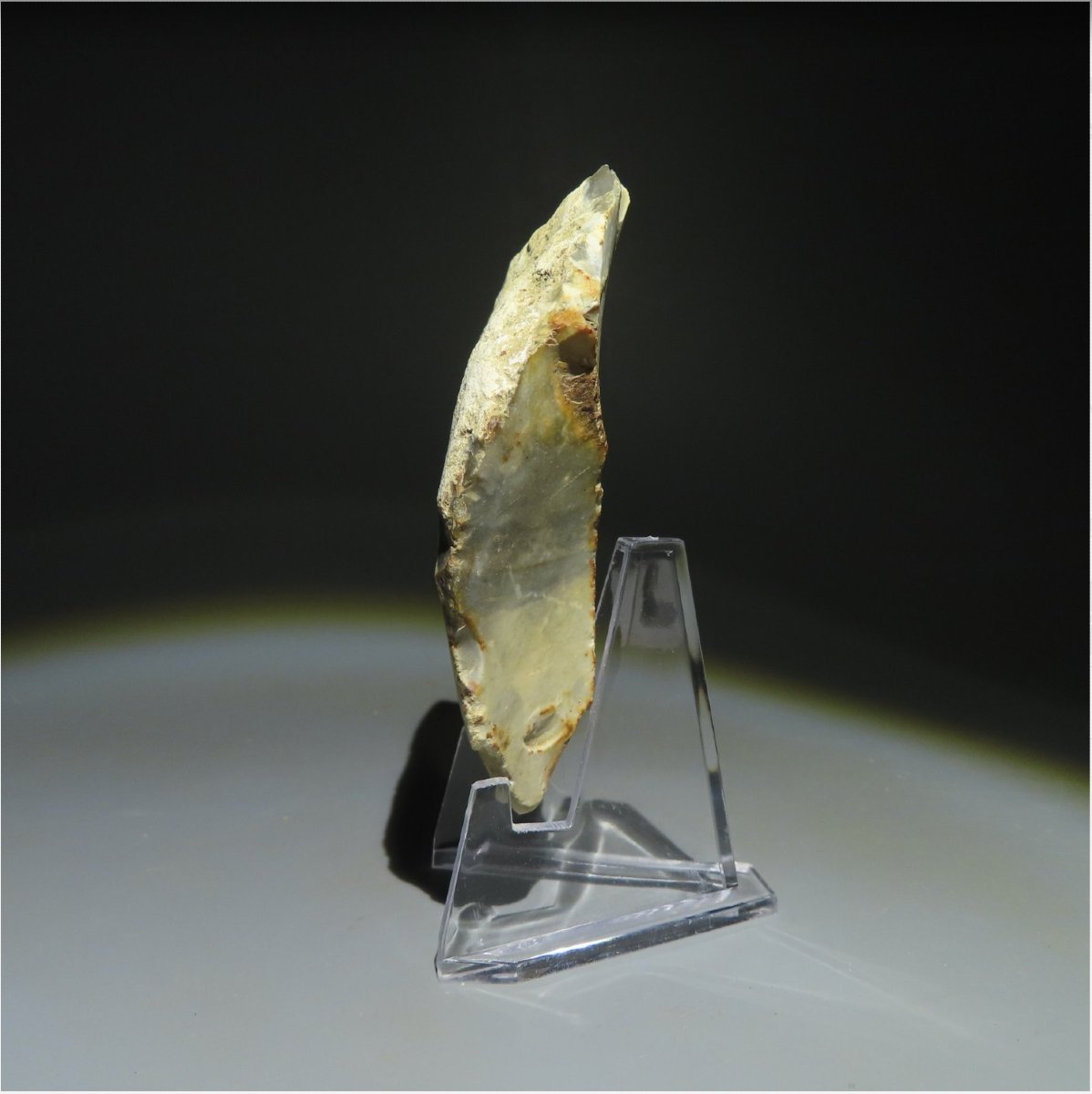



Exceptional lithic artifact originating from the UNESCO World Heritage site of Spiennes (Belgium), one of Europe’s major Neolithic centers for the extraction and working of flint. This tool, knapped from light gray Maastrichtian flint with ochre hues, exemplifies the technical mastery of Michelsberg craftsmen. Its continuous archaeological patina, soft and satin-like, displays iron-rich veining and mineral halos typical of millennia-long burial.
The harmonious balance of its ovoid form, biconvex profile, and tense cutting edge reveals a complete command of the prehistoric chaîne opératoire: core extraction, flake removal, retouching, partial polishing, and shaping of the active edge. Both functional and aesthetic, it embodies the sophistication of Neolithic toolmaking.
Technical CharacteristicsObject: Side scraper on flake
Culture: Michelsberg (Late Neolithic)
Date: 4500–3500 B.C.
Material: Light gray Maastrichtian flint with ochre tones
Dimensions: 9.5 cm
Condition: Intact, unrestored; continuous stabilized patina
Provenance: Spiennes (Camp-à-Cayaux, Mons, Belgium)
Authenticity: Official certificate provided
Sale: European specialized auction, under expert supervision
This tool corresponds to a side scraper, a typology recognized in international museum catalogues (French Ministry of Culture “Joconde” database, British Museum, Penn Museum).
It is defined as a thick flake whose lateral edge has been retouched with regular scalloped removals to form a functional cutting edge for scraping or smoothing organic materials.
Its morphology, knapping technology, and raw material identify it as part of the Michelsberg culture (4400–3500 B.C.), one of the defining archaeological complexes of the Middle-to-Late Neolithic in Northwestern Europe.
The Spiennes site, listed by UNESCO, covers over 100 hectares of prehistoric mining galleries and represents one of the most advanced prehistoric mining and production complexes in Europe, combining extraction technology, standardized manufacture, and regional distribution of specialized tools.
The Maastrichtian flint of Spiennes, quarried from the Chalk Formation of Spiennes, is characterized by its pale gray color, subtle ochre-iron veining, and fine homogeneous grain.
The satin patina and mineral accretions seen on this artifact perfectly match the petrographic signature of Spiennes flint, as documented in geological studies (Flintsource.net), confirming its authentic and traceable provenance.
Penn Museum (Philadelphia), inv. EU1362D: Scraper – Spiennes, Belgium — identical typology.
Royal Museums of Art and History (Brussels), Spiennes Collection (est. 1867): series of flake tools exhibiting the same morphology and raw material.
National Belgian and French collections: comparable specimens catalogued in Michelsberg corpora and Onroerend Erfgoed inventories (2019).
These institutional parallels confirm the typological and technological authenticity of the present example within the Spiennes production tradition.
Formal and Technological AnalysisVolume: thick flake with ovoid outline and biconvex profile — ergonomically balanced.
Dorsal face: converging negatives of flake removals, symmetrically organized.
Ventral face: smooth surface from controlled direct percussion.
Cutting edge: active lateral edge with clear stepped retouches; presence of micro-polish indicating functional use (likely woodworking or vegetal scraping).
Surface: continuous satin patina with small residual cortex zones, evidencing the original flint nodule.
Authenticity: natural patina, absence of restoration, stable ancient wear — all indicators of genuine archaeological origin.
The Michelsberg culture marks a major transformation in Neolithic Europe: the evolution from simple domestic agriculture to a proto-industrial organization of lithic production.
The mines of Spiennes, with their deep vertical shafts and on-site knapping workshops, epitomize this technological and social revolution.
Scrapers such as this one are direct witnesses of standardized craftsmanship, where the tool embodies both technical utility and symbolic meaning, uniting function and culture.
UNESCO: Neolithic Flint Mines of Spiennes (Mons) — official heritage record.
Fourny, M., “Reassessment of the Absolute Chronology of the Michelsberg Culture in Belgium,” Notae Praehistoricae 44 (2024).
Claes, B. & Ghesquière, V., The Neolithic Spiennes Collection, Anthropologica et Praehistorica 128 (2019).
Onroerend Erfgoed, The Michelsberg Settlement of Spiennes, Inventory 2019.
Flintsource.net, Spiennes Flint – Camp-à-Cayaux Chalk Formation.
Penn Museum, inv. EU1362D, Scraper – Spiennes, Belgium.
This artifact fulfills the three core criteria of archaeological expertise:
Material authenticity – verified patina, mineralization, and UNESCO-proven provenance.
Technological integrity – complete chaîne opératoire, original edge, no modern retouching.
Documentary value – direct alignment with Michelsberg corpora and national museum holdings.
It thus stands as a reference specimen for any collection dedicated to European prehistory and the origins of human technology.
Cultural SignificanceBeyond its utilitarian role, this scraper is a testament to prehistoric genius — an expression of technical awareness, controlled craftsmanship, and innate aesthetic sensibility.
Flint, shaped by human hands with intelligence and precision, becomes here a mineral memory of labor, a symbol of the dawn of human ingenuity.
All our artifacts are shipped in reinforced, professionally packed parcels, via tracked and signed-for Colissimo with full insurance coverage.
Each shipment is monitored and documented, ensuring the safety, traceability, and preservation of the piece.
Antikarts guarantees professional handling, integrity, and full compliance with international art trade standards.
Note: The stands, frames, and display accessories visible in the photographs are for presentation purposes only and are not included in the sale.
Explore similar pieces and discover your ideal find:
archeology