THIS OBJECT WAS SOLD
Granodiorite Funerary Mask – Egypt, Late Period, Idealized Face


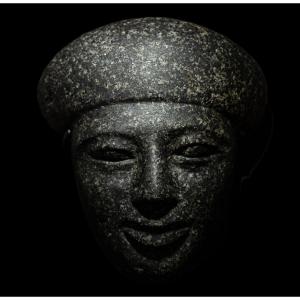


Funerary mask in hard stone, carved from fine-grained granodiorite, depicting a youthful face beneath a close-fitting “cap” wig. The modelling is confident and characteristic of late workshops: softly arched brows, taut upper eyelids, finely incised inner canthi, straight nasal ridge, and gently outlined lips forming a discreet smile.
The ancient polish varies subtly — more pronounced on the cheekbones, nose, and lips — while the recessed areas retain a finely pecked surface showing regular tool marks, typical of hammer and chisel work followed by abrasive finishing.
The frontal edge of the wig is sharply defined by a continuous incised groove. A small ancient impact, worn and stabilized, appears at the crown. The edges display minor historical chips consistent with the patina.
The reverse shows a crisp, crystalline ancient break with visible quartz, feldspar, and biotite inclusions — a clear indicator of authentic ancient fracture, with no trace of modern sawing or cutting.
Technical characteristics
Culture / Period: Egypt, Late Period, 664–332 B.C. (stylistically close to the 26th Dynasty).
Material: Dark granodiorite with light inclusions of quartz, feldspar, and brown mica.
Dimensions: 16 × 12 cm (22.2 cm with stand).
Weight: Approx. 5 kg (including stand).
Condition: Excellent for an ancient lithic fragment; satin patina, minor historical abrasions to nose tip and wig edge; no restoration, no repainting.
Historical context
During the Late Period, stone masks complemented the sarcophagi of high-ranking officials. The use of hard stones such as diorite or granodiorite symbolized permanence, power, and status. These idealized visages, with serene expressions and enveloping wigs, were intended to transfigure the deceased into the eternal realm, following a rigorously codified iconography.
Formal and material analysis
Wig (“cap” type): Regular hemispherical volume with a clear frontal edge; slight ancient bruise on the rear-right quadrant, stabilized and inactive.
Eyes: Perfectly symmetrical almond-shaped eyes; sharp upper lids, fuller lower lids; inner corners cut in “V”-form; no modern retouching.
Nose & Mouth: Straight nasal ridge, tip softly worn; full lips with visible labio-mental groove — a detail often found in Saite statuary.
Surface: Alternation of ancient polish and fine pecking, producing a delicate “orange-peel” texture in the recesses; no traces of modern rotary tools or sawing.
Mineralogy: Dark matrix with natural light inclusions and biotite scintillations; consistent ancient polish on contact points.
Reverse: Uneven ancient break with glistening, sharp crystals confirming an authentic fracture with no modern intervention.
These observations align with the geological report by Dr. R. L. Bonewitz (TL05402) confirming the identification of granodiorite, the low-cut wig with incised frontal line, and the deliberately youthful treatment of the facial features.
Cultural significance
A museum-quality work, emblematic of the Late Period funerary canon and carved from a prestigious stone. The precision of the carving, the coherence of the modelling, and the remarkable preservation make this mask a reference piece within any collection of Egyptian art.
Provenance and documentation
Formerly in a private collection of a medical professional (United States).
Previously in a French collection.
Acquired in 2012 from a New York gallery.
Formerly in the Maurice Nahman Collection (Cairo, from 1950), by descent.
Documentation included:
– Interpol AIAD search n°10900-180444 (negative result).
– Geological report R. L. Bonewitz n°TL05402 (petrographic analysis).
– French export license n°227349 (category 1B).
– Spanish import license n°I/1734/2024.
– Technical report by Dr. Alberto Maria Pollastrini.
– Certificate of authenticity.
Modalités de paiement acceptées
Les moyens de paiement suivants sont acceptés :
Chèque : l’expédition de l’objet sera effectuée uniquement après encaissement effectif du chèque.
Virement bancaire : nos coordonnées bancaires vous seront communiquées après confirmation de votre choix.
Carte bancaire : un lien de paiement sécurisé vous sera envoyé pour finaliser la transaction en toute sécurité.
Merci de nous envoyer un message en précisant le mode de paiement choisi afin que nous puissions vous transmettre les informations nécessaires et organiser la suite de la transaction.
Explore similar pieces and discover your ideal find:
archeology