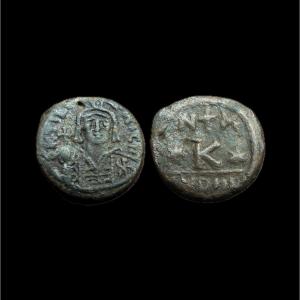
THIS OBJECT WAS SOLD
Etruscan Votive Head — Certificate Of Authenticity + Qed Test + Expert Report
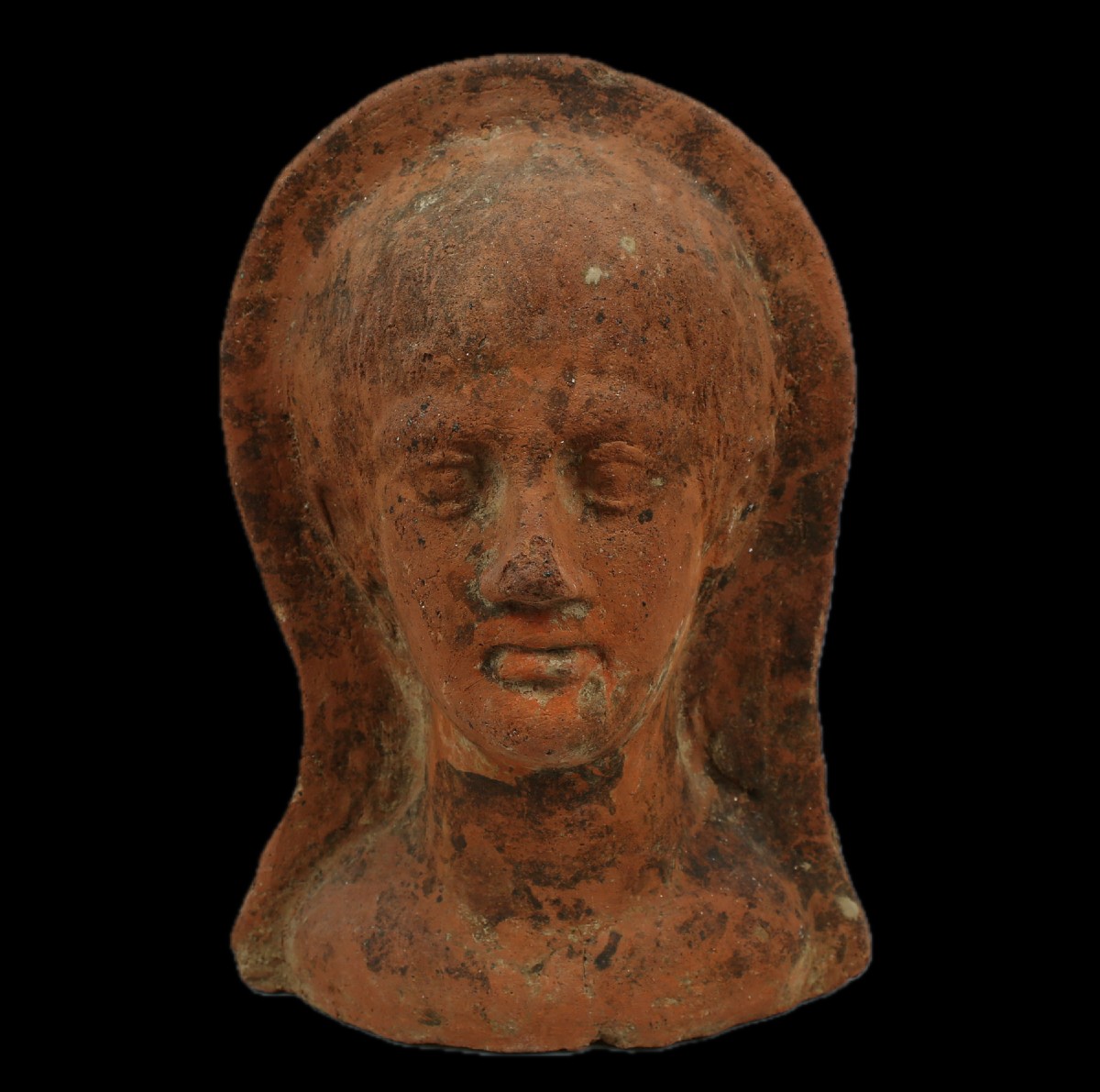
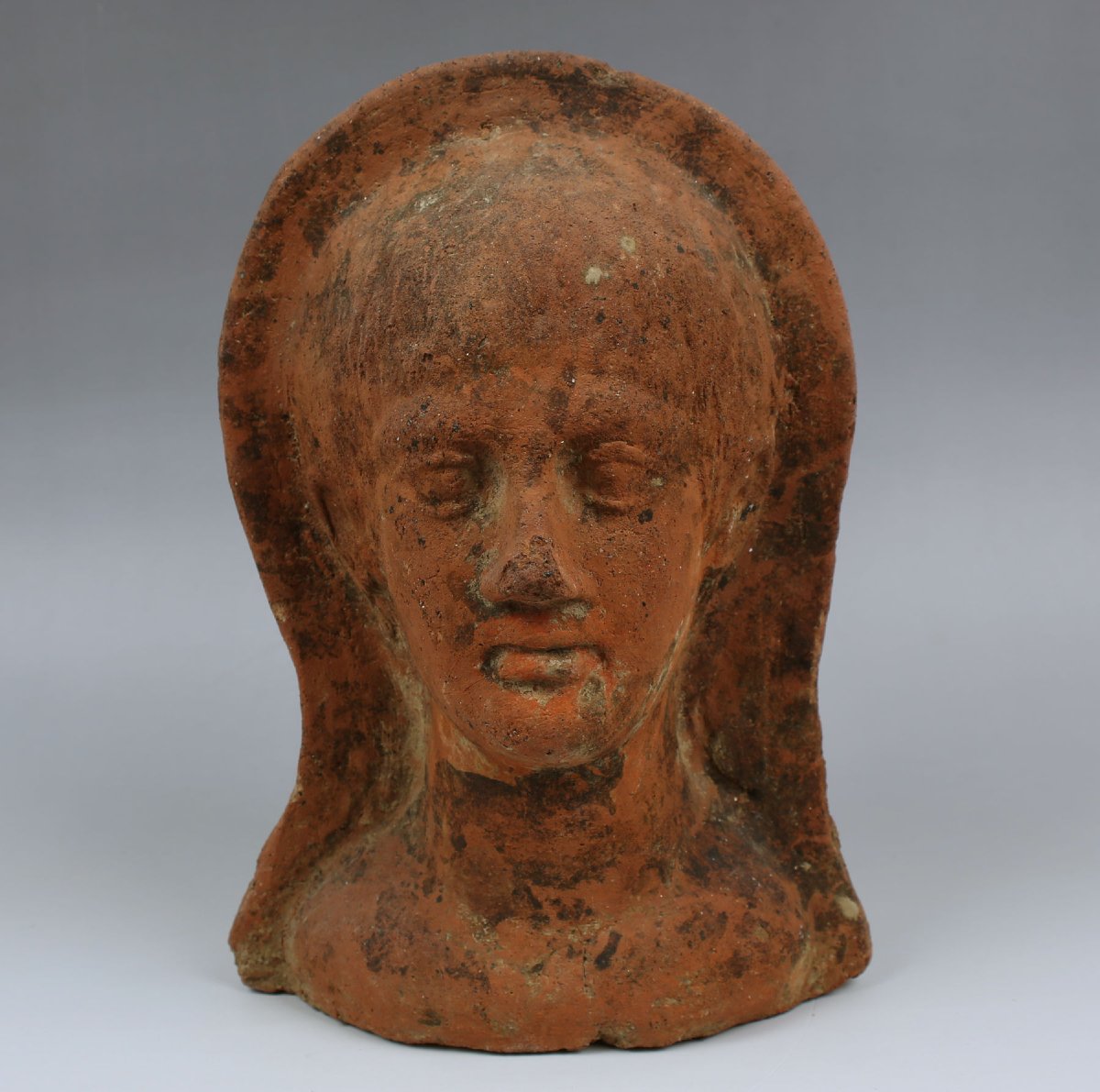
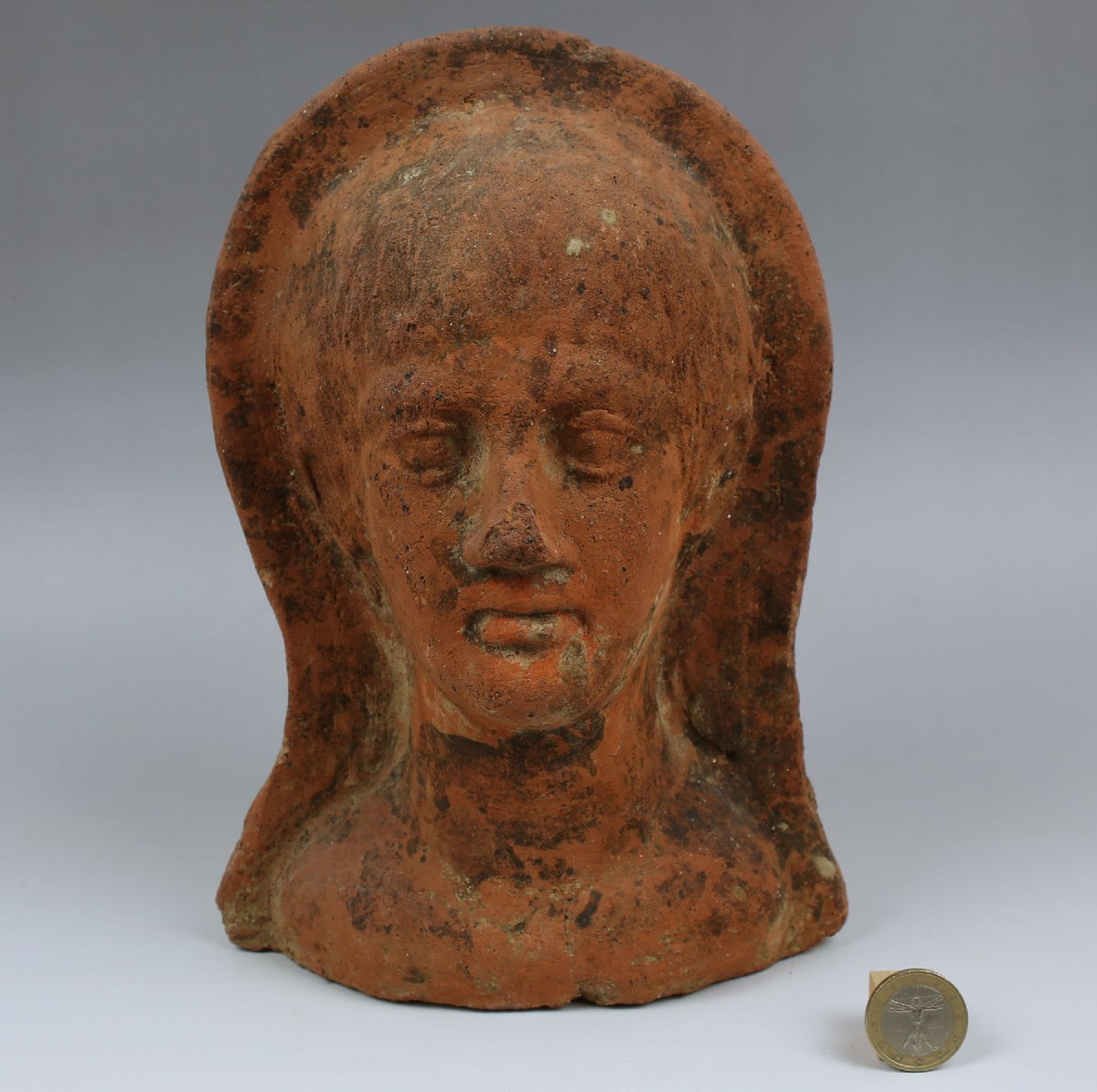
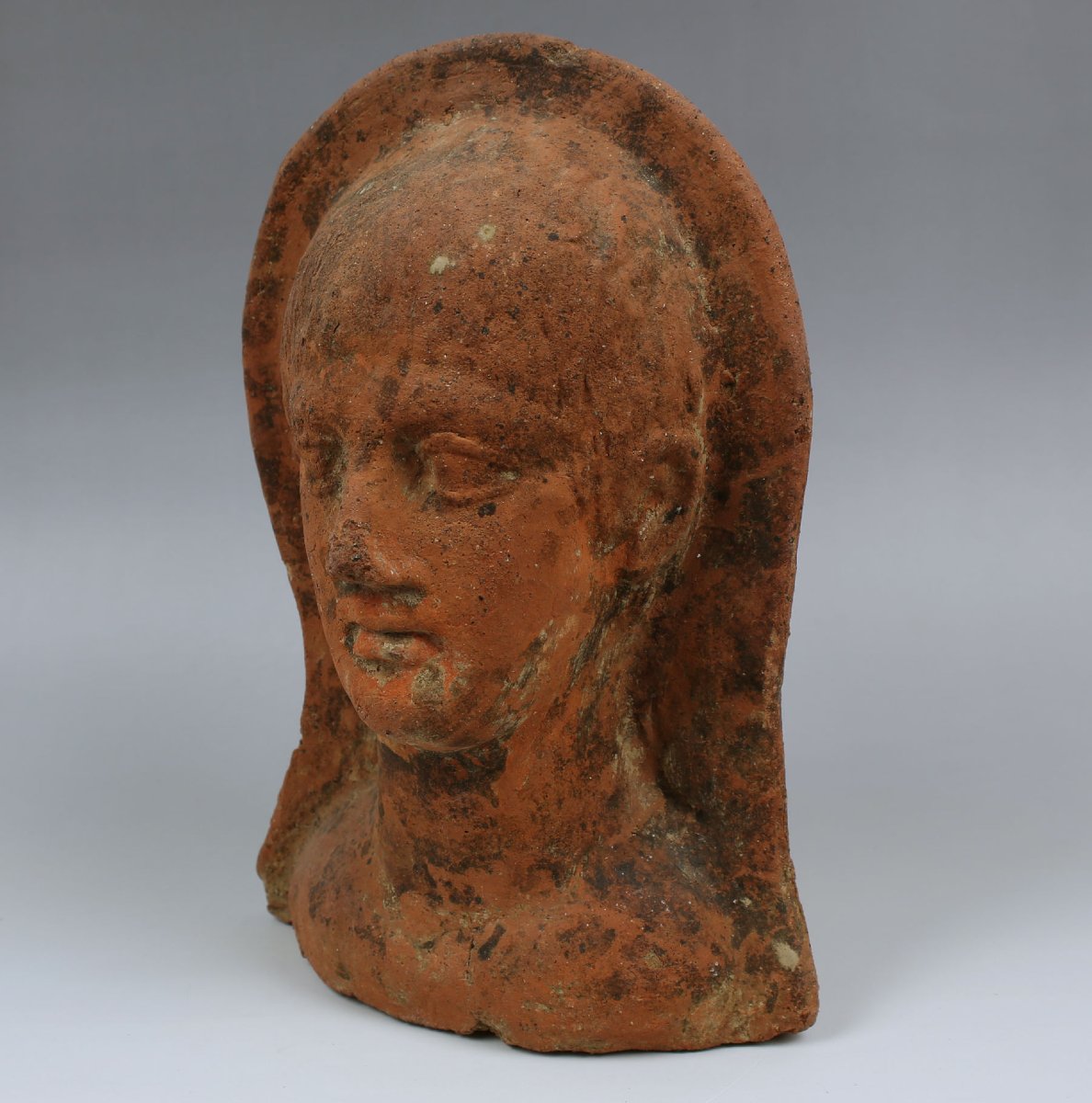
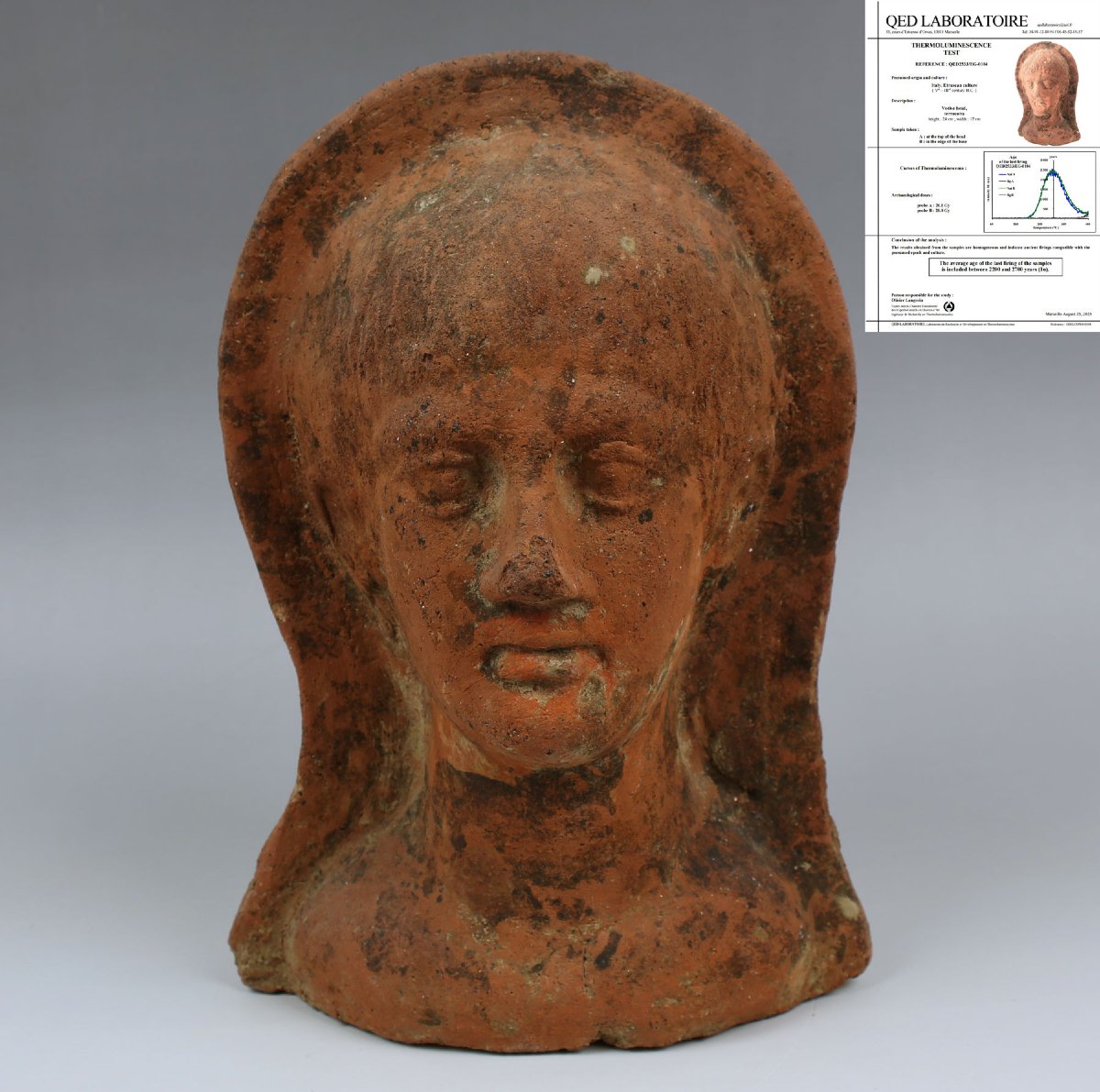
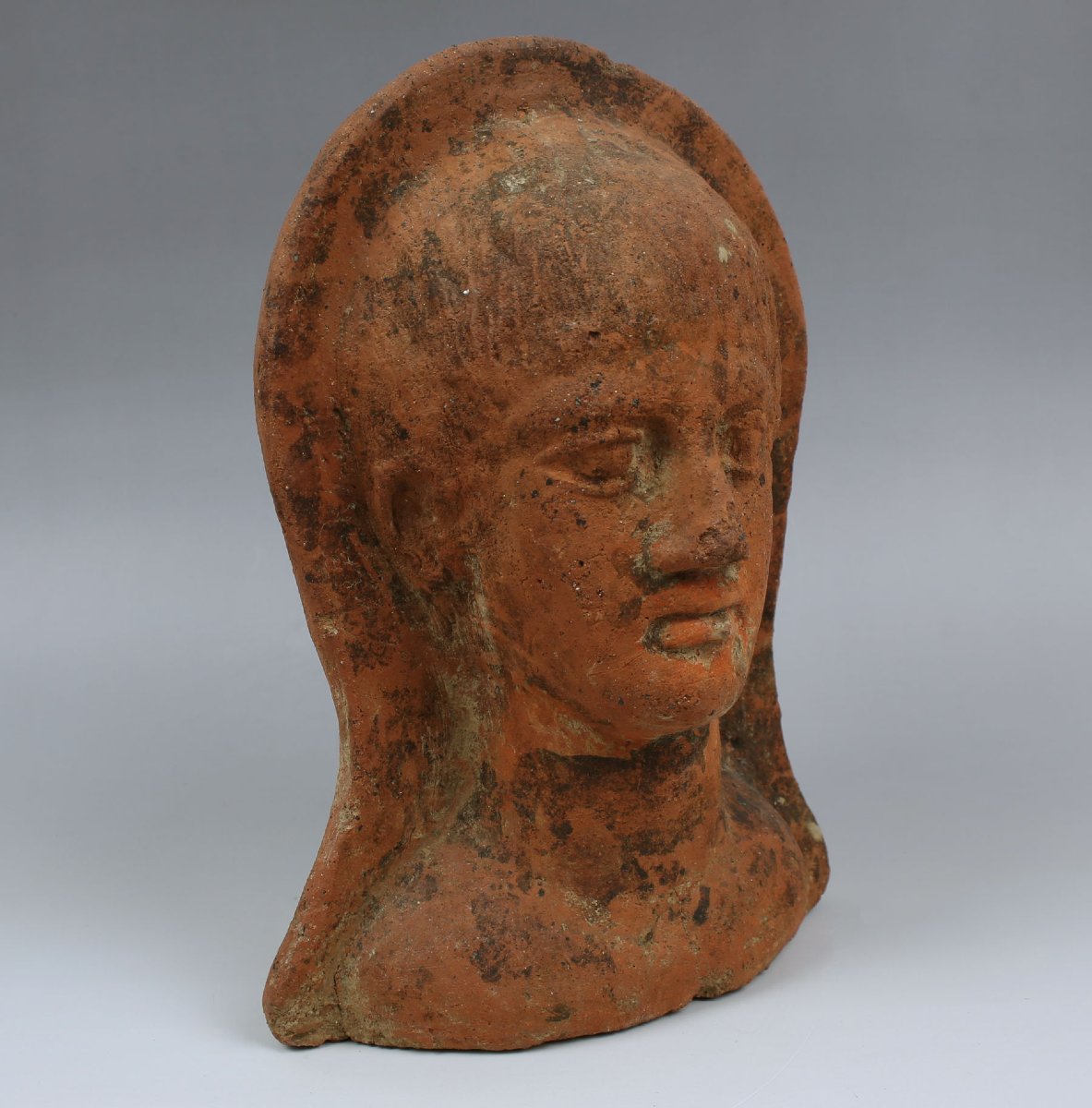


Originating from a rigorously documented provenance chain—former Belgian private collection, transfer through a Spanish antiquarian in 2022, and subsequent return to Brussels—this Etruscan terracotta votive head displays a commanding sculptural presence. The face, conceived as a frontal mask with full modelling, features a high forehead framed by a broad cappuccio forming an aureole. The thick eyelids, closed mouth, and slightly indented base evoke a restrained yet expressive votive stylization.
The surface, in a deep brick-red tone, is enriched with calcareous encrustations, greenish oxidation traces, and ancient chippings—authentic witnesses to long burial.
Under raking light, one observes a dense clay body with coarse mineral temper, visible mould seams, and tool retouches around the nose and lips. The slightly concave reverse confirms a press-moulded technique, completed by hand-finishing.
A QED thermoluminescence test (ref. QED2533/EG-0104) accompanies the piece, scientifically confirming its ancient firing and chronological authenticity.
Technical characteristics
Object: Anatomical votive model of a head
Culture: Etruscan
Period: 5th–4th century B.C.
Material: Red terracotta with mineral temper; burial patina with calcareous concretions and localized green iridescence
Dimensions: Approx. 240 × 165 × 130 mm
Condition: Good overall preservation; ancient wear to nose and edge of cappuccio, minor chips at base, fine surface abrasions; excellent structural stability; no visible restoration
Provenance: Former Belgian private collection → Spanish antiquarian (2022) → Belgian private collection, Brussels
Authenticity: Certificate of authenticity and QED thermoluminescence test included (ref. QED2533/EG-0104); typological and technical consistency; patina and deposits consistent with ancient burial context
Acquisition: Conducted within a certified professional European art market network, following museum-level standards of traceability and expertise
Historical context
In Classical Etruria, therapeutic sanctuaries were filled with anatomical votive offerings—eyes, limbs, organs, and heads—deposited either to request healing or in thanksgiving for divine intervention. These figures, mould-made and hand-retouched, formed a symbolic language of the body, wherein the devotee presented the image of the afflicted part to obtain restoration.
The votive heads, rarer than other anatomical types, encapsulated the entire human identity within an image of piety and wholeness, frequently linked to the sanctuaries of Menrva (Minerva) or Aplu (Apollo).
Formal and material analysis
Volume and profile: Full visage with rounded chin and broad forehead beneath an aureolate cappuccio; smooth lateral contours uniting temple and cheek.
Iconography: Serene expression, half-closed eyes, closed mouth; short hair under a stylized hood structuring the mass.
Patina and deposits: Brick-red surface with calcareous concretions and stable greenish oxidations; homogeneous encrustations indicating ancient sedimentation.
Workshop technique: Press-moulded fabrication with spatula retouches on nose, lips, and eyelids; slightly hollowed reverse for lightness; fine scraping striations visible under raking light.
Clay and firing: Ferruginous orange clay with siliceous inclusions; clean reddish-brown break; consistent oxidizing firing.
Signs of age and authenticity: Minor nose wear, peripheral chips, discreet dry cracks at base; no active deterioration.
Scientific verification: QED thermoluminescence test confirming antiquity; stylistic and technical coherence; no modern intervention observed under ×10 magnification.
Cultural significance
By the authority of its modelling, the authenticity of its patina, and the clarity of its workshop traces, this Etruscan votive head stands as one of the most evocative testimonies of ancient sacred medicine—an image offered as an intermediary between suffering and salvation.
The harmony between scientific validation (TL), typological reading, and surface sedimentation confers upon this piece a museum-level authenticity.
Its hieratic, introspective presence makes it both an archaeological and spiritual object, uniting faith, form, and history in a single enduring image.
Explore similar pieces and discover your ideal find:
archeology