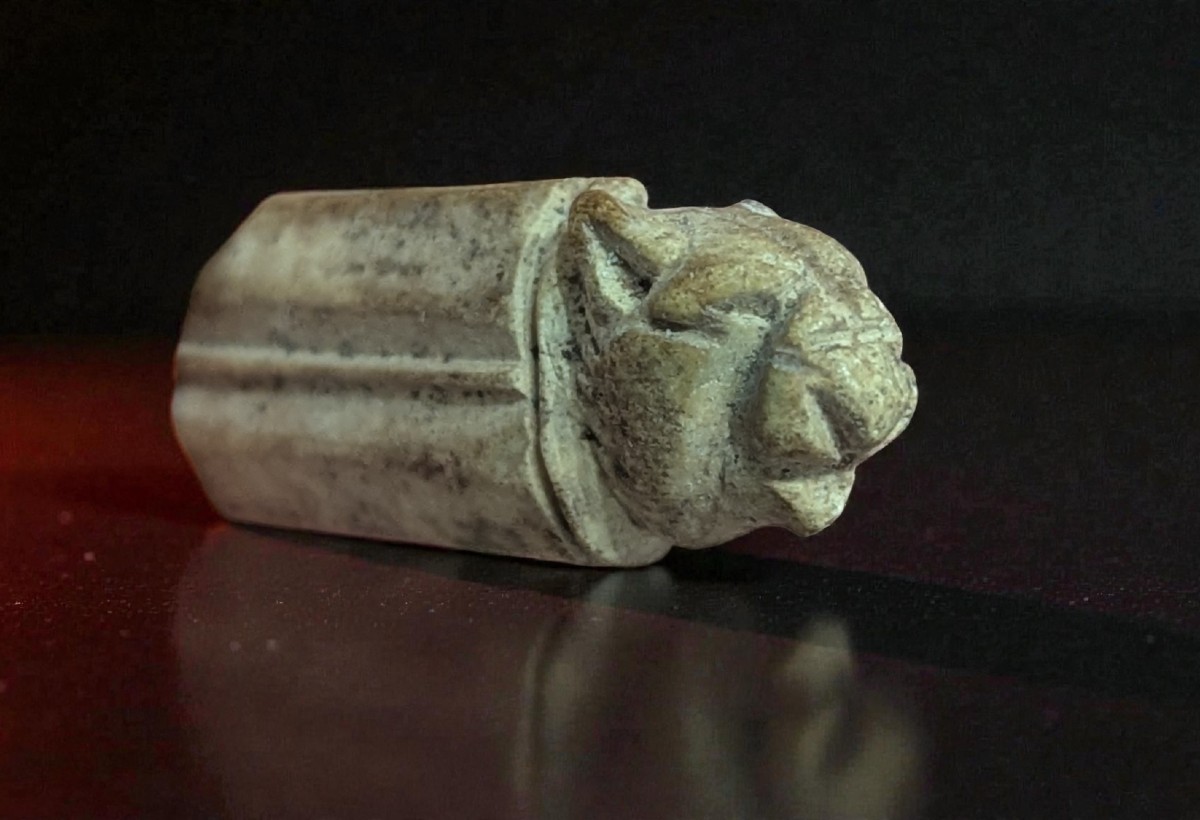
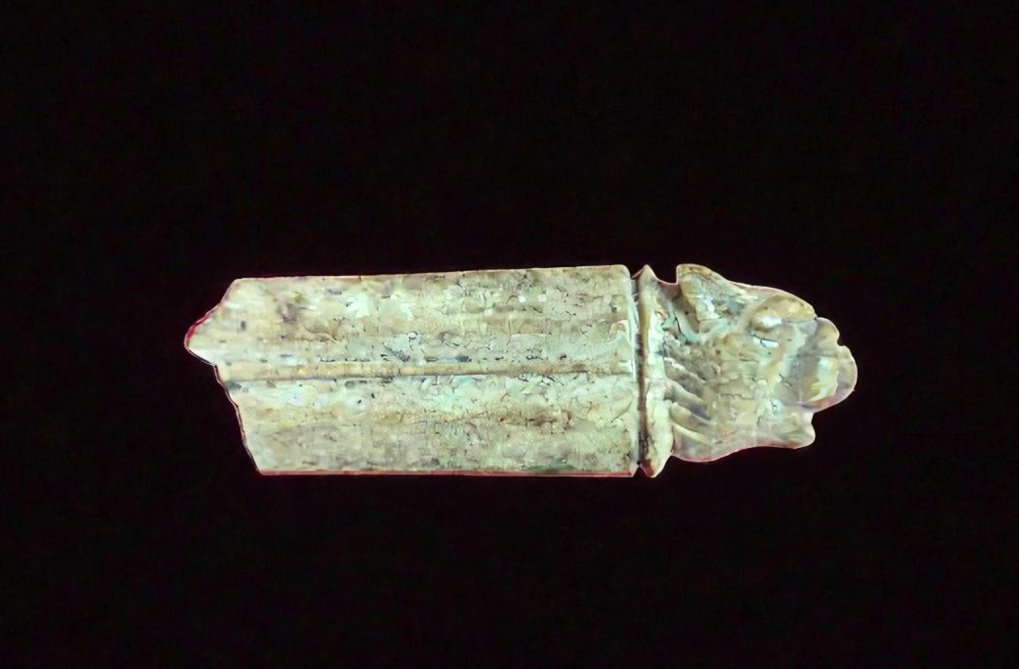


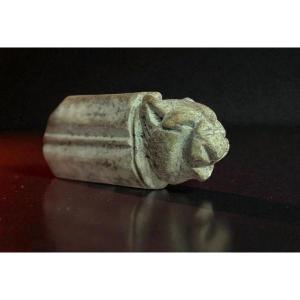


Roman Knife Handle In Bone With A Lion's Head - Roman Empire - 1st-2nd Century Ad
ROMAN BONE KNIFE HANDLE WITH LION'S HEAD Roman Empire - 1st-2nd century AD Knife handle (manubrium cultri) in carved bone, decorated with a stylized lion or panther's head in the round. 4 cm long. Animal bone (probably bovine), beige-cream patina. Carved end representing a feline head (lion or panther) with open mouth, incised mane details. Polygonal handle with finger grooves. Molded collar at the transition between the head and the shaft. Good condition. Clean and well-preserved carvings. Handle of a table knife or personal knife (cultellus). Lion heads, symbols of strength and protection, were particularly prized in Roman craftsmanship. 1st-2nd century AD. Louvre Museum: similar handles inv. S 2673 and S 2703, same lion iconography and comparable dimensions. Provenance: formerly in the Julien Bessonneau collection. Julien Bessonneau (1842-1916), from a wealthy industrial family, significantly expanded his linen and hemp weaving factories, becoming the leading industrialist in Angers in the 1870s. On the eve of the First World War, his businesses employed approximately one in sixteen Angers residents. Like many business leaders of his time, he established social programs, including a sports club that would become SCO Angers, and contributed to the growth of the aeronautics industry with the famous Bessonneau hangars, which were widely used during the war. He owned several prestigious residences: the Château des Brosses near Saint-Clément-de-la-Place, the Château de Mûrs south of Angers, and a large private mansion in the center of Angers, as well as a Parisian residence on the rue de Constantine. A great collector, he amassed a vast art collection: paintings, decorative arts, sculptures, African and Oceanic objects, and numerous archaeological pieces. His post-mortem inventory in 1916 revealed hundreds of antique objects (Cypriot, Greek, Phoenician, Gallo-Roman vases, etc.). His purchases are documented by numerous invoices from specialist dealers. After his death, neither his heirs nor his company continued to expand this collection. A major sale in 1956 dispersed a portion of the works.
450 €
Period: Before 16th century
Style: Rome and Antic Greece
Condition: Good condition
Material: Bone
Length: 4
Reference (ID): 1663204
Availability: In stock
Print