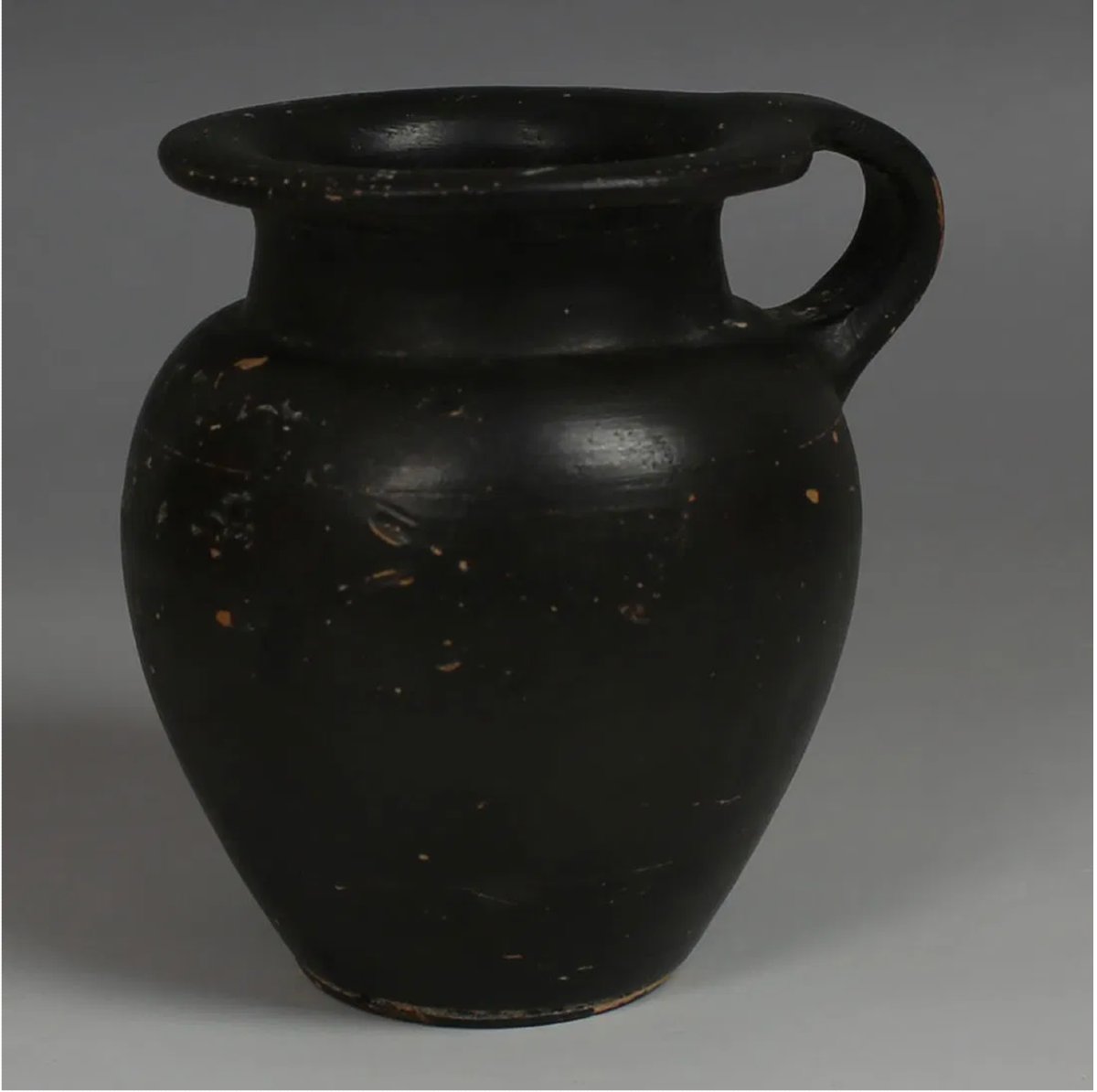
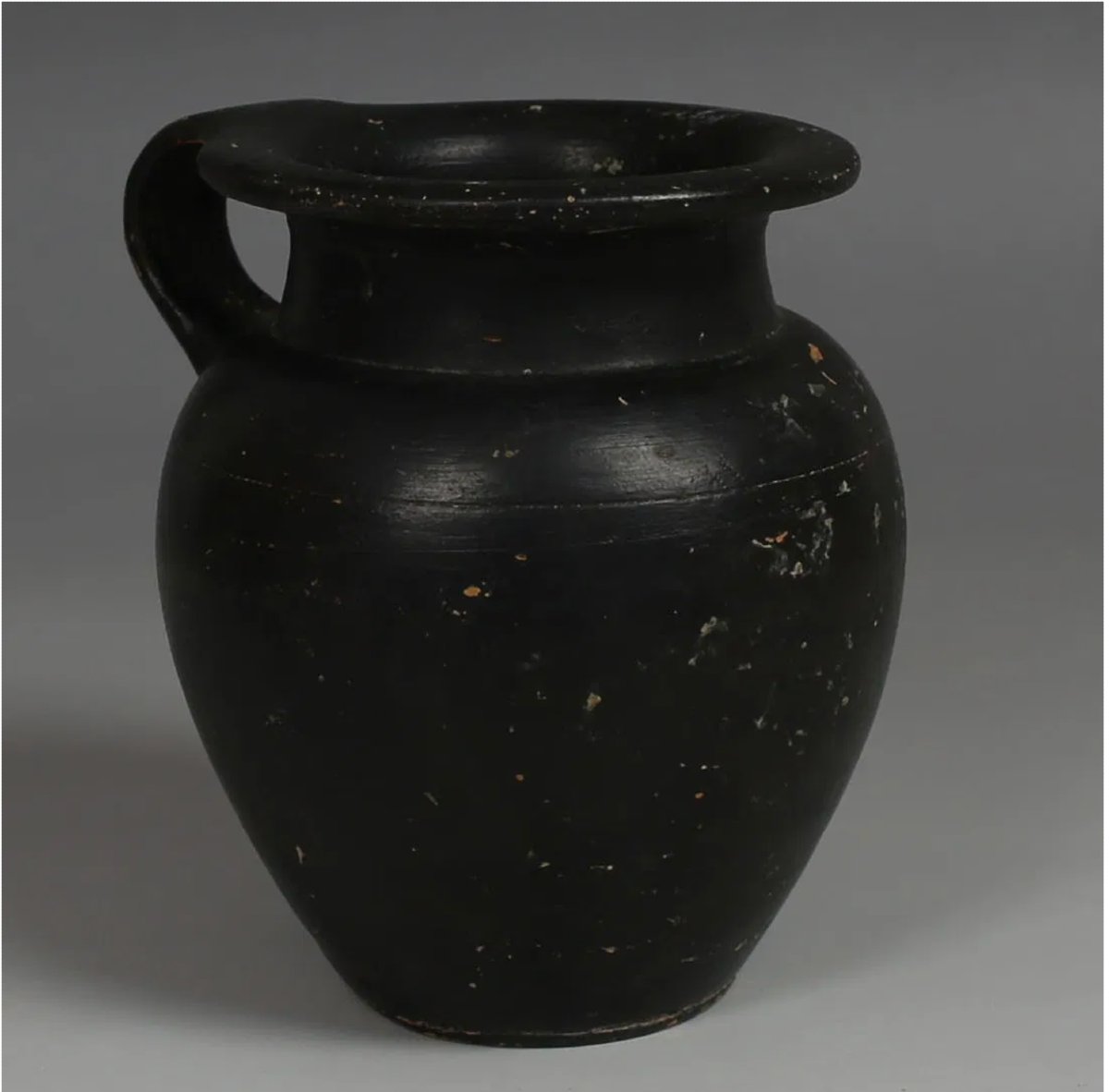
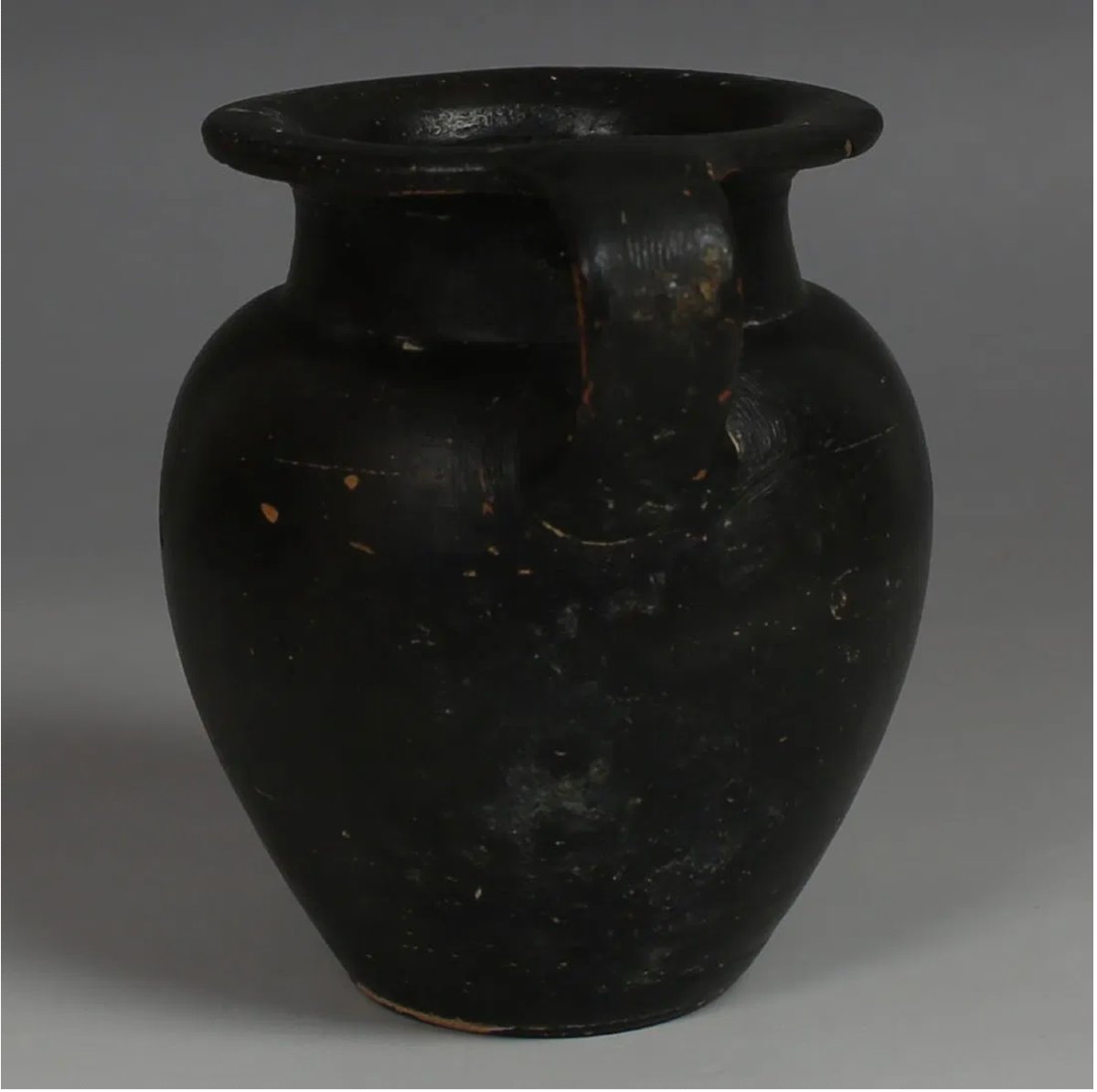


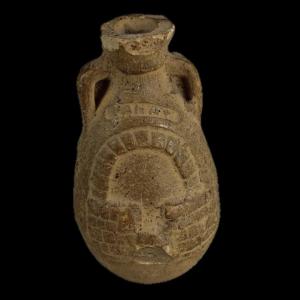
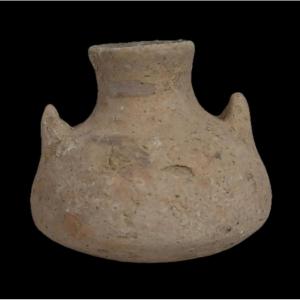
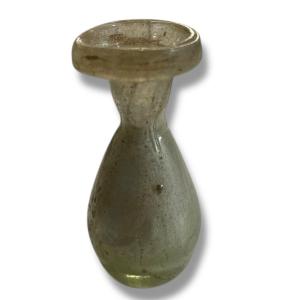
This intimate-sized olpe constitutes a material testament to the daily life and votive practices of Late Classical Greece (4th century BC). Far from luxury productions, this object is distinguished by its raw material authenticity and its "as found" condition of discovery. Examination of the epidermis reveals a richly textured surface: the beige-pink terracotta is dotted with significant calcareous concretions and grayish sedimentary deposits. This mineral coating, veiling the original clay color in places, constitutes an indelible temporal seal. It attests to prolonged burial in a natural environment and guarantees the absence of aggressive chemical cleaning, thus preserving the piece's archaeological integrity.
Characteristics
Object: Olpe with globular body (miniature jug).
Culture: Greek.
Period: 4th century BC (Late Classical Period).
Material: Terracotta, calcareous excavation patina.
Dimensions: Height: 82 mm | Width: 77 mm | Depth: 78 mm.
Condition: Good state of conservation; structural integrity preserved; surface presenting heavy calcareous sedimentation.
Provenance: Ex-private German collection, acquired in 1986 from P.L., Paris.
Documentation: Sold with Certificate of Authenticity.
Historical Context While the olpe is typologically defined as a wine-pouring jug, reduced-size modules (here 8 cm) possessed a polyvalent function. They frequently served to hold perfumed oils, ointments, or perform ritual libations. In the 4th century BC, common Greek pottery evolved towards streamlined forms where functionality ranked first. These objects accompanied the citizen in daily gestures or served as modest offerings in burials, symbolizing the continuity of sustenance in the afterlife.
Formal and Material Analysis
Morphology: The piece presents the continuous profile characteristic of the olpe, treated here with a globular, quasi-spherical body, lending visual robustness to the whole. The short neck flares towards a simple rounded lip, designed for smooth pouring. The single handle, connecting the shoulder to the rim, is a solid strap, dimensioned for a one or two-finger grip.
Shaping: Slight asymmetries of the body and horizontal striae perceptible beneath the patina betray rapid and efficient wheel-throwing. The base, flat or slightly concave, ensures stability.
Material and Patina: Surface analysis is decisive for expertise. The absence of figurative decor focuses attention on the material. The terracotta, granular and matte in appearance, presents whitish (calcareous) and earthen concretions deeply incrusted in the pores. This natural crystallization, impossible to reproduce artificially with this degree of coherence, validates the object's millennial antiquity and its underground history.
Cultural and Decorative Value This small olpe possesses the nobility of everyday objects from Antiquity. Its value lies not in complex ornamentation, but in its archaeological truth. It constitutes a tangible fragment of Greek domestic history. For the collector, it offers the guarantee of an authentic object, whose provenance is established since the mid-1980s, and which bears the respectable marks of its 2,400 years of existence.
Expertise Report The analysis confirms the attribution and authenticity:
Typology: Form consistent with common Greek ceramic of the 4th century BC.
Surface Condition: The calcareous sedimentation is natural and ancient.
Traceability: Provenance documented since 1986 (Collection P.L., Paris, then Germany).










 Le Magazine de PROANTIC
 TRÉSORS Magazine
 Rivista Artiquariato