THIS OBJECT WAS SOLD
Fragment Of Roman Fresco With Ducks – With Certificate Of Authenticity


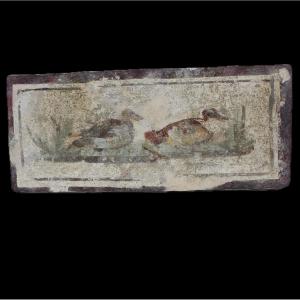


Rectangular fragment of a Roman painted wall plaster depicting two ducks moving within an aquatic landscape framed by an architectural border. Despite the marks of time, the piece shows a striking stylistic and material coherence with Imperial-period frescoes of the 1st century AD: mineral-based pigments (ochres, ferric reds, copper greens, browns), dense fine lime plaster, and a single pictorial register framed by a double painted line. The surface wear, losses and abrasions function here as strong indicators of authenticity: nothing in the technique, patina, or internal mortar structure suggests a modern imitation.
CharacteristicsObject: Fragment of Roman wall painting depicting ducks
Material: Lime plaster on thick support, mineral pigments applied a fresco and/or a secco
Culture: Roman
Period: 1st century AD
Dimensions: approx. 135 mm × 317 mm × 32 mm
Condition: Good overall condition; professionally stabilised
Provenance: Former French private collection, Chevallier-Verel Collection, Paris; acquired in the early 20th century
Parallels: Duck frescoes from Pompéi (Frieze of the Fountain; Duck Fresco; House of the Bear) – see Hauser, Pompeji vol. 2, Casa dell’Orso (1988); Maiuri, Una Nuova Pittura Nilotica a Pompei, 1955
Certificate: Delivered with certificate of authenticity
In the 1st century AD, wall painting played a major role in the visual staging of Roman interiors. In Pompéi, Stabiae and Herculaneum, walls were frequently adorned with illusionistic compositions: imagined architectures, marine landscapes, verdant gardens, and Nilotic scenes animated with aquatic birds. Ducks, geese and similar waterfowl appear often for both their decorative appeal—elegant silhouettes, fluid movement—and their symbolic value: abundance, domestic harmony, and evocations of idealised gardens or Nile landscapes.
This fragment clearly belongs to that tradition: a horizontal composition with sparse vegetation, two birds in gentle motion, all framed by a painted border that originally formed part of a larger decorative scheme. Such panels typically adorned the lower or middle zones of dining rooms (triclinia), reception chambers, or corridors leading to interior gardens.
Formal & Material AnalysisSupport & structureOblong fragment with irregular edges cut from a larger fresco.
Cross-section reveals thick, homogeneous lime plaster with small air cavities and minimal mineral inclusions—typical of well-prepared Roman mortar.
The back shows irregular modelling, traces of smoothing, scattered pigment remains, small ancient perforations from detachment, and faint remnants of old collection numbering—attesting to long-term collection history.
The composition is organised into three zones:
1. Outer frame:
Wide purplish-brown band with abrasion revealing underlying lime; worn corners enhancing the antique patina.
2. Inner frame:
A pale line doubled with a darker one, sometimes crisp, sometimes softened by erosion—typical of quick work on fresh plaster.
3. Main scene:
Two stylised ducks facing one another on a narrow horizontal groundline within an aquatic setting.
– Left duck: painted in darker tones (browns, greens, greys), rendered with light strokes and layered pigments; fine beak, eye suggested by a tiny dark accent; elongated body with subtle colour transitions indicating plumage.
– Right duck: warmer palette (ochres, ferric reds, yellows), slightly turning back; chest and flank highlighted with lighter touches, with a diluted green wash below to suggest water or a bank.
Despite abrasions and losses—especially central fading—the general structure of the scene remains clearly legible: silhouettes, groundline, vegetation masses. The hand is trained and confident, consistent with Roman workshop fresco practice.
Landscape & vegetationLeft: fan-shaped cluster of thin bluish-green stems.
Right: darker vertical reeds.
The softened greens, likely from malachite or blended mineral pigments, match the muted tones commonly seen in ancient frescoes.
Matte, evenly aged patina; micro-chipping, whitening speckles, slight lime powdering.
These alterations are characteristic of long burial followed by decades in a scholarly collection.
Professional stabilisation ensures excellent structural stability; no intrusive modern overpainting, no glossy varnish; any interventions remain discreet and fully respect the ancient surface.
This fresco fragment unites several highly desirable qualities:
– a refined, immediately readable motif,
– a genuine antique patina with coherent mineral pigments,
– a convincing archaeological reverse,
– and a prestigious provenance from a French collection assembled in the early 20th century.
Its manageable format, elegant subject, and clear connection to Pompeian Nilotic compositions make it an ideal centrepiece for a collector’s cabinet, study, or interior wall. Both intimate and visually striking, it offers the rare opportunity to own a genuine section of Roman mural painting with strong decorative and cultural appeal.
Detailed Expert Notes1. Official identificationType: Roman wall-painting fragment with animal motif
Technique: Multi-layer lime plaster; pigments applied a fresco, with some a secco details
Date: 1st century AD, confirmed by palette, borders, and Pompeian parallels
Function: Decorative panel in a domestic or semi-public space (triclinium, reception room, garden corridor)
– Nilotic and avian frescoes from Pompeii, Stabiae, Herculaneum
– House of the Bear (Casa dell’Orso), Pompeii (Hauser 1988)
– Maiuri’s studies on Nilotic painting (1955)
These parallels confirm its place within the Roman decorative tradition that imported idealised nature and exotic water landscapes into domestic interiors.
The composition mirrors key features of preserved Campanian frescoes:
– birds placed along a narrow groundline,
– attenuated green and ferric red pigments,
– double framing system demarcating the scene.
– A. Maiuri, Una Nuova Pittura Nilotica a Pompei, 1955
– F. Hauser, Pompeji, vol. 2, Casa dell’Orso, 1988
– R. Ling, Roman Painting, Cambridge University Press
– R. Laurence & A. Wallace-Hadrill (eds.), Domestic Space in the Roman World
This work embodies the Roman desire to bring nature—idealised, serene, exotic—into the home. The gentle movement of the ducks, the delicate vegetation, and the controlled palette showcase the sophistication of Roman domestic art. Owning such a fragment offers direct access to the aesthetic universe of ancient Campanian villas.
Provenance & Guarantees– Provenance: Chevallier-Verel Collection, Paris, early 20th century
– Collection history: preserved in private hands until the present sale
– Certificate: Supplied with a detailed certificate of authenticity (description, date, culture, provenance)
The provenance is consistent, well-established, and fully aligned with best practices in the circulation of cultural property.
Explore similar pieces and discover your ideal find:
archeology