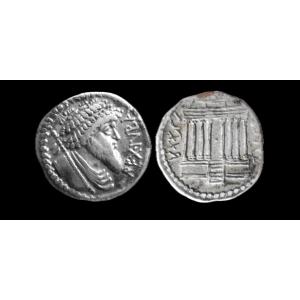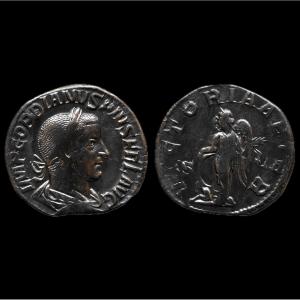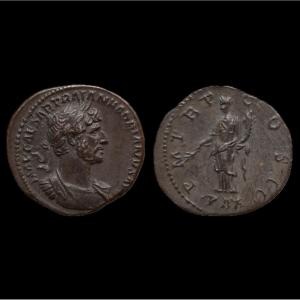


Very Fine Denarius Of Julia Paula — Certificate Of Authenticity
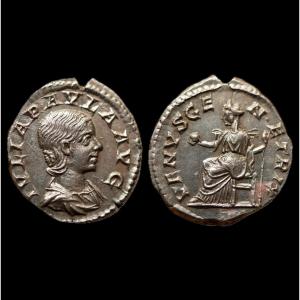
This silver denarius of Julia Paula, struck at Rome in AD 219–220 under Elagabalus, belongs to an issue of great Severan elegance, immediately recognizable by its obverse IVLIA PAVLA AVG with a draped bust right, and by its reverse VENVS GENETRIX, where Venus is seated left, holding a globe in the extended right hand and a scepter in the left; the attribution fully accords with RIC IV.II (Elagabalus) 222, and is confirmed by the British Museum entry, by Numista, as well as by specialized comparanda from CNG, all of which give the same typological scheme, the same dating, and the same mint. The type may rightly be presented as well sought-after, Numista assigning it a rarity index of 90, which is sufficient to place this issue within a zone of sustained interest for collectors of early third-century female denarii.
Each specimen is examined, described, and accompanied by a certificate of authenticity in accordance with the standards of the art and heritage market; this one is immediately appealing for the balance of its small module, the quality of its style, the remarkable sharpness of the portrait, and a very harmonious metallic presence, fully in line with the known norms of the issue, the British Museum publishing a specimen of 3.13 g, while Numista gives for the type a benchmark of 3.1 g for 19 mm, with an observed variation of about 2.56 to 3.55 g and 18 to 20.2 mm, within which the described specimen, at 3.33 g for 20 mm, fits with excellent coherence.
Analysis & Expertise
Close observation under ×10 magnification and raking light. Direct examination of the obverse reveals a portrait of Julia Paula right of particularly convincing presence, whose hair—rendered in regular waves and drawn back into a low braid—retains very satisfactory definition, with a clean forehead, a well-opened eye, a fine nasal line, a delicately modeled mouth, and a chin that remains firmly held, while the drapery, seen from the front, remains legible at the base of the bust and gives the whole that aristocratic bearing so characteristic of the finest Rome-mint issues for Severan empresses; the peripheral legend unfolds with broad and favorable readability, and the beaded border, still well followed around a large part of the circumference, frames the portrait with real visual distinction. This physiognomy closely matches the type description given by Numista, which notes a draped bust right with wavy hair tied in a braid, as well as that of the British Museum, which records the same obverse for a reference specimen.
The reverse shows a seated Venus Genetrix left whose reading remains particularly satisfactory, as the figure retains her seated posture, the gesture of the right hand bearing the globe, and the vertical hold of the scepter in the left, according to a simple, clear, and immediately intelligible composition that counts among the most elegant iconographies of Julia Paula’s coinage; the legend VENVS GENETRIX remains largely present, and the overall layout of the field allows the figure to “breathe” with a nobility of composition that is wholly appreciable. Here again, the coin corresponds exactly to the description retained by the British Museum, Numista, and CNG, all of which give, for RIC 222, a Venus seated left holding a globe or an apple according to cataloguing traditions, and a vertical scepter.
The silver surface presents a very coherent ancient appearance, in a sustained light-gray tone, with relief still catching the light vividly on the hair, facial contour, and the principal volumes of the reverse, while minor traces of material life, discreetly distributed in the fields, integrate naturally into the physiognomy of an ancient denarius that truly circulated; the flan further shows, at the upper part, a short, well-stabilized old marginal striking crack, a feature frequently observed on small hammer-struck silver modules, which here does not interrupt either the reading of the type or the aesthetic balance of the coin, but rather underscores the frankness of its ancient manufacture.
What particularly distinguishes this specimen is the conjunction, on a restrained module, of several very concretely sought-after qualities: a female portrait of great elegance, a well-developed obverse legend, a Venus reverse perfectly legible in its concept, and metrology very well situated within the attested range for the reference; the result is a coin valued not merely as a catalogue number, but as a true cabinet piece, still capable—within its very substance—of preserving the grave, official grace of Julia Paula’s earliest issues.
Characteristics
Authority.
This issue belongs to Julia Paula, empress of the very beginning of Elagabalus’ reign, within the framework of official Rome production dated AD 219–220.
Mint.
The mint is Rome, as concordantly given by the British Museum, Numista, and CNG for this type.
Dating.
The strike belongs to AD 219–220, a chronology unanimously retained for this reference.
Denomination.
Silver denarius, a denomination expressly stated by the British Museum and Numista.
Metal.
Silver, in accordance with the consulted typological notices.
Weight.
The recorded weight for this specimen is 3.33 g, very favorably within the range documented for the type, Numista indicating about 2.56 to 3.55 g, and the British Museum publishing a specimen of 3.13 g.
Diameter.
The recorded diameter is 20 mm, fully compatible with the published range of 18 to 20.2 mm and with Numista’s 19 mm benchmark.
Technique.
Hammer struck, on an irregularly round flan, according to the Numista type entry.
Obverse.
IVLIA PAVLA AVG, draped bust of Julia Paula right, hair waved and tied in a braid.
Reverse.
VENVS GENETRIX, Venus seated left, holding a globe in the extended right hand and a scepter in the left.
Typological references.
Identification rests on RIC IV.II (Elagabalus) 222, with the corresponding OCRE ric.4.el.222, and market concordances RSC 21 and Thirion 468 noted by CNG.
Collecting position.
The type may be presented as well sought-after, with a Numista rarity index of 90, confirming real attractiveness within the corpus of Julia Paula denarii.
Historical context
This issue belongs to the very compressed moment when Julia Paula appears at the forefront of imperial power at the beginning of Elagabalus’ reign, emperor from AD 218 to 222; specialist notices present her as Augusta in AD 219–220, and online biographical data recall that she married Elagabalus in 219, before the union was dissolved shortly thereafter, between 220 and 221, giving all of her coinage a singular chronological density and a naturally heightened historical presence.
The choice of the reverse VENVS GENETRIX deserves particular attention, for Numista translates the legend as “Venus the mother,” giving the issue an immediately perceptible dynastic and maternal resonance, especially fitting for a newly promoted empress; the seated Venus holding globe and scepter thus conveys less a merely decorative grace than a language of legitimacy, protection, and continuity, admirably condensed into the denarius’ small format.
Cultural value
The cultural value of this piece is very real, because it unites—within a finely made silver module—three dimensions that immediately speak to the discerning collector: the ephemeral yet intense historical visibility of Julia Paula, the classical quality of the Severan female portrait, and the presence of Venus Genetrix, whose numismatic formulation remains among the most elegant of the early third century.
For a cabinet devoted to Roman empresses, this specimen has particular appeal, because it derives not only from a prestigious name, but from a brief, well-identifiable, stylistically refined issue whose message is immediately legible; the collector finds here a fine portrait, a seated divine figure of excellent bearing, a clear titulature, and that rare sense of a coin that concentrates—economically and precisely—an entire moment of the imperial court.
Traceability & Guarantees
From a European provenance, from an established numismatic dealer, this specimen was acquired through a specialized international transaction conducted within a recognized numismatic network and validated by reference experts, in accordance with the highest standards of the art and heritage market; examination of the present object retains the stylistic, technical, epigraphic, and metrological characteristics effectively observable on the coin, set within the framework of recognized references for Roman imperial coinage.
Each specimen is examined, described, and accompanied by a certificate of authenticity in accordance with the standards of the art and heritage market; in the present case, the concordance between the obverse titulature IVLIA PAVLA AVG, the reverse VENVS GENETRIX, the Rome mint, the dating AD 219–220, the observed weight data, and the reference RIC IV.II 222 establishes a particularly solid numismatic attribution.
Period: Before 16th century
Style: Rome and Antic Greece
Condition: Good condition
Reference (ID): 1730253
Availability: In stock