SABRE known as NimchaMoroccoLate 18th centurySteel, wood, copperTotal length: 103 cm; blade length: 87 cmSlightly curved blade, with one cutting edge and three grooves on each side; geometric-shaped p[...]
19th-century brass table or altar incense burner. Originating from the Caucasus, more precisely Armenia or Georgia. A nearly identical form is found in the Maghreb countries. This beautiful object is [...]
"Persia, Ghalam Zani, pair of silvered copper vases, signed, Isfahan, Qajar dynasty, Iran" Pair of Ghalam Zani wedding vases circa 1900-1920. They are made of silvered metal chased "in repoussé" and o[...]
Moroccan dagger, called a Koumya. Slightly curved blade, wooden handle with brass fittings. Beautiful ornamentation. Early 20th century. Good overall condition. Dagger dimensions: 38.5 x 8.5 cm. Blade[...]
Moroccan dagger, called a Koumya. Wooden handle, pommel covered with silver-plated metal and bone. Slightly curved blade, wooden handle with silver-plated fittings. The blade is curved and engraved o[...]
Koumya-type dagger - West Africa, probably Mauritania, early 20th century. A simple yet interesting koumya due to its geographical origin. The blade is of European import. The handle has wooden scales[...]
The khanjar is a type of dagger originating in Persia and widely adopted in most Islamic cultures. Besides its functional use, the khanjar also served to indicate rank or social status. The more ornat[...]
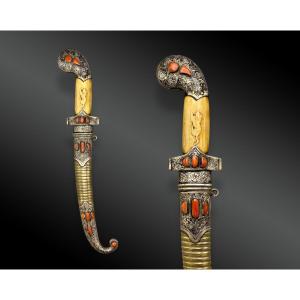
The "bichaq" is a side knife typical of Ottoman, Balkan, and Southern European regions. Carried by military personnel and high-ranking officials, it was often adorned with silver, coral, and other pre[...]
A rare set of three African bronze statues, representing stylized anthropomorphic figures, including one carrying a vessel on its head. These pieces were made using the traditional lost-wax casting te[...]
Central Africa, 19th century: Solid wood sculpture, carved from a single block, depicting a stylized anthropomorphic figure supporting a bifurcated upper form suggesting a receptacle, pillar, or totem[...]
A very beautiful antique camel saddle from the early 20th century. This Rahal is representative of the folk art of the Saharan Tuareg of that era. It is an uncommon model, embellished with brass studs[...]
Important Persian vase with two handles, chased bronze and copper, 19th century. In used condition, with a beautiful patina. This large and wide vase, probably a former cauldron from the Kashkai cultu[...]
Pair of Moroccan riding stirrups - Morocco, 19th century. Stirrups in wrought iron with silver damascening. Weight approximately 685g each. Dimensions of each approximately 18cm x 17cm x 12cm.
Moroccan riding saddle - Morocco, 19th century. Wooden frame covered in animal hide with a quilted and embroidered leather saddle cover. Minor damage and missing pieces, but solid and still presentabl[...]
Short sword, known as a yataghan - Ottoman Empire, 19th century. Single-edged, convex blade. Maker's mark on one side. Grip made of two blond horn scales. A silver band is missing from the back of the[...]
Moroccan Koumya dagger - Morocco, 1955. With its original traditional suspension cord. Wooden handle decorated with chased silver arabesques and floral motifs. Chased silver scabbard with arabesques a[...]
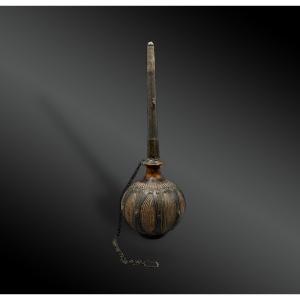
Incense burner (perfume burner) Persian - Persian World, Qajar Iran, 19th century. A beautiful piece of brasswork from the Oriental and Islamic world. The incense burner is made of chased and openwork[...]
Short Afghan saber, also known as a Khyber saber - Afghanistan, 19th century. The hilt has two bone scales and a chased brass mount. The blade is single-edged with a T-shaped back. The wooden scabbard[...]
A large ewer called an "Ibriq" resting on its complete basin with soap dish. Total height: 58 cm. Originating from Turkey, Ottoman Empire, 19th century, and in superb condition. Our red copper model h[...]
Short Afghan saber, also known as a Khyber saber - Afghanistan, 19th century. Horn scale grip and brass hilt. Single-edged blade with a T-shaped back. Wooden scabbard covered in black leather. The sca[...]
This cutlass is certainly of Balkan origin, probably Serbian. It can be dated to the 19th century. Its size and robust appearance are likely related to its use in hunting. The shape of the blade is re[...]
Small Navaja knife - Spain, Toledo, second half of the 19th century. The blade is acid-etched on both sides (partially erased) with "TOLEDO" and "RECUERDO". The handle is decorated with brass, tortois[...]
Provinces of the Ottoman Empire – Late 19th/Early 20th Century. A late Ottoman civilian knife, entirely made of iron, complete with its original sheath, representative of prestigious provincial produc[...]
Beautifully crafted leather rug, entirely carved in relief, featuring a highly intricate design. The black surface is finely cut to reveal the light leather beneath. A 19th-century piece, possibly ear[...]
Ottoman saber, also known as a pala - Ottoman Empire, 18th-19th century. Curved, single-edged blade with a T-shaped back. The blade is of good quality. The grip is made of two horn scales and a guard,[...]
Camel saddle from the Camel Regiment (1799-1801) created for the Egyptian campaign. The Army Museum at Les Invalides in Paris holds a similar example. 133 cm x 47 cm x 38 cm high.
Interesting and rare group of polychrome terracotta sculptures that form the scene of the massacre of the innocents, where a trivial tribe of African or Mesoamerican origins were placed as executioner[...]
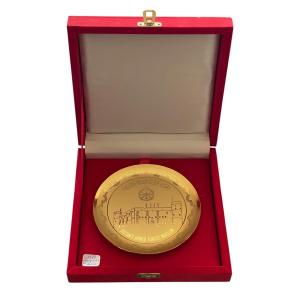
Exceptional diplomatic gift from the Sultanate of Oman, presented to a French national responsible for foreign affairs.
I personally know its provenance.
Gold-colored commemorative plaque offered by[...]
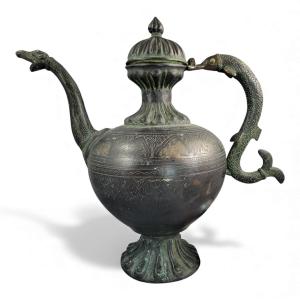
An important ewer or pitcher, called an Aftabé in Central Asia. Made of tinned bronze, with an ovoid body, curved spout, and bronze handle, it is in very good condition. The body is decorated with cal[...]
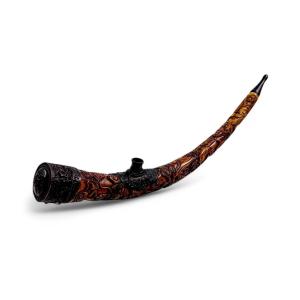
Long carved bone opium pipe with Guanyin, dragon and crane motifs in relief. Darkened detailing and strong sculptural presence.
Measurements
Weight: 495 g
Length: 49 cm
Diameter: 5 cm
Condition
[...]
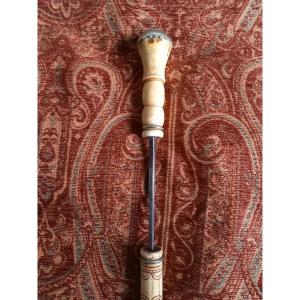
Using a fine European blade, a craftsman from a distant trading post in the early 20th century created this walking stick for a European. It is composed of a series of turned bone and metal rings. The[...]
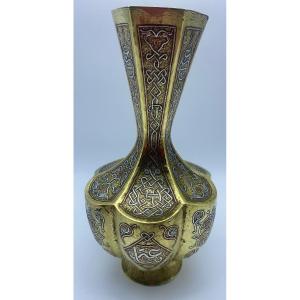
Syria, circa 1900. A six-lobed brass vase inlaid with silver and copper, in the Mamluk style, decorated with Islamic scrolls, intricate decorative motifs, calligraphy, and floral designs. Very good co[...]
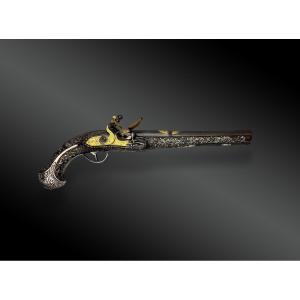
FLINTLOCK PISTOL, FOR THE ORIENTAL MARKET, SILVER AND GOLD DAMASCUSEurope – 18th centurySteel, wood, silver, and gold Total length: 43 cm - Barrel length: 27 cm – Muzzle diameter: 15.5 mmFluted then r[...]
Dating from around 1850, this monumental Indian bronze aftaba functions as a sculptural object as much as a vessel. Its generous scale, dramatic silhouette and untouched patina make it a strong focal [...]
Important, large, chased brass vase, 63 cm high. It is decorated all over with calligraphy, braids, trellises, mandorlas, and medallions, all hand-engraved with a burin. Brass is a yellow alloy, compo[...]
Ethiopian Manuscript Bible - Ethiopia, 19th century or earlier. Manuscript Bible in Ge'ez script with its animal-skin carrying case. 9cm x 6.5cm x 3.5cm
A striking little object in its case, 7.5 cm long, made from meerschaum, amber, and silver, depicting a coiled serpent holding loft hollow, very sharp steel rostrum, allowing it to pierce and smoke a [...]
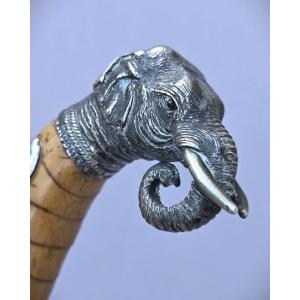
A walking stick with a pretty silvered bronze pommel in the shape of an elephant's head. The shaft is made of bamboo, adorned with silver studs on the upper part. Metal ferrule. The entire cane measur[...]
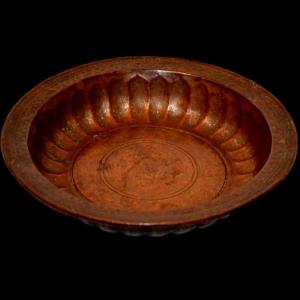
An antique Turkmen basin decorated with twenty-nine wide gadroons. A wide, everted rim is engraved with two friezes of stylized arrowheads, called "medahils." It is in very good condition. The piece i[...]
Omani battle shield, known as a "terr" shield - Oman or Zanzibar, 18th-19th century. This shield is made from a single piece of very thick, compressed and molded animal hide. The hides generally used [...]
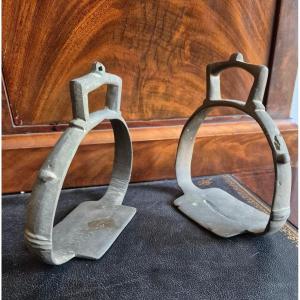
Pair of Ottoman hammered bronze stirrups, late 18th - early 19th century. Beautiful surface patina. Fine Turkish cavalry craftsmanship. Dimensions: approximately 13 x 12 cm. Weight: 635 grams per pair[...]
A fine Tuareg dagger dating to the late 19th century, originating from the central Sahara (Air region of Niger or Adrar des Ifoghas, Mali).
The dagger has a 14 cm double-edged blade with traditional [...]
Oriental helmet known as a kulah khud, Ottoman Empire/Iran. 19th century. Hemispherical iron crest engraved with figures in a foliage design. Surmounted by a 14cm quadrangular spike. Two plume holders[...]
Exceptional large Berber dagger with a curved, single-edged blade and impala (gazelle) horn handle. Length 64 cm, blade 34 cm, blade width 5.5 cm. Good overall condition, with signs of use. Ethnic edg[...]
Pair of Kabyle razor knives, North Africa, late 19th/early 20th century. Identical pair with geometrically decorated blades made from a single piece of metal with a razor edge. Decorated cedar wood sh[...]
Decorated with a ram's head (Aries). Carved and painted handle, enhanced with gilding. Wear and paint loss on the handle. Steel blade damascened with gold and silver. Scabbard missing. 19th century wo[...]
A porcelain dish painted by Jules Vandercruyce, signed and dated April 25, 1860, and titled: Episodes of the War, India in 1857*. Jules Vandercruyce was a sea captain, appointed inspector for the Lloy[...]
Italy (Venice or Padua), second half of the 16th centuryHistorical contextIn the 16th century, Venice and the Ottoman Empire had a complex relationship: rivals on the seas but essential trading partne[...]
Proantic uses a cookie to analyze traffic and improve its service by using Google Analytics. Data sent to Google Analytics (frequency of visits to the site and pages visited) are anonymous. No other cookie tracks your activity, your personal data is not collected. Thank you for helping us to have better understanding how Proantic is used.























 Le Magazine de PROANTIC
 TRÉSORS Magazine
 Rivista Artiquariato