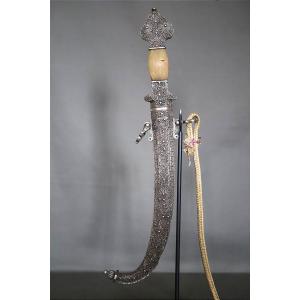
Mughal Jade Horsehead Dagger
The khanjar is a type of dagger originating in Persia and widely adopted in most Islamic cultures. Besides its functional use, the khanjar also served to indicate rank or social status. The more ornate it was, the higher the rank. Many Mughal rulers possessed a collection of elaborately designed khanjar daggers crafted from precious materials such as jade, gold, and gemstones.
This example:
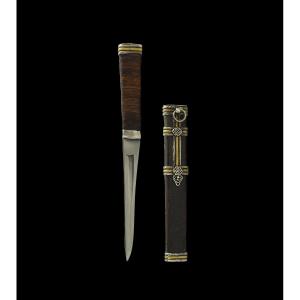
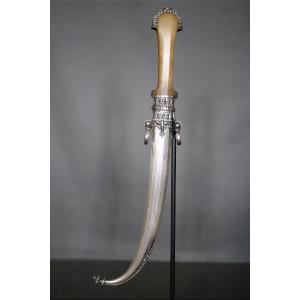
A refined and elegant khanjar, whose horse-head hilt was highly prized by the Mughals. The light gray jade fades to a pale gray towards the blade, a common characteristic of Mughal hilts. The hilt is carved with a lily motif typical of the Mughal style and features a spherical center. Some of these jade hilts were made from two pieces, but this one is carved from a single block of jade. The horse's head is particularly elegant, with finely sculpted mane, ears, and mouth. The hilt is inlaid with 20-karat gold and set with cabochon rubies and sapphires. The wootz steel blade is typical of the khanjarli style, with its characteristic curve and central ridge. The wootz center features a contrasting pattern, while the sides and tip retain their original polish, revealing the wootz motif.
Condition: Most of the gold has worn away, and the blade has been restored by the Gotscha workshop.
Mughal jade horse-head khanjar
Condition: Good condition; the gold has been restored.
Dimensions: Handle length: 13.2 cm
Blade length: 23 cm
Blade thickness: 5.3 mm
Overall length: 35.5 cm
Weight: 345 g
Comparable items:
– Philippe Missillier Collection: Splendour, lot 38 at Sotheby's (similar handle shape and construction).
Provenance
The German art market
This example:
A refined and elegant khanjar, whose horse-head hilt was highly prized by the Mughals. The light gray jade fades to a pale gray towards the blade, a common characteristic of Mughal hilts. The hilt is carved with a lily motif typical of the Mughal style and features a spherical center. Some of these jade hilts were made from two pieces, but this one is carved from a single block of jade. The horse's head is particularly elegant, with finely sculpted mane, ears, and mouth. The hilt is inlaid with 20-karat gold and set with cabochon rubies and sapphires. The wootz steel blade is typical of the khanjarli style, with its characteristic curve and central ridge. The wootz center features a contrasting pattern, while the sides and tip retain their original polish, revealing the wootz motif.
Condition: Most of the gold has worn away, and the blade has been restored by the Gotscha workshop.
Mughal jade horse-head khanjar
Condition: Good condition; the gold has been restored.
Dimensions: Handle length: 13.2 cm
Blade length: 23 cm
Blade thickness: 5.3 mm
Overall length: 35.5 cm
Weight: 345 g
Comparable items:
– Philippe Missillier Collection: Splendour, lot 38 at Sotheby's (similar handle shape and construction).
Provenance
The German art market
24 000 €
Period: 18th century
Style: Orientalism
Condition: Fully restored
Material: Metal
Length: 35.5cm
Reference (ID): 1682835
Availability: In stock
Print