



Italian-ottoman Command Hammer Known As "al-baraka"
Italy (Venice or Padua), second half of the 16th century
Historical context
In the 16th century, Venice and the Ottoman Empire had a complex relationship: rivals on the seas but essential trading partners. This coexistence, mixing confrontations and exchanges, gave birth to a Métis material culture, where the Venetian workshops integrated Ottoman elements into their luxury creations destined for the Levant. It is in this climate of pragmatic diplomacy and artistic emulation that ceremonial objects such as this hammer of command appeared, combining Italian technique and oriental symbolism.
Description
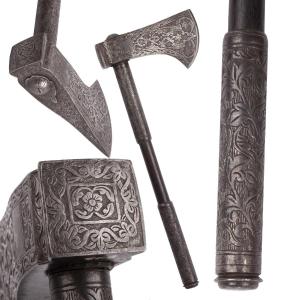
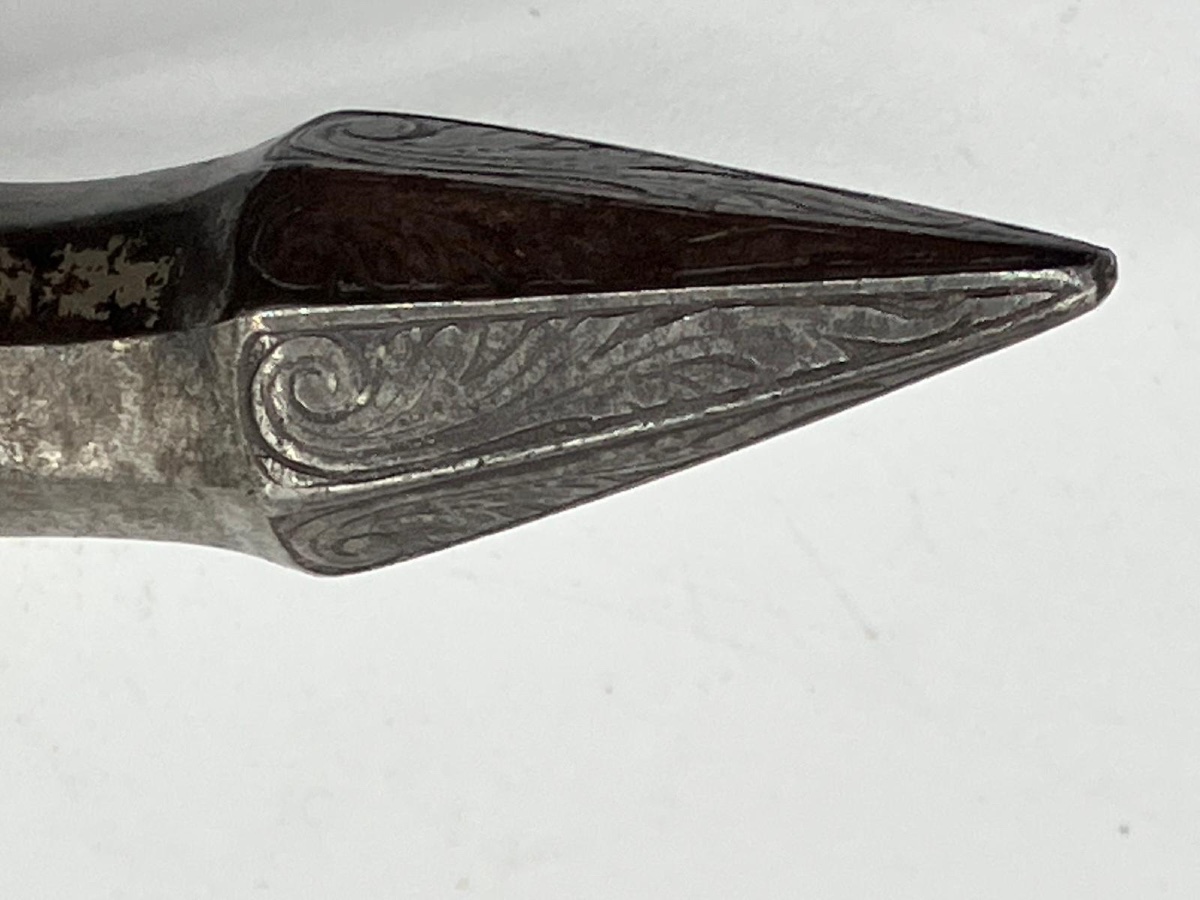
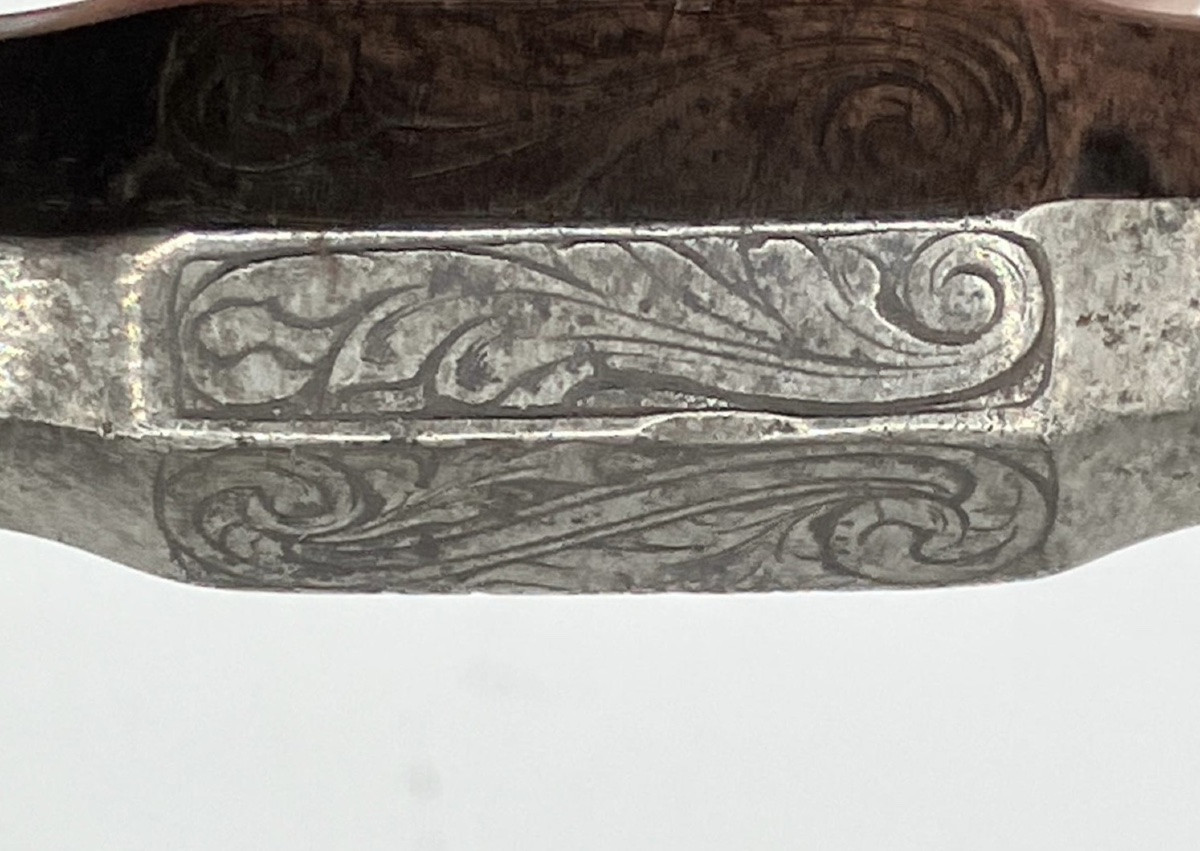
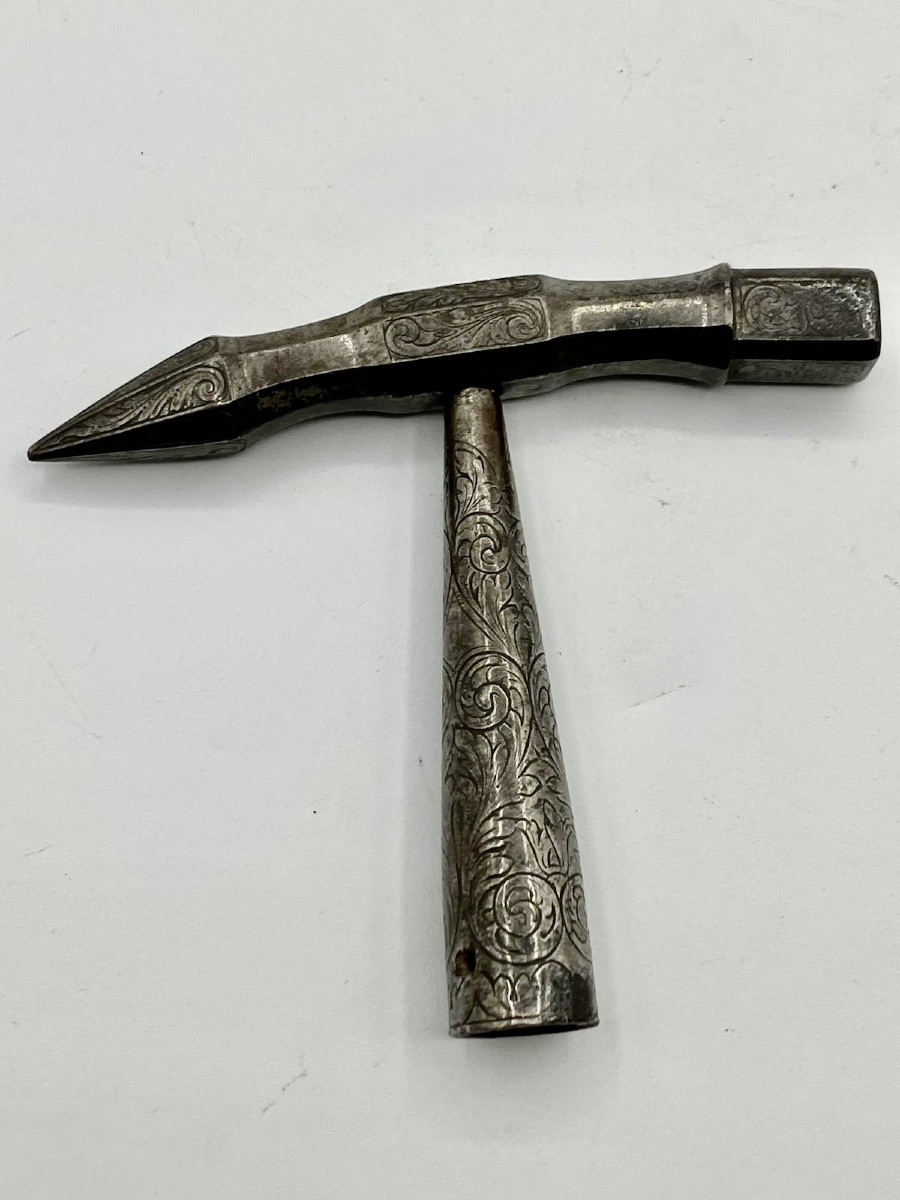
Command or ceremony hammer, entirely made of wrought iron, finely chiseled and engraved on both sides. The head, slightly curved and asymmetrical, with a rounded corbin beak, derives from the models of hammers of the Italian Renaissance, but here reinterpreted in a function of pomp and prestige. The soft profile of the beak, without sharpness or aggressive tip, confirms that it is a symbol of authority more than an instrument of combat. The engraved decoration features interlaced ribbons and stylized Arabic calligraphic motifs, arranged in regular and balanced cartridges. On one of the sides, the inscription "البركة" (al-Baraka), meaning "the blessing", expresses the spiritual protection and legitimacy of the command. The handle, also made of wared iron, is enshred in the head and solidly riveted. Its base pierced with two crossing fixing holes indicates that it was fixed on a stem or a ceremonial stick, use confirmed by the general balance of the piece. The whole, of a homogeneous and satin patina, testifies to an Italian workshop work of great mastery, combining technical rigor and sense of symbol. Dimensions: 11 × 12 cm
Stylistic analysis
This hammer perfectly illustrates the fusion of Italian and Ottoman aesthetics of the 16th century: – the elongated profile and balanced proportions are reminiscent of Venetian or Dalmatian ceremonial objects; - while the calligraphic and plant decoration refers to the Ottoman tradition of ceremonial weapons, often offered as a diplomatic gift.
Function and symbolism
An object of apparaty above all, this hammer was not a utilitarian weapon but a symbol of command, comparable to the Western scepter. The term al-Baraka expresses divine protection and prosperity, central notions in the legitimization of Ottoman power. By its ornamentation and structure, it could be presented during public ceremonies, diplomatic audiences or ceremonial parades, signaling the presence and blessing of the leader. Its use can be compared to that of Mamluk ritual clubs or "oath hammers" used by some dignitaries to seal an official or military act.
Museum comparisons and references
– Topkapi Museum, Istanbul: ceremonial gilded copper club, identical calligraphic decoration, 16th century (inv. 2/1574) – Correr Museum, Venice: Italian-levantine command hammer, golden damask iron, around 1580. – Sotheby's London, Arts of the Islamic World, 2019, lot 161: “Command hammer, Ottoman-Venetian style”, sold £12,500.
Historical analysis
Objects such as this "al-Baraka" command hammer embody the diplomacy of forms specific to the Mediterranean world of the 16th century. This is most likely an Italian production, from the Venetian or Paduan workshops, where the craftsmanship of art ironwork achieved great mastery. It testifies to an artistic dialogue between two rival but interdependent powers - Venice and the Sublime Porte - where art became a vector of mutual recognition and respect. This piece could have been intended for an Ottoman dignitary or a Venetian ambassador, as a sign of alliance, peace or 'blessing of power'. It thus illustrates the role of Venice as a bridge between East and West in the heart of the 16th century.
Attenuated engraving on the inscribed side, showing small punctures and old micro-shocks. The patina, homogeneous and stable, testifies to a natural aging of the wrought iron without modern intervention. The reading of the calligraphic cartridge remains perceptible under grazing light or in polarized photography, confirming the authenticity and coherence of a 16th century work.
State of conservation
Assessment
Taking into account: – the quality of the forge and the decor, – the rarity of the type, - and the visible wear of the calligraphic cartridge, which partially attenuates the reading of the inscription but reinforces, if necessary, its authenticity, The state is perfectly consistent with a 16th century iron, without modern restoration, and retains all its historical and symbolic interest. The slight decrease in readability does not detract from the heritage and aesthetic value of this exceptional Italian-Venetian command object.
The positioning of the three shafts and the large loop on the left, as well as the sinuous lower structure, correspond closely to the tughra of Süleyman I.
This strongly reinforces the hypothesis that the engraving of a wrought iron command stick reproduces (or is directly inspired) by the tughra of Sultan Süleyman the Magnificent - typical of weapons, locks, ceremonial pieces or diplomatic objects of the 16th century
Historical context
In the 16th century, Venice and the Ottoman Empire had a complex relationship: rivals on the seas but essential trading partners. This coexistence, mixing confrontations and exchanges, gave birth to a Métis material culture, where the Venetian workshops integrated Ottoman elements into their luxury creations destined for the Levant. It is in this climate of pragmatic diplomacy and artistic emulation that ceremonial objects such as this hammer of command appeared, combining Italian technique and oriental symbolism.
Description
Command or ceremony hammer, entirely made of wrought iron, finely chiseled and engraved on both sides. The head, slightly curved and asymmetrical, with a rounded corbin beak, derives from the models of hammers of the Italian Renaissance, but here reinterpreted in a function of pomp and prestige. The soft profile of the beak, without sharpness or aggressive tip, confirms that it is a symbol of authority more than an instrument of combat. The engraved decoration features interlaced ribbons and stylized Arabic calligraphic motifs, arranged in regular and balanced cartridges. On one of the sides, the inscription "البركة" (al-Baraka), meaning "the blessing", expresses the spiritual protection and legitimacy of the command. The handle, also made of wared iron, is enshred in the head and solidly riveted. Its base pierced with two crossing fixing holes indicates that it was fixed on a stem or a ceremonial stick, use confirmed by the general balance of the piece. The whole, of a homogeneous and satin patina, testifies to an Italian workshop work of great mastery, combining technical rigor and sense of symbol. Dimensions: 11 × 12 cm
Stylistic analysis
This hammer perfectly illustrates the fusion of Italian and Ottoman aesthetics of the 16th century: – the elongated profile and balanced proportions are reminiscent of Venetian or Dalmatian ceremonial objects; - while the calligraphic and plant decoration refers to the Ottoman tradition of ceremonial weapons, often offered as a diplomatic gift.
Function and symbolism
An object of apparaty above all, this hammer was not a utilitarian weapon but a symbol of command, comparable to the Western scepter. The term al-Baraka expresses divine protection and prosperity, central notions in the legitimization of Ottoman power. By its ornamentation and structure, it could be presented during public ceremonies, diplomatic audiences or ceremonial parades, signaling the presence and blessing of the leader. Its use can be compared to that of Mamluk ritual clubs or "oath hammers" used by some dignitaries to seal an official or military act.
Museum comparisons and references
– Topkapi Museum, Istanbul: ceremonial gilded copper club, identical calligraphic decoration, 16th century (inv. 2/1574) – Correr Museum, Venice: Italian-levantine command hammer, golden damask iron, around 1580. – Sotheby's London, Arts of the Islamic World, 2019, lot 161: “Command hammer, Ottoman-Venetian style”, sold £12,500.
Historical analysis
Objects such as this "al-Baraka" command hammer embody the diplomacy of forms specific to the Mediterranean world of the 16th century. This is most likely an Italian production, from the Venetian or Paduan workshops, where the craftsmanship of art ironwork achieved great mastery. It testifies to an artistic dialogue between two rival but interdependent powers - Venice and the Sublime Porte - where art became a vector of mutual recognition and respect. This piece could have been intended for an Ottoman dignitary or a Venetian ambassador, as a sign of alliance, peace or 'blessing of power'. It thus illustrates the role of Venice as a bridge between East and West in the heart of the 16th century.
Attenuated engraving on the inscribed side, showing small punctures and old micro-shocks. The patina, homogeneous and stable, testifies to a natural aging of the wrought iron without modern intervention. The reading of the calligraphic cartridge remains perceptible under grazing light or in polarized photography, confirming the authenticity and coherence of a 16th century work.
State of conservation
Assessment
Taking into account: – the quality of the forge and the decor, – the rarity of the type, - and the visible wear of the calligraphic cartridge, which partially attenuates the reading of the inscription but reinforces, if necessary, its authenticity, The state is perfectly consistent with a 16th century iron, without modern restoration, and retains all its historical and symbolic interest. The slight decrease in readability does not detract from the heritage and aesthetic value of this exceptional Italian-Venetian command object.
The positioning of the three shafts and the large loop on the left, as well as the sinuous lower structure, correspond closely to the tughra of Süleyman I.
This strongly reinforces the hypothesis that the engraving of a wrought iron command stick reproduces (or is directly inspired) by the tughra of Sultan Süleyman the Magnificent - typical of weapons, locks, ceremonial pieces or diplomatic objects of the 16th century
3 000 €
Period: 16th century
Style: Orientalism
Condition: En l'etat
Material: Wrought iron
Reference (ID): 1651361
Availability: In stock
Print