Ottoman Kindjal Dagger In Filigree Silver
The "Kindjal" or "Khandjali" is a type of double-edged dagger found primarily in the Caucasus and Central Asia. Depending on its origin, the "Kindjal" is often decorated with precious metals such as ivory, silver, or gold. The blades are usually made of high-quality steel, with various fullers, some of which are made with a twisted core steel pattern. While most blades are smooth and polished, there are also examples with heavily chiseled edges.
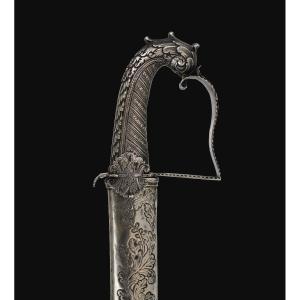
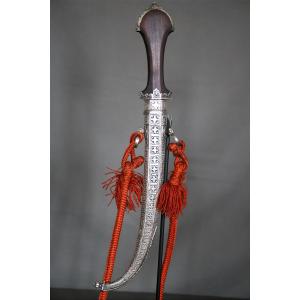
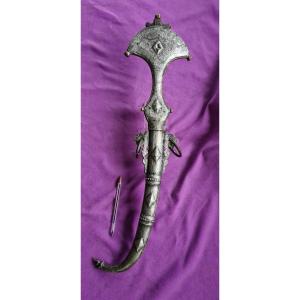
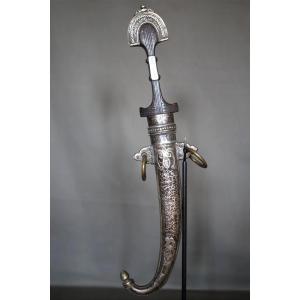
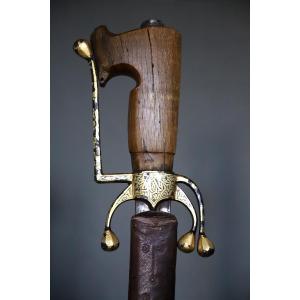
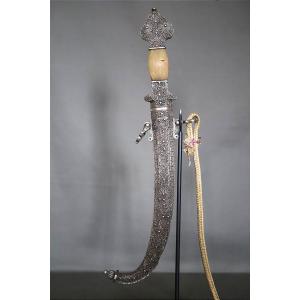
This example: A rather unusual example that can clearly be classified as a "kindjal" due to its overall shape. However, the wootz blade and silver filigree fittings show a strong Ottoman influence, as evidenced by the Kurdish 'khanjar' and 'Yataghan' daggers. The hilt is entirely silver-plated and has a fine inlaid filigree design, decorated with lozenge-shaped silver appliques and a beaded edge along the contours.
The scabbard consists of two wooden plates, held together by two silver fittings, decorated with an intricate filigree decoration of arabesques, enhanced with lozenges.
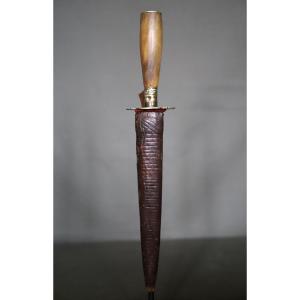
The central part of the scabbard was covered with a small remnant of worn goatskin, restored with new green goatskin. The blade: Typical 'kindjal' shape, straight and double-edged. The blade is entirely made of very fine wootz steel, possibly Persian or Turkish. The blade has a small fuller on the foregrip and two narrow fullers on the central part. The tip is reinforced, designed to pierce armor and chainmail.
This example: A rather unusual example that can clearly be classified as a "kindjal" due to its overall shape. However, the wootz blade and silver filigree fittings show a strong Ottoman influence, as evidenced by the Kurdish 'khanjar' and 'Yataghan' daggers. The hilt is entirely silver-plated and has a fine inlaid filigree design, decorated with lozenge-shaped silver appliques and a beaded edge along the contours.
The scabbard consists of two wooden plates, held together by two silver fittings, decorated with an intricate filigree decoration of arabesques, enhanced with lozenges.
The central part of the scabbard was covered with a small remnant of worn goatskin, restored with new green goatskin. The blade: Typical 'kindjal' shape, straight and double-edged. The blade is entirely made of very fine wootz steel, possibly Persian or Turkish. The blade has a small fuller on the foregrip and two narrow fullers on the central part. The tip is reinforced, designed to pierce armor and chainmail.
3 800 €
Period: 19th century
Style: Orientalism
Condition: Good condition
Material: Sterling silver
Length: 42cm
Reference (ID): 1515060
Availability: In stock
Print