



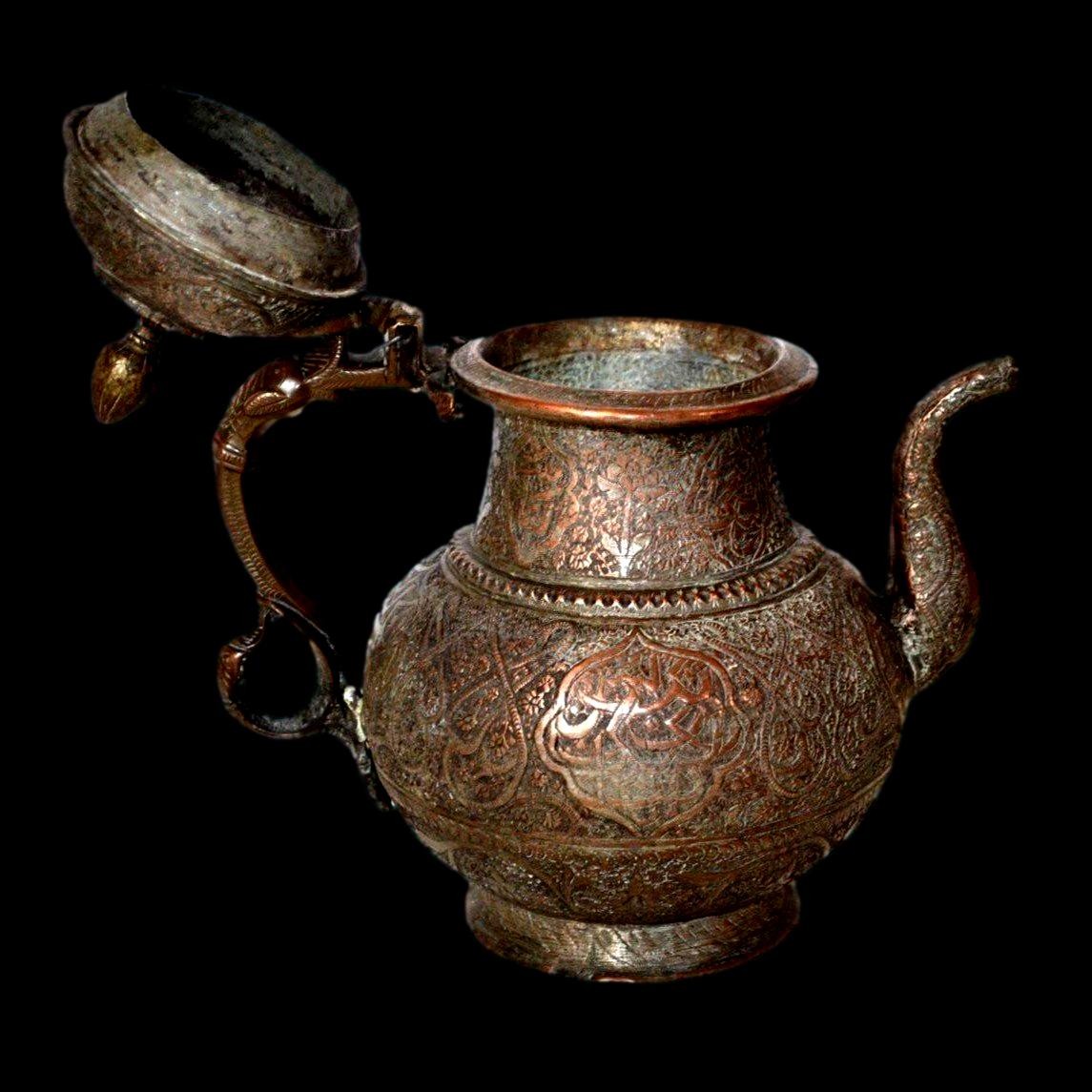


Aftabé, A Highly Ornate Tinned Bronze Ewer, Central Asia, 19th Century, Very Good Condition
An important ewer or pitcher, called an Aftabé in Central Asia.
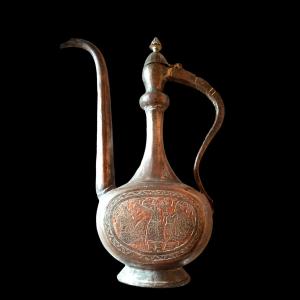
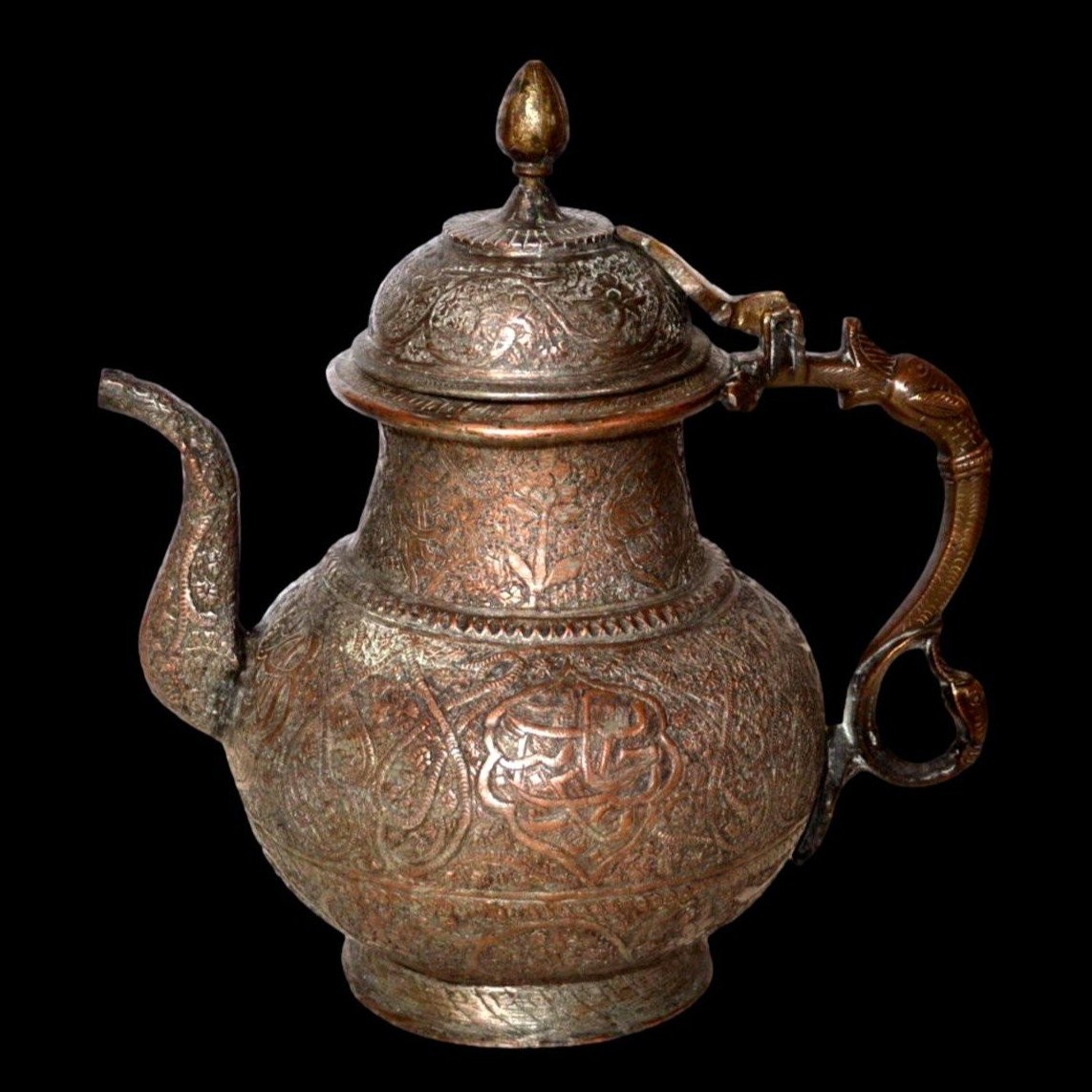
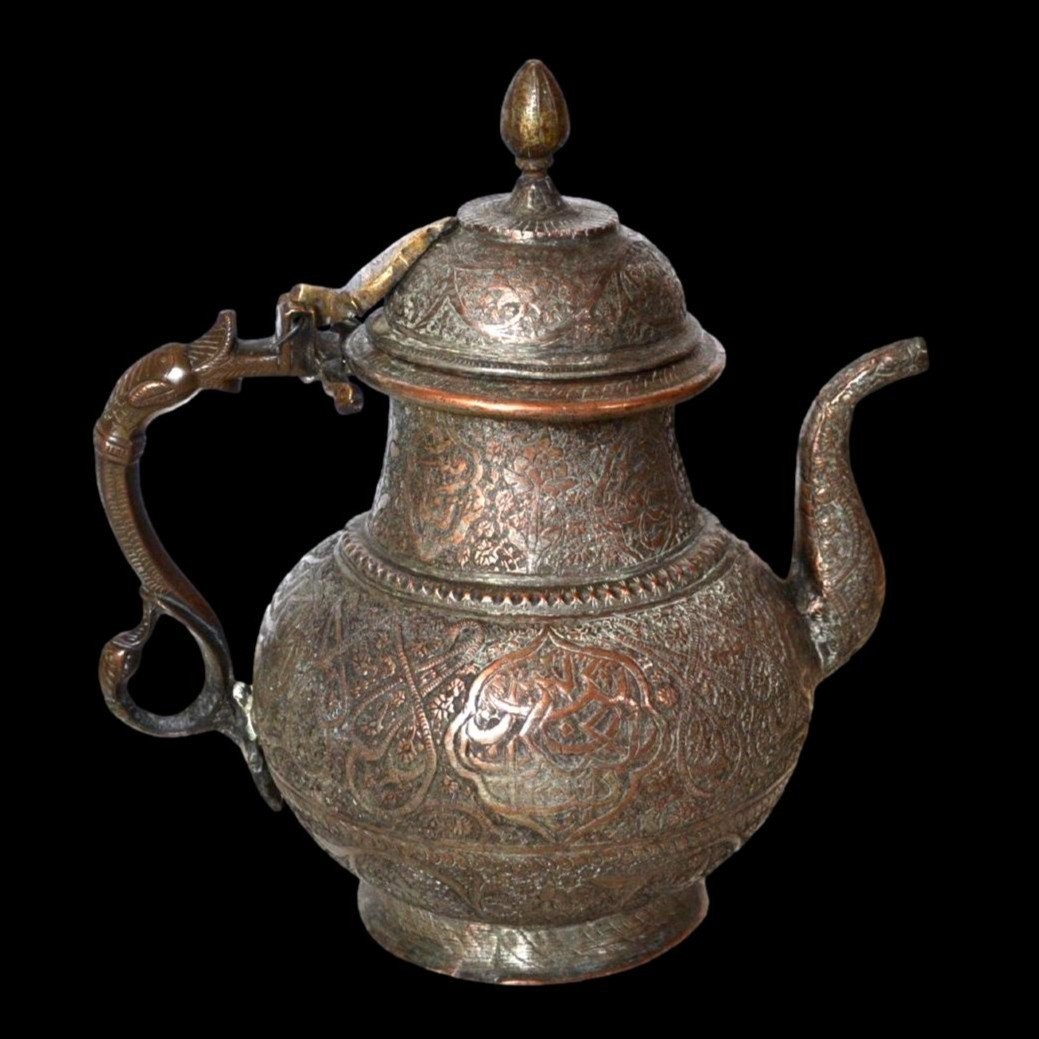
Made of tinned bronze, with an ovoid body, curved spout, and bronze handle, it is in very good condition.
The body is decorated with calligraphic cartouches and mandorlas, flowers and leaves, and long interlacing boteh patterns forming inverted domes or hearts.
These decorations symbolize faith ("al-iiman") and love.
The neck is striated and decorated with flowers, and a large floral Greek key pattern on the base completes the piece.
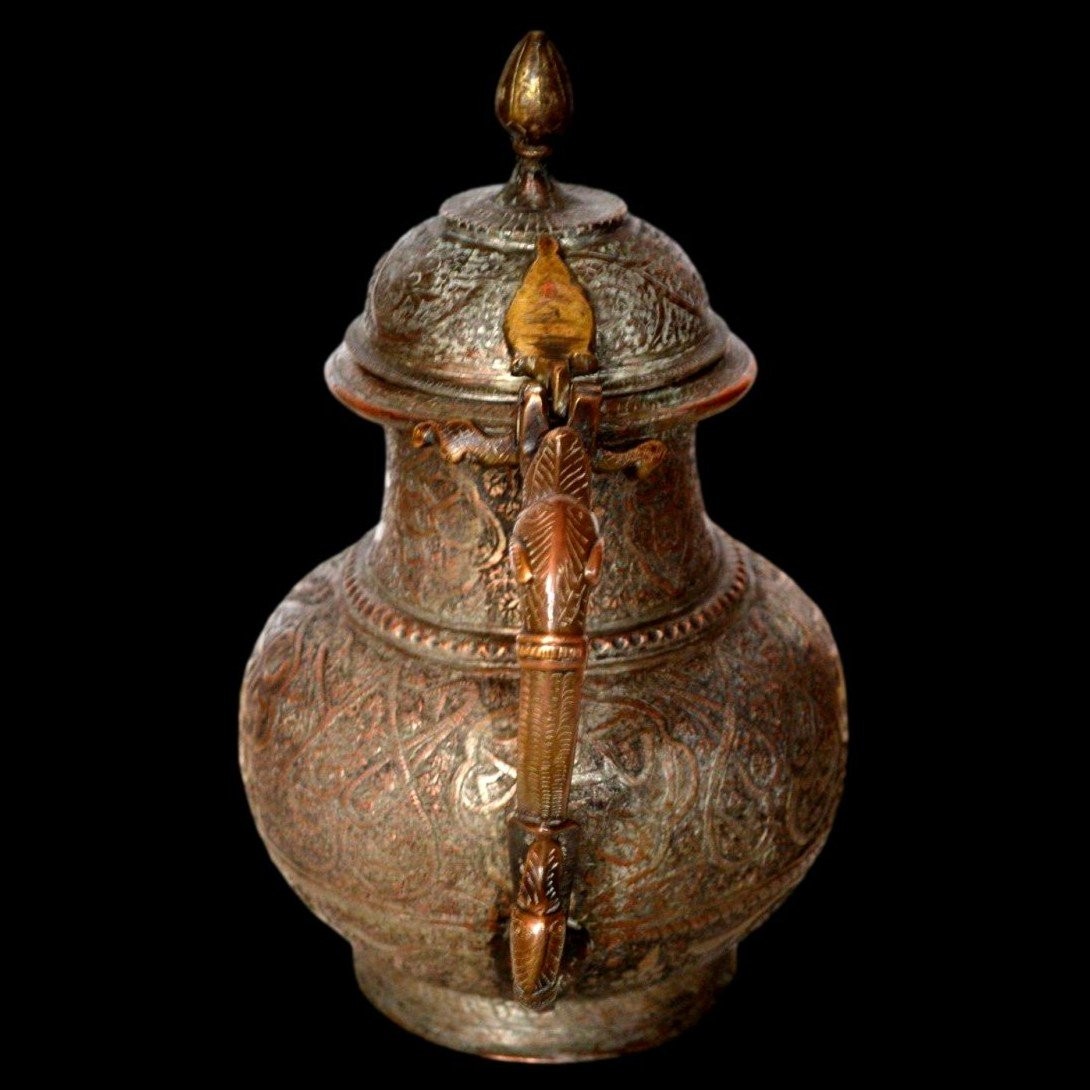
The long, serpentine handle curves into a striated S-shape, ending at both ends with fantastic animal heads and wide, decorated attachments.
The entire piece is bronze, with a domed lid decorated with a floral Greek key pattern and surmounted by a striated finial.
This type of ewer was, and still is, primarily used for ablutions, washing the face and hands, during prayers and ceremonies. religious.
## "The festival of the initiates, standing ready to serve, the beauties from all sides hold the ewer in their hand, the lovers wash their hands with all their soul, while the beauties pour the water, ewer in hand."
Reading and translation, AS Melikian-Chirvani, 1973 p. 119. 19th century, very good condition, collector's item.
Origin: Central Asia, Persia, under the Qajar Dynasty.
Ewers are among the most beautiful objects of Islamic art.
Dimensions: Height: 29 cm - Diameter: 19 cm - Width: 28 cm - Weight: 1954 grams.
We present other models of ewers from different origins on Proantic. (Persia, Azerbaijan, Ottoman Empire, Central Asia, India) For information:
# The Qajar Dynasty or Qajars (Qājār, Qadjar, Qajar, Persian:
Qajar was a Turkmen dynasty that ruled Iran from 1786 to 1925.
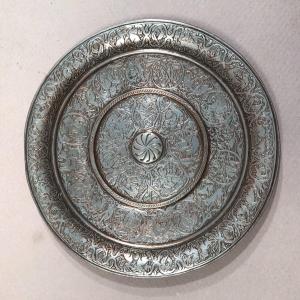
The fine engravings demonstrate the skill of the engravers.
These objects are found in major collections of Islamic art museums worldwide: Museo Nazionale del Bargello, Florence, Italy; Museum für Islamische Kunst, Staatliche Museum zu Berlin, Berlin, Germany.
FREE SHIPPING WITHIN FRANCE via Colissimo:
France €0 / EUR €25 / WORLDWIDE €50.
For further information, please contact me at +33 6 13 36 09 30 or winsteinprovence@gmail.com.
www.winsteinprovence.com
Texts and photos © WINSTEIN, all rights reserved.
Made of tinned bronze, with an ovoid body, curved spout, and bronze handle, it is in very good condition.
The body is decorated with calligraphic cartouches and mandorlas, flowers and leaves, and long interlacing boteh patterns forming inverted domes or hearts.
These decorations symbolize faith ("al-iiman") and love.
The neck is striated and decorated with flowers, and a large floral Greek key pattern on the base completes the piece.
The long, serpentine handle curves into a striated S-shape, ending at both ends with fantastic animal heads and wide, decorated attachments.
The entire piece is bronze, with a domed lid decorated with a floral Greek key pattern and surmounted by a striated finial.
This type of ewer was, and still is, primarily used for ablutions, washing the face and hands, during prayers and ceremonies. religious.
## "The festival of the initiates, standing ready to serve, the beauties from all sides hold the ewer in their hand, the lovers wash their hands with all their soul, while the beauties pour the water, ewer in hand."
Reading and translation, AS Melikian-Chirvani, 1973 p. 119. 19th century, very good condition, collector's item.
Origin: Central Asia, Persia, under the Qajar Dynasty.
Ewers are among the most beautiful objects of Islamic art.
Dimensions: Height: 29 cm - Diameter: 19 cm - Width: 28 cm - Weight: 1954 grams.
We present other models of ewers from different origins on Proantic. (Persia, Azerbaijan, Ottoman Empire, Central Asia, India) For information:
# The Qajar Dynasty or Qajars (Qājār, Qadjar, Qajar, Persian:
Qajar was a Turkmen dynasty that ruled Iran from 1786 to 1925.
The fine engravings demonstrate the skill of the engravers.
These objects are found in major collections of Islamic art museums worldwide: Museo Nazionale del Bargello, Florence, Italy; Museum für Islamische Kunst, Staatliche Museum zu Berlin, Berlin, Germany.
FREE SHIPPING WITHIN FRANCE via Colissimo:
France €0 / EUR €25 / WORLDWIDE €50.
For further information, please contact me at +33 6 13 36 09 30 or winsteinprovence@gmail.com.
www.winsteinprovence.com
Texts and photos © WINSTEIN, all rights reserved.
1 160 €
Period: 19th century
Style: Orientalism
Condition: Excellent condition
Material: Bronze
Width: 28 cm
Diameter: 19 cm
Height: 29 cm
Reference (ID): 1667622
Availability: In stock
Print