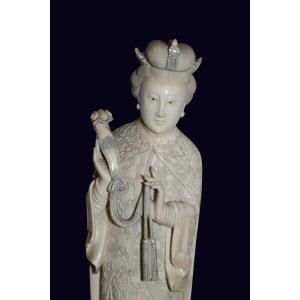
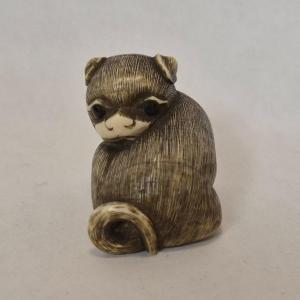
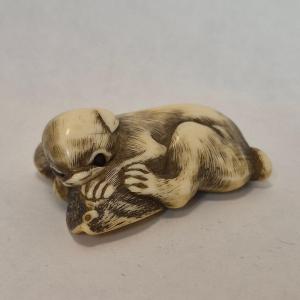
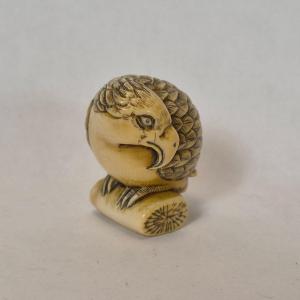
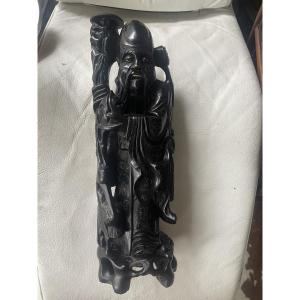
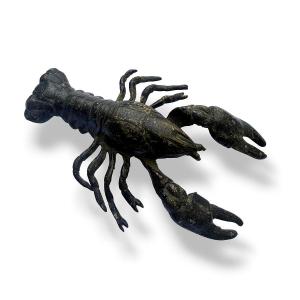
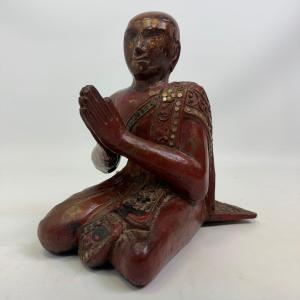
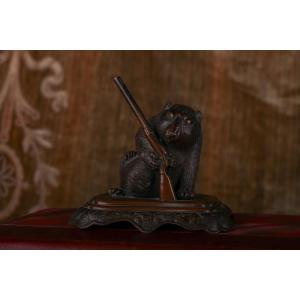
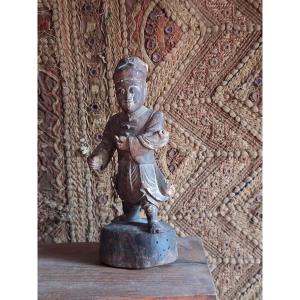
This magnificent Japanese statuette from the Meiji/Taishō period (late 19th - early 20th century) celebrates the joy of hard work and commerce. Carved with extraordinary precision, it depicts a smilin[...]
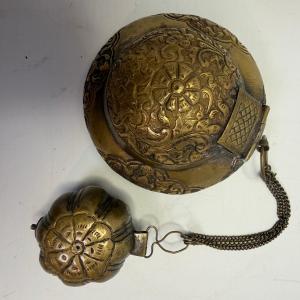
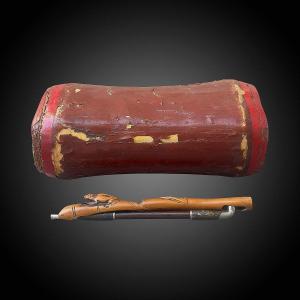
Tibet, circa 1900. Rare and imposing Tibetan flint purse (also called a mechag or chuck muck), made of leather adorned with repoussé silver plates, inlaid with turquoise and coral set in silver mounts[...]
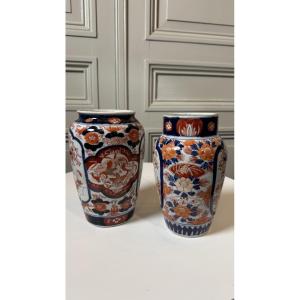
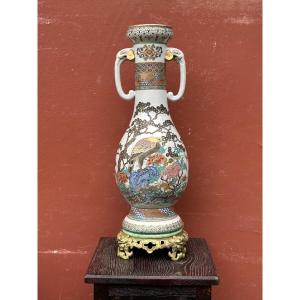
A sophisticated pair of Kyoto Satsuma vases from the Kinkozan workshop, made c.1890–1905. Deep cobalt shoulders and bases anchor the composition, while the bodies carry finely painted garden scenes of[...]
A refined pair of Kyoto Satsuma miniature moon-flask vases from the late Meiji period, c.1895–1910. The compact flattened forms sit lightly on their low feet, creating a balanced silhouette ideal for [...]
Urushi lacquered bakingo decorated with a Hoho (phoenix) relief in gold powder on a roiro (black) ground. Details in red lacquer, gold mosaic (kirikane), and mother-of-pearl (aogai). Japan, Meiji-Tais[...]
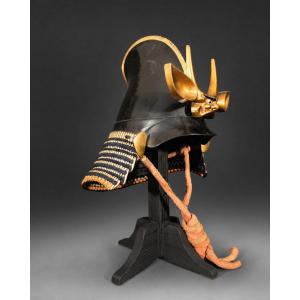
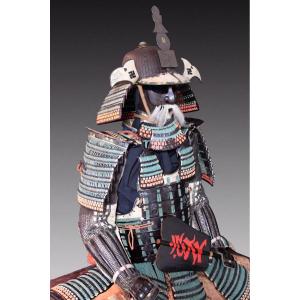
HON-KOZANE MARU DO TOSEI GUSOKU Neoclassical style samurai armor -Edo period, 17th-18th century - Signature on the kabuto: Jōshū jū Saotome IetadaKabuto [helmet]: Red iron kabuto (tetsu sabiji) compos[...]
Discover the perfect harmony of the Orient with this magnificent Serpentine Jade sculpture, a treasure of Chinese art. Its soft, almost translucent green color evokes the purity and serenity of imperi[...]
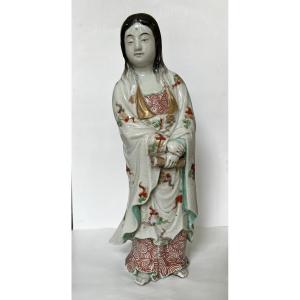
A superb glazed porcelain figurine, expressively modeled and with particularly luminous polychrome decoration. It depicts Lu Xing, the god of prosperity and success, dressed in a long ceremonial robe [...]
This exceptional Japanese statuette from the Meiji era captivates with its humanity and narrative detail. It depicts a traveler or peasant, his back heavily laden with a basket of harvests (fruits or [...]
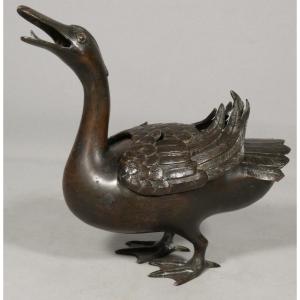
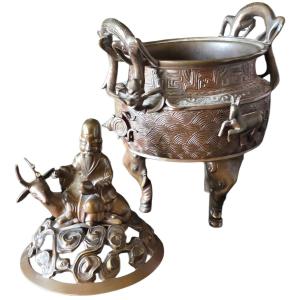
Bronze incense burner, China, late 19th century, Qing dynasty, in good condition. The lid is surmounted by a Foo dog, signature under the base. Trace of an old repair on one foot. Shipping possible, p[...]
Snuffbox or opium jar, hand-painted glass on both sides, with jadeite stoppers and a bone or ivory spoon. China, early 20th century, Qing dynasty. The decoration inside the container is exquisitely de[...]
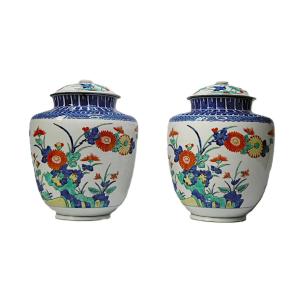
A finely painted Kyoto Satsuma covered jar with a calm, atmospheric landscape extending around the body. Soft hills, riverbanks and distant pavilions blend with chrysanthemum clusters in a pastel pale[...]
Snuffbox or opium jar, made of multiple layers of sculpted lacquer over a copper core. A work known as Peking lacquer, China, late 19th century, Qing dynasty. Its patina indicates extensive use. In pe[...]
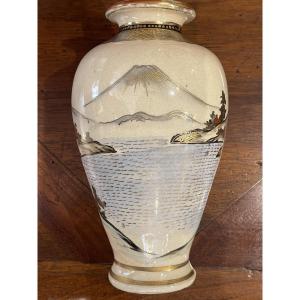
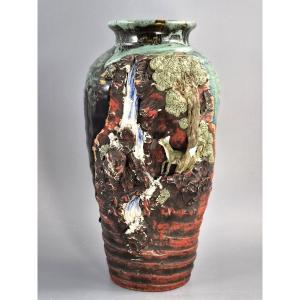
A globular Satsuma vase decorated with polychrome enamels and gold on a cobalt-blue ground. The neck features an elegant raised floral motif reminiscent of a chrysanthemum.
The body is adorned with l[...]
Auspicious “Tongzi” Figure. A youthful figure carved in polished agate, depicting a young porter whose head rests on his shoulder against a large pomegranate. His raised hand, with finely incised fing[...]
Description Additional Information Shipping. Amethyst incense burner, a semi-precious hard stone, a very delicate and perfectly executed piece; one can only marvel at the sculptor's dexterity. These i[...]
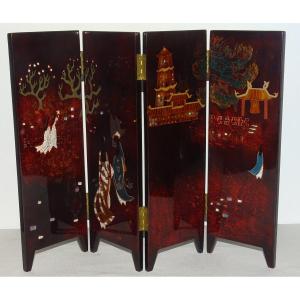
This Japanese-made folding screen is composed of two panels with raised gold motifs. The background is black lacquer, as is the back, which is also decorated very simply. The motifs depict exotic bird[...]
A beautiful pair of early 20th-century mottled opaque glass bottle vases from Beijing, with faceted octagonal bodies and necks. In excellent condition, dimensions: H 20 cm, width 10 cm
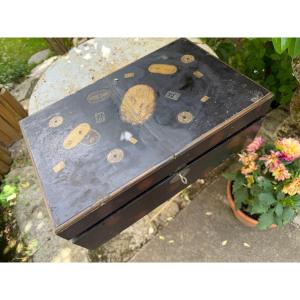
Chinese Lacquer Tea Box Circa 1880 "Pretty tea box circa 1880 in black lacquer decorated with palace scenes in cartouches on all sides. It rests on four giltwood claw feet. Late 19th century Chinese w[...]
Important Chinese plique-à-jour bowl, a very beautiful piece from the late 19th/early 20th century, showcasing plique-à-jour work. Plique-à-jour is an enameling technique similar to cloisonné but usin[...]
A beautiful bar crafted from Chinese lacquer and inlaid with hardstones. This piece features multiple compartments accessible through six doors, a drop-down door, and a lid. On the sides, two doors re[...]
Peking enamel bowl, a very beautiful piece in blue Peking enamel, late 19th century work, richly decorated with floral and foliate motifs, minor enamel chips, white reverse, octagonal shape. Free and [...]
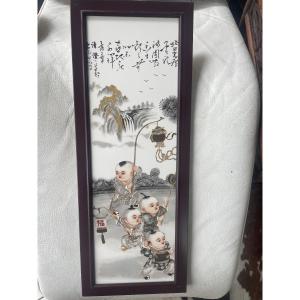
Asia, circa 1900: Large silk painting depicting a poetic nature scene: birds perched on flowering branches, delicate peonies, vibrant irises, and refined vegetation. The whole is rendered with exquisi[...]
This
beautifully matched pair of Meiji-period Satsuma dishes was produced in Kyoto
for the Yasuda export company and signed underneath by the artist Shuzan (秀山). Hand-thrown bodies give each dish
a[...]
This doll, made by the artisan Susumago, is characterized by its high-waisted obi. Its head bobs ("donko," by analogy with a newborn baby who cannot hold its head up). The style is called "kinakina," [...]
This circular base, resting on two cleats, was once used to store a small barrel. Its worn appearance gives it a wabi-sabi aesthetic. It can be used to display a bonsai tree, or a terracotta or plaste[...]
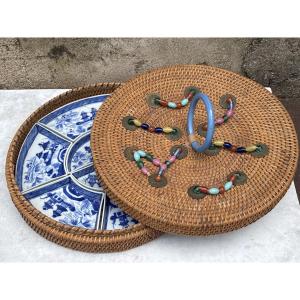
This openwork wicker box was used in markets. Circa 1900-1930. It was closed with loops. It shows signs of wear and tear, with stains. Like many everyday objects, this box embodies a Mingei principle:[...]
This is a bow and arrow set that was used by Japanese nobles indoors on tatami mats or wooden floors. The aim was to hit a moving circular target. As the bow is old, it is recommended not to string it[...]
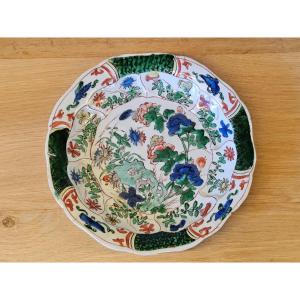
Antique Chinese porcelain commission dish, draining dish. East India Company, so-called commission dish. Polylobed shape decorated with bouquets of peonies, hibiscus, and chrysanthemums. Dish adorned [...]
China, 20th century: "Large porcelain cachepot mounted in bronze," coral-colored porcelain decorated in gold with stylized poppies, the top encircled in bronze and resting on a bronze base, bronze han[...]
Important octagonal Chinese porcelain dish for the East India Company. Beautiful central blue and white decoration, in good condition. Dimensions: Height 8 cm, diameter 38.5 cm
A covered bowl with a continuous design of landscapes and typical houses, resting on a heron or crane, auspicious animals frequently found in the decoration of Asian objects, both in China and India. [...]
Beautiful Japanese obi or sash in ochre tones with wisteria flower embroidery. Gold thread embroidery. Thick and beautifully crafted obi. Showa period. Shipping costs extra.
Japanese tobacco smoking box, in gold lacquer on a black background, decorated with prunus and landscape, opening with two drawers, containing the compartment for embers with a metal lid, and the rese[...]
Obi, or Japanese sash, embroidered with cherry blossoms, irises, chrysanthemums, ivory, and pine. The very Japanese design and soft colors blend seamlessly into any interior. Showa period. Shipping co[...]
Japanese kakemono decorated with flower pots: irises, plum blossoms, peonies. Includes a shishi (Japanese sapphire). Various stamps on the decoration. Showa period. Some wear visible in photos. Shippi[...]
Jingasa, Edo period, with a gold lacquered Mon. The owner's name is inscribed inside in black lacquer. It is complete with its original interior. Diameter 40 cm. Shipping costs extra.
Tall ceramic vase with white glaze and gold-trimmed lines. Made by the renowned Ito Tozan workshop. Unique piece created by Ito Tozan III (1900-1970). Japan, circa 1960, 26 x 12 cm. With its original [...]
A Seto ceramic trinket dish with a modern fish design. Japan, circa 1950, 25.5 x 19 x 3 cm. Seto is a city in the Nagoya region famous for its clay and ceramics. It is so well-known that in Japanese, [...]
A beautiful glass vase by the artist KYOHEI Fujita (1921-2004), who received numerous awards from the Japanese art world and was exhibited at the Metropolitan Museum in New York. Decorated with waves [...]
This charming Chinese statuette, measuring 19 centimeters high, represents the Laughing Buddha, also known as Budai. His seated posture and jovial expression symbolize good fortune, prosperity, and ha[...]
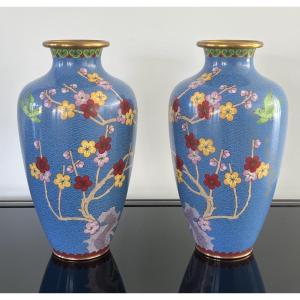
A pair of Chinese cloisonné enamel vases decorated with a five-clawed imperial dragon against a bright turquoise background, colorful clouds, fire symbols, stylized ocean waves, and lotus flowers, all[...]
20th Century Asian Lacquer Cabinet with Hardstone Flower Vase Decoration, Opens with Four Doors, Decorated Sides, Black Lacquered Wood Top, Very Fine Quality Cabinetmaking, H127 / 70 / 50 cm
Elegant and refined, this antique Chinese stool, dating from the second half of the 19th century, is distinguished by its black lacquered wood frame richly adorned with hand-painted gold and red flora[...]
Rare pair of cobalt blue glass obelisk vases with engraved designs, mounted in gilded bronze – 19th centuryExceptional pair of obelisk-shaped vases in cobalt blue glass, richly decorated with engraved[...]
A beautiful Satsuma ceramic bowl, hand-painted with flowers, branches, and delicate golden details.The lid, topped with a gilded handle, adds a refined and harmonious touch.An object that reflects the[...]
Arita. Double gourd-shaped vase with polychrome underglaze decoration of fish and crabs in nets. Gold lacquer on the neck. Signed Matsuura, of Arita. Height: 23 cm. Japan, late 19th century
Singa Batak is an apotropaic figure (protective magic intended to ward off evil or negative influences, such as misfortune). Singa Batak is a figure from the mythology of the Batak people of North Sum[...]
Large Baotou rug, China, circa 1920, decorated with deer, a crane in flight, clouds, flowering peonies, and a maple tree. One hole and several moth holes.
Large Indian chest made of exotic wood, adorned with wrought ironwork. The domed top opens two-thirds of the way up with two wrought iron hinges, revealing a large storage space traditionally used for[...]
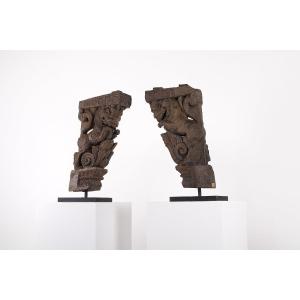
Fragment of a medieval temple in reddish-brown sandstone. In the lower right, the head of an elephant, probably Ganesha, holds a lotus flower in its trunk upon which a female figure kneels in prayer, [...]
Japanese covered box in nielloed iron inlaid with gold and silver. Komai workshop, Kyoto, Japan. Meiji period (1868-1912). The lid is finely inlaid with a seated figure. Some wear necessitates minor r[...]
Proantic uses a cookie to analyze traffic and improve its service by using Google Analytics. Data sent to Google Analytics (frequency of visits to the site and pages visited) are anonymous. No other cookie tracks your activity, your personal data is not collected. Thank you for helping us to have better understanding how Proantic is used.