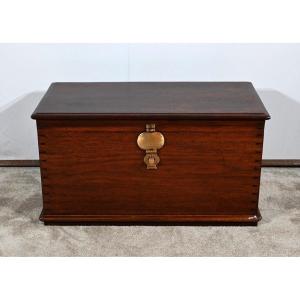


Lacquered Wooden Chest In The Namban Style. Japan, 17th Century. Early Edo Period.
Artist: Namban
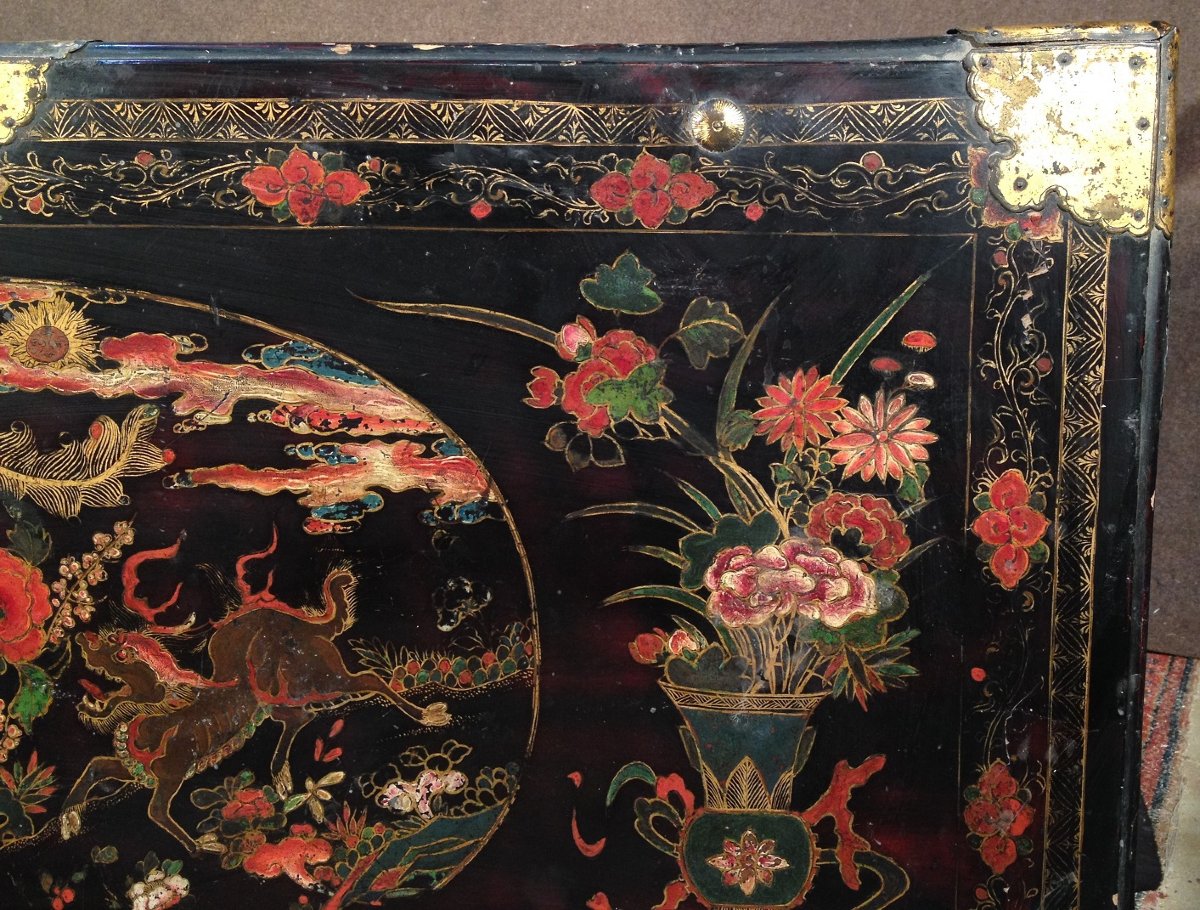
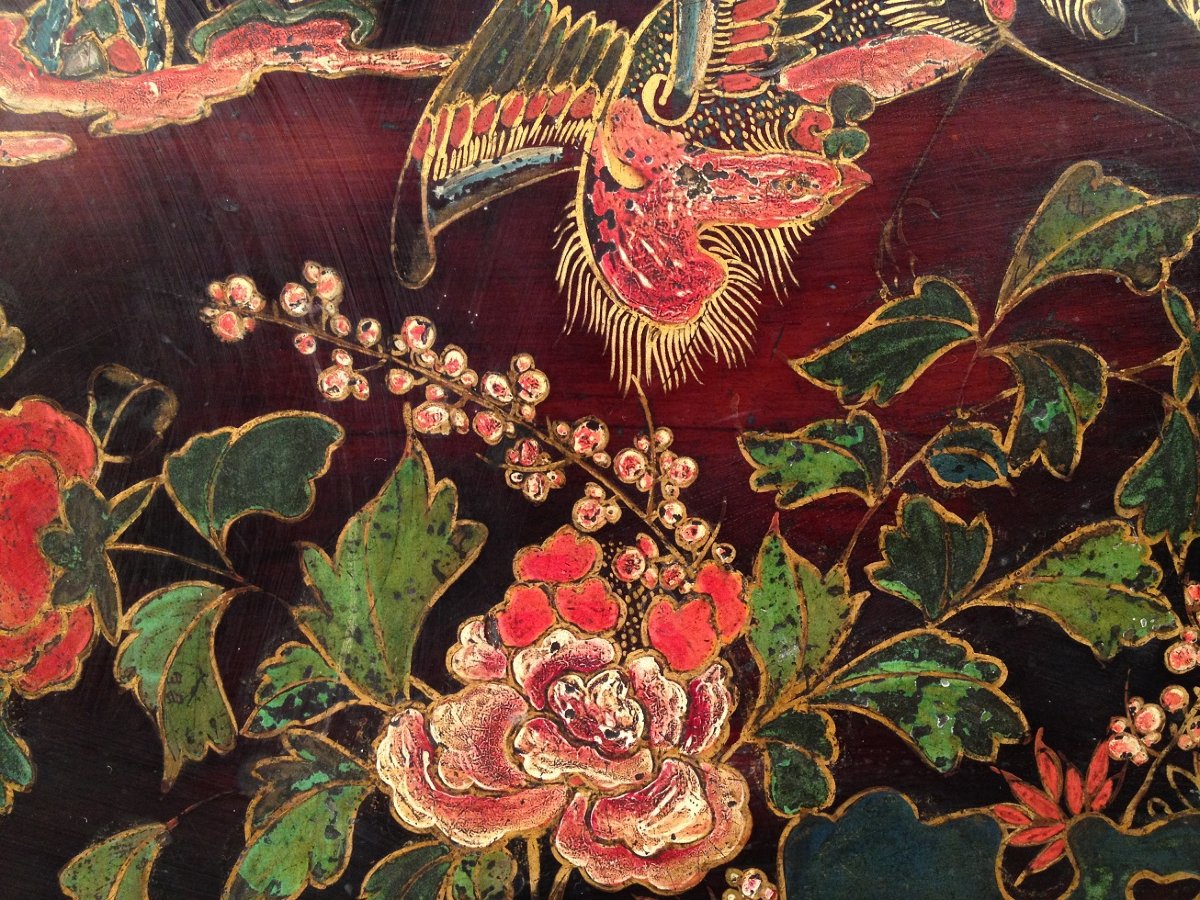
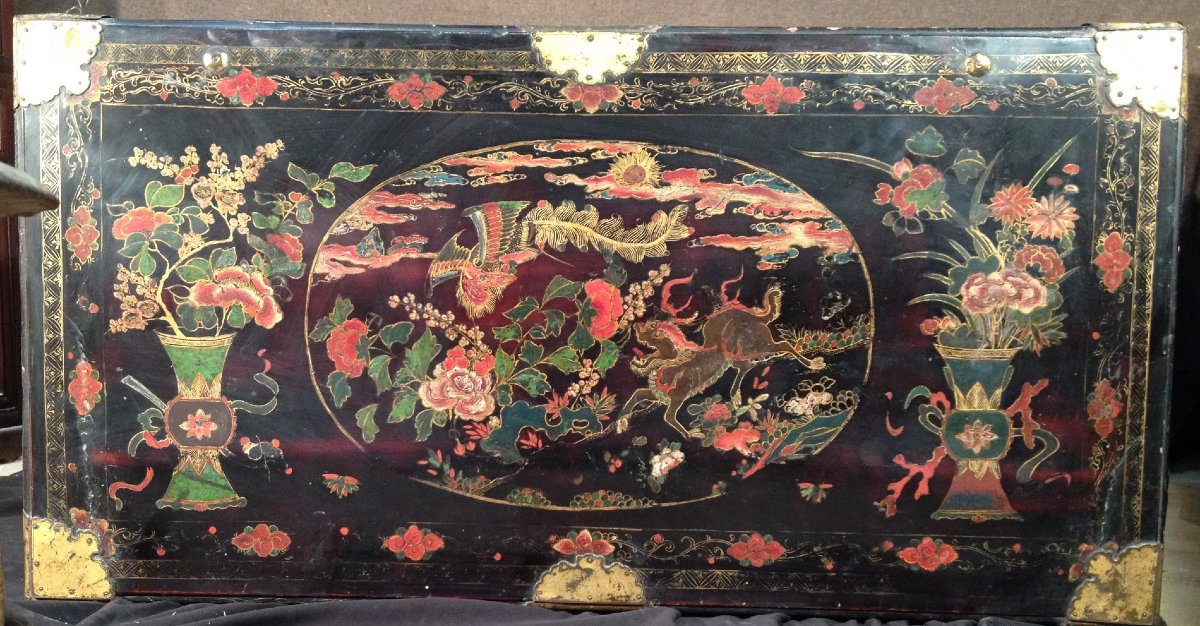
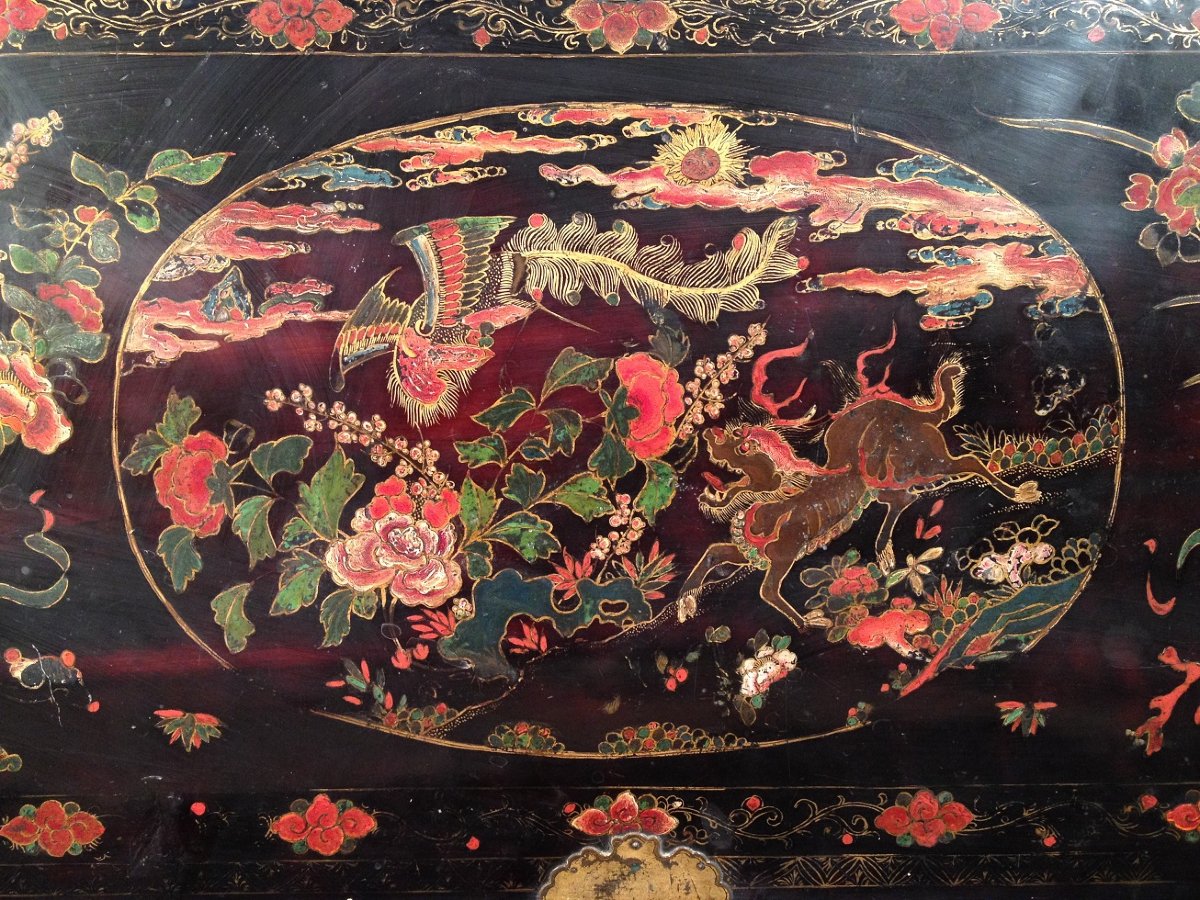
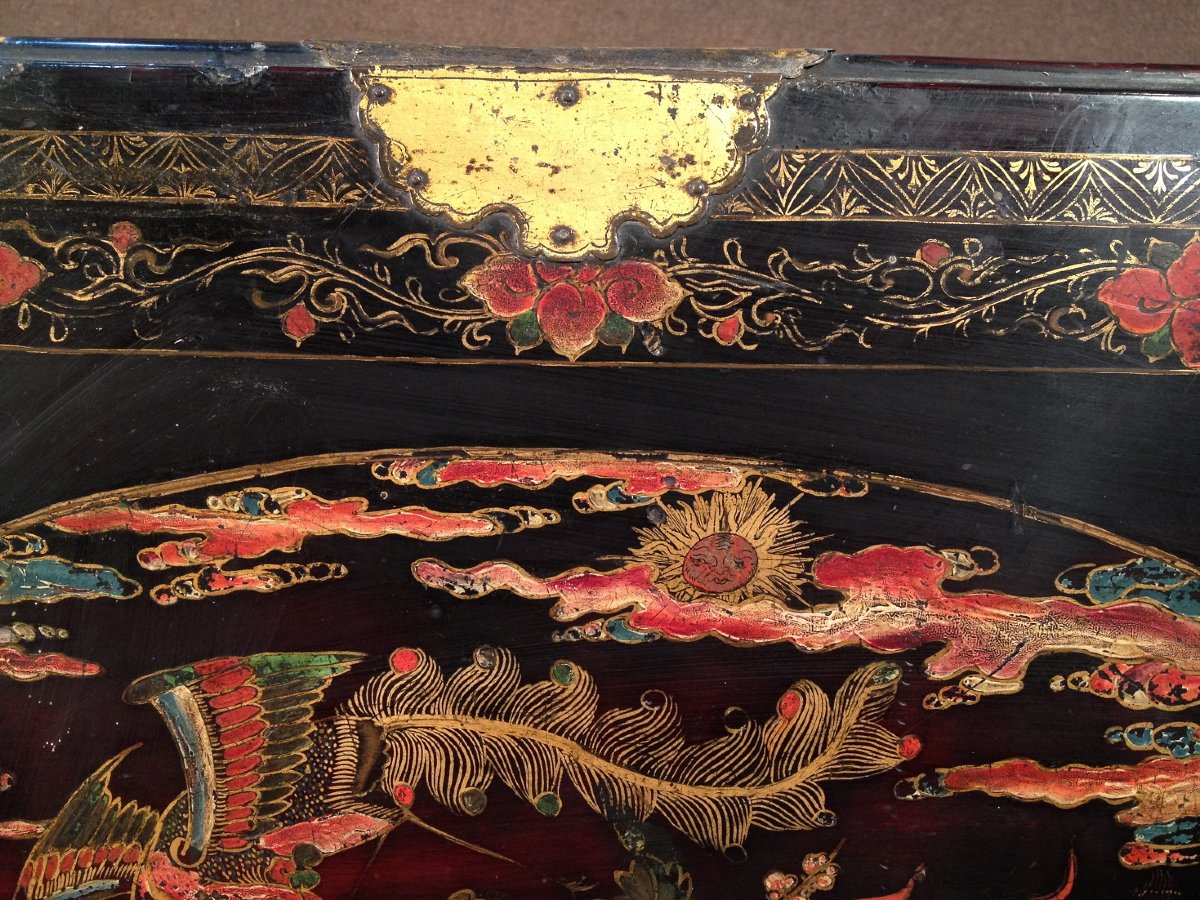
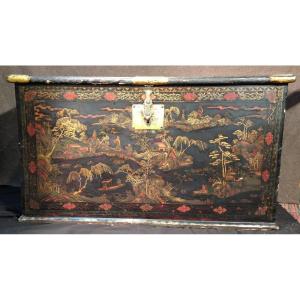
Wooden chest covered in black Urushi lacquer, decorated with polychrome lacquer and gold, with gilded copper mounts. On the top, within an oval panel, a Kirin and a Ho-o are depicted moving through a landscape filled with peonies. Curiously, a radiant sun in a distinctly European style appears in the cloudy sky. This oval cartouche is surrounded by two vases filled with flowers.
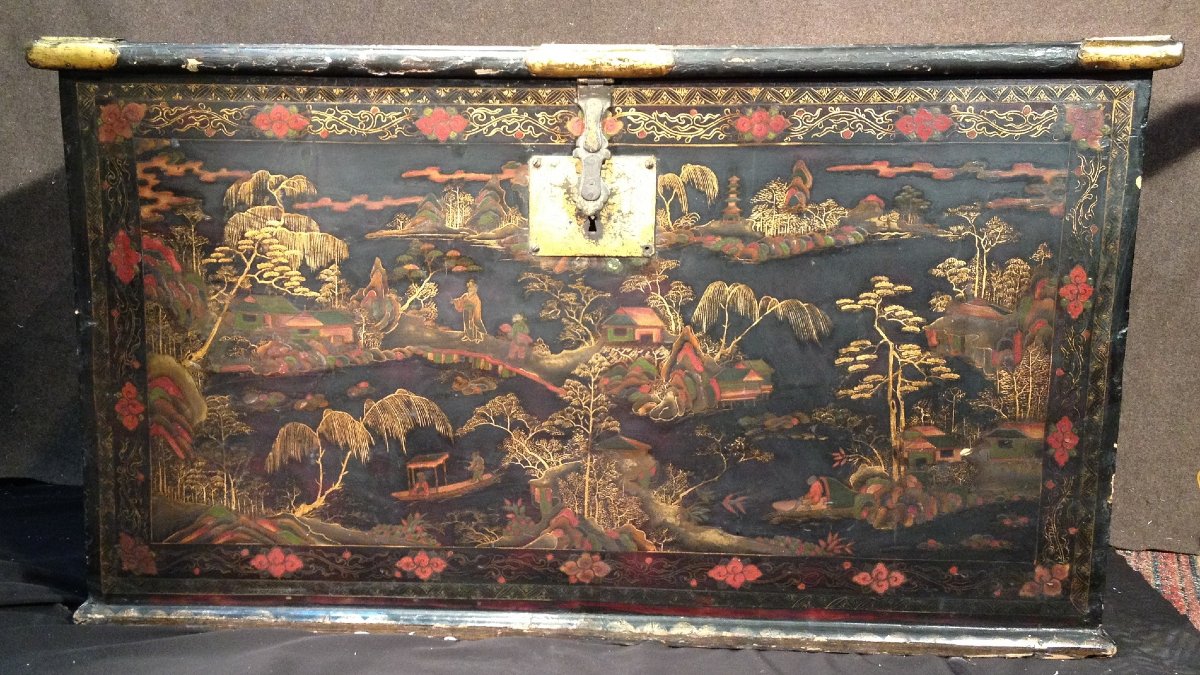
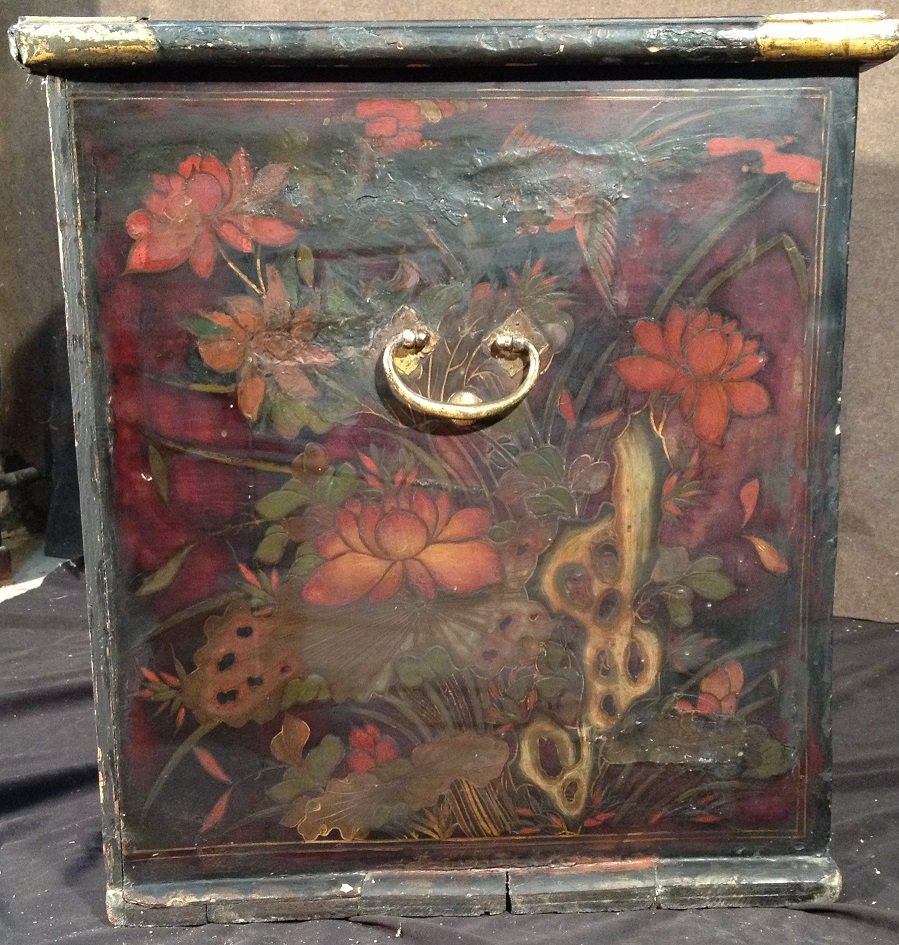
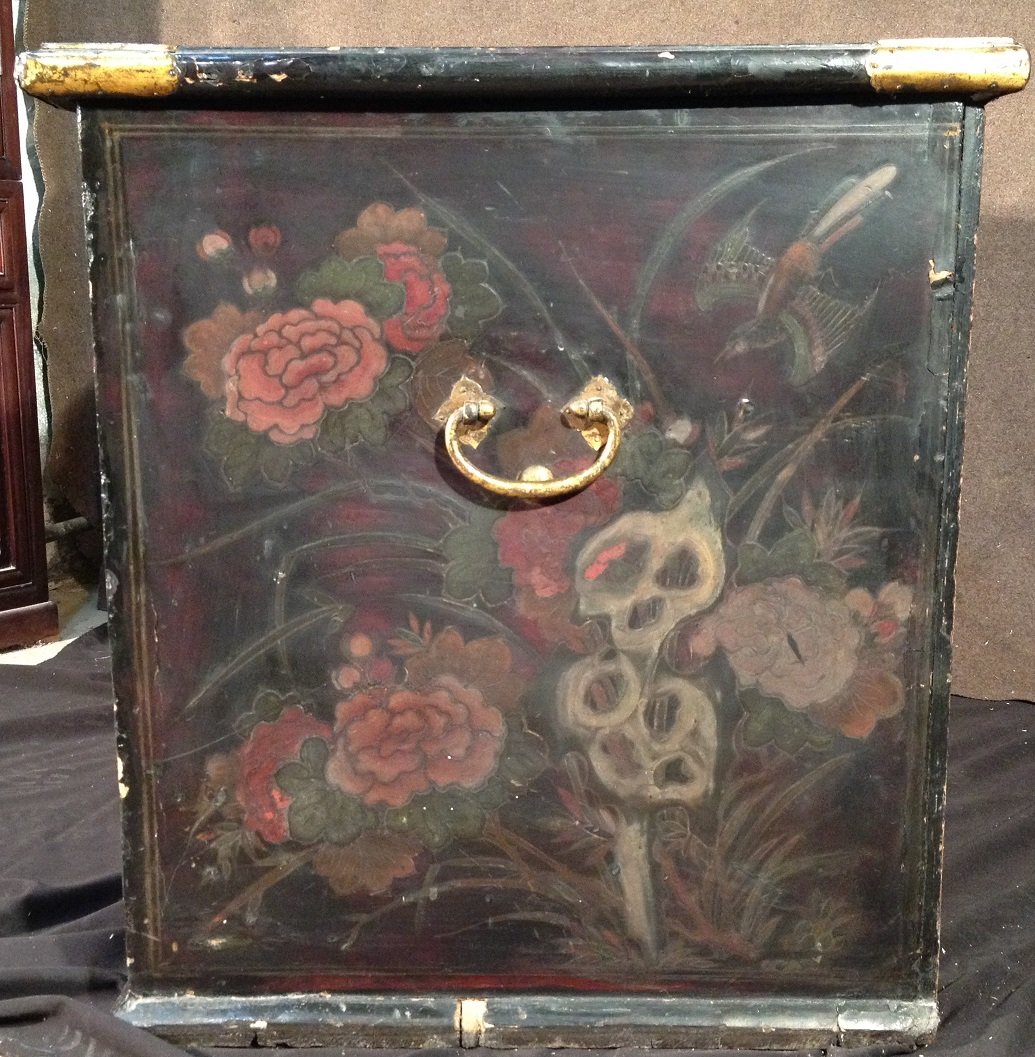
The front is richly decorated with a lakeside landscape animated by figures. On the sides, one can admire artistically rendered lotuses and peonies.
Large chests of this shape are well known. They were created in the mid-17th century for Europe and are always decorated with gold-powdered motifs on a black background. Their quality varies greatly depending on the financial means of the patrons; the finest feature red-lacquered details and inlays of mother-of-pearl and sometimes gold, such as the famous “Mazarin” chests. We know of no other chest with polychrome decoration.
However, we have in our collections an older travel chest, from the 16th century—Momoyama, or perhaps even Muromachi?—lacquered in black and gold, which has lost much of its decoration, but whose preserved interior, which remains intact, is entirely decorated with landscapes in colors similar to those on our chest. The more naive designs confirm a date nearly a century earlier. The colors of our chest are admirably preserved, which is due in large part to the excellent quality of the lacquer work, particularly a very thick and sturdy base of black urushi, and the fact that the chest was entirely coated with a European varnish a very long time ago to restore its original luster and revive the gold on the gilded parts, which contributed to its good state of preservation.
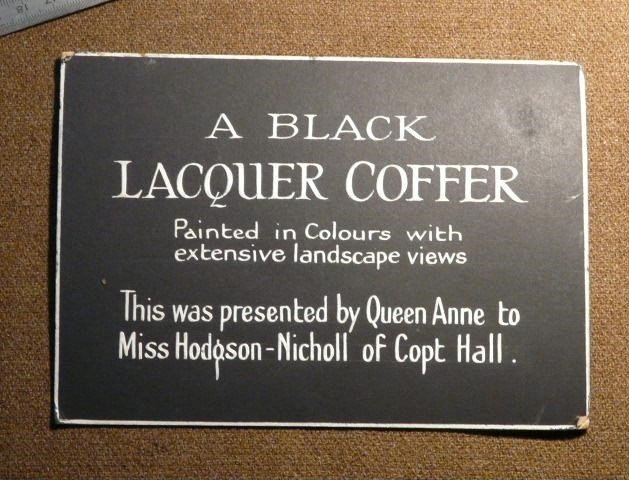
A small collector’s label on textured paper indicated that this chest had been given by Queen Anne of England to a lady of her court, Miss Hodgson-Nicholl of Copt Hall. This label was lost or stolen; all that remains is a photograph. Like any label, it does not prove this provenance, but it provides an important clue that a researcher could verify—starting with the discovery of a possible inventory of Copt Hall’s furnishings or a royal document attesting to this gift, which would likely have been made around 1700?
In the early 20th century, the English magazine *The Connoisseur* reported the following auction result:
“Amongst the lace sold at Puttick’s was an old Italian rose-point bedcover, 9 ft. 5 in. × 9 ft. 2 in., which is said to have been given by Queen Anne to one of her maids-in-waiting upon the latter’s marriage to a Hodgson-Nicoll of Copt Hall. The hammer fell at a bid of £210.”
This passage corroborates the text on the label.
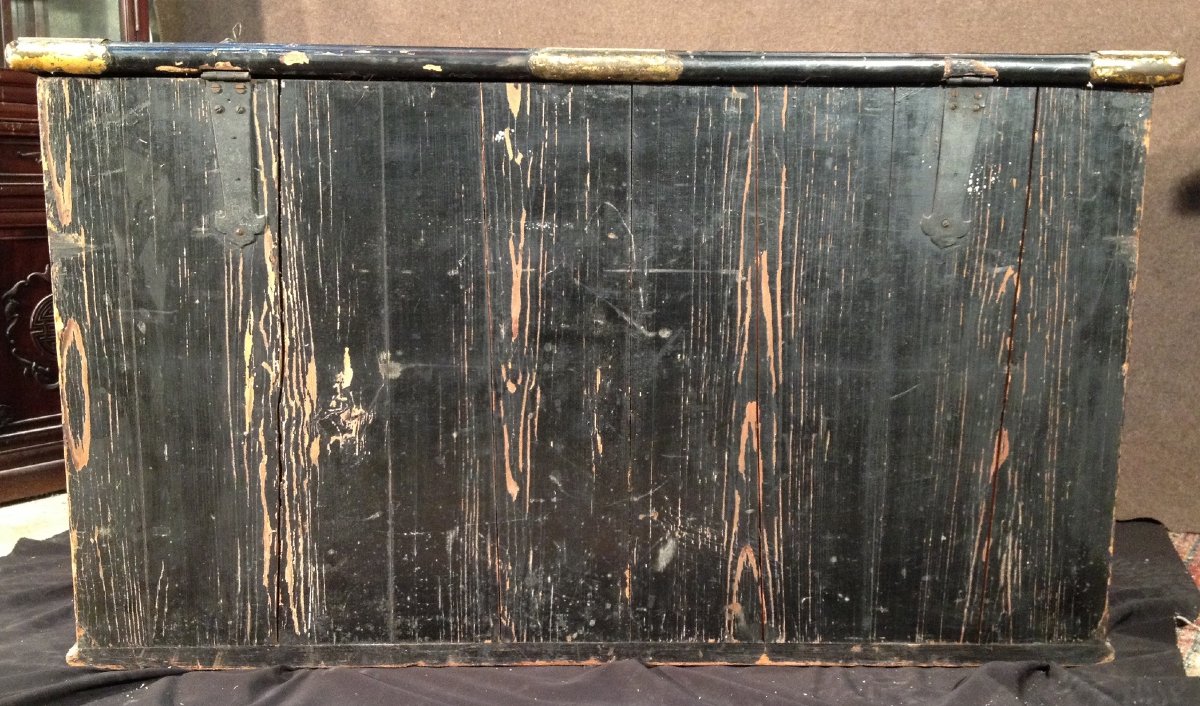
The gilding was likely done at the time of the gift, with the aim of restoring the gold leaf on a chest that, by 1700, had already been in use for 50 years.While the top and front retain their original decoration, we are not certain that the sides do. Indeed, the colors are duller, and the design of the rocks catches our eye, though it does not entirely convince us. We have never cleaned the sides, which are covered with poor-quality varnish; their condition is evidence of the work done by European varnishers, but we could clean them upon request.
Approximate dimensions: 120 × 60 × 60 cm.
The interior is simply lacquered in red. The back is covered with only a few thin layers of Urushi, which, due to their thinness, have not withstood the test of time as well.
An exceptional piece.
The front is richly decorated with a lakeside landscape animated by figures. On the sides, one can admire artistically rendered lotuses and peonies.
Large chests of this shape are well known. They were created in the mid-17th century for Europe and are always decorated with gold-powdered motifs on a black background. Their quality varies greatly depending on the financial means of the patrons; the finest feature red-lacquered details and inlays of mother-of-pearl and sometimes gold, such as the famous “Mazarin” chests. We know of no other chest with polychrome decoration.
However, we have in our collections an older travel chest, from the 16th century—Momoyama, or perhaps even Muromachi?—lacquered in black and gold, which has lost much of its decoration, but whose preserved interior, which remains intact, is entirely decorated with landscapes in colors similar to those on our chest. The more naive designs confirm a date nearly a century earlier. The colors of our chest are admirably preserved, which is due in large part to the excellent quality of the lacquer work, particularly a very thick and sturdy base of black urushi, and the fact that the chest was entirely coated with a European varnish a very long time ago to restore its original luster and revive the gold on the gilded parts, which contributed to its good state of preservation.
A small collector’s label on textured paper indicated that this chest had been given by Queen Anne of England to a lady of her court, Miss Hodgson-Nicholl of Copt Hall. This label was lost or stolen; all that remains is a photograph. Like any label, it does not prove this provenance, but it provides an important clue that a researcher could verify—starting with the discovery of a possible inventory of Copt Hall’s furnishings or a royal document attesting to this gift, which would likely have been made around 1700?
In the early 20th century, the English magazine *The Connoisseur* reported the following auction result:
“Amongst the lace sold at Puttick’s was an old Italian rose-point bedcover, 9 ft. 5 in. × 9 ft. 2 in., which is said to have been given by Queen Anne to one of her maids-in-waiting upon the latter’s marriage to a Hodgson-Nicoll of Copt Hall. The hammer fell at a bid of £210.”
This passage corroborates the text on the label.
The gilding was likely done at the time of the gift, with the aim of restoring the gold leaf on a chest that, by 1700, had already been in use for 50 years.While the top and front retain their original decoration, we are not certain that the sides do. Indeed, the colors are duller, and the design of the rocks catches our eye, though it does not entirely convince us. We have never cleaned the sides, which are covered with poor-quality varnish; their condition is evidence of the work done by European varnishers, but we could clean them upon request.
Approximate dimensions: 120 × 60 × 60 cm.
The interior is simply lacquered in red. The back is covered with only a few thin layers of Urushi, which, due to their thinness, have not withstood the test of time as well.
An exceptional piece.
180 000 €
Period: 17th century
Style: Asian art
Condition: Condition of use
Material: Lacquer
Length: 120cm
Height: 60cm
Depth: 60cm
Reference (ID): 1807377
Availability: In stock
Print