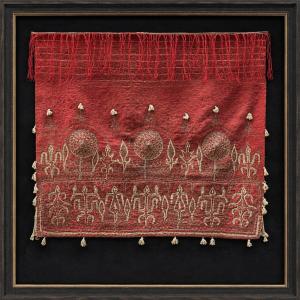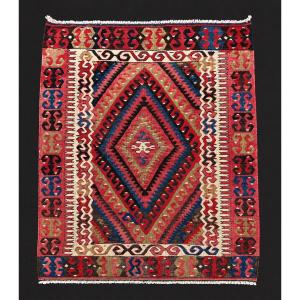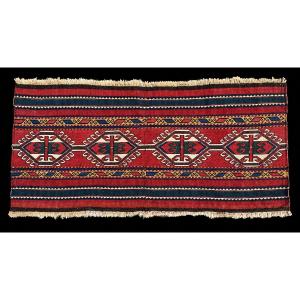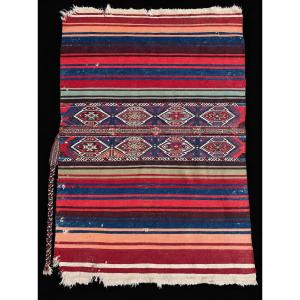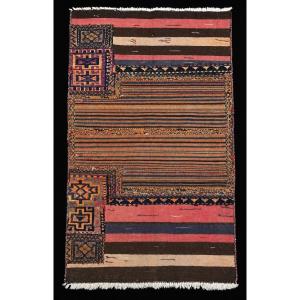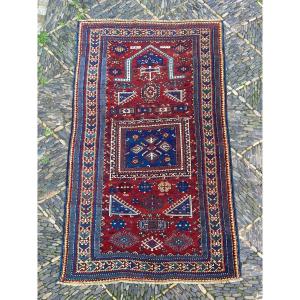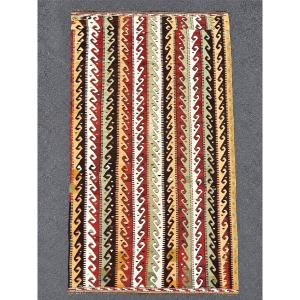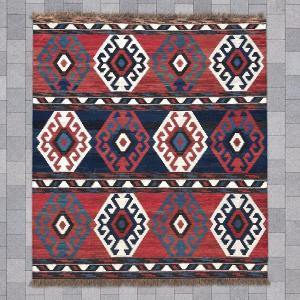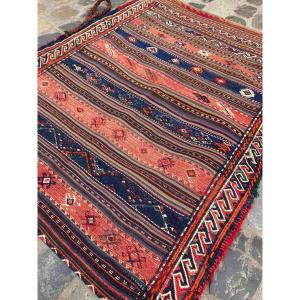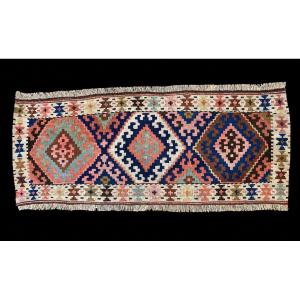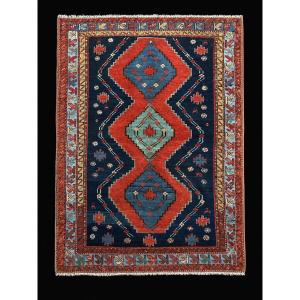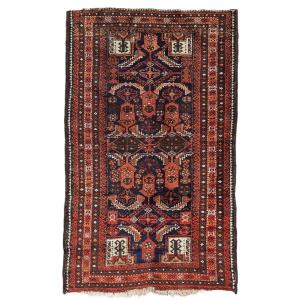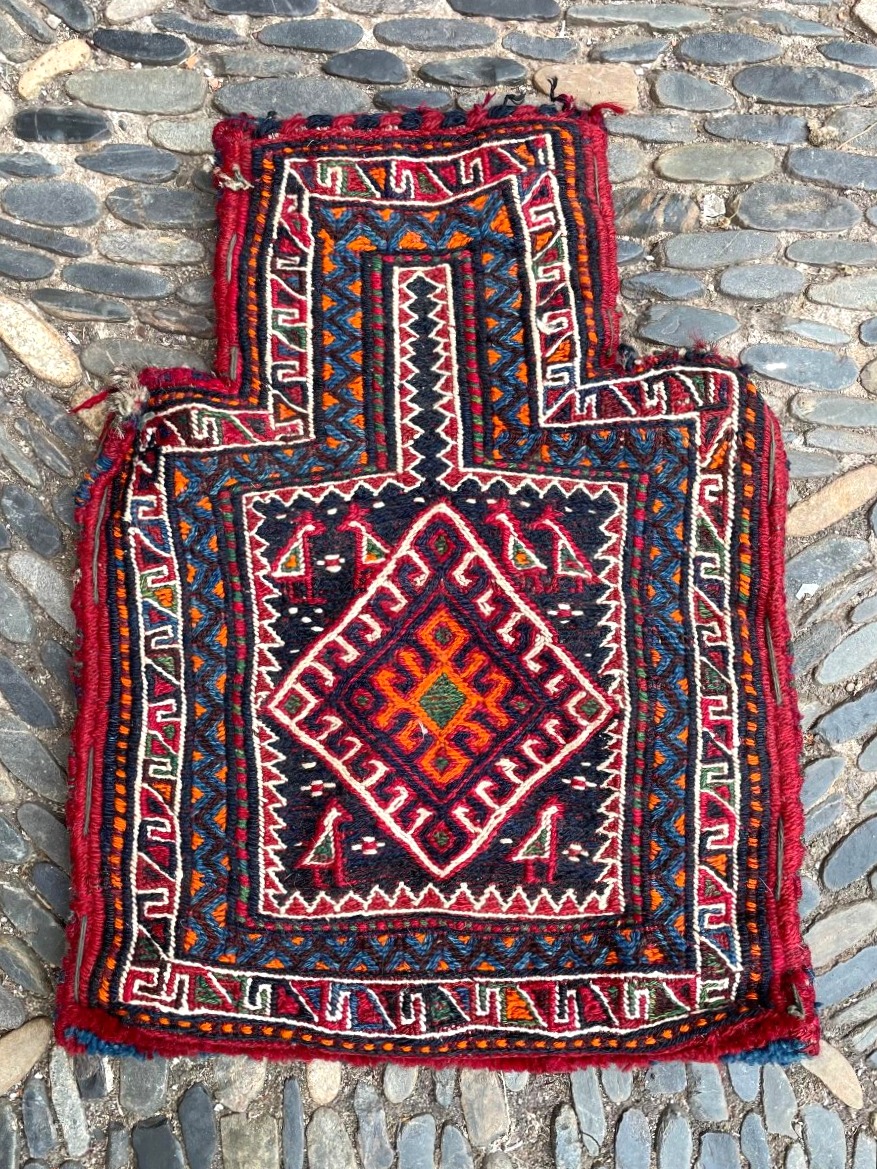


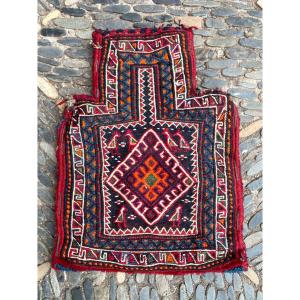


Namakdan (salt Bag). Bathiyari / Persia. Circa 1900. 50 X 38 Cm
Salt was an essential resource for nomadic life: it was part of the diet of both people and livestock, and was also used in certain processes related to dyeing wool.
To store and transport it, people crafted pouches with a distinctive shape, tapering toward the top like a neck. This narrow opening served a very practical purpose: to keep the salt protected and prevent it from spilling.
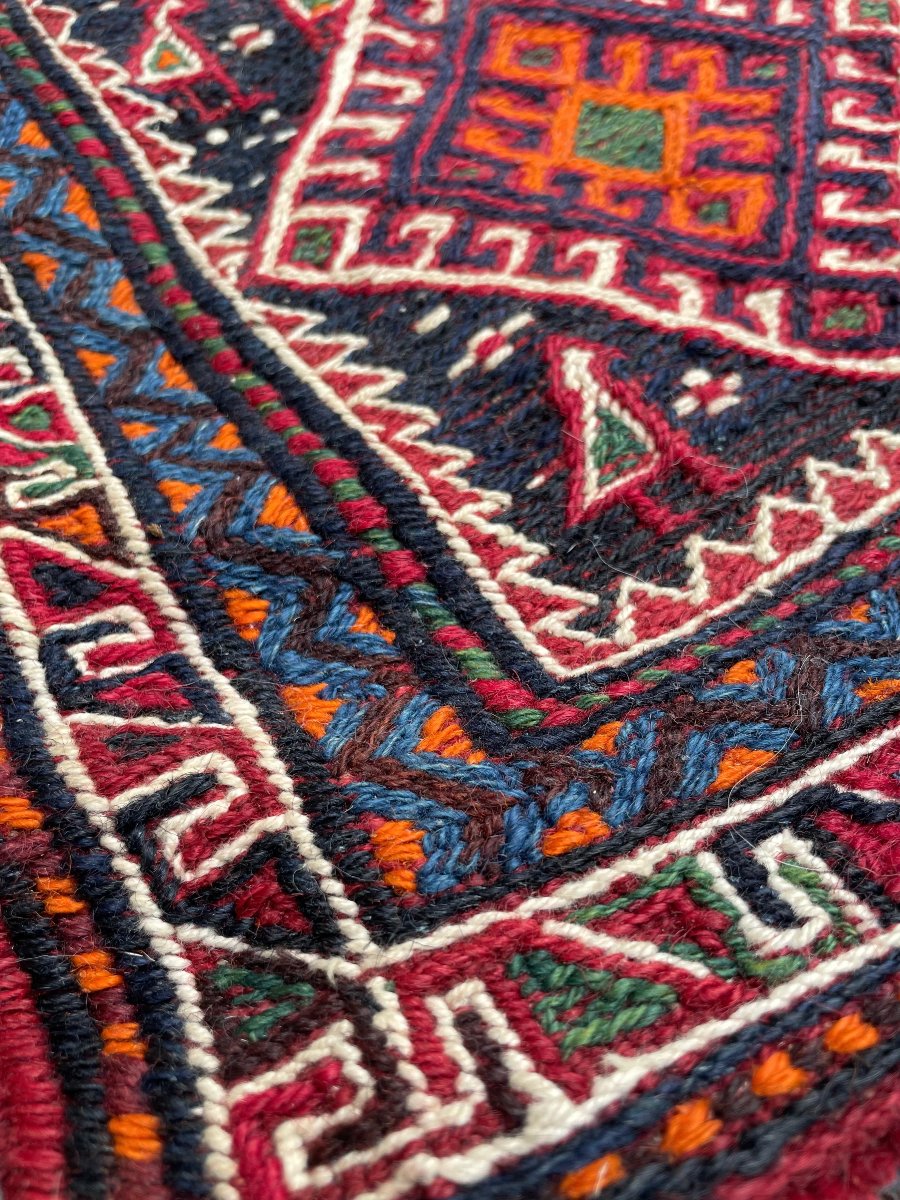
It is this connection between utility and beauty that strikes me about this Namakdan. Its shape serves a practical purpose, yet it also serves as a canvas for richly detailed decoration. On the front, the sumak weave forms a carefully constructed composition, enlivened by geometric patterns and bold colors.
The back, woven in beautiful shades of indigo blue, offers a more subdued contrast. In the lower section, which bears the weight of the contents, the knotted stitch reinforces the piece. This difference in techniques demonstrates true ingenuity: each part receives the treatment suited to its function, without ever sacrificing aesthetics.
What I love about this object is its perfect balance between utility and refinement. Antique Namakdans are less familiar than rugs or large saddlebags; yet they connect us to an everyday practice that has now almost disappeared. Their rarity lends this pouch a discreet elegance, without detracting from the simplicity of its function.
Salt pouch, Namakdan
Bakhtiari / Persian origin
Mixed technique, wool on wool
50 × 39 cm
Circa 1900
Choosing an antique rug or textile is often a matter of serendipity.
If one of our pieces catches your eye, or if you’d like more information or photos, I’d be happy to discuss it with you.
Laurent Consul
Beauty of Kilims
06 42 61 73 46
To store and transport it, people crafted pouches with a distinctive shape, tapering toward the top like a neck. This narrow opening served a very practical purpose: to keep the salt protected and prevent it from spilling.
It is this connection between utility and beauty that strikes me about this Namakdan. Its shape serves a practical purpose, yet it also serves as a canvas for richly detailed decoration. On the front, the sumak weave forms a carefully constructed composition, enlivened by geometric patterns and bold colors.
The back, woven in beautiful shades of indigo blue, offers a more subdued contrast. In the lower section, which bears the weight of the contents, the knotted stitch reinforces the piece. This difference in techniques demonstrates true ingenuity: each part receives the treatment suited to its function, without ever sacrificing aesthetics.
What I love about this object is its perfect balance between utility and refinement. Antique Namakdans are less familiar than rugs or large saddlebags; yet they connect us to an everyday practice that has now almost disappeared. Their rarity lends this pouch a discreet elegance, without detracting from the simplicity of its function.
Salt pouch, Namakdan
Bakhtiari / Persian origin
Mixed technique, wool on wool
50 × 39 cm
Circa 1900
Choosing an antique rug or textile is often a matter of serendipity.
If one of our pieces catches your eye, or if you’d like more information or photos, I’d be happy to discuss it with you.
Laurent Consul
Beauty of Kilims
06 42 61 73 46
280 €
Period: 20th century
Style: Orientalism
Condition: Excellent condition
Material: Wool
Length: 59 cm
Width: 39 cm
Reference (ID): 1835899
Availability: In stock
Print