Miniature globe, 5cm in diameter, by Heymann in Berlin, held by two angels or cupids playing with the globe. Unusual decorative brass mount. The entire piece measures 9cm in height and the base is 4.3[...]
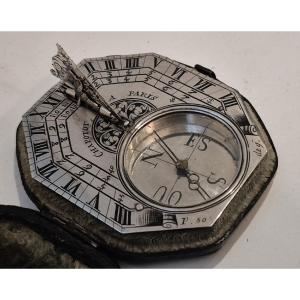
Chapotot, Silver Octagonal Horizontal Sundial, Paris, circa 1687-1691. This silver octagonal horizontal sundial is signed "Chaptot à Paris" and dates from between 1687 and 1691 due to the discharge ma[...]
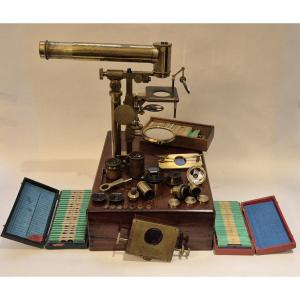
A spectacular universal achromatic microscope by Charles Chevalier, signed "Microscope Achromatique Universel de Charles Chevalier Ingénieur Opticien Breveté Palais Royal 163 à Paris," dating from the[...]
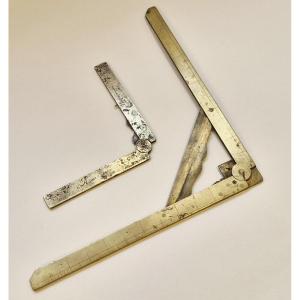
A set of two 18th-century brass folding rulers: - A six-inch (half-foot) folding ruler by Baradelle in Paris, circa 1740. This is almost certainly by Nicolas Jacques Baradelle. The instrument measures[...]
An 18th-century small surgical set comprising six scalpels with various blades and a snuffbox. The handles are made of bone or ivory. Three of the scalpels bear the mark of the heart, likely by Weber [...]
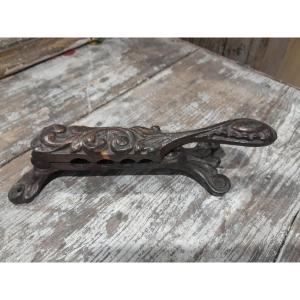
A cast iron corkscrew, decorated with scrolling foliage. It was used to shrink corks so they could be inserted into the neck of a vial or bottle, making it airtight. Traces of an orange patina are vis[...]
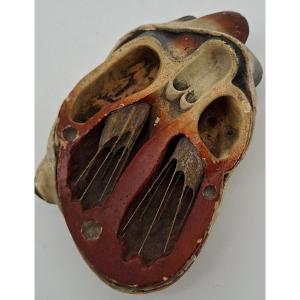
Fortunately, this part of the heart is not fixed to any support, allowing for manipulation and observation of all its surfaces… Karl Ernst Bock, German physician and anatomist, 1809–1874. Graduating i[...]
Karl Ernst Bock, German physician and anatomist, 1809–1874. Graduating in medicine in 1831, he specialized in anatomy, physiology, and pathology at the University of Leipzig, where he became a full pr[...]
It must have been more convenient to observe a tongue from all angles when it was presented to students as a plaster anatomical model rather than an actual anatomical cross-section… Karl Ernst Bock, G[...]
Karl Ernst Bock, German physician and anatomist, 1809–1874. Graduating in medicine in 1831, he specialized in anatomy, physiology, and pathology at the University of Leipzig, where he became a full pr[...]
Karl Ernst Bock, German physician and anatomist, 1809–1874. Graduating in medicine in 1831, he specialized in anatomy, physiology, and pathology at the University of Leipzig, where he became a full pr[...]
Very rare circular pewter syrup container with a long spout and a turned wooden handle with a beaded socket. Control mark: crowned C / AVALLON. Mark of Etienne SERGENT, master craftsman in 1769: crown[...]
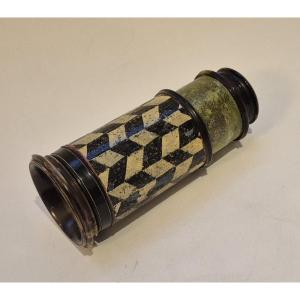
A spyglass constructed of horn and cardboard, lined with wallpaper featuring a typically Italian, perhaps Florentine, checkered pattern, and green vellum on which the remains of small silver tools are[...]
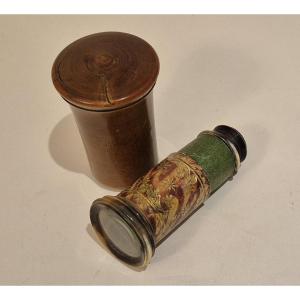
A spyglass constructed of white and brown horn and cardboard lined with paper, embossed with a rich decoration of small gilt tools. The spyglass is unsigned but Italian, dating from the mid-18th centu[...]
A spyglass constructed of white and brown horn and cardboard lined with white-dyed fish skin (ray or shark) and green vellum. The spyglass is unsigned but French, dating from the 18th century. The ori[...]
Small miniature globe or world map, signed NK* Publishers in Paris, blackened wood base, early 20th century. This globe is in good overall condition. It is signed on the side. Note: minor imperfection[...]
A superb terrestrial globe published by J. Forest and the geographers-publishers Girard & Barrère in Paris, circa 1900–1914. This is a large model (32 cm in diameter), resting on an elegant, richly or[...]
Antique brass folding rule/square – Butterfield Paris – “Pied de Roy”, “Pied du Rhin” scales – 18th century
Rare antique brass folding rule and square, signed Butterfield Paris, dating from the lat[...]
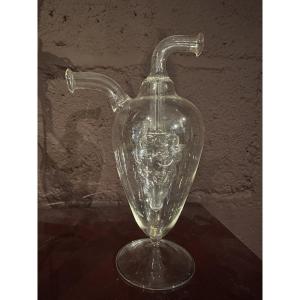
A fine pair of blown glass apothecary ampoules, circa 19th century. They feature emery stoppers and a frosted pontil mark at the base and top of the ampoule body. Some air bubbles are present. Total h[...]
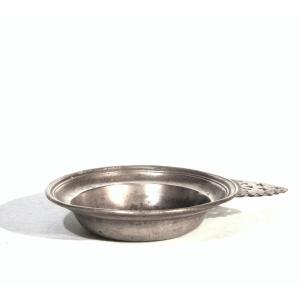
Pewter bleeding palette, circular with a molded, rounded rim, with an openwork bracket decorated with stars and a flamed heart.Control mark: "PARIS", used from 1780.Mark of Louis Nicolas Boicervoise, [...]
18th-Century English Brass Sector, Signed “R. Glynne Fecit”, c. 1750–1775
Length (closed): 16 cm — Width: 3.8 cm — Material: Solid brass
A fine mid-18th-century English brass sector, clearly signed [...]
This small calculating machine, invented and patented by Casimir Louis Chambon in 1876, consists of four printed cylinders: 1 to 9, 10 to 90, 100 to 900, and 1000 to 9000. These cylinders allow the pe[...]
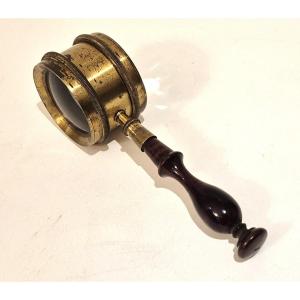
Large and early lens, or simple microscope, known as the Coddington microscope, after its inventor Henry Coddington in 1829. The instrument is unsigned, as is typical. The Coddington microscope consis[...]
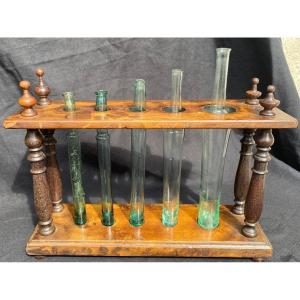
Five blown glass test tubes and their walnut stand, dating from the 18th century. Stand dimensions: 33.3 cm x 10 cm x 24.5 cm high. Height of the tallest test tube: 25 cm
Cast iron pharmacy cork cutter, late 18th century. Traditionally used to reduce the size of corks so they could be inserted into a vial or bottle, thus creating an airtight seal. This is a traditional[...]
A beautiful educational object representing a large sunflower seed. The object opens in three parts to reveal the entire seed and its germ. A highly original, almost abstract piece. In good condition.[...]
Large, unsigned German technical drawing instrument set, dating from the second half of the 18th century. This large set includes: - A beam compass with two dry points, one of which can be replaced wi[...]
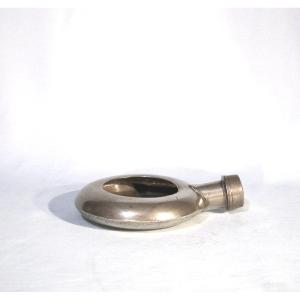
Lenticular-shaped pewter spittoon with tubular spout and screw-on cap. Diameter: 12.6 cm. Length: 16.5 cm PARIS, Second half of the 19th century Rare medical object in perfect condition.Bibliography :[...]
Hammond typewriter, model 12 half-moon, 1905. The Hammond typewriter is named after its designer, James Bartlett Hammond (1839-1913). He believed that the typewriter should allow not only the use of d[...]
A fine example of a camera lucida bearing the signature "Moreau Opticien / 16 rue de Seine," indicating that it was made by the Parisian optical firm Moreau, founded in 1830 and active until the 1890s[...]
Antique surgical equipment from the early 20th century, headlamp and case marked Drapier & Sons, United France. Ideal for a cabinet of curiosities or a collection of antique surgical instruments. Good[...]
This instrument consists of a brass base and stand, to which a semi-circular metal dial and a gnomon are attached. The circular base has a felt underside. It incorporates a compass with a central need[...]
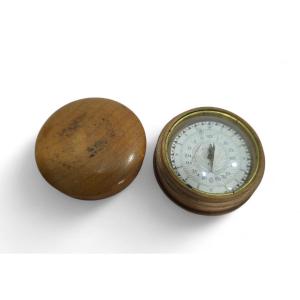
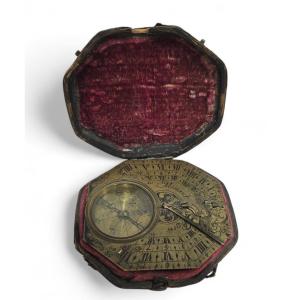
A charming 19th-century portable sundial, presented in an elegant turned wooden case. This compact and refined scientific instrument testifies to the craftsmanship and precision of 19th-century timeke[...]
A rare 19th-century Asian portable sundial, finely crafted in bronze and adorned with semi-precious stones. This exquisite instrument combines scientific functionality with artistic ornamentation, ref[...]
An elegant 19th-century portable sundial, crafted from partially silvered bronze and finely engraved with precise graduations and decorative details. This compact timekeeping instrument testifies to t[...]
A charming 19th-century portable sundial, presented in its original wooden case. This compact instrument exemplifies the craftsmanship and functionality of 19th-century scientific inventions. Designed[...]
A charming 19th-century portable sundial, presented in its original wooden case. This compact instrument exemplifies the craftsmanship and functionality of 19th-century scientific inventions. Designed[...]
An exceptional 18th-century octagonal brass sundial, signed "Johan Schrettegger, Augsburg," featuring a blued steel pointer, a folding latitude arc engraved from 10° to 90°, and an engraved equinoctia[...]
An elegant 19th-century portable sundial, signed "Dollond London," finely crafted in wood and brass. The renowned Dollond family of London were among the most prominent makers of scientific instrument[...]
A charming portable sundial in engraved wood, dating from the 19th century. This compact timekeeping instrument exemplifies the practical elegance and craftsmanship of traditional scientific instrumen[...]
This 19th-century horizontal bronze sundial is a remarkable piece. It is inspired by the designs of Erasmus Habermel (c. 1538–1606, Prague), one of the most celebrated instrument makers of the late Re[...]
A rare 19th-century Chinese portable sundial, finely crafted in engraved and enameled bronze. This instrument, with its precise details, testifies to the craftsmanship and scientific artistry of Qing [...]
A rare and fascinating 19th-century terrestrial globe, finely carved in ivory, which opens to reveal a sundial hidden inside. This extraordinary piece illustrates the skill and ingenuity of 19th-centu[...]
A rare 19th-century American portable sundial, finely engraved on bronze, bearing the names of various American cities for geographical reference and calibration. This remarkably crafted instrument te[...]
A magnificent 19th-century portable sundial, signed "T. Mason, Dublin," made of partially silvered brass and adorned with delicate engravings. This elegant scientific instrument testifies to the preci[...]
An exceptional German portable sundial, finely engraved and made of gilt brass, signed "J. Vogler," and preserved in its original case. Made in the 18th century, this exquisite instrument testifies to[...]
An elegant 19th-century pocket sundial, designed to be carried by hand, crafted from finely engraved silver-plated metal. This compact and functional timepiece reflects the refinement and precision ch[...]
A charming portable sundial in engraved wood, dating from the 19th century. This compact timekeeping instrument illustrates the practical elegance and craftsmanship of traditional scientific tools of [...]
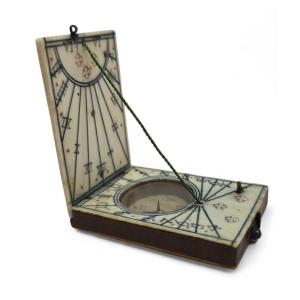
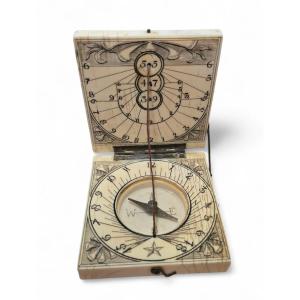
A rare portable sundial in engraved ivory, a fine example of 17th-century German scientific instrumentation, probably made in Nuremberg, a city renowned for its precision and horological innovations. [...]
An exceptional portable sundial in engraved ivory, a fine example of 18th-century German craftsmanship, likely made in Nuremberg, one of Europe's historic centers for the manufacture of scientific ins[...]
An elegant, portable brass sundial, finely engraved and signed "Menant à Paris," testifying to the precision and expertise of French artisans specializing in scientific instruments. This compact and e[...]
An elegant, portable bronze sextant, used for nautical navigation. Finely crafted, it features precise details and a compact design. A beautiful example of traditional maritime instrumentation, it tes[...]
Rare equinoctial ring. Signed "N Bion A PARIS", circa 1700, in bronze, composed of meridian and equatorial rings. Latitude engraved with names of European cities alternating with floral motifs. Rotati[...]
Field surgical kit. The rarity of this piece lies in the number of items it contains: Mayo scissors, curved Mayo scissors, needle holder, swabbing forceps, and smear forceps. Plus one (unidentified). [...]
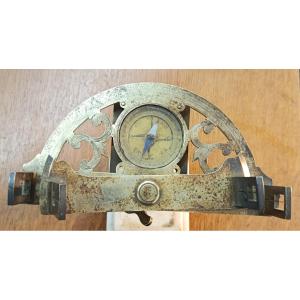
18 th - century bronze graphomètre with sighting vanes , made by renard , ParisGeodeticvand topographic instrumentCompass diamètre : 4,7 cmHeight with ball joint and base : 15 cmWidth : 18 cmComplete [...]
A case signed "M[ais]on DUBOIS | Surgical Instruments | 21 rue M. Le Prince | Paris," [circa mid-20th century]. The case is made of fruitwood, and the instruments are chrome-plated and silver-plated m[...]
Proantic uses a cookie to analyze traffic and improve its service by using Google Analytics. Data sent to Google Analytics (frequency of visits to the site and pages visited) are anonymous. No other cookie tracks your activity, your personal data is not collected. Thank you for helping us to have better understanding how Proantic is used.


























 Le Magazine de PROANTIC
 TRÉSORS Magazine
 Rivista Artiquariato