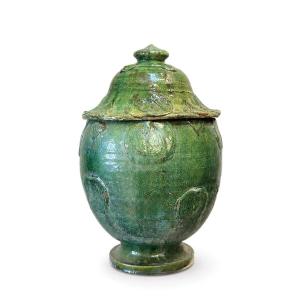
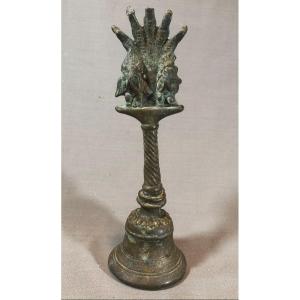
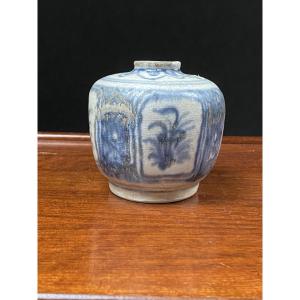
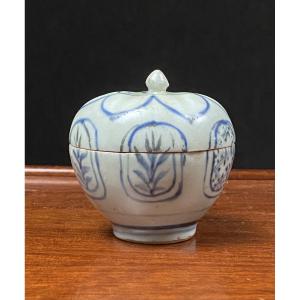
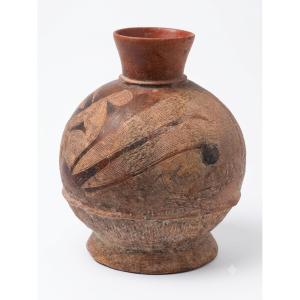
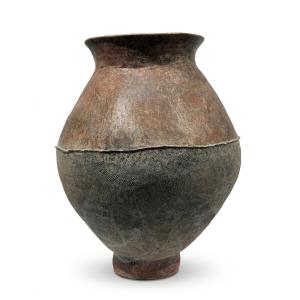
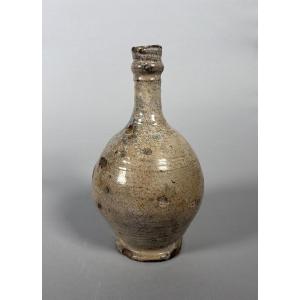
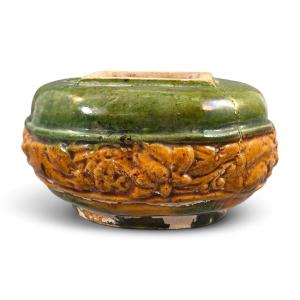
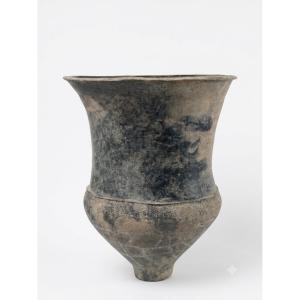
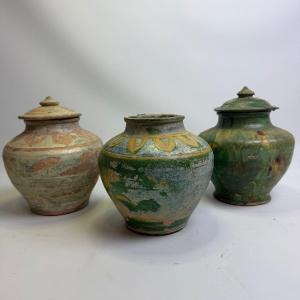
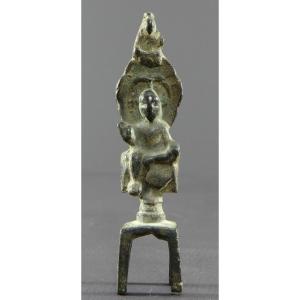
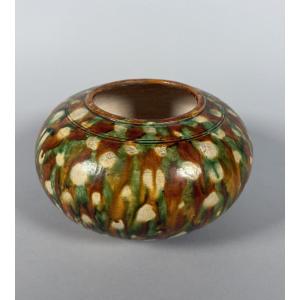
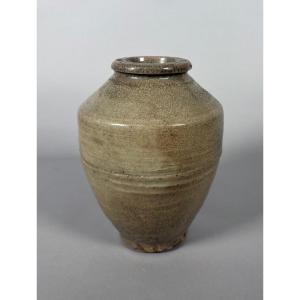
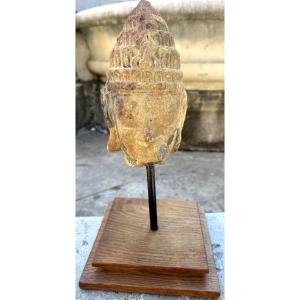
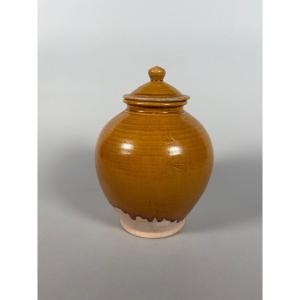
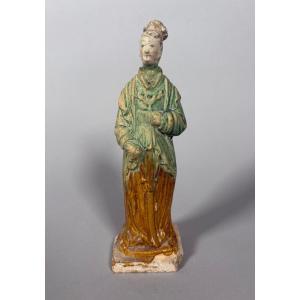
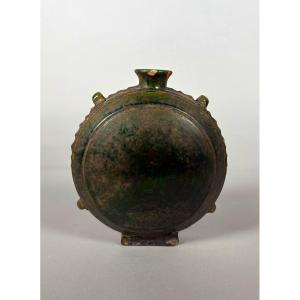
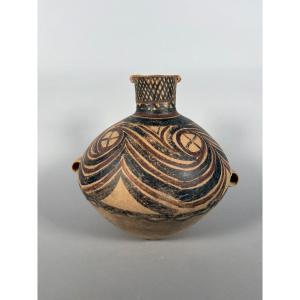
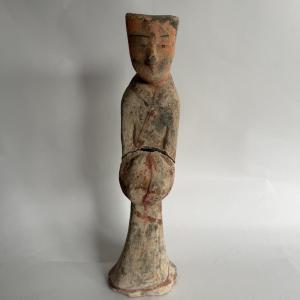
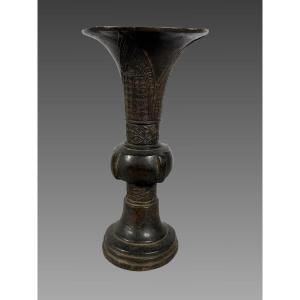
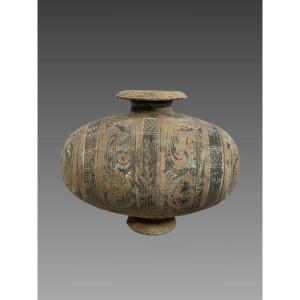
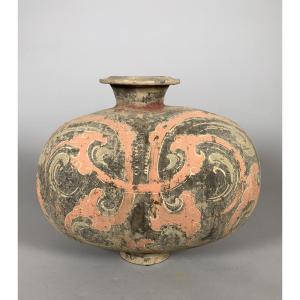
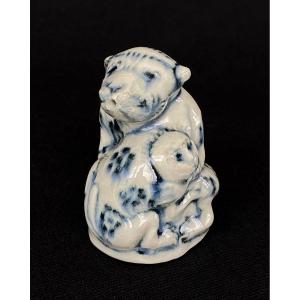
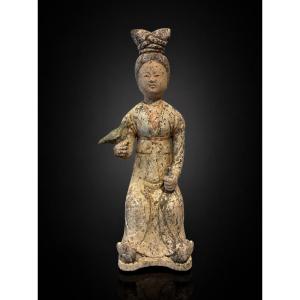
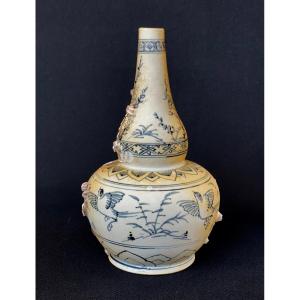
White-glazed pot, China, Tang Dynasty (618-907). Important globular pot with a rounded neck. White glaze applied over a white slip. The lower part and body are left unglazed, revealing the pinkish-bei[...]
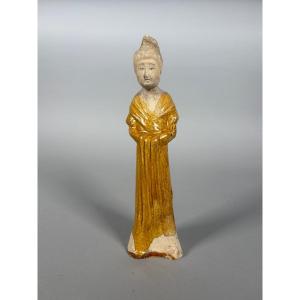
This terracotta statuette of a Tang dynasty court lady is an excellent example of the renowned funerary “Fat Ladies.” Her full and rounded silhouette, serene posture, broad calm face and ample robe re[...]
Exceptional funerary terracotta diorama depicting an ox pulling a covered cart, perfectly aligned with the repertoire of mingqi models from the Northern Qi dynasty. The piece stands out for its cohere[...]
An extremely rare Qinbai ceramic bowl from the kilns of the Southern Song Dynasty (1128-1279). The interior is decorated with stylized lotus motifs incised into the bowl. This bowl testifies to the ab[...]
Front section of a Chinese imperial tile with a five-clawed dragon motif. Period: 16th century. Formerly pierced for hanging. Antique piece with damage. Diameter: 12 cmShipping within France and EU on[...]
A statue depicting an imposing camel and a guide seated on its back. China, Tang Dynasty. 600-900 AD. Polychrome terracotta. Dimensions: length: 44cm, height: 41cm, width: 17cm. Condition: rider's hea[...]
Bi DISCChinaGreen marbled stone, probably jadeDiameter: 4.5 cmThickness: 1.5 cm(on bronze base)Large flat disc made of polished green stone, with a circular hole in the centre.The earliest jade bi dis[...]
Facing tile with interlacing decoration. Central Asia, 14th-15th century. Unglazed clay tile with molded interlacing decoration combining palmettes and florets. Mounted on a plexiglass backing. Total [...]
Bronze vase with two handles in the form of Chinese lions, their heads turned outwards. A decorative band in relief depicts the symbolic image of a Chinese dragon's head. China, Yuan/early Ming dynast[...]
A terracotta Mingqi with a beige slip, depicting a Bactrian camel.In very good condition.Please note that all ancient Chinese terracotta sculptures were placed in the tombs of the deceased to accompan[...]
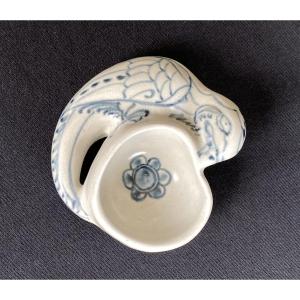
A Qingbai 'fish' water dropper.Yuan dynasty (1279-1368).The body covered in a pale blue Qingbai glaze and molded as a fish-form water dropper. The fish’s open mouth serves as the spout, while a small [...]
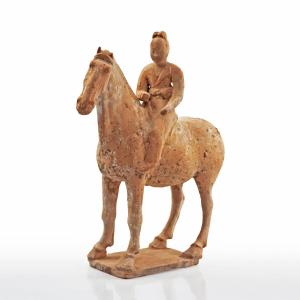
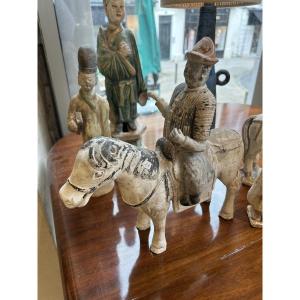
Description A terracotta Ehorseman, datable to the Tang Dynasty (618–907 AD), this work is a representative example of Chinese funerary sculpture characterized by a high level of technical skill and s[...]
Clothing clasp in the shape of a scorpion. Bronze piece with a double patina. China, Han period (206 BC–220 AD). Exquisite craftsmanship and high-quality detail. Length: 9 cm. Free and insured shippin[...]
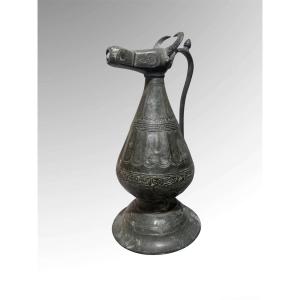
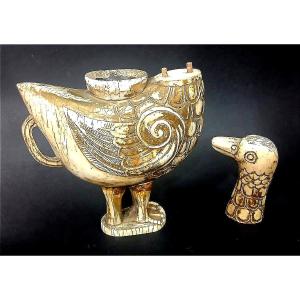
I am clearly frustrated because my research leads me to the Louvre, where a similar zoomorphic lamp of Iranian origin from the 12th-13th century is present in the collections (Caucasus, Khurasan)... B[...]
Ancient ritual keris – Indonesia (Java or Bali), pre-Islamic period
Fully forged from a single piece of iron, length: 17.5 cm
Rare ancient keris, entirely forged from one single piece of iron, inclu[...]
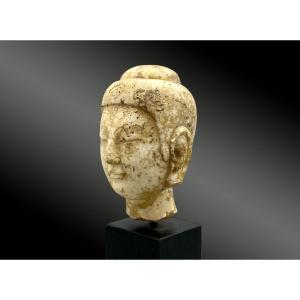
BUDDHA HEADChina, Sui dynasty, late 6th–early 7th centuryMarbleH: 9; W: 5 cm(burial patina and restorations) This Buddha head is particularly elegant: its half-closed, slanted almond-shaped eyes conve[...]
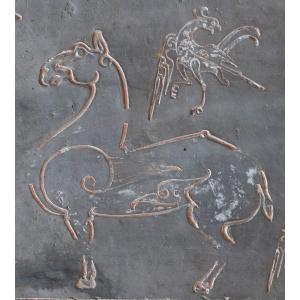
An imposing sculpted terracotta brick, part of the corpus of funerary architectural elements from the Han dynasty, a period marked by a strong symbolic codification of the afterlife and the rise of a [...]
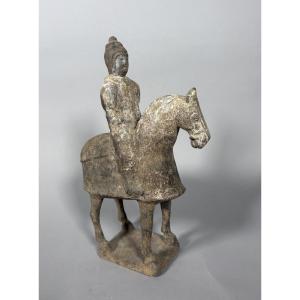
A terracotta sculpture depicting a horseman, a remarkable example of funerary art from the Northern Wei dynasty, a pivotal period in northern China, under the rule of the Xianbei people, which develop[...]
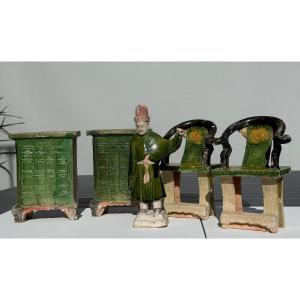
This miniature terracotta table, covered in green and honey glazes typical of Ming period funerary workshops, is a fine example of furniture intended to accompany the deceased into the afterlife. Rais[...]
A small terracotta offering table transports us to the heart of Ming dynasty Chinese funeral rituals. Resting on four tubular legs glazed in a deep green, it evokes the rustic furniture of traditional[...]
Two small, miniature pieces of furniture, crafted from terracotta and covered in a deep green glaze, seem to emerge untouched from a silent world: the funerary dwellings of Ming dynasty China. Their c[...]
On the carefully gridded upper surface, two recesses hold a tripod pot and a small bowl—both removable—also coated in a glossy green glaze. The slightly bulbous pot still bears the marks of hand-model[...]
Here is a piece from the past. Dating from the Song Dynasty (960-1279), this double-handled pot from Henan Province (east-central China), with its deep black glaze, will grace your home. It rests on a[...]
Large, wide, and deep Chinese bowl from the Yuan Dynasty (1279-1368). Made of stoneware from the Cizhou kilns, it features a typical cream glaze and minimalist ochre decoration. The potter's wheel is [...]
China – Cizhou kiln, Yuan Dynasty (1279-1368) / Ming Dynasty (1368-1644) Beige glazed stoneware jar with brown glaze decoration of a character (glaze chips) Height 18cm, diameter approx. 30cm - €680 -[...]
Large, shallow bowl resting on a ring-shaped ceramic foot, decorated with incised sgraffito on a white slip, composed of lozenges and crosshatching highlighted with green and yellow glazes. 10cm high,[...]
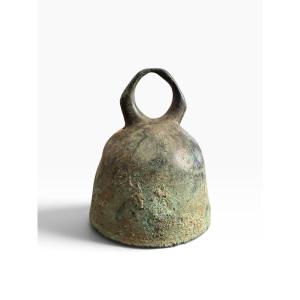
Bronze gong with a typical green patina, dating from the 15th/16th century, Khmer period in Vietnam. The Central Highlands of Vietnam then belonged to the Khmer Empire. The center of this empire was l[...]
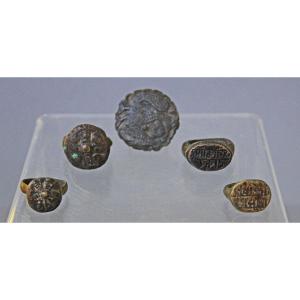
13th-14th Century Bronze Islamic Ring w Silver Inlaid Eight Pointed StarA beautiful large medieval ring with beautiful silver inlay through the ring. the main focus is the inlaid eight pointed star.Th[...]
This rare set comprises twelve Chinese zodiac figurines, each modeled in terracotta and covered with ancient polychromy using mineral pigments. The figures, depicted standing, hold in their hands the [...]
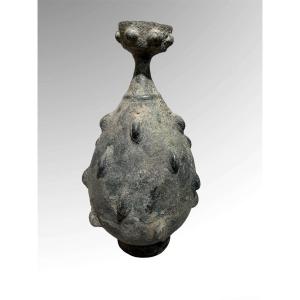
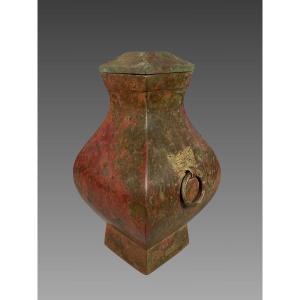
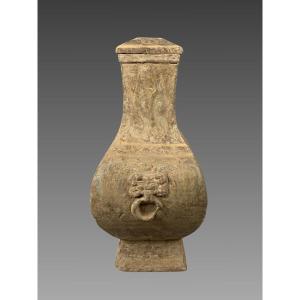
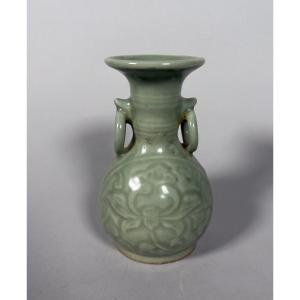
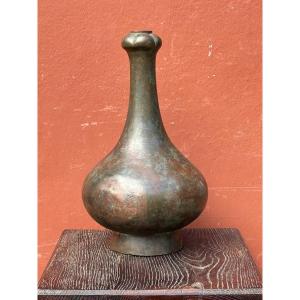
Extremely rare bronze HU vase, China, Han Dynasty (206 BC - 220 AD). Bulging body, two handles in the form of masks (rings missing). Excavated find, beautiful nuanced patina, very hardened clay on the[...]
Six-panel Japanese folding screen from the Edo-Meiji period. Signed Hasegawa Setsushū, painter of the Hasegawa (or Kanō) lineage active during the Edo period (17th-19th century).
This monumental funerary statuette (75.5 cm) is an emblematic work of mingqi ("spirit objects") statuary from the Han Dynasty. Depicting a court lady in an attitude of protocolar reverence, it is dist[...]
Fragment of a medieval temple in reddish-brown sandstone. In the lower right, the head of an elephant, probably Ganesha, holds a lotus flower in its trunk upon which a female figure kneels in prayer, [...]
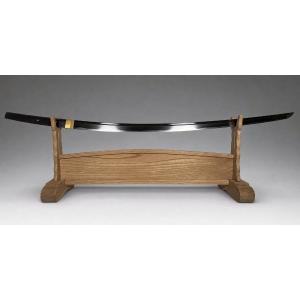
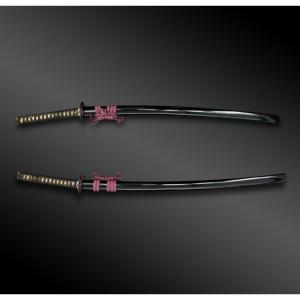
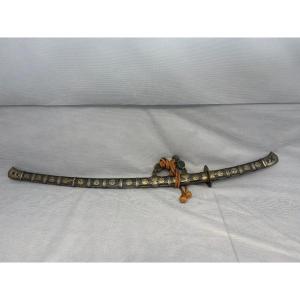
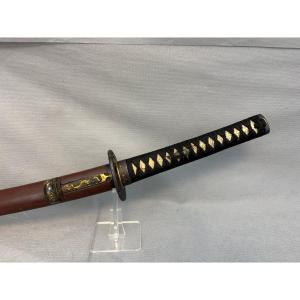
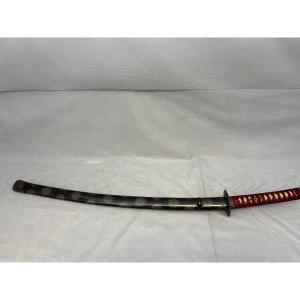
SABER called Itomaki-no-tachi signed Bushū ju Shimohara Ju Yasushige with Hozon certificateBushu Province, JapanMuromachi period (1336-1573)Steel, wood, iron, copper, shakudo, brass, silverNagasa: 73.[...]
Beautiful carved sandstone temple plaque. Minor chips to the nose and mouth: see photos. Very heavy: approx. 70 kg. Height: 77 cm, Width: 55 cm, Depth: 21 cm. Secure delivery by carrier. Please feel f[...]
This sandstone temple fragment depicts a Surasundari, a celestial female figure emblematic of medieval North Indian sculpture. The young woman is shown in a tribhanga pose, with a pronounced hip sway [...]
China, terracotta depicting a court lady commonly known as a Fat Lady. It features ochre-gray hues with traces of white slip and highlights of red pigment. A moving representation of a court lady, she[...]
Tanto Uda Kunimune (宇多国宗) in Koshirae, with a very rare Shiji-Mei signature on the blade and Kinzogan (gold) inscriptions. (Shipping costs included for the EU, extra for international).This Tanto i[...]
A finely made Southern Song dynasty temmoku tea bowl from the Dong Zhang kiln in Fuqing, Fujian province, dating to the 12th–13th century.Wheel-thrown stoneware with a compact rounded form and gently [...]
Visible in Paris. Free local pickup in the capital and its suburbs. Shipping within France: €20, contact me for shipping to Europe and the rest of the world. Small Cizhou-type jar with a globular body[...]
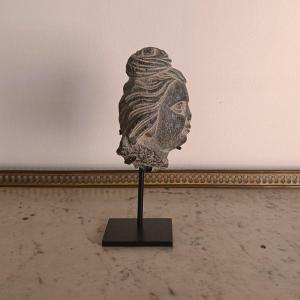
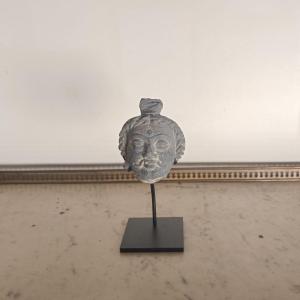
Head of Shakyamuni Buddha on a standAfghanistan/PakistanAncient Gandhara region2nd-4th century ADOur Buddha head is distinguished by a full face, with delicately drawn brow ridges meeting at the base [...]
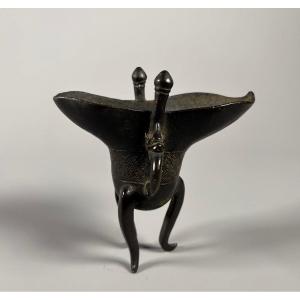
Tripod "Jue" Cup, China, Ming Dynasty (1368-1644). This cup replicates the shape and motifs of the Jue ewers of the Shang Dynasty. Resting on three blade-shaped feet, the body is decorated with archai[...]
Stone sculpture depicting the head of Shiva wearing the high ascetic topknot. Grey sandstone. Gupta Dynasty. India. 4th-6th century. Dimensions: 28 x 10 x 8 cm
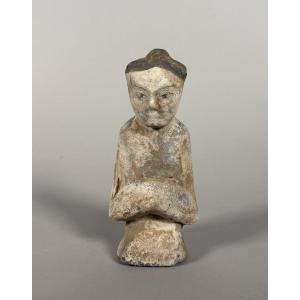
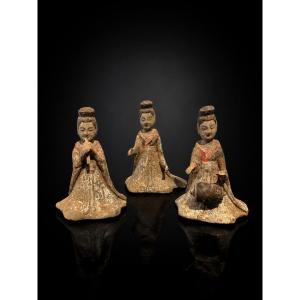
Sculpture of a Mingqi, China, Han Dynasty (206 BC to 221 AD). Sculpture of a dancer in an imperial court dress. Terracotta painted with a white, black, gray, and red slip. Mingqi are ritual funerary s[...]
A quietly powerful celadon for refined interiors: scalloped foliate rim, carved chrysanthemum rosette and scrolling foliage under a sea-green glaze that pools like water and softly pales at the edge. [...]
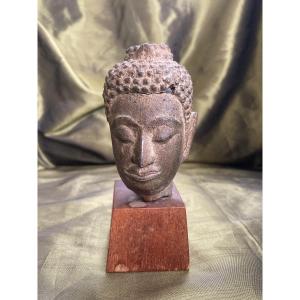
Bronze Buddha head with a dark golden patinaOld Kingdom of SiamAyutthaya School14th-15th centuryThe Buddha's youthful face is characterized by great gentleness and an expression of inner peace. Delica[...]
Examined under binocular magnification (×10) and raking light, this stucco head of Buddha, mounted on a modern display base, exemplifies with remarkable precision the serene beauty and spiritual refin[...]
Boucle médiévale dorée Collection BigotUne boucle dorée originale, probablement d'époque mérovingienne, mais assurément du haut Moyen Âge.La dorure est probablement en or ou en cuivre ; il s'agit d'un[...]
Grey sandstone sculpture representing Witsanukam (avatar of Vishnu, architect god) in his form as dvarapala (temple guardian), Khmerizing Kingdom of Lopburi, 13th century. Photo of a model of the god [...]
China - Tang Dynasty (618-907) Large terracotta prancing horse, ochre and beige, with a chestnut mane, raising its right foreleg high, harnessed and ready to depart. Height 47.5 cm. Thermoluminescence[...]
Elegant funerary figure of a Tang Dynasty court lady (仕女俑), modelled in reddish-grey terracotta, coated with a white slip and painted in original polychromy. Authentic pigment remains are clearly visi[...]
Proantic uses a cookie to analyze traffic and improve its service by using Google Analytics. Data sent to Google Analytics (frequency of visits to the site and pages visited) are anonymous. No other cookie tracks your activity, your personal data is not collected. Thank you for helping us to have better understanding how Proantic is used.