Roman Bronze Padlock With A Male Protome, 1st–3rd Century A.d. Archaeology
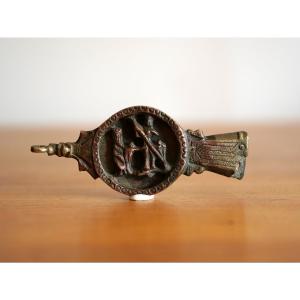
A rare Roman bronze padlock belonging to a particularly sought-after type, known as the “protome” type, characterized by a protective cover topped with a male head sculpted in the round.
The head has a distinctive appearance, with Celtic stylistic elements, giving the piece a remarkable sculptural presence. The design is enhanced by an ornamentation of small bone fragments, arranged on the top of the body as well as on the lid.
The object consists of several distinct parts: a body containing the locking mechanism and a protective lid hinged on the right side. Originally, the locking ring was positioned at the back of the padlock and locked onto the left side.
Beyond its sculptural quality, this type of padlock demonstrates remarkable technical mastery. Concealed within its particularly small dimensions was a highly complex mechanism, the design of which represents a true miniaturization of ancient engineering. These devices, as decorative as they are ingenious, rank among the most unique achievements of Roman locksmithing.
Unfortunately, the hinge, now oxidized, no longer allows the lid to be opened. The keyhole is therefore inaccessible.
Roman padlocks decorated with bronze faces constitute a very distinctive category of ancient locksmithing, at the intersection of utilitarian objects, miniature sculpture, and mechanical ingenuity.
Their origin appears to lie in northeastern Italy, particularly in the regions of Venice, Aquileia, and Concordia, before spreading to several provinces of the Empire, including Roman Britain, Germania, and Illyria.
This family of padlocks has been the subject of a seminal scholarly publication: Romano-Celtic Mask Puzzle Padlocks, by Jerry Slocum and Dic Sonneveld, published in 2017. This work compiles a corpus of 156 artifacts. A complementary typological study, devoted to classifying padlocks according to the characteristics of their covers, was also conducted by Vanessa Muros under the title Padlock groupings based on lock covers. This study focuses on a selection of 128 padlocks from public and private collections. These figures underscore the rarity and significance of these objects, examples of which remain underrepresented in collections and on the antiquities market.
A remarkable testament to the sophistication of Roman locksmithing, where utilitarian function is combined with a genuine pursuit of aesthetics.
Dimensions: 3.1 cm in height.
Provenance: Former Normandy collection (auction house)
Price excludes shipping costs
Police Registry Ref.: A270
Professional Antique Dealer – Guarantee & peace of mind when purchasing
As a professional antique dealer, I am committed to offering only authentic items that have been carefully selected and are legally marketable. Each piece is chosen for its historical, aesthetic, or collectible value and undergoes a rigorous verification of its provenance.
Invoice and Traceability. Each purchase comes with a detailed invoice and a certificate of authenticity, guaranteeing the item’s provenance and ensuring complete transparency.
Legal Compliance. All items comply with current French and European legislation. Any archaeological items are offered in accordance with the Heritage Code (Articles L.542-1 et seq.). Items that may be subject to specific regulations (cultural artifacts, antiques, items made of specific materials) are sold strictly in accordance with the law.
International Buyers. Buyers outside of France are advised to verify the regulations applicable in their country regarding the importation of cultural artifacts or antiques.
Right of Withdrawal.In accordance with the law (Article L.221-18 of the Consumer Code), you have 14 days after receipt to return an item. Return shipping costs are the responsibility of the buyer. The item must be returned in its original condition.
Quality Commitment. Buying from a professional ensures security, transparency, and reliability. I am available to answer any additional questions you may have before making a purchase.
Period: Before 16th century
Style: Rome and Antic Greece
Condition: Good condition
Material: Bronze
Height: 3.1 cm
Reference (ID): 1849584
Availability: In stock