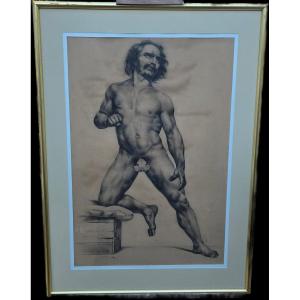


Male Nude Academic Study – Drawing Signed Geltzer, Dated 1863
Artist: Geltzer
A 19th-century academic drawing, signed Geltzer and dated 1863, depicting a male nude in a dynamic pose, executed in black chalk or graphite pencil on paper.
The figure, a mature man with shoulder-length wavy hair and a prominent mustache, is represented in a complex pose combining a twisting torso with an asymmetrical arrangement of the limbs.
His right leg is extended, with the foot firmly planted on the ground, while his left leg is bent and supported by a cushioned wooden studio bench. His right arm is flexed, with the fist held close to his chest, while his left arm extends downward, the open hand resting near his thigh. His head is raised and turned to one side, with his gaze directed upward.
This composition allows the artist to explore the muscular tensions created by the pose, particularly in the shoulders, chest, abdomen, arms, and legs.
The anatomical modeling is achieved through a network of fine, closely spaced lines, occasionally crosshatched, with varying densities to create gradual transitions between light and shadow.
The careful rendering of the musculature demonstrates an understanding of anatomical structure, while the more pronounced contours emphasize the joints and changes in the body's planes.
Particular attention is given to the expressive face, the treatment of the hair, and the detailed rendering of the hands and feet. The simply drawn wooden bench situates the figure within an artist's studio.
A fig leaf conceals the model's genitalia, reflecting a convention of modesty sometimes encountered in academic representations. Whether this detail was added at a later date has not been established.
Historical Background and Academic Training
This drawing belongs to the tradition of male nude studies practiced in European art academies throughout the 19th century.
The study of the human figure was a fundamental part of artistic education. Academic training generally followed a progressive method, beginning with copying prints, followed by drawing from plaster casts of classical sculptures, and eventually working from the live model.
Male nude studies, commonly referred to as académies, enabled students to develop their knowledge of human anatomy, proportion, foreshortening, and the modeling of form through light and shadow.
The pose represented here, with one leg supported on a bench and the torso twisted, provides an exercise in understanding muscular structure, balance, and the relationship between different parts of the body.
No engraving or printed model corresponding precisely to this composition has yet been identified. The drawing may therefore have been executed from a live model or copied from an academic print that has not yet been located.
This work belongs to a group of three male academic studies of identical dimensions, all signed Geltzer and dated 1862 or 1863.
One of the other drawings, entitled The Soldier at Rest (Le Soldat au repos), reproduces a composition by Marc Antoine Hervier, engraved by Alexis-François Girard in the early 19th century.
The use of that particular engraving in the teaching program of the Academy of Fine Arts in Bruges, Belgium, is historically documented.
The Bruges Museums preserve two drawings made after the same engraving by students of the Academy, one dated 1833 and the other 1838.
This connection raises the possibility that Geltzer may also have received artistic training at the Bruges Academy. However, this remains a hypothesis, as no archival documentation has yet confirmed the artist's enrollment or place of study.
Signature and Dating
The drawing bears the handwritten signature "Geltzer" and the date 1863 in the lower left corner.
The artist's full identity and career have not yet been established.
Further research has been initiated with the Bruges Museums to investigate whether the artist's name appears in the Academy's historical student records.
Condition and Framing
The drawing is in good overall condition for its age.
Some minor creases, small age-related imperfections, and signs of wear to the paper are present, as shown in the photographs. These do not significantly affect the overall appearance of the composition.
The fine lines, crosshatching, and tonal variations remain well preserved.
The drawing is presented in a later gilt frame with a decorative mat and is protected under glass.
Dimensions
Framed height: 77 cm (30.3 in)Framed width: 57 cm (22.4 in)
Visible drawing height: 61 cm (24 in)Visible drawing width: 42 cm (16.5 in)
850 €
Period: 19th century
Style: Napoleon 3rd
Condition: Condition of use
Material: Paper
Reference (ID): 1848590
Availability: In stock
Print