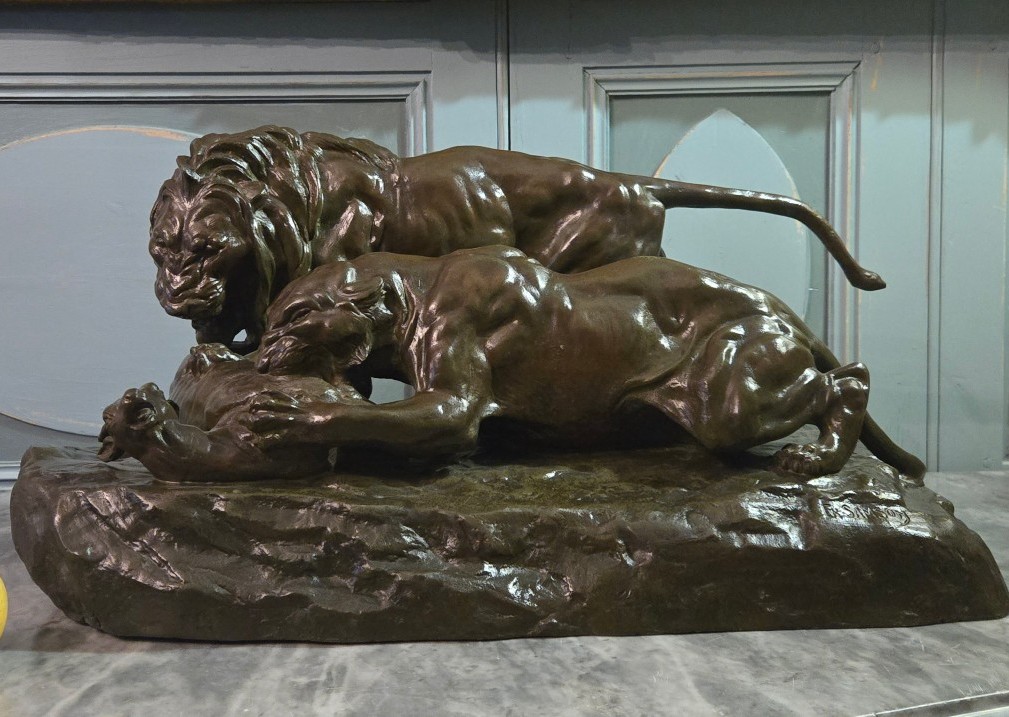
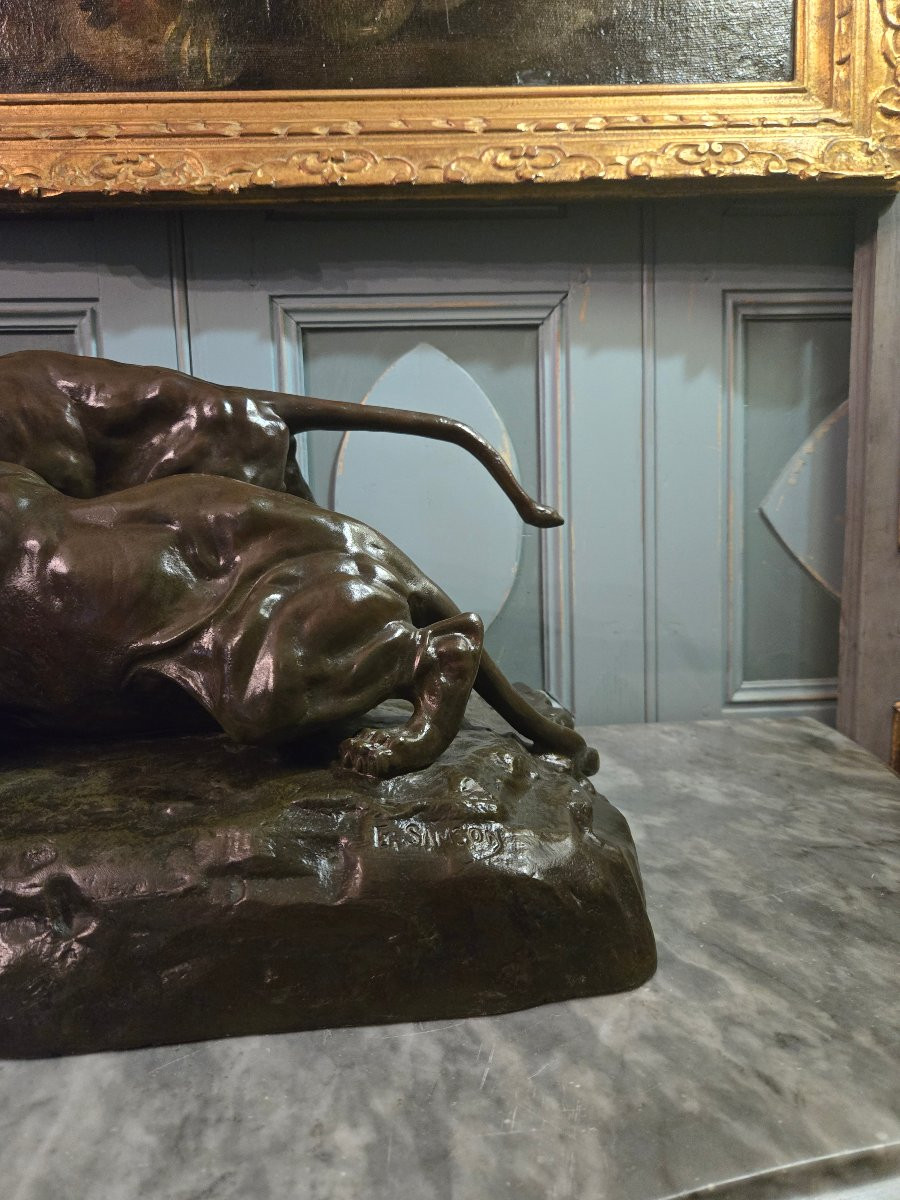
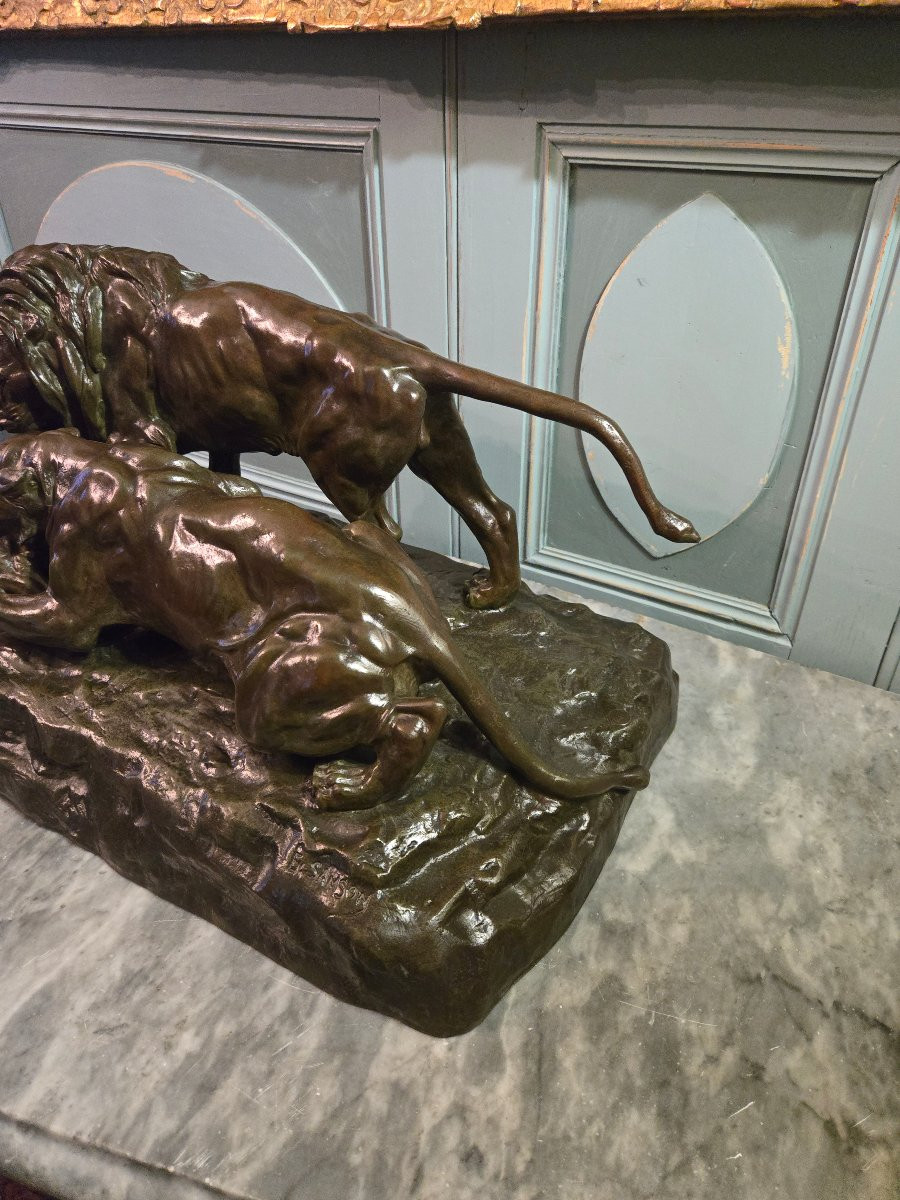


Lion And Lioness Attacking A Gazelle After E. Samson, Important Animal Sculpture.
Artist: Emmanuel Samson
An important animal sculpture depicting a lion and lioness caught in the act of hunting, attacking a gazelle. This spectacular composition perfectly illustrates the late 19th-century taste for animal scenes imbued with naturalism and dramatic tension. The lioness, in the foreground, firmly holds the gazelle beneath her paws, while the lion, slightly behind, dominates the scene with his stature and elaborately sculpted mane. The interplay of postures, the anatomical precision, and the expressive power of the poses lend the whole a great visual intensity. The terrace, treated as a naturalistic rock, plays an integral part in the composition and reinforces the impression of movement and realism. The modeling is distinguished by its great finesse: powerful and taut musculature, expressive heads, and precise rendering of the paws, necks, and bodies. These qualities attest to a particularly meticulous model. The sculpture is made of art zinc, a material widely used in France from the second half of the 19th century for producing large-scale decorative and animal sculptures. Unlike bronze, zinc cannot be reworked or chased after casting, so the quality of the model and the mold had to be impeccable from the outset, which explains the remarkable precision of the details. The entire piece is covered with a beautiful antique patina imitating bronze, applied using the pigment glazing technique. This patina, with its deep brown tones nuanced with olive-green highlights, is homogeneous and well-preserved; it admirably highlights the volumes and gives the sculpture a visual presence very close to that of an art bronze. The base is signed “E. Samson” for Emmanuel Samson (1860-1926), and the sculpture bears two identical foundry marks, stamped into the material, inscribed “Fabrication française – Made in France – Paris.” These marks attest to Parisian production, characteristic of the large foundries specializing in art zinc at the end of the 19th and beginning of the 20th centuries, a period during which Paris established itself as one of the major centers of this type of production. With its substantial dimensions, the quality of its modeling, the elegance of its patina, and the clarity of its attribution, this sculpture constitutes a major decorative piece, representative of French animal sculpture of the Belle Époque and of the now re-evaluated history of art zinc. Dimensions: Width: 67 cm Depth: 38 cm Height: 34 cm Emmanuel Sanson (1860–1926) was a French animal painter and sculptor, recognized as one of the major representatives of French animal sculpture at the turn of the 19th and 20th centuries. Born in Paris, he trained under leading academic masters such as Alphonse de Neuville and Jean-Léon Gérôme, before developing a personal style marked by a powerful naturalism and a keen sensitivity to the observation of the animal world. Early on, Emmanuel Sanson made his mark with his hunting scenes and animal groups, which he explored in both painting and sculpture. He exhibited regularly at the Salon des Artistes Français, as well as at specialized exhibitions related to hunting, venery, and dog shows, where his works were praised for their energy, anatomical accuracy, and sense of movement. His sculptural work demonstrates a constant interest in scenes of predation, pursuit, and dramatic tension—emblematic themes of Belle Époque animal sculpture. To ensure high-quality distribution of his pieces, Emmanuel Sanson collaborated with several renowned Parisian foundries, producing his sculptures in both bronze and art zinc, a material then commonly used for large-scale decorative works. Animal groups like the one presented here perfectly illustrate his taste for strong narrative compositions, where the precision of the modeling serves a spectacular and deeply expressive staging.
1 400 €
Period: 19th century
Style: Napoleon 3rd
Condition: Excellent condition
Material: Other
Reference (ID): 1696362
Availability: In stock
Print