

Giacinto Massola, Dante And Beatrice, Episode Of La Vita Nuova
Artist: Giacinto Massola
GIACINTO MASSOLA
DANTE AND BEATRICE.
EPISODE FROM LA VITA NUOVA
GIACINTO MASSOLA
Sarzana, 1820 – Genoa, 1865
Pencil and grey wash on paper
24.5 × 21 cm / 9.6 × 8.3 in
How often does a life change in a single glance?
For Dante, it was enough — to recognise in Beatrice not only the course of his own fate, but a figure destined to transcend it.
From that moment, Beatrice becomes more than a beloved presence: she is transformed into a guiding principle of Dante’s inner and poetic world. In La Vita Nuova, she appears as the object of a deeply introspective and spiritualised love; in the Divine Comedy, she assumes an even greater role — that of a guide, leading Dante through Paradise and embodying a form of idealised wisdom and grace. Without Beatrice, Dante’s poetic universe would be unimaginable: she is not merely its subject, but its source.
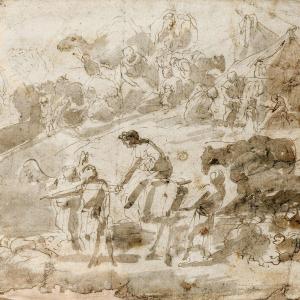
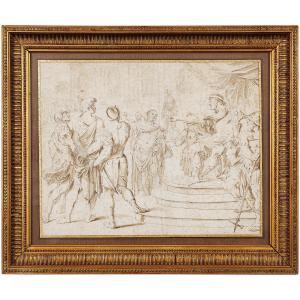
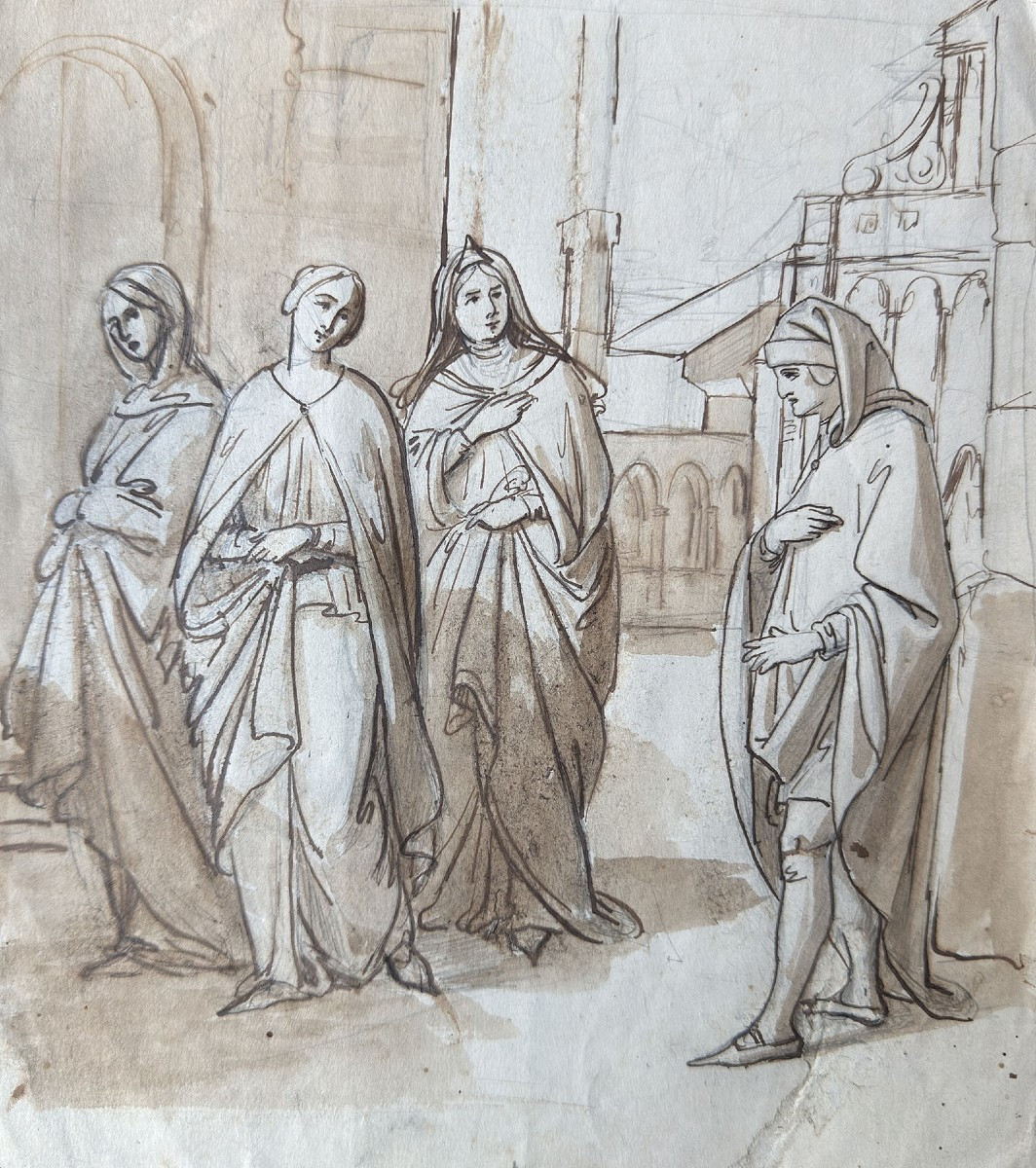
This drawing by Giacinto Massola is based on an episode from La Vita Nuova (c. 1294), Dante Alighieri’s early autobiographical work devoted to his love for Beatrice Portinari. Unlike the more familiar and frequently illustrated episodes from the Divine Comedy, the present composition focuses on a profoundly human and psychologically charged moment, centred on silence, misunderstanding, and emotional distance.
The scene refers to an episode in which Dante, concealing his true feelings, pretends to show interest in other women. When rumours of this reach Beatrice, she chooses not confrontation, but refusal — she declines to acknowledge him. It is precisely this restrained and silent rejection that Massola elects to depict.
Beatrice appears dressed in white, a traditional symbol of purity, but also of distance. She is accompanied by two women: her friend Monna Vanna walks at her side, while a maid follows just behind. The group passes near the Santa Trinita Bridge in Florence, anchoring the scene within a recognisable urban setting.
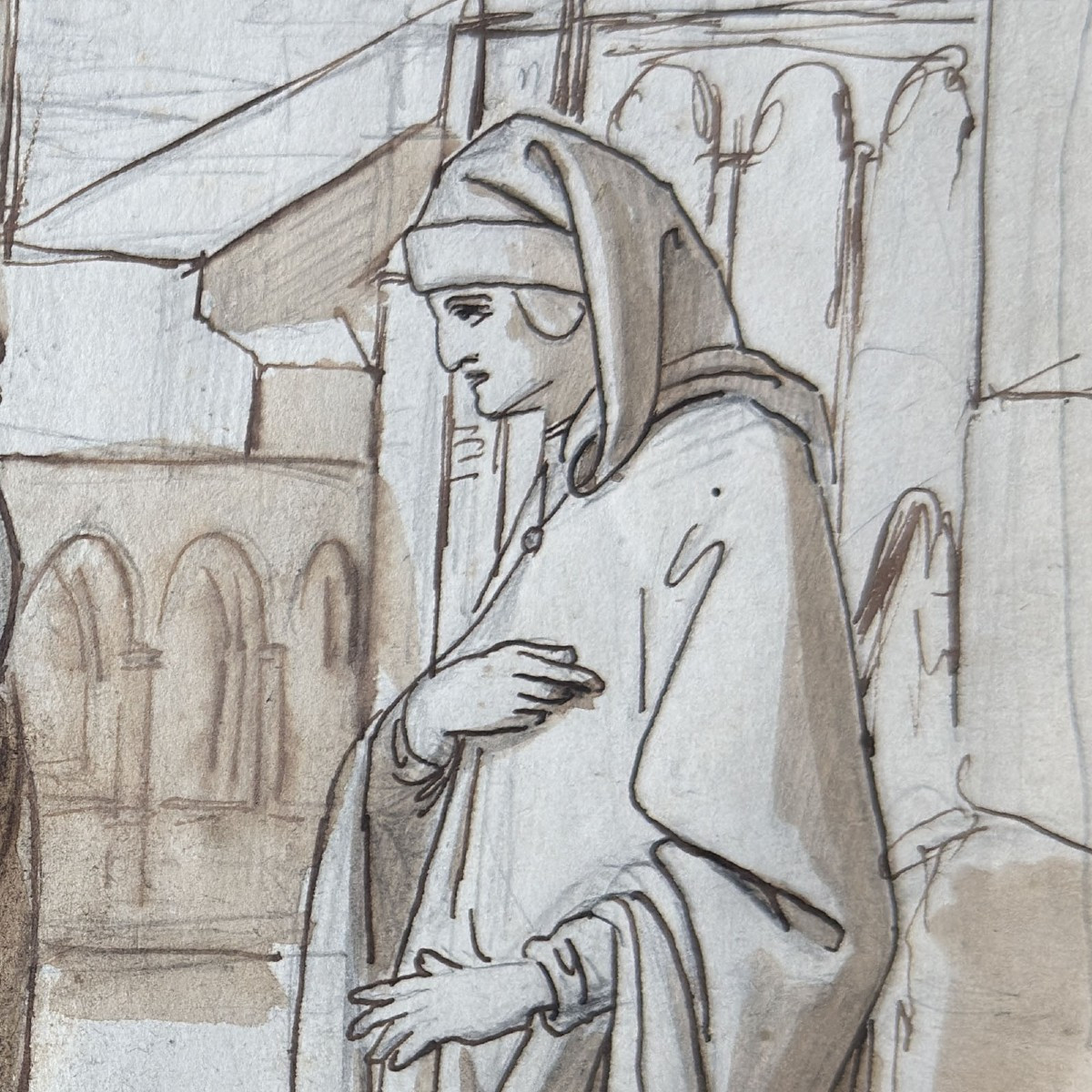
Dante, by contrast, is placed at the margin of the composition, visually and emotionally excluded. The absence of direct interaction intensifies the tension of the scene: meaning is not conveyed through action, but through gesture, posture, and the measured space separating the figures.
The choice of this subject is closely connected to the artistic language of the Italian Risorgimento. In the nineteenth century, artists, often unable to express political aspirations directly, turned to the past as a shared cultural language. Through figures such as Dante and Beatrice, they articulated ideas of identity, memory, and moral unity.
Massola returned repeatedly to the figure of Dante, whom he regarded as an embodiment of Italian cultural consciousness. This drawing stands among the most compelling examples of his engagement with Dantean themes, combining academic precision with a late Romantic sensitivity and a refined psychological insight.
Here, the episode from La Vita Nuova is not treated as a simple literary illustration, but as an independent meditation on love, silence, and ethical trial. The past is not merely represented — it becomes a means of reflection, a language through which the concerns of the present are quietly expressed.
DANTE AND BEATRICE.
EPISODE FROM LA VITA NUOVA
GIACINTO MASSOLA
Sarzana, 1820 – Genoa, 1865
Pencil and grey wash on paper
24.5 × 21 cm / 9.6 × 8.3 in
How often does a life change in a single glance?
For Dante, it was enough — to recognise in Beatrice not only the course of his own fate, but a figure destined to transcend it.
From that moment, Beatrice becomes more than a beloved presence: she is transformed into a guiding principle of Dante’s inner and poetic world. In La Vita Nuova, she appears as the object of a deeply introspective and spiritualised love; in the Divine Comedy, she assumes an even greater role — that of a guide, leading Dante through Paradise and embodying a form of idealised wisdom and grace. Without Beatrice, Dante’s poetic universe would be unimaginable: she is not merely its subject, but its source.
This drawing by Giacinto Massola is based on an episode from La Vita Nuova (c. 1294), Dante Alighieri’s early autobiographical work devoted to his love for Beatrice Portinari. Unlike the more familiar and frequently illustrated episodes from the Divine Comedy, the present composition focuses on a profoundly human and psychologically charged moment, centred on silence, misunderstanding, and emotional distance.
The scene refers to an episode in which Dante, concealing his true feelings, pretends to show interest in other women. When rumours of this reach Beatrice, she chooses not confrontation, but refusal — she declines to acknowledge him. It is precisely this restrained and silent rejection that Massola elects to depict.
Beatrice appears dressed in white, a traditional symbol of purity, but also of distance. She is accompanied by two women: her friend Monna Vanna walks at her side, while a maid follows just behind. The group passes near the Santa Trinita Bridge in Florence, anchoring the scene within a recognisable urban setting.
Dante, by contrast, is placed at the margin of the composition, visually and emotionally excluded. The absence of direct interaction intensifies the tension of the scene: meaning is not conveyed through action, but through gesture, posture, and the measured space separating the figures.
The choice of this subject is closely connected to the artistic language of the Italian Risorgimento. In the nineteenth century, artists, often unable to express political aspirations directly, turned to the past as a shared cultural language. Through figures such as Dante and Beatrice, they articulated ideas of identity, memory, and moral unity.
Massola returned repeatedly to the figure of Dante, whom he regarded as an embodiment of Italian cultural consciousness. This drawing stands among the most compelling examples of his engagement with Dantean themes, combining academic precision with a late Romantic sensitivity and a refined psychological insight.
Here, the episode from La Vita Nuova is not treated as a simple literary illustration, but as an independent meditation on love, silence, and ethical trial. The past is not merely represented — it becomes a means of reflection, a language through which the concerns of the present are quietly expressed.
190 €
Period: 19th century
Style: Napoleon 3rd
Condition: Good condition
Material: Paper
Length: 21 cm
Height: 24,5 cm
Reference (ID): 1697921
Availability: In stock
Print