



Louis XVI Style Turkish Daybed After Georges Jacob – Late 19th Century
A French Louis XVI-style Turkish daybed (lit de repos à la turque), crafted in carved, molded, and painted beechwood during the last third of the 19th century, based on a design created around 1785 by Georges Jacob (1739–1814).
The original model is preserved at the Château de Compiègne, in the collections of the Musée du Louvre (inventory no. OA 9451).
Historical Background and Origins of the Design
Developed in France during the 18th century, the Turkish daybed belongs to a category of furniture designed for relaxation, conversation, and the more intimate spaces of aristocratic residences.
Combining the functions of a bed and a sofa, this type of furniture is characterized by two raised ends, often gracefully curved and terminating in outward scrolls.
Its design reflects the 18th-century European fascination with Oriental-inspired furnishings, interpreted by French cabinetmakers and chairmakers according to contemporary decorative tastes.
In her reference work Le Mobilier domestique, vocabulaire typologique, Nicole de Reyniès identifies this form as a lit de repos à chevet enroulé, also known as a turquoise, lit de repos à la turque, or sultane (vol. I, pp. 192–193).
During the reign of Louis XVI, Georges Jacob, one of the leading Parisian chairmakers of the period, developed a neoclassical interpretation of this design, combining the flowing lines of the scrolled ends with elaborate carved decoration.
The original daybed, made around 1785 and stamped G. JACOB, features two scrolled ends decorated with acanthus leaves, floral garlands, foliage, and beaded ornamentation.
Its rails are carved on all four sides with intertwined ribbons and heart-and-dart motifs, while the four tapered, fluted legs are enriched with water leaves and gadrooning.
Measuring 195 cm in length, this carved and gilded wooden daybed is now preserved at the Château de Compiègne under Louvre inventory number OA 9451.
From Fontainebleau to Empress Eugénie's Music Salon
The history of the original daybed continued into the 19th century.
Recorded at the Château de Fontainebleau during the 18th century, it subsequently entered the collections of the Château de Compiègne.
During the Second Empire, Empress Eugénie developed a particular interest in furnishings from the Ancien Régime, especially those associated with Queen Marie Antoinette, whose memory she greatly admired.
In 1862, Georges Jacob's daybed was installed in the Empress's Music Salon at the Château de Compiègne, alongside other Louis XVI furnishings.
According to research published by historian Mathieu Caron in Le Garde-Meuble et l'invention du mobilier historique au XIXe siècle, Empress Eugénie probably selected the daybed because she believed it had once belonged to Marie Antoinette.
However, this presumed royal provenance was already questioned during the 19th century and has never been conclusively established.
In 1865, the salon was further furnished with a sofa, two bergères, and two armchairs originally made for Marie Antoinette's private cabinet at the Château de Saint-Cloud.
These pieces were arranged to complement Jacob's daybed, creating an interior that evoked the Queen's private apartments.
The Music Salon at Compiègne thus illustrates the renewed appreciation of 18th-century French furniture during the Second Empire and the important role played by Empress Eugénie in its revival.
Our daybed belongs to this broader tradition of 19th-century historicist furniture, inspired by the work of the great French chairmakers of the Ancien Régime.
Description of Our Daybed
Our example follows the overall composition and carved decorative vocabulary of Georges Jacob's original design, while incorporating certain modifications to its proportions and construction.
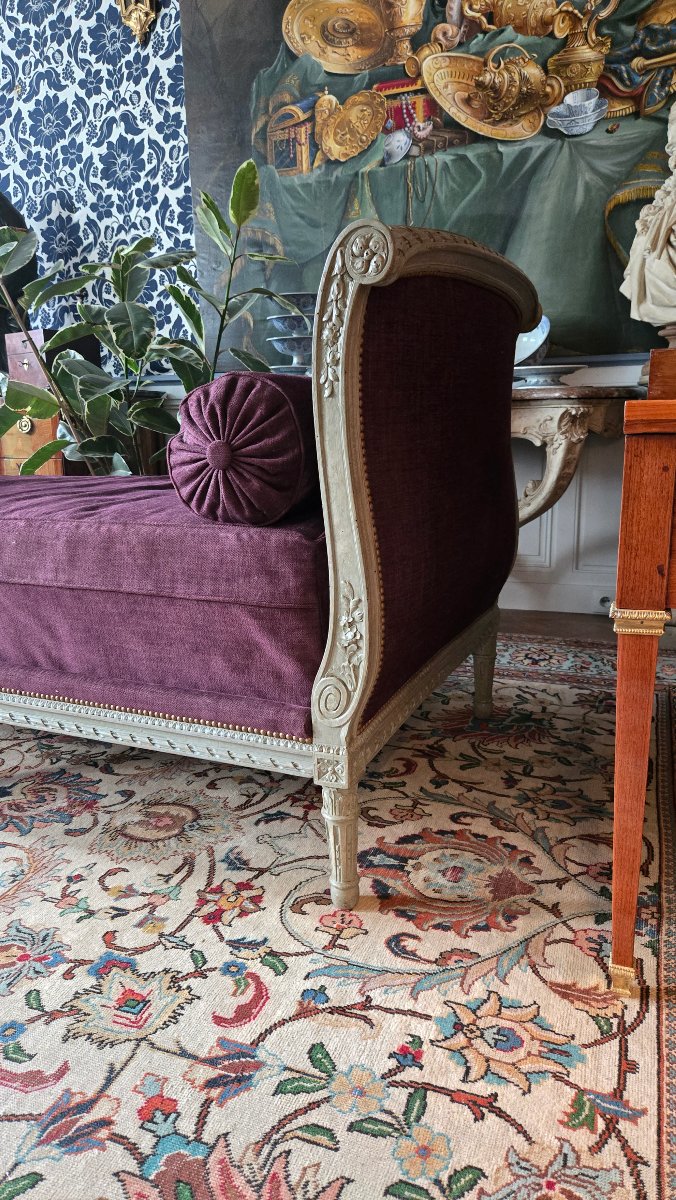
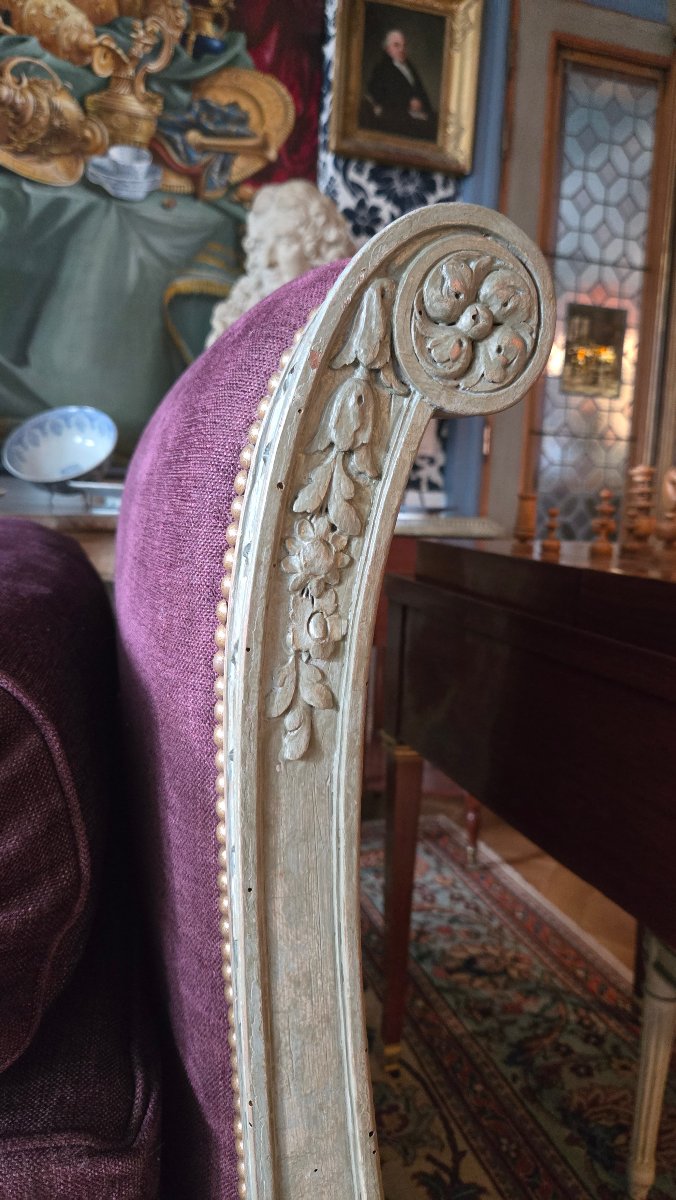
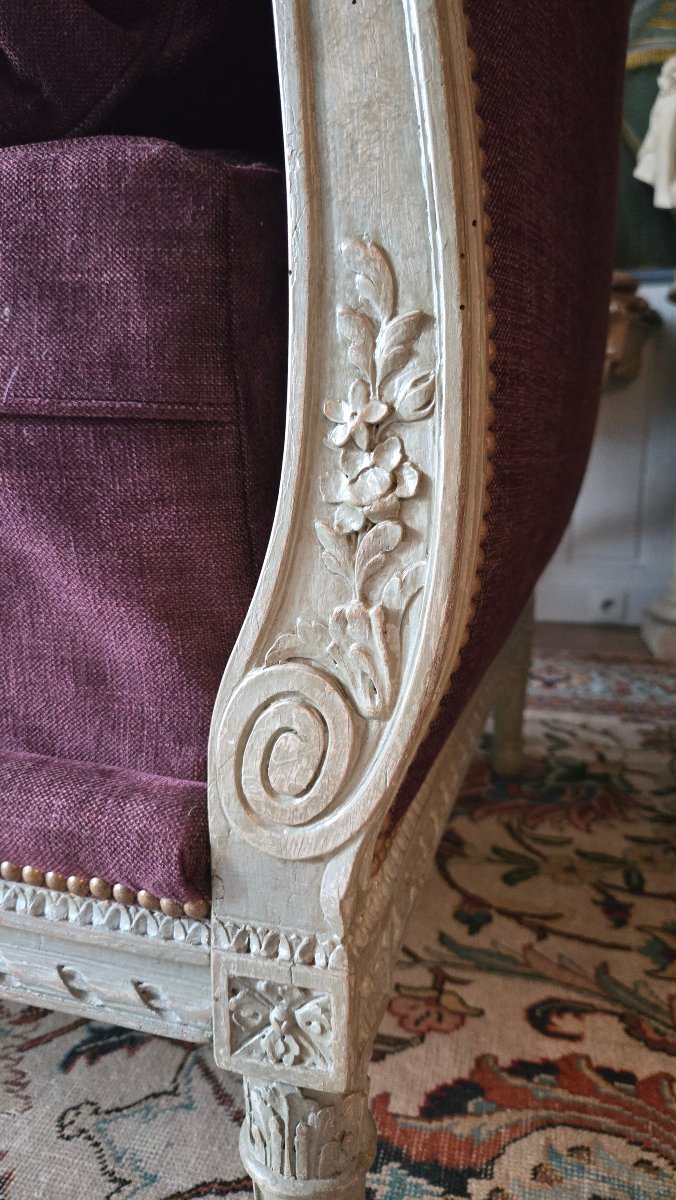
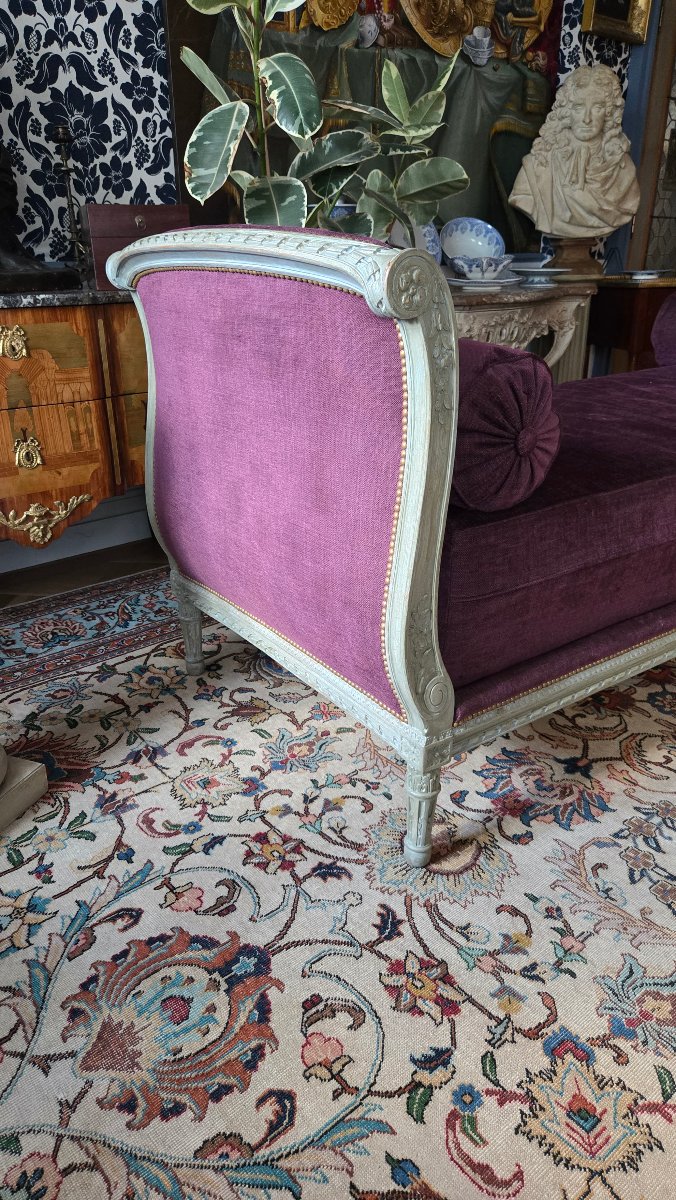
Made entirely of molded and carved beechwood, it features two gracefully curved, outward-scrolling ends, terminating in floral rosettes.
The uprights are decorated with cascading flowers and foliage following the curvature of the frame. The upper sections display carved ribbon ornamentation, while the long rails are embellished with intertwined ribbons and heart-and-dart motifs.
The square corner blocks are carved with floral ornaments.
The tapered, fluted legs feature upright leaves at the top, with delicate carved stems extending into the fluting.
The entire wooden frame is painted in an aged blue finish with soft greenish-gray tones. The subtle variations, areas of wear, and minor irregularities of the painted surface emphasize the carved details.
Unlike Georges Jacob's original model, which measures 195 cm and stands on four legs, our example measures 225 cm in overall length.
This larger construction accommodates a full sleeping surface measuring 190 × 80 cm (approximately 75 × 31.5 inches).
To provide additional support and structural stability, an extra leg was incorporated at the center of each long rail, bringing the total to six legs.
The daybed is fully disassemblable. The two end sections are secured to the longitudinal rails by internal bolts, following traditional furniture-making techniques.
Another notable feature is its fully finished construction on all sides.
Both ends are molded and carved on their inner and outer faces, while the front and rear rails receive the same decorative treatment.
This allows the daybed to be positioned either against a wall or freely in the center of a room, where it can serve as an elegant sofa or daybed.
Upholstery, Provenance, and Condition
Acquired from a private collection, this daybed was reupholstered several years ago.
Both end sections are upholstered on their inner and outer faces in a rich plum-colored upholstery fabric, contrasting with the aged blue-green painted frame.
The upholstery is finished with decorative round-headed brass-colored nails.
The daybed comes complete with a new bed base and mattress, a matching plum-colored bedspread, and two cylindrical bolsters finished with gathered rosette ends.
The piece is in excellent usable and presentational condition, with recently renewed upholstery and an antique painted wooden frame retaining the natural signs of age and wear.
With its generous proportions, fully finished construction, and decorative design derived from the original preserved at Compiègne, this daybed illustrates the renewed interest in Georges Jacob's creations during the second half of the 19th century.
Historical and Bibliographical References
- Musée du Louvre, Department of Decorative Arts, Méridienne (Lit de repos), Georges Jacob, circa 1785, inventory no. OA 9451, on deposit at the Château de Compiègne.- Nicole de Reyniès, Le Mobilier domestique, vocabulaire typologique, vol. I, Paris, Imprimerie nationale, 1987, pp. 192–193, figs. 627–632.- Mathieu Caron, Le Garde-Meuble et l'invention du mobilier historique au XIXe siècle. Du palais au musée, Dijon, Éditions Faton, 2021, pp. 300–302, fig. 157.
Dimensions
Overall length: 225 cm (88.6 in)Overall depth: 89 cm (35 in)Height of the scrolled ends: 97.5 cm (38.4 in)Sleeping surface height: 57 cm (22.4 in)Mattress size: 190 × 80 cm (74.8 × 31.5 in)
1 800 €
Period: 19th century
Style: Louis 16th, Directory
Condition: Good condition
Material: Painted wood
Reference (ID): 1846894
Availability: In stock
Print